Showing posts with label depression. Show all posts

Sunday, April 25, 2010

Does Guilt and Disillusionment Play a Role in Combat PTSD?

Yes.

A recent study confirms the role of guilt and the need to resolve meaning-of-life issues in those attempting to move beyond PTSD:

Combat veterans commonly report guilt and depression following stressful military experiences. More depressed veterans often report higher levels of posttraumatic stress disorder (PTSD; Dohrenwend et al., 2006). Guilt also appears to be a distress-related response, potentially increasing both avoidant coping and PTSD (Henning & Frueh, 1997; Street, Gibson, & Holohan, 2005), potentially worsening prognosis and treatment response (Kubany et al., 1995; Owens, Chard, & Cox, 2008). Understanding the multiple influences on PTSD is a pressing priority, particularly with current military deployments.

Cognitive restructuring models of coping (e.g., Park & Ai, 2006) may explain why PTSD develops in some trauma survivors and not others. Posttraumatic stress disorder is believed to result when a traumatic event shatters core beliefs that enable people to establish meaning in life (Janoff-Bulman, 1992). If people cannot cognitively restructure traumatic events, regain meaning in life, and rebuild core beliefs, depression and guilt may develop. ...

Veterans of various service eras (N =174) completed an Internet survey about combat exposure, posttraumatic stress disorder (PTSD) symptoms, depression, guilt, and meaning in life. Results of a hierarchical regression indicated that younger age; higher levels of combat exposure, depression, and guilt; and lower meaning in life predicted greater PTSD severity. The interaction between meaning in life and depression also was significant, with a stronger inverse relation between meaning and PTSD at lower levels of depression. Meaning in life may be an important treatment concern for veterans with PTSD symptoms, particularly at higher levels of functioning.

Source: "Posttraumatic stress disorder, guilt, depression, and meaning in life among military veterans," Journal of Traumatic Stress, Volume 22 Issue 6, Pages 654-657


Saturday, January 16, 2010

Combat Clips: A Selection of OEF/OIF Veteran Study Statistics, January 2010

News clips examining recent PTSD, TBI and other combat trauma or deployment-related study insights. First, Jennifer Thomas for HealthDay via BusinessWeek:

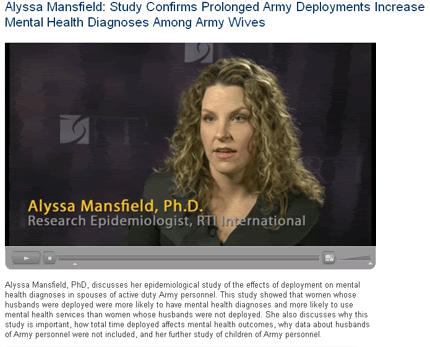
War isn't just tough on soldiers. Army wives whose husbands were deployed have higher rates of depression, anxiety, sleep disorders and other mental health issues than the wives of soldiers who stayed home, a new study shows.

Researchers looked at the medical records of more than 250,000 wives, accounting for most women married to active-duty U.S. Army personnel. Between 2003 and 2006, about 34 percent of the women's husbands deployed for one to 11 months, 35 percent deployed for longer than 11 months, while 31 percent of soldiers were not sent overseas.

Among wives of soldiers deployed for up to 11 months, researchers found almost 3,500 more diagnoses of depression, anxiety, sleep disorders and other mental health issues than among wives who[se] husbands stayed home.


Click on image above to see Mansfield discuss study.


Saturday, October 31, 2009

A Real Fright: The Psychological Scars of Combat

It's a standard American ritual. Today, you'll probably be booed at by scary tricksters knocking on your door, demanding sugary treats.

Perhaps you'll see a chainsaw-wielding demon on the street and laugh. Or maybe you'll dress in scary costumes and get a kick out of reveling in and even poking fun at Halloween's fantasy of fear and death and danger.

Of course, some of us don't have to rely on the eve of All Saints Day to be immersed in dark times and emotions.

Those who've been to war have tapped fear and death and danger on the shoulder. They've lived the more difficult side of life. And many, when they return from the pit of hell, struggle to find the inner and outer security and confidence long since lost to them on some dusty combat trail. Getting their life back isn't as easy as peeling off a costume, wiping off the fake blood or putting away a candy dish.

I wonder what they think about Halloween?

Below the fold, a few recent articles that reveal how the daily fear, anxiety and solitude of PTSD affects some of our recently returned troops. Read as many of them as you can find time for.


Sunday, July 19, 2009

Update on OEF/OIF Veterans' Mental Health, VA Benefit Issues

Building upon some of the data-rich news clips shared earlier this week, a few more grafs to consider.

Jia-Rui Chong, Los Angeles Times:

About 37% of veterans returning from Iraq and Afghanistan have mental health problems, a nearly 50% increase from the last time the prevalence was calculated, according to a new study published today analyzing national Department of Veterans Affairs data.

The study, which examined the records of about 289,000 veterans who sought care at the VA between 2002 and 2008, also found higher rates of post-traumatic stress disorder and depression. ... The previous study of national VA data, which examined Iraq and Afghanistan war veterans seeking care between 2001 and 2005, found that 25% of those veterans received mental health diagnoses. About 13% were diagnosed with the anxiety disorder PTSD and 5% with depression.

The new study by Seal and her colleagues, published in the American Journal of Public Health, found that 22% of the veterans in the study had PTSD and 17% had depression. When the researchers compared veterans of Afghanistan from early in the war to veterans of Iraq four years later, they found the rates of PTSD diagnosis more than tripled.


Monday, April 06, 2009

Sage Markers of Military Culture Change: Generals Continue Coming Forward to Share Their Stories of PTSD and Suicide

Wisdom. What is it?

Something forged out of experience, certainly. Usually that wisdom-forging insight stems from a walk down a challenging or difficult path, and combat experience would surely qualify here, one requiring either cognitive or physical effort (or both) to overcome.

Cognitive elements might include grappling with the events of one's own life as well as contemplating the greater meaning of those experiences. This avenue to wisdom will also eventually lead to a consideration of the greater forces on one's life or the existence of a higher power.

And what would the value of all of this wisdom work be if its product is not shared with others -- no matter the cost?

Cited in Richard Hawley Trowbridge's doctoral dissertation, "The Scientific Approach of Wisdom," [doc] social psychologist and Rutgers University professor Deirdre A. Kramer distinguishes five specific functions of wisdom: (a) finding solutions to problems that confront the self; (b) advising others; (c) management of social institutions; (d) life review; and (e) spiritual introspection.

One function, as noted above, of wisdom concerns its responsibility and ties to social institutions. Again, what benefit would wisdom have if not shared with larger society through organized (and other) means? Those in positions of power to enlighten and broaden the knowledge and understanding base of society and its institutions, especially when the activity might threaten one's career or image, are to be applauded.

Those who do this work are our modern sages and heroes.

When I say hero, it is as described by Franciscan priest and writer Richard Rohr in his book, Quest for the Grail:

The American Plains warriors, according to ancient legend, used to say in the morning: "It's a good day to do great things." To be able to say that and mean it was a magnificent ambition. Such an aspiration stirs something deep in the heart of any [striving] to be a hero. ...

A hero, for the record, is not a saint, much less a god.

In the great mythologies and legends, the hero is always an ordinary human being, with at least one tragic flaw. A hero is one who simultaneously keeps an eye on himself and a goal beyond himself.

Four Army generals of late have become my heroes.


Friday, September 12, 2008

Military Kids Also Serve, Feel Stress and Strain of Nation's Wars

Did you know that about 700,000 American children have had at least one parent deployed in the Middle East since our invasion of Afghanistan? Today, over 155,000 kids have a deployed parent overseas supporting our operations in Afghanistan and Iraq.

While a resilient bunch, a lot of worry and strain are being carried on their little shoulders. Are they getting all the support they need?

Back in May, I spoke at a "Healing the Hidden Wounds" summit organized by National Public Television and NAMI-TN. Among the stream of amazing speakers drawn together that day was a 24-year military wife and mom (and active professional social worker with Ft. Campbell's Family Readiness Group and the Centerstone Community Mental Health Centers).

Susan Pease's words were among the more poignant of the day. She tried to answer the question, "What do military families need?" From my notes, here were a few of her responses:

  • Military kids are desperately in need of resources and supports. Their needs appear to be among the most overlooked of all aspects of of our nation's protracted wartime stance. While Military Family Life Consultants, Military OneSource and MilitaryHOMEFRONT are wonderful resources, more are needed.

  • Military children are acting out and need more peer group programs. Some are stealing prescription drugs from parents, coping with abandonment issues and angry that their deployed parents have missed so many important days (like graduation, etc.) over the years. These are signs that more substantial peer group programs are needed to help cushion their experience. Parents can't do it all.

  • Parents are also under stress and need more child care tools. Left behind on their own -- as strong and capable as they are -- they are starved for supports and tools to help their kids to cope with the many emotions they feel before, during and after deployment. Parents need more adolescent care help, and parenting help, and activities that will bring kids together and foster ways for them to be able to talk their feelings and anger and worries out with each other.


Tuesday, August 26, 2008

New York Times Reports on the Unique Characteristics of Combat TBI

Lizette Alvarez of the New York Times writes of the special blast category that is combat-related traumatic brain injury (TBI). The entire piece is well worth a read, but I'd like to share a few of the more statistics-heavy grafs:

As many as 300,000, or 20 percent, of combat veterans who regularly worked outside the wire, away from bases, have suffered at least one concussion, according to the latest Pentagon estimates. About half the soldiers get better within hours, days or several months and require little if any medical assistance. But tens of thousands of others have longer-term problems that can include, to varying degrees, persistent memory loss, headaches, mood swings, dizziness, hearing problems and light sensitivity. ...

Little is known medically by doctors or scientists about what happens to a brain as a result of a powerful bomb blast, as opposed to car crashes on a highway, blows to the head on a football field or a bullet wound. These are the first wars in which soldiers, protected by strong armor and rapid medical care, routinely survive explosions at close range and then return to combat.

The bomb blasts, which throw off energy waves — atmospheric overpressures and underpressures — that are absorbed by the body, add a little-studied dimension to the trauma. Scientists are only now beginning to study the extent of the damage.


Saturday, July 19, 2008

Army Chief: Fort Bliss' Warrior Resilience Program Should be Replicated

This month marks the one year anniversary of the opening of the Fort Bliss Restoration and Resilience Center in Texas.

Back in May, Secretary of Defense Robert Gates visited the groundbreaking facility, which offered up the first test of the Army's new holistic Warrior Resilience Program, saying, "This center here is illustrative of what can be done."

The one-of-a-kind program offers its participating Afghanistan and Iraq veterans group and individual therapy sessions with meditation, yoga, acupuncture, massage therapy, chiropractic and hot-stone therapy treatments.

[Fort Bliss is not the only enlightened embrace of a more holistic approach to treating combat PTSD by the Army. A welcome progression forward of military culture occurred in March when the Army sought proposals for $4 million in grant monies to be spent investigating "spiritual ministry, transcendental meditation, yoga, bioenergies such as Qi gong, Reiki, [and] distant healing."]

Building on all of this, it's great to see that Army Chief of Staff Gen. George Casey, following a visit to Fort Bliss last week, seems to agree with the movement.


Family Strains Worsen as Wars Drag On, Deployments Add Up

From David Crary, AP:

Far from the combat zones, the strains and separations of no-end-in-sight wars are taking an ever-growing toll on military families despite the armed services' earnest efforts to help. ...What makes today's wars distinctive is the deployment pattern — two, three, sometimes four overseas stints of 12 or 15 months. In the past, that kind of schedule was virtually unheard of. ...

An array of studies by the Army and outside researchers say that marital strains, risk of child maltreatment and other problems harmful to families worsen as soldiers serve multiple combat tours.

For example, a Pentagon-funded study last year concluded that children in some Army families were markedly more vulnerable to abuse and neglect by their mothers when their fathers were deployed in Iraq and Afghanistan.

In Iraq, the latest survey by Army mental health experts showed that more than 15 percent of married soldiers deployed there were planning a divorce, with the rates for soldiers at the late stages of deployment triple those of recent arrivals.

For the Army, especially, the challenges are staggering as it furnishes the bulk of combat forces. As of last year, more than 55 percent of its soldiers were married, a far higher rate than during the Vietnam war. The nearly 513,000 soldiers on active duty collectively had more than 493,000 children.


Saturday, June 07, 2008

Are PTSD-Medicated Veterans Dying in Sleep -- or Committing Suicide?

Important story on the cluster of OEF/OIF veterans who have recently been found to have died in their sleep, or thought to have committed suicide, while heavily medicated and being treated for PTSD. First, a May 23 introduction by Julie Robinson of the Charleston Gazette:


A Putnam County veteran who was taking medication prescribed for post-traumatic stress disorder died in his sleep earlier this month, in circumstances similar to the deaths of three other area veterans earlier this year.

Derek Johnson, 22, of Hurricane, served in the infantry in the Middle East in 2005, where he was wounded in combat and diagnosed with post-traumatic stress disorder while hospitalized.

Military doctors prescribed Paxil, Klonopin and Seroquel for Johnson, the same combination taken by veterans Andrew White, 23, of Cross Lanes; Eric Layne, 29, of Kanawha City; and Nicholas Endicott of Logan County. All were in apparently good physical health when they died in their sleep.

Johnson was taking Klonopin and Seroquel, as prescribed, at the time of his death, said his grandmother, Georgeann Underwood of Hurricane. Both drugs are frequently used in combination to treat post-traumatic stress disorder. Klonopin causes excessive drowsiness in some patients.

He also was taking a painkiller for a back injury he sustained in a car accident about a week before his death, but was no longer taking Paxil.


Thursday, April 03, 2008

Unknown Allies: School Shooting Victims and Combat Veterans

Back in September, I sat down with Diane Strand, a reporter for DeKalb's MidWeek News, to discuss combat PTSD and other issues covered in my book, Moving a Nation to Care.

Those of you who read PTSD Combat regularly know I'm currently a student at Northern Illinois University and shared my experiences the day of the shooting and beyond.

Just this past Wednesday, I posted here on my column that ran in the Northern Star, relfecting on the fact that veterans are a dazed school shooting student's natural ally; they understand the pain and trauma of being in danger and in the vicinity of extreme violence (on an entirely different level than those of us on campus that day, however). Another commonality is an increased risk for post-traumatic stress disorder.


Wednesday, April 02, 2008

Army Vice Chief of Staff General Richard Cody: Soldiers, Families 'Stretched and Stressed' to Limit

Yesterday, in morning testimony before the House Veterans Affairs Subcommittee on Health, we heard Colonel Charles W. Hoge, M.D., Director of the Division of Psychiatry and Neuroscience at Walter Reed Army Institute of Research, say studies show "longer deployments, multiple deployments, greater time away from base camps, and combat intensity all contribute to higher rates of PTSD, depression, and marital problems."

Appearing later the very same afternoon before the Senate Armed Services Committee, Army Vice Chief of Staff General Richard Cody stated [written testimony pdf]:

Today’s Army is out of balance. The current demand for our forces in Iraq and Afghanistan exceeds the sustainable supply and limits our ability to provide ready forces for other contingencies. ...Current operational requirements for forces and insufficient time between deployments require a focus on counterinsurgency training and equipping to the detriment of preparedness for the full range of military missions.

Given the current theater demand for Army forces, we are unable to provide a sustainable tempo of deployments for our Soldiers and Families. Soldiers, Families, support systems, and equipment are stretched and stressed by the demands of lengthy and repeated deployments, with insufficient recovery time. Equipment used repeatedly in harsh environments is wearing out more rapidly than programmed.

Army support systems, designed for the pre-9/11 peacetime Army, are straining under the accumulation of stress from six years at war. Overall, our readiness is being consumed as fast as we build it. If unaddressed, this lack of balance poses a significant risk to the All-Volunteer Force and degrades the Army’s ability to make a timely response to other contingencies.


Tuesday, March 25, 2008

New Age Treatments for a New Age of Warfare: Army Seeking Alternative, Holistic Therapy Research Proposals

Noah Shachtman at Wired (and cheers back to you, Noah, for the 'special thanks' mention and link to PTSD Combat) looks at the Army's obviously necessity-inspired opening-up of minds and pocketbooks regarding the use and exploration of alternative treatment options for wounded returning troops:

The military is scrambling for new ways to treat the brain injuries and post-traumatic stress of troops returning home from war. And every kind of therapy -- no matter how far outside the accepted medical form -- is being considered. The Army just unveiled a $4 million program to investigate everything from "spiritual ministry, transcendental meditation, [and] yoga" to "bioenergies such as Qi gong, Reiki, [and] distant healing" to mend the psyches of wounded troops. ...

The Defense Department "is dedicated to supporting evidence-based approaches to medical treatment and wants to support the use of alternative therapies if they are proven efficacious," notes a recently-issued request for proposals.

But many of these treatments haven't been held up to much rigorous scientific scrutiny before. So the Army is looking to hand out $4 million in "seedling grants" to "conduc[t] rigorous clinical studies" into all sorts of "novel approaches." Projects "containing preliminary data" will be eligible for up to $1 million. But even "innovative but testable hypotheses without preliminary data" could get as much as $300,000. Proposals are due May 15.

Full Defense Center of Excellence for Psychological Health (PH) and Traumatic Brain Injury (TBI) program announcement for the Military Psychological Health Research – Complementary and Alternative Strategies grant is available online as an MS Word doc. Grant instructions and application forms are available, too.


Monday, March 24, 2008

Study: Traumatic Injuries Hurt Even One Year Out

From ScienceDaily:

Most patients have moderately severe pain resulting from their injuries one year after sustaining major trauma, according to a new article. "Pain is a natural accompaniment of acute injury to tissues and is expected in the setting of acute trauma," according to background information in the [JAMA Archives of Surgery] article.

Recent studies have shown that most patients with pelvic fractures and lower extremity injuries continue to experience chronic pain five to seven years after injury. Pain after injury can lead to disability, post-traumatic stress disorder and depression.


Wednesday, March 05, 2008

Study: PTSD-Substance Abuse Link Hinders Positive Outcomes in Both

From Medical News Today:

* Up to one-half of those seeking help for substance-abuse disorders (SUDs) also have posttraumatic stress disorder (PTSD).

* New findings show that the frequency of a PTSD is greater among those dependent on drugs rather than alcohol, and that having a PTSD tends to predict a more severe course and worse outcome for an SUD.

From one-third to one-half of those seeking treatment for a substance-use disorder (SUD) can also have posttraumatic stress disorder (PTSD). The first multi-center study of PTSD among individuals seeking treatment for an SUD has found a greater prevalence of PTSD among those who were drug- rather than alcohol-dependent, and that having PTSD was associated with a more severe course and worse outcome for an SUD.

Results are published in the March issue of Alcoholism: Clinical & Experimental Research.

"We already knew that there is a quite relevant association between PTSD and SUDs," said Martin Driessen, professor of psychiatry at Ev. Hospital Bielefeld in Germany, and corresponding author for the study.

"More specifically, PTSD is a risk factor for the development of an SUD, particularly a drug dependence. However, it was unclear whether this is true for both abusers and dependent subjects, or only one of these groups, which is why we studied clearly dependent subjects."

"Drug dependence has frequently been observed in war veterans who also suffer from PTSD," added Andreas Heinz, director and chair of the department of psychiatry at Charité - University Medical Center Berlin. "Both men and women often increase drug abuse and develop dependence following war and other trauma."


Saturday, November 24, 2007

Two Years in the Life of a Soldier

A detailed piece from the Dayton Daily News:

For two years Elizabeth Bowen watched her husband, Ryan, endure more than 40 surgeries, frequent nightmares and the devastating effects of Post Traumatic Stress Disorder. ...

It was Oct. 26 and Ryan already had been in Georgia for six weeks, much of it spent waiting for word from the Army medical board that would determine his level of disability for injuries he received when a roadside bomb exploded under his tank in Baghdad during his second tour.

The 24-year-old Army specialist had just said goodbye to friends heading to Iraq for a third tour. "Some of these guys I've known since the first time," he said. Back in his hotel room, his mind began racing. He started pacing, hyperventilating.

Then he began to cry.


Thursday, November 15, 2007

Another Fort Drum Soldier, AWOL to Seek PTSD Care, Arrested

From the Associated Press:

A soldier who served two combat tours in Iraq was arrested Wednesday for leaving the Army without permission more than a year ago to seek treatment for post traumatic stress disorder.

At a news conference hours before his arrest, Sgt. Brad Gaskins said he left the base in August 2006 because the Army wasn't providing effective treatment after he was diagnosed with PTSD and severe depression. "They just don't have the resources to handle it, but that's not my fault," Gaskins said.

Tod Ensign, an attorney with Citizen Soldier, a GI rights group that is representing Gaskins, said the case is part of a "coming tsunami" of mental health problems involving Iraq and Afghanistan vets. Last month, the Veterans Administration said more than 100,000 soldiers were being treated for mental health problems, and half of those specifically for PTSD.


Thursday, October 18, 2007

OEF/OIF Vets Seeking PTSD Care from VA Jumps 70%, Mental Health Counseling Tops 100,000

From tomorrow's USA Today:

The number of Iraq and Afghanistan war veterans seeking treatment for post-traumatic stress disorder from the Department of Veterans Affairs jumped by nearly 20,000 — almost 70% — in the 12 months ending June 30, VA records show.

More than 100,000 combat veterans sought help for mental illness since the start of the war in Afghanistan in 2001, about one in seven of those who have left active duty since then, according to VA records collected through June. Almost half of those were PTSD cases.

The numbers do not include thousands treated at storefront Vet Centers operated by the department across the country. Nor do they include active-duty personnel diagnosed with the disorder or former servicemembers who have not sought VA treatment.

About 1.5 million U.S. troops have served in Iraq or Afghanistan. Of those, 750,000 have left the military and are eligible for VA health care. The nearly 50,000 VA-documented PTSD cases far exceed the 30,000 military personnel that the Pentagon officially classifies as wounded in the conflicts.


Thursday, October 11, 2007

National Depression Screening Day

As part of Mental Illness Awareness Week every October, one day is set aside by clinicians throughout the country to offer free screenings and educational programs. Today is that day (apologies this post is so late). Details from About.com:

What Should I Expect During a Screening?

Screenings are free and completely confidential. The screening is an opportunity to learn more about anxiety and mood disorders, complete a brief screening questionnaire, and speak one-on-one with a mental health professional. If appropriate, you may be referred for a complete evaluation.

As part of the screening, you will have the opportunity to:

* Complete a written screening questionnaire,
* Discuss your results with a health professional,
* Get a list of clinicians and treatment facilities in your area,
* Watch an educational video,
* Pick up some pamphlets and brochures, and
* Fill out a "friends and family questionnaire" for a loved one.

To find a site near you, visit www.mentalhealthscreening.org.

If you can't get out today in time for a free consultation, About.com has a list of online depression screening tools.


Tuesday, December 05, 2006

Costs of Iraq War Catalogued in Notable McClatchy Piece

Coming on the heels of NPR's compelling investigation, McClatchy Washington Bureau reporters Kevin G. Hall and David Montgomery deliver a significant piece today. Sharing a few grafs, but suggest taking the time to read it in full:

At Fort Leonard Wood in Missouri, swimming pools closed a month early this fall, and shuttle vans were sharply curtailed in an effort to trim spending. At Fort Sam Houston in Texas, unpaid utility bills exceeded $4 million, and the base reduced mail delivery to cut costs. Belt-tightening at the bases is only the beginning. As the United States spends about $8 billion a month in Iraq, the military is being forced to cut costs in ways big and small.

Soldiers preparing to ship to Iraq don't have enough equipment to train on because it's been left in Iraq, where it's most needed. Thousands of tanks and other vehicles sit at repair depots waiting to be fixed because funds are short.

At the Red River Army Depot in Texas, the Fort Worth Star-Telegram reported in October that at least 6,200 Humvees, Bradley Fighting Vehicles, trucks and ambulances were awaiting repair because of insufficient funds. ... Tanks and helicopters are one thing; the toll on America's warriors and their families is another.

Click on 'Article Link' below tags for more...

The figure don't look much better for the military's human capital:

More than 73,000 soldiers returning from Iraq and Afghanistan have been diagnosed with post-traumatic stress disorder (PTSD) and with problems such as drug abuse and depression. That's enough people to fill a typical NFL stadium.

Internet blogs written by soldiers or their wives tell of suicide attempts by soldiers haunted by the horror of combat, civilian careers of reservists who've been harmed by deployment and redeployment, and marriages broken by distance and the trauma of war. "Back-to-back war deployments has changed both of us - to where it's as if a marriage does not exist anymore," wrote a woman calling herself Blackhawk wife on an Iraq war vets Web site. "We just go through the daily steps of life and raising children as best we can."

A mother of a returning soldier posted this: "Since he has been back, he has had 3 DUIs, wrecked his truck, attempted suicide, been diagnosed with PTSD" and is being kicked out of the Army. The length of the war in Iraq has strained all aspects of the armed forces, said Dov Zakheim, who was the Pentagon's chief financial officer from 2001 to 2004. "In 2003, I don't think anybody predicted it would go as long as World War II and the wear and tear on equipment would be as intense," said Zakheim, now a vice president for global strategy consultant Booz Allen Hamilton Inc. "When I left the department, we were spending less than $4 billion a month on Iraq. Now it's pretty much doubled."

The length of the Iraq war surpassed that of World War II last month. The costs of the wars in Iraq and Afghanistan and the global fight against terrorism are expected to surpass the $536 billion in inflation-adjusted costs of the Vietnam War by spring. That's more than 10 times the Bush administration's $50 million prewar estimate.

More >>


Previous/Older Posts Return Home

Archives
2011: Jan Feb
2010: Jan Feb Mar Apr May Jun Jul Aug Sept Oct Nov Dec
2009: Jan Feb Mar Apr May Jun Jul Aug Sept Oct Nov Dec
2008: Jan Feb Mar Apr May Jun Jul Aug Sept Oct Nov Dec
2007: Jan Feb Mar Apr May Jun Jul Aug Sept Oct Nov Dec
2006: Jan Feb Mar Apr May Jun Jul Aug Sept Oct Nov Dec
2005: Sept Oct Nov Dec

Legal Notice

The information presented on this web site is based on news reports, medical and government documents, and personal analysis. It does NOT represent therapeutic prescription or recommendation. For specific advice and information, consult your health care provider.

Comments at PTSD Combat do not necessarily represent the editor's views. Illegal or inappropriate material will be removed when brought to our attention. The existence of such does not reflect an endorsement.


This site contains at times large portions of copyrighted material not specifically authorized by the copyright owner. This material is used for educational purposes, to forward understanding of issues that concern veterans and military families. In accordance with U.S. Copyright Law Title 17 U.S.C. Section 107, the material on this site is distributed without profit. More information.