x

Monday, March 30, 2009

VA Hiring Vets for Outreach, Army's 'Warrior Resilience and Thriving' Program, TRICARE West Offers Benefit Help, Female Veteran Testifies Re: PTSD

Recently in the news:

  • The Associated Press | VA hires vets to go find comrades who need help - "Graner is one of 100 former service members hired nationally by the Department of Veterans Affairs as outreach specialists to help get Iraq and Afghanistan veterans into programs aimed at easing their transition back to civilian life. They frequent job fairs, welcome-home events and other places where troops back from the wars might congregate and look for those struggling to adjust. The goal is to persuade them to visit one of 230-plus vet centers nationwide...[for] free services from job hunting assistance to marriage and mental health counseling. Experts applaud the effort to actively search for veterans who may need help, even if some advocates say the program should be much bigger."

  • USA Today | Military puts focus on epidemic of suicides - "In Maj. Thomas Jarrett's stress management class ... American troops are urged ... to strive for 'post-traumatic growth.' During a 90-minute presentation entitled "Warrior Resilience and Thriving," Jarrett, a former corporate coach, offers this and other unconventional tips on how troops can stay mentally healthy once they return home. He quotes Roman Emperor Marcus Aurelius, Paradise Lost author John Milton and German philosopher Friedrich Nietzsche... Walking through the crowd of young GIs in the makeshift classroom, Jarrett urges them to fight their "internal insurgents."

  • News-Leader | Videos explain health care benefits to military families - "Military families throughout TRICARE’s west region now have a new way to learn about their health care benefits through the movies. ... “TRICARE 2 You” video topics, which run an average of three minutes in a prime-time news format, include explanations of TRICARE plan options, how to access specialty care, behavioral health resources, pharmacy options and newborn enrollment, among others. “We wanted to do whatever it takes to help our beneficiaries maximize use of their TRICARE benefit and avoid out-of-pocket costs,” said David J. McIntyre, president and CEO of TriWest Healthcare Alliance. “This is especially useful for service members, particularly those in the National Guard and Reserve who live or work in rural areas without convenient access to military base resources,” he said. Produced by TriWest, in partnership with TRICARE Regional Office-West, the videos are housed in the company’s new TRICARE 2 You Online Library."

  • IAVA | Iraq Veteran Testifies On Capitol Hill - "Veteran Carolyn Schapper testified at a hearing before the House Veterans Subcommittee on Disability & Memorial Affairs about the disparities in PTSD diagnosis for male and female soldiers in combat. During her deployment to Iraq from October 2005 to September 2006, Carolyn participated in over 200 combat patrols as a member of a Military Intelligence unit with the Georgia National Guard."
More PTSD Combat Diigo links.

Labels: , , , , , , , , , , , ,

Sunday, March 29, 2009

Female Faces of War - Part 2: Military's Leading Ladies Have Come a Long Way, Baby


"It's either her or me in this engine room!"

One of my favorite films of all time (a close second to Some Like it Hot) is Operation Petticoat released in 1959 by MGM, featuring Cary Grant and Tony Curtis and a gaggle of Army nurses who have had to hitch a ride on their WWII submarine, the USS Sea Tiger.

This weekend, a phenomenal group of gals (along with hundreds of boy scouts on their own excursion) gathered on the Battleship Massachusetts as the Female Faces of War Conference and Overnight Adventure set sail. One can only wonder what the men who served on that ship would have to say about all of this; but, we sure did have a great time.

I'm catching up with research paper writing at the moment, so some photos of the event will have to do until I can write more. An all-around success and a great honor to be among women of all generation who have worn the uniform.


A few more Operation Petticoat clips in extended.

Click on 'Article' link below tags for more...

Another short clip (this one has Spanish subtitles) has Curtis' character making his moves on one of the nurses:


The film was so popular that it was resurrected as a 1977 television series. The opening, with all of the ship's men ogling the women, was considered funny in its own day to most (just as the film was). The problem, of course, is that this type of humor is filled with stereotypes that can be disrespectful to women sensitive to the issue of sexual harassment and/or violence.


A culture of hyped-up masculinity that considers women first and foremost sexual objects can lead to serious problems like
women in uniform face today involving military sexual trauma (MST). While this kind of mindset still exists in our world, I think it's becoming a bit less blatant -- a bit less openly embraced -- in America.

When I was a flight attendant, in my early years (1987 to about 1991 or so) our flight decks were littered with explicit photos of women -- hidden in discrete ways and locations so that only by knowing which small cover on the instrument panel to lift or which page of a log book to turn to would they be revealed.

As more women moved up the ranks, and into the cockpit's left seat especially, our company began a campaign to stop the practice. But, legal challenges in this arena are still taking place; United Airlines, for example, earlier this month settled a lawsuit brought by a former female pilot on just this charge. Continental and Alaska Airlines both had similar suits in the '90s.

Women in the military are also forcing cultural change.

It is a slow process, however, especially since the organization they work for is a government entity and not a private business that is highly averse to such publicity. Change is likely to take longer than any would like to imagine, but it is taking place.

The "leading ladies" serving in Afghanistan and Iraq will ensure that progress for women in the military continues to move in the right direction....just as those ladies serving in past generations paved the way for them today.

Again, what a pleasure to be with them this weekend.

[UPDATE Nov 13, 2009]: My presentation PowerPoint:


Related Posts

Labels: , , , , , , ,

Monday, March 23, 2009

Stop-Loss to be Stopped, Military Families to Get Pentagon Dover Travel Assist, Obama Nixes Private Insurance Provision of 2010 VA Budget

  • CNN | Pentagon to phase out unpopular 'stop-loss' program - "The military will phase out its "stop-loss" program, the contentious practice of holding troops beyond the end of their enlistments, for all but extraordinary situations, Defense Secretary Robert Gates announced Wednesday. Instead, the military will use incentives programs to encourage personnel to extend their service. Starting this month, the department will provide 'special compensation of $500 per month' to troops whose tour has been extended, Gates said. 'This special compensation will be applied retroactively to October 1, 2008, the date when Congress first made it available.'"

  • NTM Lede Blog | Pentagon Will Help Families Travel to Dover - "Defense Secretary Robert M. Gates said today that the Pentagon would pay for families to travel to Dover Air Force Base in Delaware if they want to be present when the body or remains of a loved one is returned from war. Mr. Gates announced last month that the Pentagon was reversing its longstanding policy of barring media coverage during the repatriation of fallen soldiers at Dover. He said then, and reiterated today at a news conference, which the Pentagon's Web site streamed live, that the decision about media coverage would be up to each family."

  • Washington Post | Obama's Turnabout On Vets Highlights Budgeting Nuances - "The relatively small proposal -- third-party billing would have saved about $540 million, less than 1 percent of the overall VA budget -- was not even part of Obama's official [2010 VA] budget but quickly threatened to undermine Obama's credibility with veterans. Ultimately, however, Obama listened to the veterans ... 'When you do public policy behind closed doors, you throw a lot of things on a wall, and some things stick and some things don't stick,' said Bob Wallace, executive director of Veterans of Foreign Wars. 'I think the administration and the president handled this with class, bringing the veterans in to talk with them, listening to their positions and two days later the chief of staff saying, 'It's over.''"
Gates announcement on stop-losses and Dover travel assistance:


More PTSD Combat Diigo links.

Labels: , , , , , , , , ,

Sunday, March 22, 2009

Female Faces of War - Part 1: Jessica Lynch and Lori Piestewa

This past week has marked the sixth anniversary of the start of the Iraq War. As I prepare for my presentation at next weekend's Female Faces of War conference, I'm going through some of my previous writing related to the women warriors of this era. I'm also in the midst of writing my Honors Capstone paper, Combat Veterans, Mass Media and the Advancement of Social Consciousness, that I've been researching since January.

Something I'm still shaping, but wish to share with you...

Women have been smack-dab in the middle of three significant historical markers and media stories to have come out of the Iraq War era so far (as nearly 20 percent of deployed forces in the Middle East, they are a part of many more, of course). Three female service members in particular have also -- each in their own way -- played a role in coming forward to set the record straight on an important issue, provide important evidence and testimony, and share something they felt was hidden or not understood correctly by society.

Three notable female figures of the Iraq War's first year:
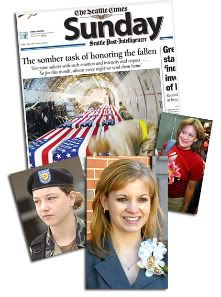
  • Jessica Lynch, an Army private held hostage and made into a hero after her support convoy came under attack during the initial invasion of Iraq in March 2003, set the record permanently straight about what really happened.

  • Sabrina Harman, former Army Reserve specialist with the 372nd Military Police Company who would later be convicted of participating in Abu Ghraib's horrors, photographed both prisoners and the guards meting out the abuse during the fall of 2003 "trying to expose" what was happening -- even while taking part herself.

  • Tami Silicio, a Kuwait-based military contractor whose photos of fallen U.S. service members' flag-draped coffins created an uproar after the Seattle Times published them in April 2004, acted to show military families the dignified way in which the bodies of their loved ones were were being transported home.
As you can see, I'm not going the easy route, listing merely "heroes" -- although Lynch certainly qualifies as one in my book. The reason Harmon is included yet others are not? There is no doubt that her digital images and emails home describing what was happening at Abu Ghraib prison shaped the course of Iraq War history.

Though their contributions widely differ, it is clear that each made a significant mark. I'll be expanding on their influence as I piece together my remarks for the FFW conference; when I have those ready, I'll be sure to share them with you here as well.

Although a departure from the PTSD-focus on this blog, in extended a few excerpts from a piece I wrote in 2007 about Jessica Lynch and the saga she was swept up in. This post also pays tribute to Lori Piestewa, Lynch's best friend and the first female service member to die in Iraq.

Click on 'Article' link below tags for more...

Author's Note: The following are excerpts from a paper I submitted as my final assignment in Northern Illinois University’s special section, Iraq on Film – COMS 496 M, offered in Spring 2007 and taught by Professor Jeffrey Chown. Forging an Icon [pdf] looked at earlier 'hot button' issues having to do with Iraq War politics, military propaganda and media criticism. I offer the sections having to do with Lynch and Piestewa here as a reminder of the strength, resiliency and moral compass women have brought with them into the military.

Although the names Jessica Lynch and Soshanna Johnson are readily recognized in most homes across the United States, another soldier with them the morning they were ambushed in Nasiriyah – Lori Piestewa – doesn’t have nearly the same ring. It’s a curious thing since Piestewa, Lynch’s Fort Bliss, Texas, roommate and a mother of two, was the first female to lose her life in Iraq mere days into the initial invasion. As a member of the Hopi tribe on Arizona’s Navajo reservation, she was also the first Native American woman killed in action on foreign soil. In the aftermath of the Nasiriyah attack, Lynch and Johnson and Piestewa (along with others) were taken prisoner. Piestewa would die in captivity and faded from the greater public’s view quite quickly, while Lynch and Johnson - to a somewhat lesser degree – became America’s first heroes of the Iraq War.

Though Piestewa could have chosen to stay back due to a shoulder injury, the 23-year-old volunteered for deployment so that she could watch over her 19-year-old roommate; she carried out her service to country and friend with skill and bravery and heart, but most Americans don’t know her name. In fact, even the media appears not to be all that familiar with her name. As recently as April 2007, in an interview with CBS’ Early Show, Lynch spoke again of her battle buddy. The show transcript of her words contains a glaring error: Piestewa’s name is misspelled as ‘Laurie’ rather than ‘Lori.’ Perhaps a bit of a simple mistake, but one that speaks volumes about our general knowledge of Piestewa. Her Fort Bliss roommate continues to try to correct the record on what happened in Iraq, however, going to great lengths to say she was a survivor, not a hero like her friend. “Lori is the real hero,” Lynch says. ...

It was March 23, 2003, the third day of the U.S. invasion, when a portion of the 507th Army Maintenance Company’s support convoy, running late and at half strength, their 18 vehicles (two being towed) lagging behind the rest of the 600-vehicle convoy, missed a turn and wound up lost. Capt. Troy King, commander of the 507th had chosen to lead the straggling leg of the convoy rather than move north with the others. Since leaving Camp Victory in Kuwait, he had been up for 55 straight hours, and he and his troops were into their second night of continuous movement. Radio communications were failing, and a shortcut to make up for lost time ended up costing them even more as their trucks got stuck in the soft Iraqi sands. A checkpoint that should have announced a turn off of Route Blue (the code name for the highway they were traveling on) had been deserted after the main line passed through. As a result, the convoy found themselves headed straight into Nasiriyah as dawn broke.

Only after clearing the wakening city once did Capt. King realize that the convoy was heading in the wrong direction. As the order was given to move out of the area quickly, small arms and machine gun fire, mortars and RPGs suddenly tore out from every direction. As the convoy’s vehicles accelerated, pulling up the rear was Piestewa along with her passengers, Pfc. Jessica Lynch (whose truck had broken down earlier that evening, Piestewa coming to her aid, saying, “Get in!”), 1st Sgt. Robert J. Dowdy, and two troops that had been picked up after their vehicle had gotten stuck in the sand, Spc. Edward Anguiano and Sgt. George Buggs. As the Humvee sped through the ambush, the soldiers inside firing their M-16s, Lynch glanced over at her friend as she raced to drive them to safety.

Piestewa looked cool, calm and in control.

In front of the Humvee, a 5-ton wrecker piloted by Spc. Edgar Hernandez and carrying passenger Spc. Shoshana Johnson swerved to avoid hitting an Iraqi truck parked in the middle of the road. Hernandez lost control of the vehicle, and they crashed. Nearing the scene of this crash, an RPG struck Piestewa’s front-left wheel well, sending the vehicle violently under the wrecker’s hitch. Dowdy was killed immediately. Anguiano and Buggs sank into the grave under unclear circumstances. Badly injured, unconscious yet still alive, Piestewa and Lynch were taken to Nasiriyah’s Saddam Hospital by their Iraqi captors. While Lynch would be dramatically rescued, her friend, the life draining from her body, would not make it out of Iraq alive. ...

With the forward momentum of Operation Iraqi Freedom in full swing, Americans were served up super-sized helpings of the story of a “[b]lond and waiflike” female soldier boldly fighting-to-the-end, guns a-blazing against the Iraqi militia until her ammo was spent. Early reports by the press had her “emptying her M-16 into Iraqi soldiers,” fighting “fiercely,” getting “stabbed and shot multiple times,” not to mention that she “killed several of her assailants.” Jessica Lynch was presented to the American public and the world as if she were a real-life GI Jane action figure. Operation Rally the American Public, the military and the media’s propagandistic ‘war on the truth,’ had clearly commenced. “She was fighting to the death,” one unnamed official was quoted as saying. “She did not want to be taken alive.”

As the ground war kicked up, a larger U.S.-Middle East media war sparked up, too. This ‘air’ war revolved around what footage should and should not be shown. Images of dead American soldiers and five visibly frightened POW’s captured in Nasiriyah were broadcast on Iraqi TV, while a controversial video tape aired on Al Jazeera showing both Piestewa, still clinging to life, and Lynch in their hospital beds (NBC News would air an edited version of this footage in December 2003).

Word was that the medical staff abused them, slapping them about. Of Lynch’s injuries, the Associated Press reported that she had “two broken legs and a broken arm, plus at least one gunshot wound.” Government and media reports told of her being brutally raped. Perversely, the story would soon develop into a well-timed, patriotic, ‘feel-good’ piece for the media and the military; they both pounced and capitalized on it. Reporters were roused from their beds in the early morning hours, told to rush into CENTCOM for an important briefing – many saying after-the-fact that they thought Saddam had been captured – only to be spoon-fed the fable of Jessica Lynch. ...

But the heroes are fighting back with the truth.

On April 24, 2007, Jessica Lynch appeared at a Committee on Oversight and Government Reform hearing entitled Misleading Information from the Battlefield. Its goal was to examine the facts surrounding the Pat Tillman case. Looking every bit the media darling with her blond bob and sweet smile, she challenged the military and the media for their outright lying about the circumstances of her capture and her rescue, saying of them, “I'm still confused as to why they chose to lie and try to make me a legend when the real heroics of my fellow soldiers that day were legendary.” Of the media, specifically, Lynch said, “They should have found out the facts before they spread the word like wildfire.” Instead they were too busy “all repeating the story of the little-girl Rambo from the hills of West Virginia, who went down fighting. It was not true.” The soldier also spoke of the illogic of telling lies in order to pump up stories like hers in Iraq and Tillman’s in Afghanistan, saying, “The bottom line is, the American people are capable of determining their own ideals for heroes, and they don't need to be told elaborate lies. I had the good fortune to come home and to tell the truth. Many soldiers, like Pat Tillman, did not have that opportunity.”

In closing she said, “The truth of war is not always easy. The truth is always more heroic than the hype.”

As for her best friend, Lori Piestewa, on January 19, 2007, Lynch named her daughter Dakota (the Hopi word for ‘friendship’ or ‘ally’) Ann (all three women now sharing the same middle name) in her honor. Piestewa, whose surname means ‘water pooled on the desert by a hard rain,’ would also have a 2,608-foot mountain peak near Phoenix posthumously renamed in her honor. While her story may have been lost in the military and media rush to create a hero out of Lynch, the strength of her character and her bravery have clearly left a mark with those who knew her. Too bad the rest of us weren’t given a chance to know Piestewa at the time of her death. It would have been a great comfort to her family – and to America as well.

Video of Lynch's testimony:


Related Posts

Labels: , , , , , , , ,

Wednesday, March 18, 2009

Congressman Sestak on Veterans, TBI and Brain Awareness Week


Eearlier today, Congressman Joe Sestak (PA-07) took to the floor of the House of Representatives to talk briefly about 2009's Brain Awareness Week, which began Monday and continues through March 22.

Click on 'Article' link below tags for more...

In educational interest, article(s) quoted from extensively.

"This is the week that Society for Neuroscience members spread throughout America to speak about the exciting wonders of the mind," Sestak said. But, he added, they also take the time to engage us on issues having not only to do with neuroscience, but also on how to care for patients who suffer damage, such as traumatic brain injury.

"I speak about this as a veteran," Sestak said. "As the Pentagon announced earlier this month that 360,000 of those 1.8 million members of our society who went to Iraq or Afghanistan have returned with a brain injury."

The vast majority of these returning troops have healed, and will heal, he said -- but about 90,000 will have lasting damage.

Remarkable numbers, especially when we recall the big splash a report by USA Today's Gregg Zaroya made in November 2007, revealing that a look at veterans' records showed that ~20,000 OEF/OIF vets showed signs of having some form of TBI -- although the official military count was well below that.

In fact, in January 2007, as Moving a Nation to Care was moving towards its May publication date and the window to making any changes was a day or two away, I had called my publisher in a panic. Opening my review copy to its first page, reading its first paragraph, out jumped what was at the time a glaring typo: a sentence stating that 20,000 of returning Afghanistan and Iraq veterans had been diagnosed with traumatic brain injury.

The official figure at the time was actually ~2,000.

We were able to catch that misprint before the presses were fired up, and I was able to breathe a sigh of sweet relief. Little did I know how quickly my worries would become pointless, and how swiftly the stats that I'd collected in my slim offering would be outdated and dwarfed by the figures yet to come.

Below, some of the latest science, politics and progress on the diagnosis and treatment of TBI, and a recommended documentary. And, if you're interested in sharpening your brain (and the knowledge you pour into it), Dr. Deb has some fun suggestions -- and Mind Hacks will, well, blow your mind.

Gregg Zaroya, USA Today:

Pentagon officials estimated for the first time Wednesday that up to 360,000 Iraq and Afghanistan veterans may have suffered brain injuries. Among them are 45,000 to 90,000 veterans whose symptoms persist and warrant specialized care.

Army Brig. Gen. Loree Sutton provided the estimate during a news conference about March as Brain Injury Awareness Month. She heads the Pentagon's Centers of Excellence for Psychological Health and Traumatic Brain Injury. ...

Sutton based her estimate upon military health-screening programs showing that 10% to 20% of returning troops have suffered at least a mild concussion. Among them are 3% to 5% with persistent symptoms that require specialists such as an ophthalmologist to deal with vision problems.

Sutton's estimate is similar to a RAND Corp. study last year that said 320,000 may have suffered a brain injury. Following direction from Congress, the U.S. military began to screen all troops returning from the war zones for brain injury last year.

Kelly Kennedy, Military Times:

A hearing meant to give Defense Department officials a chance to explain their plans for spending $900 million allocated for mental health care quickly turned into a debate on how that money should be spent. ...

We keep getting studies,” Rep. John Murtha, D-Pa., chairman of the House defense appropriations panel, said at a hearing Tuesday. “That’s the problem with the Defense Department — they study it to death.” ...

Lawmakers had plenty of ideas of their own: Buy more helicopters to get wounded troops out of Afghanistan faster; begin treating traumatic brain injuries immediately using hyperbaric oxygen chambers; and, most importantly, quit spending so much time studying options that never become reality. ...

But Army Brig. Gen. Loree Sutton, director of the new Defense Center of Excellence for Psychological Health and Traumatic Brain Injury, said there is much positive news since her program was created. ...

She said there are 20 new sites to deal with mental health and traumatic brain injury issues, that a new pilot program helps young people who now need assisted-living services, and that 2,700 providers have been trained about PTSD and TBI. However, she said, the Defense Department missed its goal for hiring new mental health providers.

“Are we hiring enough?” Embrey saked. “I don’t think we could hire enough at this point. The services had hoped to hire 1,000, and they’ve hired 800, so they’re not as successful as they’d like.”

She said officials are working on better recruiting methods, but there is a national shortage of mental health care workers. ...

Murtha said service members in Afghanistan are dying at higher rates from their injuries than service members in Iraq, and he blamed it on a lack of transportation. “It’s taking longer to get out of Afghanistan,” he said. “I would assume it’s because they can’t evacuate them as quickly as they might.”

Rep. Sanford Bishop, D-Ga., asked why the military is not yet using hyperbaric oxygen chambers to treat TBI in the wake of a recent study of 16 people with TBI that showed all 16 improved.

A new study is seeking participants:

Dr. Paul Harch, LSUHSC Clinical Associate Professor of Emergency Medicine, is the principal investigator of a pilot study to determine the effectiveness of one or two courses of hyperbaric oxygen therapy in treating chronic traumatic brain injury (TBI) and TBI with post traumatic stress disorder (PTSD). The study grew out of previous experience in treating TBI with hyperbaric oxygen therapy with improvement in symptoms and function.

Thirty participants will be recruited – half will have traumatic brain injury and half will have both traumatic brain injury and post traumatic stress disorder. The participants will undergo oral, written, and computers tests, as well as an MRI (if the participant has not had one since injury) and SPECT brain imaging. Participants will have 40 hyperbaric oxygen therapy treatments and can request up to 40 more if not improved to his/her satisfaction.

Round trip airfare to New Orleans will be provided to all veterans approved for the study. Depending on branch of service, housing and meals are free or at highly discounted rates. More information, call: 504-309-1445 or 504-309-4948.

In other military TBI research, from the Jan/Feb 2009 Defense Centers of Excellence In Action newsletter [pdf]:

Researchers from the Defense and Veterans Brain Injury Center (DVBIC) - a DCoE component center - have published the results of a randomized clinical trial comparing different treatment approaches for those with traumatic brain injury.

The study, appearing in the December issue of the Archives of Physical Medicine and Rehabilitation, compared two rehabilitation approaches: “cognitive didactic” versus “functional-experiential.” Although the findings suggest advantages to both methods, the cognitive approach resulted in better short-term gains in mental function and was more effective in helping younger patients return to work or school. The functional method led to higher rates of independent living among older patients. Both methods had been validated in prior research but had never been tested head-to-head.

“Our results show long-term functional improvements in both groups,” said lead author Rodney Vanderploeg, Ph.D., a research psychologist at the Tampa Veterans Affairs (VA) Medical Center and University of South Florida. Vanderploeg said that one year after treatment about 6 in 10 study participants overall were employed and living independently.

“This is remarkable,” wrote Vanderploeg and colleagues, “given that none were capable of work or independent living at baseline” and 90 percent had brain injuries
that were considered severe.

The study included 360 veterans or active-duty troops, mostly men, with moderate to severe traumatic brain injury (TBI). Enrollment for the study ran from 1996 to May 2003, shortly after the onset of the war in Iraq. As such, most of the participants sustained their injuries not in combat but in vehicle crashes, falls or other incidents.

More in the latest DVBIC Brainwaves [pdf] newsletter.

Last year, the Brain Injury Association of NY Military Veterans Project produced a documentary, Beyond the Invisible: Living with a Brain Injury, revealing the ins-and-outs of the signature injury of our modern wars through interviews with military families coping with TBI and commentary by medical professionals.

Part 1


Part2


Part 3


Related Posts

Labels: , , , , , , , , , , , ,

Gulf War Vet Dies on Road to Honor the Fallen, Are Doctors Over-Diagnosing PTSD?, Colbert Nation to Invade the Middle East, VFA News, MTV's Real World

  • USA Today | Veteran on cross-country trek dies - "A disabled Gulf War veteran who left Norman earlier this month on a hand-propelled bicycle headed for Washington D.C. to honor fallen soldiers has died. Kevin Baker suffered a seizure Friday morning in his sleep at the home of some friends in Lake Charles, La., said Norman resident Diane Zellner. He died in an ambulance en route to a local hospital, Zellner said she was told. Baker, a 39-year-old Navy veteran, had a history of seizures, stemming from a traumatic brain injury, she said. He also had been diagnosed with lymphoma."

  • Scientific American | Soldiers' Stress: What Doctors Get Wrong about PTSD - A provoking article (of thought, certainly, and anger in some as well) says that PTSD "is under fire because its defining criteria are too broad, leading to rampant overdiagnosis;" that the "flawed PTSD concept may mistake soldiers' natural process of adjustment to civilian life for dysfunction;" and that "misdiagnosed soldiers receive the wrong treatments and risk becoming mired in a Veterans Administration system that encourages chronic disability." Mind Hanks has more commentary (its comments are reflective of the opinion tug of war).

  • On a lighter note, comedian and Comedy Central talk show host Stephen Colbert plans to take The Colbert Report to the Middle East. "I’m not supposed to tell anyone where I’m going, but just say it’s sandy and they’d like us to leave," Colbert told Stars and Stripes on Tuesday.

  • Veterans For America | News Analysis: March 18, 2009 - Always recommended, John Steinman collects another day's worth of valuable info- and link-laden tidbits.

  • MTV's “The Real World” highlights cast member and Iraq vet Ryan's recent visit to the New York office of Iraq and Afghanistan Veterans of America (IAVA). The episode, premiering tonight and rerun throughout the week, has Ryan marching in the Veterans' Day Parade and attending IAVA's Second Annual Heroes Gala.
More PTSD Combat Diigo links.

Labels: , , , , , , , , , , , ,

Tuesday, March 17, 2009

Senate Hearing on Military Suicides Slated for Wednesday, March 18, as Army Continues to Attack Problem

Over the course of the past years, with a notable uptick in tempo over the past few months, we've been witnessing a distressing rise in military suicides. We outside observers haven't been alone in taking note. The military has as well.

The Army, for instance, has been undergoing a month long "stand down" meant to put renewed focus on suicide prevention. They now enter the "chain teaching" phase, which will run through July 15. (In 2007, a 90-day PTSD/TBI education chain teaching program was initiated.) In addition, last week Army Vice Chief of Staff Peter Chiarelli held a blogger's roundtable [audio-mp3], "assuring those on the line that the Army understands the severity of the problem, and is doing everything it can to prevent even a single suicide from happening."

"The culture of the Army is that of a team," said Chiarelli. "And anytime one of our own feels so lost that he or she sees no other option than to take their own life, then we've failed as an organization." And so, the real work begins.

The Army is also introducing a new fitness program, set to launch in May, that will combine physical and mental strength and resiliency training. Army Chief of Staff Gen. George W. Casey Jr. said it is "designed to move mental fitness up to the level we give to physical fitness" and will "give more soldiers coping skills so they can deal with the difficult challenges of combat and come back stronger."

It's good to see the Army (and other military branches) responding as they are. While a small element, kudos to their using blogger's roundtables to engage more intimately and directly with us. [I was invited to take part in one last summer, but was unavailable; I mention it, though, because it does show that they are trying to reach out to more of us in ways that they never had before.]

Many, many Americans care about this issue, and wish to ensure that our military families have the resources they need when they serve, and when they return home, too.

Click on 'Article' link below tags for more...

In educational interest, article(s) quoted from extensively.

We have had much to be angry about in this regard.

But, while it's always easy for individuals from the outside to find something to criticize in large bureaucracies such as our military and VA systems (and I've been known to take part in that sport a time or two), and while members of the Senate Armed Services Subcommittee on Personnel will surely grill the military officials taking part in tomorrow's hearing on military suicide, let's also give credit where and when credit is due.

We, today, are seeing great changes to military culture.

Those of us who have been pushing on the outside deserve some credit for paying attention to the issue and acting in whatever ways we can to advocate for our military families. Veterans from previous wars, especially those of the Vietnam and Gulf War generation, who are no longer fully inside the military system have played a key role, working to secure the more positive way our younger generation of vets returning from Afghanistan and Iraq are considered and cared for.

And returning OEF/OIF veterans and military spouses and parents and siblings and aunts and uncles and friends have also rallied and made their voice heard in unprecedented ways, using new media and other more traditional channels to build community and draw attention to their needs. But, those on the inside pushing for improvement deserve credit today, too.

Yes, we have a long way to go. Yes, we are way behind.

Yes, we have lost too many to suicide, and we will surely, sadly, painfully and plainly lose too many before we can fully stem the tide. The sands of time continue to slip thorough our fingers. But, let's also take a look at the positive signs of change and corrections emanating from our military.

Let's keep it going in the right direction...

Details, schedule and witnesses for Wednesday's Senate Armed Services subcommittee hearing on military suicides:

UNITED STATES SENATE COMMITTEE ON ARMED SERVICES
_________________________________________________

There will be a meeting of the Subcommittee on PERSONNEL
Wednesday, March 18, 2009 - 2:45 PM
Room SH-216, Hart Senate Office Building

To receive testimony on the incidence of suicides of United States Servicemembers and initiatives within the Department of Defense to prevent military suicides

>>> WATCH LIVE WEBCAST <<< (Begins at 2:45 Eastern)

PANEL 1

Honorable John Cornyn
United States Senator
Texas


PANEL 2

General Peter W. Chiarelli, USA
Vice Chief of Staff
United States Army

Admiral Patrick M. Walsh, USN
Vice Chief of Naval Operations
United States Navy

General James F. Amos, USMC
Assistant Commandant
United States Marine Corps

General William M. Fraser, III, USAF
Vice Chief of Staff
United States Air Force


PANEL 3

Lieutenant General Benjamin C. Freakley, USA
Commanding General
U.S. Army Accessions Command
Deputy Commanding General,
Initial Military Training

Major General David A. Rubenstein, USA
Deputy Surgeon General
United States Army

Brigadier General Loree K. Sutton, USA
Director
Defense Centers of Excellence for Psychological
Health and Traumatic Brain Injury

Michael S. Michael S. Linnington, USA
Commandant, U.S. Corps of Cadets
United States Military Academy

Ms. A. Kathryn Power, M.Ed.
Director
Center of Mental Health Services
Substance Abuse and Mental Health Services
Administration
Department of Health and Human Services

Two weeks ago, 100 Army chaplains and chaplain assistants convened in Crystal City, Va., to see how best they can help to tackle the problem. The Pentagon reported on the gathering and the system wide suicide prevention efforts underway:


Poster being used in the Army's suicide prevention program:

army_suicide_prevention

On the just-completed month long Army-wide stand down:

The Army has created a suicide prevention task force as part of its month-long “stand-down” to address suicides among soldiers, the service’s vice chief of staff said yesterday. ...

In keeping with the complexity of the problem, the task force will have members from a range of staff sections and functional areas. “My charter is ... to look across all disciplines so… commander[s] can have a menu of tools and training programs and experts and know how to best deploy them,” McGuire said.

The task force will include representatives from the Army’s offices of personnel and human resources, the provost marshal’s office, and the medical department, and it will coordinate closely with the chief of chaplains, Lt. Col. Leo Ruth, a task force member, said in an interview with Army News Service. The task force will examine all of the Army’s recent suicides and try to find commonalities, Ruth said. ...The ultimate product, he said, will be a suicide prevention campaign plan.

The task force will only form the genesis of the campaign plan, Ruth said, stressing that the task force is a temporary organization. The Army also has partnered with the National Institute of Mental Health for a long-range study to determine the causes of suicide in the Army.

An Armywide “stand down” for suicide prevention training continues through March 15 whereby commands and individual units take part in four-hour training sessions on how to recognize and try to prevent suicides.

The centerpiece of the training is an interactive video called “Beyond the Front” that Chiarelli told online journalists is “some of the best facilitation for training that I’ve seen in 36 years in the Army.” He said the purpose of the video is to reduce the stigma of seeking help, to teach soldiers to recognize the signs of suicide and how to provide help to a buddy.

It’s especially important for junior officers and noncommissioned officers to train with the video and be able to offer intervention to soldiers at risk, Chiarelli said.

A glimpse at the "Beyond the Front" video -- a note of caution: some jarring/violent scenes open the piece:


In this local "Fort Report," Fort Huachuca participates in the Army-wide stand down, inviting and seeking the support of area civilians as well. The heartbreak and difficulty of the task before them rings through the first portion of the program, as Chaplain (LTC) David Epperson talks about the Army's heavy suicide losses.


Related Posts

Labels: , , , , , , , , , , ,

Op-Ed on Military's PTSD Dilemma, Ranch Reintegration for OEF/OIF Vets, Carrots and Sticks for Obama's 2010 VA Budget Proposal

  • The Boston Globe | The military's post-traumatic stress dilemma - Iraq vet Tyler Boudreau begins: "WITH ARMY and Marine Corps suicide rates climbing dramatically, surpassing even those killed in Iraq and Afghanistan last month, the nation is increasingly disturbed and demanding treatment for veterans. But these suicide reports highlight an important distinction: A significant portion of those returning from war are not yet veterans; they are still active or reserve service members, which means, above all, that they probably will be going back to one of our theaters of operations. And that means that any treatment for post-traumatic stress will be positioned in direct conflict with the mission itself. As a former Marine captain and rifle company commander, I witnessed this conflict firsthand."

  • Chicago Tribune | Restoring spirits of men haunted by war - 15 OEF/OIF vets recently took part in a novel reintegration program: "The veterans came from throughout the United States to spend four days at the stylish Wildcatter Ranch, invited by the Wounded Warrior Project and the owners of the ranch to help restore their spirits. Some of the men have physical injuries, but each of them is struggling to deal with combat stress and their return to civilian society. The men went canoeing and rode horses. They got massages and shot skeet. They stayed in luxurious rooms and they visited an elementary school, where the children gave them Graham Steers ball caps. 'I have never seen anything like this before,' said Harvey Stubbs Jr., 32, a Chicago-area native who was medically retired from the Army because of his injuries. 'The outpouring of love ... has been amazing. A lot of people give lip service to supporting the troops, but these people have opened their hearts to us in ways I can't believe.'"

  • CNN | Obama pledges more help for veterans - President Obama, appearing alongside VA Secretary Eric Shinseki, spoke of the $25 billion funding infusion the Department of Veterans Affairs can look forward to receiving over the next five years under his new budget. "'With this budget, we don't just fully fund our Veterans Affairs health care program, we expand it to serve an additional 500,000 veterans by 2013,' [Obama] said. He promised that the VA would "dramatically improve services" related to mental health, post-traumatic stress disorder and traumatic brain injury, and he said homeless veterans would be targeted for support."

  • Kansas City Star | Veterans assail proposal to have private insurance plans pay for their service ailments - President Obama's 2010 VA budget provision to bill private insurance for service-connected health care is under fire with veterans and their supporters. While no one will see the full budget proposal until April, this idea being floated about is "dead on arrival" according to Sen. Patty Murray [D-WA], who has an influential seat on the Senate Committee on Veterans' Affairs.
IAVA's Paul Reickhoff on MSNBC's Rachel Maddow Show:


More PTSD Combat Diigo links.

Labels: , , , , , , , , , , , , ,

Monday, March 16, 2009

Congressman Hall's COMBAT PTSD Act Deserves Our Support

Last Monday, Rep. John Hall [D-NY], the chairman of the House Veterans’ Affairs subcommittee on disability assistance and memorial affairs, introduced important legislation that would give vets coping with PTSD easier access to their disability benefits and the treatment they need. Press release:

After visiting with veterans at the U.S. Veterans Hospitals at both Montrose and Castle Point, Congressman Hall announced legislation he has written called the COMBAT PTSD Act: Compensation Owed for Mental Health Based on Activities in Theater. The legislation will remove the onus from any veteran diagnosed with PTSD to have to prove that a specific incident during combat caused his or her PTSD. Hall's COMBAT PTSD Act will make it so that any veteran diagnosed with PTSD who served in combat will automatically have the ability to get treatment and benefits for the service injury of PTSD. ...

The VA's current policy forces veterans to "prove" that a specific stressor during a war triggered their PTSD, even if they have already been diagnosed and been receiving treatment for the condition. Veterans must track down incident reports, buddy statements, present medals, and leap other hurdles to validate to the VA that their PTSD was a result from their war service.

"The current policy violates common sense," stated Hall. "A soldier who does not have PTSD before entering a war, who returns home from war with PTSD, should not have to prove that his PTSD is a result of a specific experience during war. Simply serving in combat can induce PTSD. The wars America is fighting right now have no front or rear lines. Danger can strike in any place, anywhere. It is clear that the current regulations are in need of change."

People are beginning to chime in on the issue. First up, from Luis Carlos Montalván and Rachel Natelson, Huffington Post:

Under the existing system, the VA Clinician's Guide warns examiners that PTSD symptoms are "relatively easy to fabricate," directing them to supplement treatment records with elaborate documentation from claimants' family and friends concerning changes from pre- to post-service status. Despite the fact that one of the diagnostic criteria for PTSD is an inability to recall important aspects of a trauma, reviewers routinely deny or remand claims due to incomplete information.

As labor-intensive for reviewers as for claimants themselves, this system has yielded a backlog of over 900,000 claims.

At the same time, the VA continues to measure employee productivity by number of cases processed, offering reviewers an incentive to take any shortcut necessary to clear their desks of pending claims. The resulting combination of too much work and too little time ultimately gives rise to premature -- and inaccurate -- determinations, setting in motion years of appeals. ...

According to VA spokeswoman Kerri Childress, eliminating the proof requirement "would be a travesty for veterans -- an assault to the pride of honest soldiers when other vets scammed the system."

Such cynicism, however, hardly seems justified by actual numbers; not only are 50% of rejected claims reversed at the first level of appeal, but 90% of claims that reach the final stage of review are ultimately approved. Far from ensuring the veracity of claims, the proof requirement serves chiefly to postpone the delivery of benefits, often until too late.

It should also be noted that no other disability insurance system, be it the Social Security Administration or the private medical insurance industry, is designed around a presumption of claimant fraud.

Read the rest (much there to consider), and much more coverage of this issue in extended.

Click on 'Article' below tags for more...

In educational interest, article(s) quoted from extensively.

Iraq and Afghanistan Veterans of America (IAVA) endorses Hall's legislation, saying:

Rep. John Hall (D-NY 19th) has introduced H.R. 952; which clarifies the meaning of combat with the enemy for the purposes of service connected disabilities.

Currently section 1154(b) of title 38 states that the Secretary must accept service connection of an injury if it is shown to have occurred while engaged in combat with the enemy regardless if it is officially documented or not. However, what constitutes contact with the enemy is not clearly defined in the current statute.

Rep. Hall’s Bill adds a section at the end of 1154(b) that clearly defines combat with the enemy as being in a theater of combat operations during a period of war, or in combat against hostile forces during a period of hostilities. Essentially, this bill makes contact with the enemy presumptive when claiming injuries for compensation and pension from the VA.

This is one of many corrections that are needed to plug the holes and vague language that permeates the VA disability process.

Paul Sullivan of Veterans for Common Sense (which last month released their report, Looking Forward: The Status and Future of VA [pdf]), testified before Congress on March 10.

Sullivan's statement is highly recommend. Worth noting for our discussion here, he came out strongly in favor of the COMBAT PTSD Act in his opening statement:

In February 2008, VA told this Committee it expected to treat about 333,000 Iraq and Afghanistan war veterans in 2009. However, by September 2008, VA had already treated more than 400,000.

Based on the current rate of more than 10,000 first-time patients flooding into VA each month, VA may expect a total of 520,000 Iraq and Afghanistan war veteran patients by September 2009. In contrast, VA Secretary Shinseki testified today that VA expects to treat 419,000 patients in 2010.

VCS recommends five priorities for VA’s 2010 budget.

First, VCS urges Congress to streamline VA’s claims system and quickly pass Chairman John Hall’s “COMBAT PTSD Act,” HR 952. More than 105,000 Iraq and Afghanistan war veterans are diagnosed by VA with PTSD. However, only 42,000 receive disability compensation for PTSD.

In 2008, the Institute of Medicine concluded there is a link between deployment to a war zone and PTSD. With a law or regulation based on science, VA can improve the lives of tens of thousands of disabled veterans during an economic crisis when their needs are most acute.

From the Lower Hudson Valley [NY] Journal News editorial board:

Soldiers have been required to serve multiple combat tours that sometimes stretch beyond a year, with shorter periods back home. Col. Carl Castro, an Army psychologist and suicide researcher, recently told USA Today that after six- to seven-month deployments in a war zone, troops display more depression, higher PTSD rates, and other mental health issues. "And I think it has to do with the separation from family and friends and that social support network," he said.

Yet the VA health system has a shortage of trained mental health professionals. There are long waits for support services. And the stigma persists. When the idea of awarding the Purple Heart to those with combat-related PTSD came up in May, a maelstrom of criticism ensued, with many saying there is no way to prove the injury, or that it isn't a "real combat wound." PTSD still doesn't qualify.

The staff shortages, the stigma, the stress of long deployments won't be helped by Hall's legislation. But making treatment automatic with a PTSD diagnosis is a huge step. It normalizes the war injury to soldiers, especially those who struggle with admitting they have it. Part of the duty our country owes to those who serve is to return them safe and whole, physically and mentally, to their loved ones.

Attention to this bill is necessary. Consider contacting your elected officials and discussing it with them. There are a lot of priorities on Capitol Hill right now, so it's vital to keep nudging them back to tending to this one, too.


Related Posts

Labels: , , , , , , , ,

Saturday, March 14, 2009

Michelle Obama Visits Fort Bragg, Marines 'Cover' Each Other, Army Reserve Implements Yellow Ribbon Program, Air Force Combat Drills

  • US Army | First Lady visits Fort Bragg, vows support for military families - "First Lady Michelle Obama paid a visit to Soldiers and family members at Fort Bragg in what was her first tour outside the White House. During her visit, Obama said she was inspired by the spirit of the Fort Bragg community and said she was fully committed to improving support to all military families."

  • MSNBC | Army program helps ease stress of deployment - "Army Reserve's Chattanooga-based 591st Transportation Detachment prepares to implement the new Yellow Ribbon Reintegration Program. All branches of the service have some form of the program, according to Lt. Col. Robin Smith Sr., chief well-being officer for the Army Reserve. The...program was launched "to prepare soldiers and their families for mobilization, sustain the families during mobilization and to help with reintegration with their families, communities and employers upon redeployment," he said. The program began as part of a requirement outlined in the Department of Defense Appropriations Act of 2008 and became even more important as the steep suicide rates were recorded in recent months."

  • Marine Corps News | 'Cover Me' Leaves No Marine Behind - "The Injured Marine Semper Fi Fund, hosted by Marine Corps Base Camp Pendleton, screened the film, “Cover Me,” at the South Mesa Club...March 5, to help raise awareness and educate Marine leadership about combat operational stress. The film’s conception was centered on the Corps’ need to let Marines know it is all right to seek medical help for combat operational stress and in doing so, their careers will not be adversely affected."

  • Richmond Times-Dispatch | For these airmen, it’s about surviving, not flying - "The realistic training exercise, staged in a mock village at the U.S. Air Force Expeditionary Center at Fort Dix in New Jersey, is part of new combat preparedness received by airmen who perform the ground duties that keep planes flying. The convoy's 25 members passed...They learned to "shoot and scoot." They were among 187 airmen at the center to receive advanced training before deployment overseas. The role of the Air Force in Afghanistan is crucial, especially as Taliban forces try to close a supply route through Pakistan's Khyber Pass and Kyrgyzstan seeks to shut a U.S. air base in that country. Nearly 600 airmen have been killed or wounded in Iraq and Afghanistan since the Sept. 11, 2001, terrorist attacks - and 96 percent of them have been on the ground, according to Air Force officials. Their mounting losses - partly due to expanded duties off base - prompted intensive training, begun three years ago, to help the ground airmen survive combat."
More PTSD Combat Diigo links.

Labels: , , , , , , , , , , , , , ,

Friday, March 13, 2009

March 27-28: Celebrate Women’s History Month and 'Female Faces of War' on the Battleship Massachusetts

If you're lucky enough to be a New Englander, you may be interested in attending an upcoming and one-of-a-kind event in Fall River, Mass. I'm excited to be among those who will be speaking at 'Female Faces of War,' which highlights the remarkable contributions of women in the military. Moored at Battleship Cove, home of the world's largest collection of historic naval ships, this conference will be a great way to recognize Women's History Month.

Details:

You're invited to a special event during Women's History Month!

On March 27-28, 2009, please join us at the second 'Female Faces of War' Conference and OVERNIGHT ADVENTURE on Battleship Massachusetts in Fall River, MA. The event will support the YWCA of Greater Rhode Island and the Women Protecting US exhibit at Battleship Cove.

SCHEDULE AT A GLANCE
Friday
• 5:00 reception & dinner on board USS Massachusetts
• Exhibit opening
• 7:30 show of film Lioness

Saturday
• 9am-2:30pm, Conference at Heritage State Park Visitors Center
• 12 noon lunch
• 2:30 show of film Lioness

CONFERENCE KEYNOTE SPEAKER
Brig. Gen. Wilma L. Vaught (Ret) of WIMSA , Women in Military Service to America Foundation, Inc.

WITH PRESENTATIONS BY
• Daria Sommers, filmmaker, a screening of the film Lioness
Judy Barrett Litoff, Ph.D., author and historian, Bryant University
• Sue Lynch, JD, PYT, There and Back-Again Yoga
• Ilona Meagher, author, Moving a Nation to Care: PTSD & America’s Returning Troops
• Cheryl Baxa, Ph.D., Natick Soldier Center, Nutrition Specialist

----

Registration closes March 20, 2009.
To register as attendee contact:
Paula Hague
Battleship Cove
(508) 678-1100, ext 101
e-mail

More details in extended about the overnight accommodations on the battleship and the different conference packages available. (I have to say, I'm especially looking forward to getting the chance to cross 'Spend night on famous battleship' off of my Bucket List. :o) Registration ends in a few days, so make your arrangements soon if you can join us.

Click on 'Article' link below tags for more...

Lioness trailer:


Continuing:

2-day package
Your $80 tuition ($50 for students) includes....
• Overnight lodging on board the retired WWII battleship USS Massachusetts (guests need to bring sleeping bag, pillow and toiletries)
• Dinner on Friday night
• Evening program on Friday
• Breakfast on Saturday morning
• Lunch on Saturday
• Screening of film Lioness
• Admission to conference on Saturday
• Two-day admission to all the ships and exhibits at Battleship Cove

Friday package
Your $45 ($25 for students) tuition includes....
• Dinner
• Screening of film Lioness
• Admission to Women Protecing US exhibit opening
• One-day admission to all the ships and exhibits at Battleship Cove

Saturday package
Your $35 ($25 for students) tuition includes....
• Lunch on Saturday
• Screening of film Lioness
• Admission to conference on Saturday
• One-day admission to all the ships and exhibits at Battleship Cove

Movie package
Your $10 includes....
• Admission to any showing of the film Lioness

Hope to see you there!


Related Posts

Labels: , , , , ,

Army Learns Secrecy is Deadly When it Comes to Suicide

A quick note as I say hello, again...

I'm testing out a new way for me to be able to quickly share information as I come across it online doing my research. I've been a Diigo member for years, but have only now returned to test the bookmarking system out fully.

It looks like it might fit the bill; if so, you should see more life here at PTSD Combat even as I'm still hunkered down doing research for my Honors Capstone paper -- the results of which have been accepted for presentation at a Purdue University conference in April). Thanks for your patience with me these dormant weeks and months...

Now on to Dina Greenberg at the Houston Chronicle:

The Department of the Army has finally gone public and acknowledged the alarming rate of suicide among its ranks. While Army leadership is to be commended for breaking the barrier of silence regarding mental illness in the military, the underlying culture of secrecy that has contributed to the current trend is in dire need of reform. ...

According to figures obtained by the Associated Press, there has been a steady increase in suicides since 2003, totaling 450 active duty soldiers, with the highest numbers occurring in the past year. Military suicides vary considerably between branches of the service, with the Army and Marine Corps frequently reaching the highest annual rates. Longer and more frequent deployments and the primacy of ground combat operations are factors often blamed for the Army’s higher rates of physical injury, mental illness and suicide.

In October 2008, the Army announced a five-year, $50 million collaborative study with the National Institute of Mental Health to address suicide. In a rare public admission of the urgency of the problem, Dr. S. Ward Cassells, assistant secretary of defense for health affairs, stated in the New York Times, “We’ve reached a point where we do need some outside help.” Such efforts are encouraging but will yield little immediate assistance to active duty soldiers, returning veterans and their families.

Click on 'Article Link' below tags for more...

Continuing:

It is notable that the Army only began keeping records on suicides in 1980, a policy likely fueled by the cascade of attempted and successful suicides by Vietnam veterans. In 1983, with the introduction of the diagnosis of Post Traumatic Stress Disorder (PTSD) in the American Psychiatric Association’s Diagnostic & Statistical Manual, the military and VA began, finally, to acknowledge the debilitating effects of this combat-related trauma reaction. Increased risk of suicide is among the many symptoms of the half-million Vietnam veterans diagnosed with chronic PTSD. Using the most conservative estimates, there may be as many as 75,000 active duty military or recently discharged veterans with PTSD or significant symptoms of PTSD, according to psychologist Alan Peterson of the University of Texas. Peterson is a researcher with a multidisciplinary consortium recently awarded a $25 million Department of Defense grant to study behavioral treatments for PTSD.

To date, there has been no comprehensive epidemiological study on military suicides resulting from PTSD. In 1988, however, the Centers for Disease Control presented congressional testimony, confirming 9,000 suicides among Vietnam combat veterans.

Amazing: There has not been a comprehensive epidemiological study done on military suicides as a result of PTSD as of this late date? I suppose if we don't study and quantify the problem, it is easier to dismiss -- and more difficult to treat as well.


Related Posts

Labels: , , , , , , , , ,

Thursday, March 05, 2009

New VA Report Stirs Up Long-Simmering Veterans Disability Claims Processing Controversy


Just when you think that our beleaguered veterans can relax, that health care improvements are on the way or already there, the latest VA report (yes, another one) confirms we're merely treading water. While things are all a boil, again, this week, the veterans claims processing backlog (and everything that flows from it) has been a long-simmering problem.

Click on 'Article' link below tags for much more...

In educational interest, article(s) quoted from extensively.

In October 2007, the Veterans' Disability Benefits Commission released a 544-page report (yes, one of many that year) after 2 1/2 years of studying the DoD and VA benefit claims processing nightmare. What did it find? It concluded that a sweeping system overhaul was needed to fix both systems.

Since then, not one, but two, lawsuits -- both hoping to force the VA to deliver the timely and sufficient health care benefits that military veterans have earned -- were denied on the grounds that federal courts cannot meddle in such things. [More bits of this story in the 'Related' links section in extended.]

Exasperating.

But if you're exasperated at now hearing the latest threads of the ongoing saga, of the shredding and hiding and forging and backdating of claims forms by VA personnel falling far behind in their work, imagine how our returning vets are feeling -- especially those who are doing their best to play by the rules, filling out the 20, 30 pages of forms required for a PTSD or other claim and gathering up all of the necessary supporting documents and files (no matter how difficult to acquire).

The looming 6-month to 2-year (or more) claims processing odyssey that our broken system requires our vets to endure is mind boggling to consider for someone who isn't fighting depression or TBI or PTSD. Imagine what it must be like for them.

Exasperating.

But, the reality is that they may be exasperated at this latest bit of news, but probably not so much as the rest of us are. They're already living the nightmare. They and their families know only too intimately the frustrations. They know more than any of us would care to -- or dare to.

While many working inside the walls of VA facilities across the country are good, hard-working professionals, those who took the short cut need to realize the full measure of what they've done. They're playing with people's lives. There are living, breathing, struggling people behind each and every one of those forms.

What a lousy way to treat them.

Rick Maze (ever on target) at Military Times:

A new report [all reports] about Veterans Affairs Department employees squirreling away tens of thousands of unopened letters related to benefits claims is sparking fresh concerns that veterans and their survivors are being cheated out of money.

VA officials acknowledge further credibility problems based on a new report of a previously undisclosed 2007 incident in which workers at a Detroit regional office turned in 16,000 pieces of unprocessed mail and 717 documents turned up in New York in December during amnesty periods in which workers were promised no one would be penalized.

“Veterans have lost trust in VA,” Michael Walcoff, VA’s under secretary for benefits, said at a hearing Tuesday. “That loss of trust is understandable, and winning back that trust will not be easy.”

Unprocessed and unopened mail was just one problem in VA claims processing mentioned by Belinda Finn, VA’s assistant inspector general for auditing, in testimony before the House Veterans’ Affairs Committee.

Auditors also found that the dates recorded for receiving claims, which in many cases determine the effective date for benefits payments, are wrong in many cases because of intentional and unintentional errors, Finn said.

The worst case uncovered by auditors involved the New York regional office, where employees testified that managers told staff to put later dates on claims to make it appear claims were being processed faster. A review found that 56 percent of claims had incorrect dates, although no evidence was found of incorrect or delayed benefits payments. Finn said workers reported that this practice had been used for years.

The new report comes as VA is trying to resolve an earlier controversy involving documents essential to the claims process that were discovered in bins awaiting shredding at several regional offices, which raised questions about how many past claims had been delayed or denied because of intentional or unintentional destruction of documentation.

IAVA Director of Government Affairs Todd Bowers on CNN:


Scott Waldman, Albany Times Union:

An investigation by the VA's Office of the Inspector General found that the widespread backdating of claims at the office in Manhattan was not repeated at other offices around the country. But the report recommended safeguards to ensure the backdating wouldn't happen elsewhere.

Director of Veterans Affairs Joseph Collorafi who commuted to the office by train from his Guilderland home was one of six administrators placed on paid leave last year after the backdating was discovered. However, local vets said they received since then paperwork stamped with Collorafi's signature.

An August review of a sample of 390 veterans claims at the New York office found 220, or 56 percent, were purposely altered. The inquiry also discovered more than 700 pieces of unopened mail requiring immediate attention.

The New York office serves more than 800,000 veterans in 31 counties across the state, including the Capital Region.

The report is expected to be part of a U.S. House Committee on Veterans Affairs hearing on document mishandling scheduled for [Wednesday] in Washington, D.C.

The VA has maintained that the claims were altered only in an internal computer system and that they did not delay or cancel veterans' benefits because the dates recorded on paperwork were the ones used for disbursement.

Investigators also looked at VA regional offices in Albuquerque, Boston, San Diego and Winston-Salem to determine if New York office's problems were widespread. Of the almost 100,000 claims examined at those four offices, the VA found only 4.7 were inaccurate, according to the report.

It recommended establishing claim-receipt date accuracy goals that can be used to monitor the internal computer system.

Charles G. Mills, Judge Advocate or general counsel for the New York State American Legion, in the Calaveras Pine Tree News:

Veterans seeking compensation for war injuries first must file an absurdly long form in the regional office. Current law makes it difficult to get the assistance of a lawyer, but veterans are encouraged to get help from a city or county veterans' service agency or a volunteer organization like the American Legion, the Red Cross, or the Disabled American Veterans. The VA accredits many such agencies and organizations, and the quality of their work varies from excellent to not-so-good. They all, however, follow the VA's rules and policies, without questioning whether these are in conflict with the laws Congress has passed.

If applications do not have all of the evidence needed by the claims examiner at the regional office, a letter is sent to veterans and their representatives, if any, specifying what additional evidence is needed, which the department will obtain, and which the veterans must provide. The first several pages of the letter are probably incomprehensible to average veterans, and the meat of the letter is at the end.

Eventually, in three months if veterans are lucky and in five or ten years if not, the claims are awarded or denied. There is currently a backlog of approximately one million claims. A few years ago when the backlog was about 600,000, a major effort was made to reduce it. There have been eight department secretaries, and most have been committed to but not successful at cutting the backlog.

Veterans who receive denials may appeal to the Board of Veterans' Appeals. According to the VA's own numbers in 2004, this process takes 1,041 days. Of this time, 767 days elapse after veterans have completed all paperwork, and 502 days pass while the regional office puts all the papers together, certifies them, and sends them to the board. Veterans may be represented at the board by a lawyer or by a veterans' service agency or organization. The board corrects mistakes such as misreading of the law or regulations by examiners at the regional office and is very friendly to veterans.

If veterans are not satisfied with the results of the appeal, they may appeal to the Court of Appeals for Veterans' Claims. Veterans are frequently represented by quite competent attorneys at this point. In a significant number of cases, veterans win; the board then sends the cases back to the regional office to carry out the court ruling; and the regional office sits on the cases for months or years or does not follow the board's instructions.

Most of the delay and error occurs at the regional offices. Through the writ of mandamus process, the court can direct the VA Secretary to perform the duties of the office. Usually when a writ is requested, the VA's general counsel promises to do it right away and this satisfies the court. At this point the Washington employees of the department and the board do their duty promptly. If, however, anything remains to be done at the regional office, the employees at that level do not seem to understand the seriousness of the matter and can cause further delays of several years.

There are two more layers of appeal: the Court of Appeals for the Federal Circuit, which corrects misinterpretations of the law by the VA, and the Supreme Court.

Mills recommends legal changes to ease the problem. Legislators are already reacting on their own. Imperial Valley News:

On Tuesday, March 3, 2009, the House Veterans’ Affairs Disability Assistance and Memorial Affairs Subcommittee, led by Chairman John Hall (D-NY), and the Oversight and Investigations Subcommittee, led by Chairman Harry Mitchell (D-AZ), conducted a joint hearing on “Document Tampering and Mishandling at the Veterans Benefits Administration.”

Since October 2008, the Veterans Benefits Administration (VBA) of the Department of Veterans Affairs (VA) has come under fire for three specific problems: misdating of claims at the New York Regional Office, shredding documents wrongly placed in shredder bins, and denying widows survivor benefits. The hearing focused on the changes put in place by VA to address these problems, return integrity to the disability claims processing system, and regain the trust of veterans.

“In the last few months, we have tracked a problem brought to our attention with misdating of claims information at the New York Regional Office,” said Chairman Hall. “This situation was a clear attempt by managers to fudge performance numbers. The incorrectly entered data made the regional office look like it took fewer days to process claims than in actuality – yet still beyond acceptable levels to me, or to most veterans. Although veterans were not directly harmed by this practice, since the effective date of a claim was logged correctly in a different system, perpetrators of this kind of dishonestly impact the entire veteran community’s ability to trust the institution charged with its welfare. This is shameful!”

After conducting site visits to several other regional offices, the VA Office of Inspector General (OIG) issued a report on February 27, 2009, entitled “Review of VA Regional Office Compensation and Pension Benefits Claim Receipt Dates,” which is available at this link: OIG Report. The OIG found that “the claim date inaccuracies were mostly unintentional errors” at the other regional offices. Assistant Inspector General for Auditing Belinda Finn stated that “the errors we reviewed did not cause any veterans or their beneficiaries to receive incorrect or delayed benefit payments.”

The Subcommittees also addressed the OIG mail room audit which found documents inappropriately placed in shredder bins – documents necessary to process claims as well as documents that should have been retuned to the veteran. Deputy Under Secretary for Benefits Michael Walcoff testified that VA took immediate actions in response to preliminary reports, which included a temporary cessation of shredding until it was able to relocate all shred bins and equipment to VBA management offices and inventory all claims-related mail or original supporting documents. Additionally, VA instituted new policies on shredding that require two signatures on papers to be destroyed. Walcoff said, “This effort identified 474 documents affecting benefit entitlement inappropriately placed in shred bins for disposal. These 474 documents and the 45 documents indentified by the OIG were found at 41 of our 57 regional offices and centers.” VBA also developed an 8-point plan of action to strengthen policies and procedures to safeguard veterans’ paper records. That plan is detailed here: VBA 8-Point Plan of Action

Assistant IG Finn testified that the extent of the inappropriate claim-related shredding cannot be determined and also noted that lack of controls at the various VBA regional offices (VAROs) contributed to the mishandling of claims. Finn further stated,

“VBA officials also said that some VAROs held ‘mail amnesty’ periods to encourage employees to turn in unprocessed mail and other documents without penalty or repercussions. During an amnesty period in July 2007 at VARO Detroit, VARO employees turned in almost 16,000 pieces of unprocessed mail including 700 claims and 2,700 medical records and/or pieces of medical information. The VARO determined that none of these claims or documents were in VBA information systems or associated claim files. VBA management told us of similar amnesties at other VAROs, such as an amnesty at VARO New York in December 2008 that recovered 717 documents from VARO employees.”

Exasperating.


Related Posts

Labels: , , , , , , , , , ,

Wednesday, March 04, 2009

Duckworth Awaits VA Post Approval, 'Veterans for Common Sense' Offers DoD PTSD Advice, Alaska's March Focus on TBI

  • While Illinois Veterans Affairs Director Tammy Duckworth has been tapped by President Obama to be the public face of the federal VA (as assistant secretary of public and intergovernmental affairs), her Senate confirmation hearing has yet to be scheduled. In the meantime, Michael Blecker, a Vietnam vet and executive director of Swords to Plowshares, offers this advice to them both.

  • More advice: Veterans for Common Sense unveiled its Four PTSD Priorities for 2009 asking the DoD to: 1) "implement the 1997 Force Health Protection law, PL 105-85, Section 761-771, that requires the military to provide pre- and post-deployment medical exams to all service members; 2) implement a strong anti-stigma program as required by the National Defense Authorization Act for 2009; 3) hire additional mental health professionals to meet the increasing demand for examinations and treatment; and 4) urges VA to work more closely with DoD implementing the Force Health Protection law so VA has sufficient records to provide medical care and process disability claims."

  • And in state news, legislators in Alaska are gearing up to designate March as Brain Injury Awareness Month. "Sadly, Alaska is number one per capita for TBIs [at about 800 reported cases every year] and it is one of the leading causes of death for young people in our state," said sponsor Sen. Lesil McGuire, R-Anchorage. In related news, the Pentagon reports that current wartime brain injuries are thought to be in the 180,000-360,000 range, or about 20 percent of those who have deployed to Afghanistan and/or Iraq.
  • Labels: , , , , , , ,

    Archives
    2009: Jan Feb Mar Apr May Jun Jul Oct Nov
    2008: Jan Feb Mar Apr May Jun Jul Aug Sept Oct Nov Dec
    2007: Jan Feb Mar Apr May Jun Jul Aug Sept Oct Nov Dec
    2006: Jan Feb Mar Apr May Jun Jul Aug Sept Oct Nov Dec
    2005: Sept Oct Nov Dec


    Home | About | Contact | Sitemap


    I Want You to Care About PTSD

    Subscribe to PTSD Combat...
    Your email address:
     
    Delivered once daily by FeedBurner

    Get Our News Feed (what?)

    In a hurry?
    Use the top left Blogger Search Bar.

    Author Bio
    Tour/Events
    News
    Reviews
    Excerpt
    Order
    Info Sheet
    Media Kit
    Presentations

    Ilona Meagher's Facebook profile

    "Action is good for the soul
    and the goal."

    Ilona Meagher is an independent Illinois-based online writer, new media developer and author of Moving a Nation to Care: Post-Traumatic Stress Disorder and America's Returning Troops.

    After reading of a soldier's lost battle with combat stress/PTSD in 2005, she decided to pursue the then under-reported topic.

    It would change her life.


     Public Profile


    Find Elected Officials
    Enter ZIP Code:

    or Search by State

    See Issues & Action
    Select An Issue Area:


    Contact The Media
    Enter ZIP Code:

    or Search by State


    Creative Therapy

    Legislation News

    Veterans Affairs

    Department of Defense

    Politics of PTSD

    Legal Action

    Science Advances

    Body, Mind, Spirit

    Poetic Wisdom

    Supporting Family

    Caregiver Issues

    Fighting Stigma

    Engaging Society

    The Best Medicine

    Women Warriors

    Latest PTSD Google News

    (No headlines? Enable javascript.)

    McClatchy Veterans News

    Wounded Times

    Healing Combat Trauma

    VA Watchdog


    The information presented on this web site is based on news reports, medical and government documents, and personal analysis. It does NOT represent therapeutic prescription or recommendation. For specific information and advice, consult your health care provider.

    Comments at PTSD Combat do not necessarily represent the editor's views. Illegal or inappropriate material will be removed when brought to our attention. The existence of such does not reflect an endorsement by PTSD Combat.

    This site contains at times large portions of copyrighted material not specifically authorized by the copyright owner. This material is used for educational purposes, to forward understanding of issues that concern veterans and military families. In accordance with U.S. Copyright Law Title 17 U.S.C. Section 107, the material on this site is distributed without profit. More information.

    Locations of visitors to this page

    Add to Technorati Favorites