Showing posts with label therapy (creative). Show all posts

Tuesday, March 25, 2008

New Age Treatments for a New Age of Warfare: Army Seeking Alternative, Holistic Therapy Research Proposals

Noah Shachtman at Wired (and cheers back to you, Noah, for the 'special thanks' mention and link to PTSD Combat) looks at the Army's obviously necessity-inspired opening-up of minds and pocketbooks regarding the use and exploration of alternative treatment options for wounded returning troops:

The military is scrambling for new ways to treat the brain injuries and post-traumatic stress of troops returning home from war. And every kind of therapy -- no matter how far outside the accepted medical form -- is being considered. The Army just unveiled a $4 million program to investigate everything from "spiritual ministry, transcendental meditation, [and] yoga" to "bioenergies such as Qi gong, Reiki, [and] distant healing" to mend the psyches of wounded troops. ...

The Defense Department "is dedicated to supporting evidence-based approaches to medical treatment and wants to support the use of alternative therapies if they are proven efficacious," notes a recently-issued request for proposals.

But many of these treatments haven't been held up to much rigorous scientific scrutiny before. So the Army is looking to hand out $4 million in "seedling grants" to "conduc[t] rigorous clinical studies" into all sorts of "novel approaches." Projects "containing preliminary data" will be eligible for up to $1 million. But even "innovative but testable hypotheses without preliminary data" could get as much as $300,000. Proposals are due May 15.

Full Defense Center of Excellence for Psychological Health (PH) and Traumatic Brain Injury (TBI) program announcement for the Military Psychological Health Research – Complementary and Alternative Strategies grant is available online as an MS Word doc. Grant instructions and application forms are available, too.


Saturday, August 12, 2006

Therapies for Healing Trauma

A general run-down of trauma therapy techniques can be found in an article written by Dr. Bharati Vendgadasalam running in Sunday's Malaysia Star. Topics covered include:

  • Listening
  • Anxiety Management
  • Exposure Therapy
  • Cognitive Therapy
  • Creative therapy: sand-play therapy, art therapy
  • Medications
  • Holistic Health
  • Social Support
[N]ot everybody who experiences trauma will suffer from PTSD. In fact, when given adequate support, most people recover without needing specific psychotherapy. It is when the person’s natural recovery is disrupted that specialised trauma therapies are needed.

Professional help is indicated when the intensity of trauma symptoms do not subside over weeks or months, when symptoms cause severe distress or when a person’s socio- occupational functioning or daily functioning is compromised. Therapies ought to be tailored to suit the needs of the particular individual in that particular circumstance of trauma. In fact the therapy ought to be adapted to the individual, not vice versa.


Click on 'Article Link' below tags for more...

In educational interest, article(s) quoted from extensively.

A portion from the piece:

Creative therapy: sand-play therapy, art therapy

Children are a unique population who are often unable to express their feelings or describe the traumatic event(s). Thus they require more creative therapies using toys, art, games, and sand-play. This form becomes a means of non-threatening symbolic communication to express difficult or unspeakable truths and inner conflicts. These therapies have also been used as adjunctive therapies in adults.

Medications

When appropriate, medications are prescribed. Judicious use of specific serotonin reuptake inhibitor (SSRI) antidepressant medication has been found to alleviate symptoms of post-traumatic stress disorders.

SSRIs are often needed when symptoms are severe and persistent, there is coexisting depression, or when psychotherapy alone has not relieved the symptoms.

The duration of treatment varies between six months to two years before the medication is tapered off. Recurring symptoms will need more long-term treatment.

Anti-anxiety medications including benzodiazepines on the other hand should be used only briefly, if used at all, to suppress severe anxiety reactions. These tend to be sedative, impair coordination and induce physical dependence in those who use them for prolonged periods.

Holistic health

Alongside main therapies, there are simple therapeutic interventions such as exercise or physical activity, spirituality, reading inspirational literature and ensuring proper nutrition. Adopting a healthy exercise regimen reduces the stress arousal and aids in general wellbeing.

Social support

Family support greatly aids healing and facilitates social reintegration of the individual. By being empathetic listeners, the family can help reduce feelings of loneliness, guilt and self-blame.

Family members also ought not to expect too much or too little from the patient but on instead be realistic during the period of recovery. Working with the family may not always be feasible or beneficial, such as in the case of incestuous sexual abuse wherein family members do not accept the disclosure.

Support can be provided or supplemented by good self-help groups led by sensitive and trained facilitators. Often, this helps remove a sense of isolation through sharing of experiences.


Tuesday, April 11, 2006

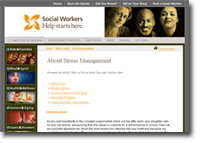
Helpful Stress Reduction Information

Social Workers offers their visitors useful information and resources for stress management that may be invaluable for those coping with PTSD -- or caring for them. Great pages to check out:

They also explore mind & spirit, suicide prevention, and living with illness topics among many others. A sample of their offerings below the fold.

Click on 'Article Link' below tags for more...

In educational interest, article(s) quoted from extensively.

Continuing:

The Impact of Stress on the Body

* Cardiovascular system – High levels of cortisol can raise your heart rate, increase blood pressure and blood lipid levels. These are risk factors in heart attack and strokes.

* Immune system – Did you ever wonder why you appear to catch more colds and come down with other infections when you’re stressed? Chronic stress tends to weaken you immune system making you more susceptible to whatever is “going around.”

* Nervous system – If your flight-or fight response system never shuts down, stress hormones can produce constant feeling of helplessness, anxiety and impending doom.

* Digestive system – Is it any surprise that you you’ll be stricken with a bout of diarrhea or a queasy stomach when you’re under stress? This happens because stress hormones slow the release of stomach acid and the emptying of the stomach. The same hormones also stimulate the colon, which speeds the passage of its contents.

Self-Help Strategies

You can do many things to help alleviate or quell stress without medications or intervention, starting simply with breathing.

Close your eyes, breathe deeply, and try to answer this question. When was the last time you felt truly relaxed? What was happening in your life? Very likely you were in a quiet, comfortable place where there was no pressure to do anything, and you could sit back and enjoy the day. You felt peaceful and at one with the world. For most people, that’s the definition of a vacation.

Think of it this way: Your body needs a vacation every day. Here are some ways to achieve that.

* Deep Breathing - When we are stressed, our breathing becomes shortened to the point that we can hyperventilate if we are faced with acute stress. Counter the natural instinct by deliberately taking four deep breaths every time you feel stressed. Slowly breathe in through your nose, hold it for five seconds and then release the air through your mouth.

* Exercise - Ongoing muscular tension goes hand in hand with chronic stress response. Counteract it by taking a brisk walk, playing a round of tennis, swimming a few laps. The goal is to keep your body limber and moving. For a more relaxing form of exercise, consider taking a yoga class or even tai chi.

Many gyms, community centers and adult night schools offer classes in this increasingly popular disciplines.

Set aside at least 10 minutes of your day to simply sit and be. It’s easier said than done, yet the benefits are tremendous. Meditation practices are equally helpful in teaching people how to quiet their thoughts and totally relax.

Keeping Diaries and Journals

Some people find solace in the privacy of their journals or diaries. Studies have shown that writing about stressful events or even huge, traumatic experiences can help to alleviate the stress and even improve the immune system. Again, community colleges, adult night schools and sometimes even hospitals offer classes in “ journaling” or therapeutic writing.

If you find that despite your best efforts to get a handle on things in your life, stress seems to be overtaking you, impeding you from living as you’d like to, making you feel chronically tired, or hopeless, a social worker may be able to help.

The goal of meeting with a skilled social worker would be to guide you to come up with a workable plan to help reduce or alleviate the stress in your life. This may entail psychotherapy to help you determine the source of the stress.


Previous/Older Posts Return Home

Archives
2011: Jan Feb
2010: Jan Feb Mar Apr May Jun Jul Aug Sept Oct Nov Dec
2009: Jan Feb Mar Apr May Jun Jul Aug Sept Oct Nov Dec
2008: Jan Feb Mar Apr May Jun Jul Aug Sept Oct Nov Dec
2007: Jan Feb Mar Apr May Jun Jul Aug Sept Oct Nov Dec
2006: Jan Feb Mar Apr May Jun Jul Aug Sept Oct Nov Dec
2005: Sept Oct Nov Dec

Legal Notice

The information presented on this web site is based on news reports, medical and government documents, and personal analysis. It does NOT represent therapeutic prescription or recommendation. For specific advice and information, consult your health care provider.

Comments at PTSD Combat do not necessarily represent the editor's views. Illegal or inappropriate material will be removed when brought to our attention. The existence of such does not reflect an endorsement.


This site contains at times large portions of copyrighted material not specifically authorized by the copyright owner. This material is used for educational purposes, to forward understanding of issues that concern veterans and military families. In accordance with U.S. Copyright Law Title 17 U.S.C. Section 107, the material on this site is distributed without profit. More information.