x

Monday, September 15, 2008

OEF/OIF Veteran Suicide Toll: Nearly 15% of Overall U.S. Military Casualties Result from Suicide

See Afghanistan, Iraq Veteran Army Suicide Rate Continues to Climb; PTSD Timeline Update for updated OEF/OIF veteran suicide data -- Ilona Meagher, 11/4/09

Back in February, the Marines released their military branch's updated suicide statistics. They revealed the number of Afghanistan and Iraq combat troops and veterans who took their own lives in 2007 had doubled over the previous year.

Earlier this month, the Army reported its own current soldier suicide data, reflecting another year of record increases. And just last week, the VA chimed in with their latest OEF/OIF veterans suicide figures -- also another record-breaker -- for its Afghanistan and Iraq veteran clients.

Gregg Zoroya of USA Today:

In 2006, the last year for which records are available, figures show there were about 46 suicides per 100,000 male veterans ages 18-29 who use VA services. That compares with about 20 suicides per 100,000 men of that age who are not veterans, VA records show.

The statistics accompany the release of a study conducted by a group of mental health experts appointed by VA Secretary James Peake to investigate the department's efforts to track and prevent suicides among veterans. ...

VA records show that 141 veterans who left the military after Sept. 11, 2001, committed suicide between 2002 and 2005. In the one year that followed, an additional 113 of the Iraq- and Afghanistan-era veterans killed themselves.

The report did not specify how many of those 113 saw combat. The increase in the number of suicides can be attributed in part to the rising number of veterans since 2001. The overall suicide statistics include veterans who served during the wars in Iraq and Afghanistan but were stationed outside the combat zones. ...

The release of the VA data comes days after the Army said 2008 may be another record year for suicides among active-duty soldiers. If the trend continues, it would surpass a record of 115 suicides set in 2007. The Army reported last week that through August, there have been 62 confirmed suicides and 31 deaths suspected of being suicides.

"If this holds true, suicide rates for the Army will surpass" the U.S. rate for the general population, an Army news release says.

What follows below the fold is a partial, quite incomplete look at where we're at today as far as Iraq and Afghanistan troop/veteran suicides are concerned. It's exasperating work; but, I'm in good company. Congress for years has struggled to get a straightforward and full data set out of the DoD and the VA, too.

Click on 'Article Link' below tags for much, much more...

In educational interest, article(s) quoted from extensively.

First, a few caveats: There are all sorts of problems that exist with the data in the table below.

DoD and VA statistics -- and a description of just what incidents are and are not counted, and why one incident is included and another not -- never seem to appear in a concise format.

Some reports, for example, don't break things down easily for us. Is the Army active-duty tally for all OEF/OIF troops or formerly-deployed forces/veterans, or does it include non-OEF/OIF forces (for example, serving in Korea), too?

I've weeded through and broken it all down to reflect only Afghanistan and Iraq figures to the best of my knowledge and ability. I welcome any additions of data and/or corrections that you may find and care to share.

OEF/OIF Suicides

Active-duty military forces
Marines, active-duty forces, deployed, 2003: 2
Army, active-duty forces, deployed, 2003: 25
Marines, active-duty forces, deployed, 2004: 7
Army, active-duty forces, deployed, 2004: 11
Marines, active-duty forces, deployed, 2005: 4
Marines, active-duty forces, deployed, 2006: 4
Army, active-duty forces, deployed, 2005-2006: 120
Marines, active-duty forces, deployed, 2007: 6
Army, active-duty forces, deployed, 2007: 115
Army, active-duty forces, deployed, January-August 2008: 62
Army, active-duty forces, deployed, through August 2008 (suspected): 31
Army, active-duty forces, between deployments, 2002-2008: ???
Army, active-duty forces, suicide attempts, 2002: 350
Army, active-duty forces, suicide attempts, 2007: 2,100 [5 per day]

Veterans
Marines, active-duty, prior deployed, 2003: 6
Marines, active-duty, prior deployed, 2004: 10
Marines, active-duty, prior deployed, 2005: 8
Marines, active-duty, prior deployed, 2006: 5
Marines, active-duty, prior deployed, 2007: 12
Veterans, separated from service, under VA care, 2002-2005: 141
Veterans, separated from service, under VA care, 2006: 113
Veterans, separated from service, not under VA care, 2002-2008: ??? [*at least 139]


OEF/OIF Suicide Totals
Active-duty military forces: 356 [+another 31 suspected]
Veterans: 295 [+another 139 not officially counted by DoD or VA]
-------------------------------------------------------------------
356+295=651 OEF/OIF active-duty troop or veteran suicides.

If we were to add in the 139 the DoD and the VA appear not to be counting (see note below), the figure rises to 790. And, if we add in the 31 suspected 2008 suicides still being investigated by the DoD, the number grows to 821.

As of today, there have been over 4, 700 U.S. OEF/OIF casualties.

If we use the conservative suicide figure above of 651, doing the math, that translates to nearly 15% (13.82 to be exact) of our Afghanistan and Iraq war losses are as a result of suicide.

If we plug in the higher figure (821), the percentage jumps to over 17% (17.43).
*Important note on the above figures:

In October, AP reported on preliminary VA research at the time, which revealed that 283 OEF/OIF veterans had committed suicide between 2001-2005.

This was the figure that I was prepared to use when testifying before the House Veterans Affairs Committee in December on this issue at the Stopping Suicide: Mental Health Challenges Within the Department of Veterans Affairs hearing.

I noted in my testimony [read | view] that the combined reported DoD and VA figures reflected the fact that 10 percent (at the time) of our overall service member casualties in the Iraq and Afghanistan wars are as a result of suicide.

The night before the hearing, I reviewed the VA's prepared remarks slated to be delivered the following day. That's when I first noticed the change. The VA figure had been decreased by 139 (from the original 283), to a total of 144 OEF/OIF suicides. Of course, I became curious: What happened to the 139 no longer being counted?

I was able to get my question answered pretty quickly.

Following my testimony, VA Mental Health Director Dr. Ira Katz (who was quite gracious and kind to me, although he's come understandably under fire quite a bit since then for his less-than-full disclosure of the VA's suicide data) introduced himself, giving me the chance to ask him privately about the changed suicide tally.

Why had the figure been reduced?

He went into a long explanation, saying that the VA incorrectly counted some veterans in their system, who in reality were still considered a part of the DoD when they died. Therefore, they weren't official VA clients and need not be included in their count.

After going back-and-forth a bit to get some more clarification, my best understanding of this logic is that 139 OEF/OIF veterans aren't being recognized in our official OEF/OIF veterans suicide data due to a mere technicality.

For example, Iraq veterans like Timothy Bowman, who'd returned to the states but had not yet enrolled in the VA for care when he committed suicide, for some strange reason doesn't need to be considered part of the overall data.

Since he wasn't a VA client, he isn't counted in the VA statistics. And since he wasn't deployed when he committed suicide, the DoD doesn't appear to include him, either, when it reports on how many of its combat zone troops have perished this way.

Is this really the best way for us to go about trying to get a real handle on the depth and breath of the OEF/OIF suicide issue?

I don't think so. Anyone else feel the same way?

Some related stats:

  • Nearly 40% of Army suicides in 2006 and 2007 were taking psychotropic drugs like Zoloft and Prozac for depression and PTSD.

  • Nearly 60% of 948 Army suicide attempts in 2006 had been seen by mental health providers before the attempt - 36 percent within just 30 days of the event.

  • More than 43,000 U.S. troops since 2003 were sent into combat even though they had been listed as medically unfit in the weeks before their scheduled deployment.

  • The "typical" soldier who commits suicide is a member of an infantry unit who uses a firearm to carry out the act, according to the Army.

  • 53% of veteran suicides from 2001-2005 came from the Guard or Reserve population; for a period during 2005, they accounted for about 50% of forces serving in Iraq and Afghanistan. However, when averaging all war years, they made up 28% of all U.S. military forces deployed.

  • 100,000 OEF/OIF vets have sought help for mental health issues, including 52,000 for post-traumatic stress disorder alone.

  • According to the DoD, there were almost 2,200 active-duty soldier suicides between 1995-2007.

  • CBS News reported in November that there were at least 6,256 veteran (of all wars) suicides in 2005 [this figure includes data collected from 45 states; the figure is, therefore, higher if taking all 50 states into account]. That’s 120 each and every week. In addition, on any given night, nearly 200,000 veterans are counted among the homeless.

  • In 2005, OEF/OIF veterans aged 20 through 24 had the highest suicide rate among all vets, about 2-4 times higher than their civilians peers. (Civilian suicide rate: 8.3 per 100,000; Veterans suicide rate: between 22.9 and 31.9 per 100,000.)

  • A 2007 survey of U.S. troops revealed that about 12% of OIF and 17% of OEF combat troops are taking prescription antidepressants or sleeping pills to help them cope.

  • The new VA suicide prevention hotline, 1-800-273-TALK (8255), recently reported that it's received more than 55,000 calls, averaging 120 per day, with about 22,000 callers saying they were veterans.


Related Posts

Labels: , , , , , ,

Friday, September 12, 2008

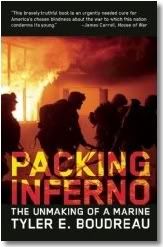
The Unmaking of a Marine: ePluribus Media Reviews Packing Inferno

The always fabulous Cho of ePluribus Media reviews Iraq veteran Tyler Boudreau's upcoming book, Packing Inferno: The Unmaking of a Marine:

Packing Inferno is a thoughtful meditation on the warrior class, combat stress and where real hell lies, which as Boudreau will tell you, isn’t in the war theatre.

The battleground is merely the foyer.

The real hell is here and now
, in the aftermath, daily, hour-by-hour, minute-by-minute, confronting the wounds -- physical and psychological -- that are the inevitable outcomes of war.

In 2004, Boudreau served as a Marine corps captain in Iraq.

Since then, his 12-years of active duty service and wartime lessons have inspired him to attempt to stir the nation's consciousness and conscience on war-related humanitarian subjects like the Iraqi refugee crisis.

To get to know the man behind the Marine a bit better, let's look beyond the book via recently published pieces into Boudreau's efforts to do right by the people he was sent to liberate.

Click on 'Article Link' below tags for more...

In educational interest, article(s) quoted from extensively.

July Daily Hampshire Gazette profile piece by James F. Lowe:

In April 2004, Marine Capt. Tyler E. Boudreau watched the exodus of Fallujah's residents in the days before American forces laid siege to the Iraqi city. Four years later, Boudreau, who has since resigned from the military and settled with his family in Leeds, says he's driven to help find ways to help Iraqis displaced during the war.

"We were in the position of creating displaced people," Boudreau said of his battalion and other units, who warned the people of Fallujah to clear out before an impending battle with insurgents in the city.

"Here are the very same people we had been sent to Iraq to liberate - in other words to help and get out of a bad situation." ...Already well versed in the documented plight of Iraqis refugees in Jordan, Boudreau said he wants to see their situation for himself. The stories he's read reflect that many are forced to drain their savings or take under-the-table jobs in order to survive. This sets them up for poverty and exploitation, he said.

Another Northampton resident already has a firsthand perspective on the refugee experience in Jordan. Claudia Lefko has been to the country four times since 2006 as part of her Iraqi Children's Art Exchange Project. ...Lefko likened Boudreau to veterans of the Vietnam War, who returned to that country after they'd laid down their arms.

"You want to connect with the source of the trauma," she said.

Boudreau said he began thinking seriously about the displacement and refugee crisis within the last year. In March, while attending a gathering of Iraq veterans in Washington called Winter Soldier, he crossed paths with Montalvan.

Montalvan, of Brooklyn, N.Y., a 17-year Army veteran, served two tours in Iraq from 2003 to 2006. Since leaving the military last year, he has advocated for an end to the war. Montalvan is now a graduate student of journalism and strategic communications at Columbia University.

Boudreau and Montalvan formed the Iraq Veterans Refugees Aid Association soon after Winter Soldier. They share the belief, Boudreau said, that the U.S. has an obligation to assist displaced Iraqis.

"The follow-up is, Let's take care of these people," he said.

Writing with Army Captain Luis Carlos Montalván, they penned a powerful entreaty on the Iraqi refugee crisis that appeared this summer in an International Herald Tribune op-ed piece:

As combat officers in Iraq, we witnessed the suffering and forced migration of millions of Iraqi civilians. These same people are now struggling to survive as refugees in neighboring countries while millions more have been displaced within Iraq, enduring unimaginable hardship and danger. ...As American officers we feel it is our nation's moral obligation to address this crisis.

According to the UN High Commissioner for Refugees, in 2007 Iraqis represented the highest percentage of people seeking asylum worldwide with a 98 percent increase in applications. From 2004 to 2007, Iraqis seeking asylum moved from the 9th largest population to the 1st.

In comparison to other industrialized countries, the United States has performed poorly in granting Iraqis asylum. Organization for Economic Cooperation and Development statistics show that Sweden has taken the most sympathetic approach to Iraqis, with 90 percent of those claiming refugee status allowed to stay. Greece and Turkey are among other countries that have granted asylum to a great number of Iraqis. ...

Perhaps our proudest legacy from Vietnam was welcoming of over a million Vietnamese who had aided U.S. forces during that conflict.

Many of these [Iraqi] refugees have provided U.S. forces with invaluable services. One such individual, whose case we have been trying to press with immigration authorities, is a translator named Ali, who helped the U.S. military in 2003 and 2004.

At a time when we had no translators assigned to us, Ali stepped forward and helped us communicate our intentions to the local people in the Al Anbar Province. Ali's courage was responsible for saving many lives, including those of American service members.

Sadly, Ali has remained trapped in Jordan for two years enduring what he describes modestly as "harsh circumstances." He tells us that food and housing is scarce, health care is inaccessible, schooling for children is largely unavailable, and that only people who have residences are eligible for jobs. ..

When the United States desperately needed Ali's help in Iraq they got it. But when Ali had to flee because of threats to his life, when he came in to his own time of need, the U.S. failed to reciprocate.

We and other soldiers who once worked with Ali are trying arduously to facilitate his request for asylum under the provisions of the U.S. Refugee Admissions Program and via applications for asylum through the United Nations.

The creeping disillusionment this officer feels with the erosion of America's traditional role as protector and final refuge to the "tired, hungry and poor" of the world (especially those who have extended their hand in our direction) courses through those lines above.

The political policy and current stance of the nation he served is fueling his work and feelings today.

But discussing politics in the same breath as PTSD makes many uncomfortable. Some may wish to sanitize the condition by keeping the focus only on the clinical. Unfortunately, war is a political as well as military tool waged by our leaders and carried out by our warriors.

Trying to keep politics, and the discussion of the morality and ethics of a certain war or invasion, out of our discussions of PTSD is like trying to keep photos of caskets hidden from a public's view.

The combat deaths still take place -- even if they're not in our face all of the time. They remain right under the surface, under our daily radar, a part of the brutal reality of war that many are all too happy not to be forced to face or see.

The ePluribus Media book review glances this same vein briefly:

Boudreau writes of attending conferences stateside, studying the literature of combat stress, and recognizing that, as other mental health professionals have documented, soldiers can cope with their mental wounds if they believe their war to be just – a fight to liberate a people for example, but they cannot when the war is not just, when it is a war of acquisition, say, for oil. Yet, issues of the morality and ethics of the Iraq invasion are the very questions that mental health professionals tend to duck. [209]

Karin Zeitvogel of Agence France Presse writes of Boudreau's August Jordan fact-finding trip, and explains why the former Marine and his Army counterpart believe their efforts benefit not only the Iraqi refugee, but the American veteran as well:

Iraqi refugee Ahmad welcomed former US marine Captain Tyler Boudreau into his cramped apartment in Amman, stretched out a hand, and said: "We forgive you for invading our country." Boudreau had served in Iraq's Babel and Anbar provinces in 2004 - months after Ahmad along with his wife and two young children had fled the violence unleashed by the 2003 US-led invasion of Iraq.

The ex-marine had now traveled to Jordan, which has become a safe haven to between 500,000 and 750,000 Iraqi refugees, with another former officer who fought in Iraq, army Captain Luis Montalvan.

They had come, they said, to repay a debt they and many other veterans feel the United States owes to the Iraqi people. Bothered by the effect on the Iraqi population of the US invasion - as well as the impact on those doing the invading - the two former captains founded the non-profit group Iraq Veterans' Refugee Aid Association (IVRAA).

Their trip to Jordan was aimed at garnering first-hand information that they can use back in the US to advocate with legislators for changes to rules governing refugee immigration. They also want to campaign in schools and in the media to raise awareness of the plight of the more than 4 million Iraqis displaced by the war, they said.

Boudreau and Montalvan believe bringing together former soldiers with the people whose plight they have helped create will help both sides heal from the invisible wounds of war.

For more information, be sure to stop at Boudeau's online journal, Deeper Than War. And check out his book, Packing Inferno.


Related Posts

Labels: , , , , , , , ,

Military Kids Also Serve, Feel Stress and Strain of Nation's Wars

Did you know that about 700,000 American children have had at least one parent deployed in the Middle East since our invasion of Afghanistan? Today, over 155,000 kids have a deployed parent overseas supporting our operations in Afghanistan and Iraq.

While a resilient bunch, a lot of worry and strain are being carried on their little shoulders. Are they getting all the support they need?

Back in May, I spoke at a "Healing the Hidden Wounds" summit organized by National Public Television and NAMI-TN. Among the stream of amazing speakers drawn together that day was a 24-year military wife and mom (and active professional social worker with Ft. Campbell's Family Readiness Group and the Centerstone Community Mental Health Centers).

Susan Pease's words were among the more poignant of the day. She tried to answer the question, "What do military families need?" From my notes, here were a few of her responses:

  • Military kids are desperately in need of resources and supports. Their needs appear to be among the most overlooked of all aspects of of our nation's protracted wartime stance. While Military Family Life Consultants, Military OneSource and MilitaryHOMEFRONT are wonderful resources, more are needed.

  • Military children are acting out and need more peer group programs. Some are stealing prescription drugs from parents, coping with abandonment issues and angry that their deployed parents have missed so many important days (like graduation, etc.) over the years. These are signs that more substantial peer group programs are needed to help cushion their experience. Parents can't do it all.

  • Parents are also under stress and need more child care tools. Left behind on their own -- as strong and capable as they are -- they are starved for supports and tools to help their kids to cope with the many emotions they feel before, during and after deployment. Parents need more adolescent care help, and parenting help, and activities that will bring kids together and foster ways for them to be able to talk their feelings and anger and worries out with each other.
Click on 'Article Link' below tags for much more...

In educational interest, article(s) quoted from extensively.

Last year, the Milwaukee Journal Sentinel's Rachel Rutledge examined the issue and drew the same conclusion:

Paralleling their parents' fight against stealthy insurgents, children at home battle enemies they can't see and often don't understand. From bed-wetting and high blood pressure to depression and isolation, the wars invade their young lives in ways that experts say are potentially damaging mentally and physically. These ways go beyond disappointment, deeper than just missing Mommy or Daddy.

As countless reports emerge about the lack of proper care for the troops, civilian and military specialists agree, not nearly enough is being done to protect their children.

A preliminary report released last year by the American Psychological Association [pdf], "The Psychological Needs of U.S. Service Members and Their Families," brings together the prevailing research:

The Impact of Military Deployment on Children and Adolescents

Military service is a reciprocal partnership between the Department of Defense, service members and their families (Department of Defense, 2002). The military culture has evolved considerably from the World War II mindset characterized by the popular slogan, if the Army wanted you to have a family, they would have issued you one! Leaders now recognize that supporting families and children is key to the readiness and retention of service members, and there is widespread acknowledgment that, in their own way, families also serve.

In 2002, the DoD published the following statement: A Social Compact promotes the advancement of the military community through the reciprocal ties that bind service members, the military mission, and families by responding to the quality of life needs. This document specifically states that one of the Quality of Life areas of particular importance is support during the deployment cycle (DoD, 2002, p.60).

The active duty force (1.4 million) is outnumbered by the associated dependent family members (1.8 million). Among these family members, 1.2 million are children and adolescents (up to age 23). The Reserve and National Guard forces number nearly 900,000 with over 700,000 dependent children (Military Family Research Institute, 2004). At any one time, over half a million children have one or more parents deployed in support of the GWOT. Clearly, the number of children who have been affected by reoccurring deployments is significant.

Before specifically addressing the consequences of deployment, the unique constellation of stressors on military children must first be acknowledged. It is generally agreed that geographic mobility (multiple moves) and isolation, frequent separations, and the normative constraints of the military culture impact children in military families (Drummet et al., 2003; Ender, 2000, 2006; Finkel et al., 2003; Segal, 2006; Watanabe & Jensen, 2000). The repeated and extended separations and increased hazards of deployment (i.e., injury and death) compound these stressors in military children's lives. However, despite these significant stressors, levels of psychopathology in military children have been found to be at or below those in the civilian population (Jensen et al., 1991; 1995), thus attesting to their resilience.

It should be recognized that children's responses to deployment are variable and depend on age and developmental stage, in addition to family and individual factors (Amen et al., 1988; Murray, 2002; Pincus et al., 2005; Stafford & Grady, 2003). In the pre-deployment phase infants have been observed to be fussy and change their eating habits. Preschoolers can be confused and saddened by pending changes in the family. School-aged children will also be saddened, but may also become angry and experience anxiety. In addition to these mood states, adolescents may withdraw and deny feelings about the upcoming separation.

In the deployment phase, preschoolers may display sadness, tantrums, changes in eating and elimination habits, and separation anxiety in regard to the remaining caretaker. School-aged children may experience more somatic complaints, changes in mood, and a decline in school performance. Adolescents may be angry, aloof, and apathetic; they may act out more or lose interest in their usual activities and experience school problems. Others may embrace the new independence and try to assume the role of the missing parent (Amen et al., 1988; Blount et al., 1992; Pincus et al., 2001; Stafford & Grady, 2003).

The post-deployment phase can lead to powerfully ambivalent emotions in both children and adolescents. High expectations and behavior changes in the returning service member contribute to the challenges of readjustment. Very young children may not recognize the service member and may be afraid of him or her. Preschoolers, while happy and excited, may also display anger about the separation. Likewise, school-aged children may be simultaneously excited and angry.

They may act out their anger or may require unsustainable levels of attention. Adolescents may be defiant and disappointed by the difficulty the service member has acknowledging the changes the adolescent made in his or her absence (Amen et al., 1988; Blount et al., 1992; Pincus et al., 2001; Stafford & Grady, 2003). The responses by children to deployment are summarized in Table 1.

Table 1. Deployment Stages and Children's Responses

(Amen et al., 1988; Murray, 2002; Pincus et al., 2001; Stafford & Grady, 2003)

Pre-Deployment
  • Infants: Fussy, changes in eating habits
  • Preschoolers : Confused, saddened
  • School-Aged: Saddened, angry or anxious
  • Adolescents: Withdrawn, deny feelings about pending separation

Deployment
  • Infants: No research
  • Preschoolers: Sadness, tantrums, changes in eating/elimination habits, symptoms of separation anxiety may appear
  • School-Aged: Increased somatic complaints, mood changes, decline in school performance
  • Adolescents: Angry, aloof, apathetic, acting out behaviors may increase, loss of interest in normal activities, decline in school performance

Post-Deployment
  • Infants: May not recognize returning service member and be fearful of him/her
  • Preschoolers: Happy and excited, but also experience anger at separation
  • School-Aged: Happy and angry, often leading to acting out behaviors
  • Adolescents: Defiant, disappointed if their contributions at home are not acknowledged

Adolescents' adaptation to their parents' deployment has been recently studied by Huebner and Mancini (2005). Participants reported depression and changes in school performance, as well as an awareness of the dangers associated with parents' deployments. The study also found that adolescents tried to protect those remaining at home from stress and negative emotions and were wary of media coverage of the war. The authors concluded that deployment often has detrimental effects on adolescents' lives, and that these stressors may overtax the adolescents'
limited coping resources beyond their capacity (p. 11). While some adolescents seek social support during a parent‘s deployment, others become socially isolated. ...

Across various studies, depression, anxiety, and internalizing disorders have been found to be related to deployment (Jensen et al., 1989, 1996; Hillenbrand, 1976; Huebner & Mancini, 2005; Kelley et al., 2001). Boys seem to suffer more effects than girls (Jensen et al., 1996), and younger children overall are more susceptible to the effects of longer deployments. Older studies also suggest that academic grades can be negatively affected (Hillenbrand, 1976; Yeatman, 1981).

Again, from the Journal Sentinel:

The war threatens the psychological well-being of soldiers, spouses and their children so much that the urgency with which the issue should be addressed "cannot be overstated," the [APA] task force [which created the above research paper] reported in February.

"It's heartbreaking," said Shannon Gallagher, a counselor at the camp in Hudson, in St. Croix County. Children from military families gathered there for a week in July as part of Operation Purple, a program offered by the National Military Family Association. ..."I have some 16-year-olds that are homesick, which is really uncommon," she said. "They feel compelled to be at home, helping their mom. . . Some have a fear that when they go home both parents might be gone." ...

Ian, a thoughtful, talkative boy from Stevens Point, expressed stress from his dad's deployment with anger, said his mom, Heidi O'Brien. He slammed doors and ordered his mom to call his dad and demand that he come home from Iraq "right now."

"It's not fair," he would tell her. "Why am I the only one without a dad?"

"He was mad at me that I let him go," she said. "He thought I should have stopped him." Ian's dad, Thomas O'Brien, a major in the National Guard, had been active in every aspect of Ian's life before he was called to active duty. He took Ian fishing, attended football and baseball games, concerts and all the events the children were involved in, Heidi O'Brien said.

"We truly missed his presence every single day," she said.

And it didn't help Ian that other kids didn't understand.

"One kid said to him, 'Your dad is in Iraq? He must get shot at every day,' " she said. Other parents and children report similar comments from their civilian peers. In group discussions at the camp, the kids ranked being made fun of and called names among the 10 worst things about being a soldier's child.

Fear that their parent would be injured topped the list. Added responsibilities, being separated from their parent and feeling unsafe also made the list, as did the realization that "your dad can come home very mean." The problems intensify the more often and the longer a parent is at war, experts say. ...

"The very large majority of Army families do a tremendous job of coping with stresses the rest of us can barely imagine," said Deborah Gibbs, lead author of a Pentagon study published last week in The Journal of the American Medical Association. "For small groups of families, the deployments are associated with substantial problems."

Another study, which appeared in the May 2007 issue of the Journal of Epidemiology had some disheartening statistics:

Rates of abuse and neglect of young children in military families in Texas has doubled since October 2002, a University of North Carolina at Chapel Hill study shows, raising concerns about the impact of deployment on military personnel and their families across the country.

The study, published in the May 15, 2007 issue of the American Journal of Epidemiology, was designed by UNC School of Public Health researchers to measure the impact of the 9/11 terrorist attacks on military and non-military families. The researchers chose to study Texas because of the large military population there and the availability of data.

Researchers found that prior to October 2002, rate of abuse and neglect – called maltreatment – was slightly higher among non-military families compared to military families. However, after the U.S. started sending larger numbers of troops to Afghanistan and Iraq in 2003, rates of abuse and neglect in military families far outpaced the rates among non-military families. Military files indicate more troops were deployed and fewer returned home in 2003.

In addition, the rate of occurrence of substantiated maltreatment in military families was twice as high in the period after October 2002 compared with the period prior to that date. During the same period, the rate of substantiated child abuse and neglect was relatively stable for non-military families, said Danielle Rentz, Ph.D., lead author of the study, which was part of her doctoral dissertation at the UNC School of Public Health.

“Among soldiers with at least one dependent, for every one percent increase in the number of active duty soldiers departing or returning, we saw an approximately 30 percent increase in the rate of substantiated maltreatment cases,” Rentz said. “These findings indicate to us that both departures to and returns from operational deployment impose stresses on military families and likely increase the rate of child maltreatment.”

State records showed that the majority of substantiated child abuse and neglect that occurred in military families was perpetrated by a parent, Rentz said. Before October 2002, the parent who was in the military was the perpetrator of abuse and neglect about equally as often as the non-military spouse. However, between October 2002 and June 2003, the non-military parent was found to have abused or neglected the children more often than the military parent.

“The stress of war extends beyond the soldier to the family left behind,” Rentz said.

Recently, the Kitsap Sun looked at one important program aimed at helping military kids bond with their peers and work through their experiences and emotions:

Military kids are ditching their deployment-related stress in the woods this week. At Island Lake Camp in Central Kitsap and Camp Seymour on the Key Peninsula, the grounds are full of teenagers who have a parent deployed, just back, or preparing to go. ...

"Camp is camp," [Kathleen Moakler of the National Military Family Association in Washington, D.C.] said, adding that having fun is the No. 1 priority, but that campers are also offered some tools to cope with deployment stress. ...

Moakler said that kids' common deployment worries are that something will happen to their parent, that the parent won't come back as the same person who left, or that they themselves will change.
There are challenges of new roles and responsibilities, and disappointment when milestones can't be shared.

"This gives them tools to deal with it, to know other children are going through what they're going through, and that's half the battle," Moakler said.

Kaleigh Basso, who will be a freshman at Bremerton High in a couple of weeks, said the Operation Purple camp "is definitely cooler because the civilian kids don't really understand what we're going through."

Basso's father spent two months in San Diego with the aircraft carrier USS John C. Stennis. Her mom is a nurse at Naval Hospital Bremerton.

"It wasn't really a worry thing," she said of her dad being gone. "It was more just stressing out because I had to take on half of his jobs and half of my mom's jobs, and I still had to deal with school." ...

This year, there will be 100 weeks of Operation Purple camps held in 62 locations across the nation.

More information
An article in July 2008's Journal of Clinical Psychology, "Psychological adjustment and treatment of children and families with parents deployed in military combat," offered its readers a "series of case vignettes [to] illustrate the psychological adjustment and treatment implications for children with parents deployed in support of military combat operations." Very informative.

In May, ABC News' Bob Woodruff filed a related video report.

And finally, loads -- and I mean, loads -- of important resources at the American Academy of Pediatrics "Support for Military Children & Adolescents" website, which has info sheets, videos and more all devoted to helping military families.


Related Posts

Labels: , , , , , , , , ,

Thursday, September 11, 2008

Heroism, PTSD, Suicide, and September 11

From NPR:

New data from a public health registry that tracks the health effects of 9/11 suggest that as many as 70,000 people may have developed post-traumatic stress disorder as a result of the terrorist attacks.

The estimate, released Wednesday by New York City's Department of Health, is based on an analysis of the health of 71,437 people who enrolled in the World Trade Center Health Registry. They agreed to be tracked for up to 20 years after the Sept. 11, 2001, attacks, and the study was based on answers they volunteered about their health two and three years after the attack.

Of the estimated 400,000 people believed to have been heavily exposed to pollution from the disaster, data suggests that 35,000 to 70,000 people developed PTSD and 3,800 to 12,600 may have developed asthma, city health officials said.

They include rescue and recovery workers, lower Manhattan residents, area workers, commuters and passers-by.

One of those people on the scene was a man named Kenny Johannemann, a WTC janitor who worked part-time in the basement of the North Tower. Michael Daly picks up the story in the New York Daily News:
Johannemann often said he might have been killed on 9/11 had he not stopped to get a cup of coffee just before the plane hit. Otherwise, he might have been on an elevator when a jet crashed and flaming fuel poured down the shaft.

Instead, he was waiting for an elevator when he heard a huge bang and the doors burst open. A man tumbled out on fire and Johannemann helped him to an ambulance. "He was burned up bad but he was still alive," Johannemann told People magazine.

In the aftermath, Johannemann appeared on the "Jenny Jones Show" and received the letter from the White House. Privately, the hero became a reclusive alcoholic.

"He just started backing away and not bothering with anyone," Joseph Maya recalled. He avoided family, even on the holidays he had always loved. He seemed convinced he was friendless and alone.

Eleven days ago, on August 31, he committed suicide.

Click on 'Article Link' below tags for more...

In educational interest, article(s) quoted from extensively.

To contrast today's reported 9/11 PTSD figures, let's take a quick look at some previous data collected [master list of September 11-PTSD studies], beginning with Psychological Sequelae of the September 11 Terrorist Attacks in New York City, which appeared in March 2002's New England Journal of Medicine.

Findings:

In our survey of a representative sample of adults living south of 110th Street in Manhattan, conducted five to eight weeks after the September 11 attacks, 7.5 percent of the respondents reported symptoms consistent with the diagnosis of current PTSD, and 9.7 percent reported symptoms consistent with the diagnosis of current depression.

These prevalences suggest that in the area below 110th Street approximately 67,000 persons had PTSD and approximately 87,000 had depression during the time of the study. Although the estimated prevalences of current psychopathology vary according to the population studied, in a benchmark national study, the prevalence of PTSD within the previous year was 3.6 percent,10 and the prevalence of depression within the previous 30 days was 4.9 percent,11 suggesting that the prevalences in our survey were approximately twice the base-line values. ...

Persons directly affected by disasters have higher rates of post-event psychiatric disorders than persons indirectly affected. Our survey showed that the prevalence of PTSD was higher among the persons who were most directly exposed to the attacks or their consequences (e.g., those living south of Canal Street, the area closest to the attacks, and those who lost possessions) than among persons with less direct exposure. Factors associated with grief (e.g., loss of a family member) increased the likelihood of depression, a finding that is consistent with the results of previous studies. ...

We also found a relation between a low level of social support and both PTSD and depression in bivariate analyses and between a low level of social support and depression in adjusted analyses. Social ties have a positive role in mental health. After a disaster, a low level of social support has been shown to be related to PTSD and depressive symptoms

Frayed or nonexistant social supports in the midst of trauma recovery is the one commonality running through all of the incidents explored in this post.

But what about training/preparation for trauma?

Information on the incidence of PTSD in 9/11 workers from a September 2007 Journal of American Psychiatry article [pdf]:

[T]he likelihood of developing posttraumatic stress disorder (PTSD) as a result of working at the WTC site was highly dependent upon an individual’s background, how soon they reported to work at the site and how long they worked at the site.

Individuals with a wide variety of previous training and experience worked at the WTC site in the days, weeks, and months following Sept. 11. Highly experienced personnel, such as medical, fire and rescue personnel as well as police officers, participated in the rescue/recovery efforts, as did individuals with little or no previous experience who volunteered.

In “Differences in PTSD Prevalence and Associated Risk Factors Among World Trade Center Disaster Rescue and Recovery Workers,” Megan A. Perrin, M.P.H., former research scientist with the New York City Department of Health and Mental Hygiene, and her colleagues report that approximately 20 percent of construction/engineering personnel and unaffiliated volunteers were likely to develop PTSD within two to three years, compared with only six percent of police officers. The likelihood of developing PTSD was also higher for people who started working at the site on or immediately after Sept. 11, for those who worked on site for longer periods of time, and for those who were injured while working at the site.

“The findings of this study establish a substantial risk of mental repercussions in volunteers who respond to disasters, including terrorist attacks,” said AJP Editor-in-Chief Robert Freedman, M.D. “While we always knew that people who were directly involved were at risk, we now know that the risk extends to those who come to help.”

The analysis was based on interviews with 28,692 workers enrolled in the World Trade Center Health Registry. The workers were assessed through 30-minute computer-assisted telephone interviews, conducted between Sept. 5, 2003, and Nov. 20, 2004. The highest rates of PTSD were found among workers who performed tasks outside of their training. These included emergency, medical, and disaster personnel who engaged in firefighting and sanitation workers who performed search and rescue operations.

The probability of developing PTSD was also elevated for those who worked at the site for more than three months, for all types of workers except police officers. Again with the exception of police officers, the relationship between time worked and the probability of developing PTSD was strongest for those who began working at the WTC site on Sept. 11, when the exposure to trauma and risk of injury were greatest.

These findings confirm that the mental health impact of the WTC disaster was significant for rescue and recovery workers, especially for those who worked outside their area of training or regular occupation,” said Megan Perrin, M.P.H., lead author of the study. “The results also reflect the critical importance of preparedness training and reinforce the necessity of providing mental health services to workers following a disaster.”

The fate of one of those heroes from a 2003 USA Today piece :

The firehouse in Maspeth, Queens, lost 19 firefighters on Sept. 11, 2001. But in the minds of those still working there, the terrorist attacks claimed another life a year later. Gary Celentani, 33, a strapping firefighter who followed two brothers into the New York City Fire Department, was at home Sept. 25, 2002, when he shot himself to death with a rifle.

Sept. 11's role in Celentani's death may never be known. In the weeks before his suicide, he suffered his mother's death and the end of a romance. Although 6-foot-3, Gary was a "teddy bear," says his brother, Ralph, who believes Sept. 11 was at least part of the reason Gary killed himself. "Nobody knew how much pain he was in," he says. ...

Celentani's suicide illustrates a disturbing trend that has emerged after tragedies such as last year's Pennsylvania coal mine disaster, the Oklahoma City bombing and Sept. 11. Some of those intimately involved in storied rescue efforts — men and women lauded as heroes — have committed suicide. ...

After Sept. 11, at least three New York men involved in rescue and recovery efforts have committed suicide, union officials say. James Kay Jr., an emergency medical technician, shot himself early last year. Six months later, Daniel Stewart, another EMT, hanged himself. And there was Celentani.

What's more, Philip McArdle, the health and safety officer for the 8,600-member Uniformed Firefighters Association, knows of about a half-dozen suicide attempts by other firefighters since Sept. 11. "That number could go higher, depending on what we do to take care of these people," he says. Experts, citing causes from post-traumatic stress to the destructive power of sudden fame, worry more such deaths will follow. ...

For firefighter Celentani and the other men and women who make a living rescuing and tending to others, traumatic situations are a routine part of life. And the pressure of dealing with such emotional events can take a toll.

At one time, there were three Celentani brothers in the fire department: Gene, a retired lieutenant; Ralph, a captain; and Gary, who joined the ranks July 14, 1996.

Gary, like most new firefighters, rotated through different engine and ladder companies. After Sept. 11, he was transferred to the Queens firehouse that housed Squad 288 and Hazmat 1.

In the weeks that followed, he and his brothers worked in the World Trade Center ruins. His two best friends were killed there, says brother Ralph, along with nearly 30 others Gary knew. His life became consumed with attending colleagues' funerals when he wasn't digging through rubble and human remains. He kept a shrine of photos of fallen firefighters in his apartment.

The rescue and recovery efforts weighed on all three brothers. Ralph knew at least 70 firefighters killed. But Gary seemed to suffer more.

Those who come to the aid of fallen comrades and civilian casualties in the combat zone also can suffer negative consequences in the years following their experiences.

You may recognize this photo.

It was snapped by Army Times photographer Warren Zinn on March 25, 2003 -- just days into our invasion of Iraq. Dwyer, a medic born into a family of New York City police officers (his father and three brothers are all cops), enlisted two days after the attacks of September 11.

Joseph Dwyer served in Iraq in the 3rd Squadron, 7th Cavalry Regiment, 3rd ID, also known as "the tip of the tip of the spear." Their 21-day push to Baghdad included only four days free of enemy fire. The photo that made Dwyer famous was taken in Faysaliyah following 10 straight hours in danger, as Iraqi fighters attacked his convoy and a rocket propelled grenade (RPG) struck his vehicle.

After calling for air strikes, a nearby house had been hit. The residents inside were injured, including little Ali Sattar. Dwyer scooped the frightened boy up and whisked him to receive care for his wounds; he also raced into the national conscousness at the time, as Zinn's powerful photo made the cover of USA Today.

At the time, readers wrote in their support of what they saw in the photograph, saying that it symbolized everything that was right about America. One reader wrote that it "explains, as no words ever could, why so many Americans support this war." The writer also thanked Dwyer "for being the American many of us aspire to become." ["Image of soldier, boy explains mission," USA Today, March 31, 2003 -- no longer available online]

Unfortunately, once Dwyer returned home, the hero was left to deal with his experiences on his own. He began drinking and sniffing inhalants, trying to tamp down flashbacks and nightmares and the endless hypervigilence and fear that consumed him.

Family and friends tried to reach out to help, including organizing an intervention. Dwyer himself also tried to pull himself out of his downward spiral. But, three days after the family's October 2005 intercession, Dwyer -- in a deep PTSD psychosis -- discharged "volley after volley" of gunfire in his apartment as police stood by.

Eventually, from the strain, his marriage frayed and broke down completely with his wife taking their daughter and fleeing for their own safety. His security blanket now gone, Dwyer's self-abuse gained even more momentum. From the Associated Press:

Officers had been to the white ranch house at 560 W. Longleaf many times before over the past year to respond to a "barricade situation." Each had ended uneventfully, with Joseph Dwyer coming out or telling police in a calm voice through the window that he was OK.

But this time was different.

The Iraq war veteran had called a taxi service to take him to the emergency room. But when the driver arrived, Dwyer shouted that he was too weak to get up and open the door. ...They found Dwyer lying on his back, his clothes soiled with urine and feces. Scattered on the floor around him were dozens of spent cans of Dust-Off, a refrigerant-based aerosol normally used to clean electrical equipment.

Dwyer told police Lt. Mike Wilson he'd been "huffing" the aerosol. "Help me, please!" the former Army medic begged Wilson. "I'm dying. Help me. I can't breathe."

Unable to stand or even sit up, Dwyer was hoisted onto a stretcher. As paramedics prepared to load him into an ambulance, an officer noticed Dwyer's eyes had glassed over and were fixed.

A half hour later, he was dead. ...

[F]or most of the past five years, the 31-year-old soldier had writhed in a private hell, shooting at imaginary enemies and dodging nonexistent roadside bombs, sleeping in a closet bunker and trying desperately to huff away the "demons" in his head. When his personal problems became public, efforts were made to help him, but nothing seemed to work.

This broken, frightened man had once been the embodiment of American might and compassion. If the military couldn't save him, [friend and fellow former Fort Bliss medic Dionne] Knapp thought, what hope was there for the thousands suffering in anonymity?

Dwyer died on June 28, 2008.

As for our WTC hero, Kenny Johannemann, Donna De La Cruz wrote of his experience in her September 12, 2001, AP piece:

As the twin giants of the skyline crumbled from their 110-story grandeur to five stories of rubble, survivors coughing up dust and eyes glazed with terror fled across bridges or simply ran through streets piling up with debris.

The lucky ones got out alive but will carry scars on their memories forever.

Clemant Lewin, a banker, said he looked from his window across the street from the towers and saw people jumping from the 80th floor. A man and woman held hands as they plunged to the pavement.

"I'm traumatized for life," Lewin said. "Someone needs to take responsibility for this. This was somebody's father, this was somebody's sister, somebody's mother. We should have seen this coming. I'm disgusted."

Soon after the first terrorist-controlled jetliner sliced into one of the towers, an elevator door opened inside and there stood a man on fire.

Kenny Johannemann, a janitor, said he and another grabbed the burning man, put out the fire and dragged him outdoors. Johannemann said he then heard the second explosion and looked up. He, too, saw people jumping from windows high up in the buildings.

"It was horrendous. I can't describe it," Johannemann said.

Blogger Bad American:

Kenny Johannemann was used by the system who needed a hero and when they were done with him, he was cast back on the scrap heap of a previously ordinary life now shattered irreparably.

And then he was expected to pull himself up by his bootstraps.

Remember the rescuer of the Baby Jessica, paramedic Robert O’Donnell who also committed suicide? This is nothing new... It’s the same with the servicemembers that come back from the gaping maw of America’s wars.

What has never changed is the absolute unwillingness of a nation that spends $62 billion to build a handful of F-22 raptor fighter jets to spend a fraction of that to take care of the people who stand behind the machines and the ordinary, un-uniformed people like Mr. Johannemann who rise to the occasion to do extraordinary things for others.

We demean ourselves as a nation and people by not paying attention and providing care to these people after the cameras have been switched off and packed away.

While these above three cases are hardly reflective of everyone's experience in similar circumstances, they should give us pause.

They should move us to consider what we might do differently to better support and prevent such traumas and eventual tragedies in the future. Maybe, if we're bright enough, we can find some higher purpose for the raw suffering they felt during their brief time on earth with us.

Are we strong enough to honor them this way?

More information
New York City's government website reviews September 11's possible mental health effects, including, post traumatic stress disorder (PTSD), depression, general anxiety disorder (GAD), and substance use disorders, and offers general information and downloadable fact sheets.

The National Center for PTSD also has an info-rich Self Care and Self Help Following Disasters page well worth a look.


Related Posts

Labels: , , , , , , ,

Remembering September 11

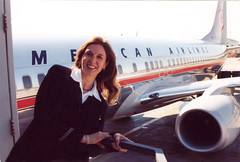
ilona_aa_oct2001For those of you who've been along with me on my personal journey these past seven years, you'll probably remember that I was a former 15-year flight attendant with American Airlines the day two of our airplanes were used in the terrorist attacks on our country.

In years past, I've written and shared photo essays on my experience of the events and my journey to Ground Zero three weeks after the attacks to pay my respects (my entire 911 collection of pictures is now on Flickr as well).

100201_chgo_ohare 100201_nyc_001 100201_nyc_002b 100201_nyc_011 100201_nyc_017 100201_nyc_020 100201_nyc_037 100201_nyc_044 100201_nyc_019 100201_nyc_058 100201_nyc_060 100201_nyc_063

While I personally was far removed from any danger that day, my life -- or, more directly, my career trajectory -- was directly affected by the day's unraveling. In fact, my advocacy for our returning veterans today can be traced back to the events of September 11, 2001.

I was one of the lucky stews.

Senior enough not to be among the 7,000 flight attendants at our airline suffering forced lay offs that fall, I also had a great husband (an AA Captain at the time; now a first officer due to their own division's sizable layoffs) who supported my choice to take the early retirement packages being offered to us.

It turned out to be a prescient move.

Click on 'Article Link' below tags for more...


Transitioning into the work that I do today wasn't a direct path or a consciously picked choice on my part. But my own life's changing trajectory in the days and weeks and months and years that followed 9/11 has been right in step with the weaving and bobbing taking place in the country as well.

Neither of us knew quite where we were heading back then.

Of course, we could immediately see the pain and losses surrounding those first casualties. But, fewer might have foretold the great difficulties in store for the day's survivors and first responders, many who are today coping with post-traumatic stress disorder and other debilitating ailments.

(Much more on September 11 PTSD in my next post).

And as for our nation's perennial protectors: our soldiers, sailors, air(wo)men and Marines? Not many of us would have wished to grasp the gravity and depth of the sacrifices they would be called on to bear as a result of the decisions made by our leaders following September 11.

Those who found themselves in a struggle for their lives either over Pennsylvania, amidst the reinforced walls of the Pentagon, or struggling to break free of the crushing fate of the Twin Towers in New York City are greatly missed.

They are all of our brothers and sisters.

For those of you who are personally and directly related or effected in any way, my heartfelt thoughts are with you and yours most especially today, the seventh anniversary of our nation's most heartbreaking day.


As an homage to my former peers at AA, who were on the front lines on September 11 as they are today, a commercial from the carrier's post-9/11 ad campaign:


Related Posts

Labels: , ,

Tuesday, September 09, 2008

National Council Magazine Reports on Community Programs Providing Support for Military Families

Far too often the needs of our military families are still not being fully met by the overwhelmed traditional healthcare systems they rely on for their care. As a result, over the past few years, local organizations have sprung up all across the country, offering tailor-made support services and reintegration programs.

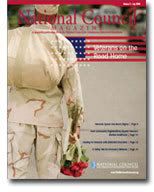
The trend is covered in full scope and detail in the current issue of National Council Magazine. Filled with first-person accounts, case studies, the latest PTSD data and much more, the National Council for Community Behavioral Healthcare's current quarterly issue is a rich resource...it's also available online as a free PDF download.

The 48-page issue offers:

Compelling, firsthand stories by veterans of the Iraq and Afghanistan wars about their continuing struggles with mental health and addiction disorders... The magazine, titled "Veterans on the Road Home," highlights the difficulties that many returning soldiers are facing and how community-based mental health and addictions organizations are helping them adjust to civilian life. ...

The magazine includes a harrowing, firsthand account by Travis Williams. The former Marine was the lone survivor of a road bomb explosion in Iraq that killed all 11 members of his rifle squad in 2005.

"When we arrived home, it seemed surreal," writes Williams, now a civilian in Montana. "I felt more out of place here than I had in Iraq. I isolated myself from friends and family and dwelled in my emptiness."

Articles from treatment centers in several states illustrate how the need for treatment far exceeds the capacity of the VA, and how community-based mental health and addictions organizations are ideally equipped to help returning soldiers reintegrate into civilian life. Congress is considering legislation to extend and supplement the treatment systems for the VA by funding the nation's network of existing public community mental health and addictions agencies. The legislation would enable more returning veterans and their families to take advantage of the mental health and addiction treatment services in their own communities.

Click on 'Article Link' below tags for more...

In educational interest, article(s) quoted from extensively.

From the introduction:

Veterans on the Road Home

Linda Rosenberg, MSW
President & CEO
National Council for Community Behavioral Healthcare

The wars in Iraq and Afghanistan no longer dominate the evening news or the public’s consciousness. According to a recent Pew Research Center poll, only 16 percent of Americans name the Iraq war as the story that first comes to mind when asked what has been in the news lately. But for the thousands of U.S. servicemen and servicewomen still serving in these war zones, the war remains a central part of their lives. And for the thousands of veterans who return home with physical and mental scars, their wounds can present particular challenges for years to come.

This is why the National Council is dedicating this issue of our magazine to veterans and their continuing struggles with mental health and addiction issues. As for returning serviceman and servicewomen, the war looms large for National Council members—community mental health and addictions services organizations—working with the families left behind during tours of duty and dealing with the war’s aftermath in the form of veterans returning with posttraumatic stress disorder, anxiety, depression, and substance abuse.

And our involvement may intensify—we may soon be on the frontlines of the veterans’ battlefield back home. At this writing, Congress is considering legislation to extend and supplement the treatment systems for the U.S. Department of Veterans Affairs by funding the nation’s network of existing public community mental health and addictions agencies. The legislation would enable more returning veterans and their families to take advantage of the mental health and addiction treatment services in their own communities.

Our members’ deep roots in the community leave us well suited to take on this welcome task. For one, veterans can receive treatment in their hometowns and not have to travel to VA centers located in other towns and cities. Our services go beyond our doors as we engage churches, schools, and other community stalwarts to become involved in a holistic approach that treats the whole family.

As our communities gear up to effectively meet the needs of returning veterans and their families, they are faced with a multitude of important questions. What do we need to know to effectively serve veterans returning from Operation Iraqi Freedom and Operation Enduring Freedom and their families? What does cultural competency mean with respect to those who have served in the military and their families? What are the unique characteristics of the conflicts in Iraq and Afghanistan that should inform treatment? What lessons can be learned from behavioral healthcare providers who already specialize in treating these veterans and family members?

To help address these pressing questions and to advise behavioral health providers about where to find additional information, we’ve developed an orientation and training manual, Meeting the Mental Health and Substance Use Needs of Veterans Returning From Operation Iraqi Freedom And Operation Enduring Freedom and Their Families. Funded by the Center for Mental Health Services within the U.S. Substance Abuse and Mental Health Services Administration, the manual aims to equip mental health and addictions staff to fully engage veterans and their families. By providing strategies, techniques, and advice, the manual is designed to serve as a resource compendium and reference tool with detailed information to guide readers who seek additional learning.

The manual will soon be available on our website at www.TheNationalCouncil.org.

In compiling the manual, we seized on the combined wisdom detailed in case studies of six community behavioral healthcare providers and state associations with special expertise in and commitment to serving veterans of Iraq and Afghanistan and their families. These innovative and collaborative aspects of their services turned into eight “lessons learned”:

Lesson #1: Understanding military culture is key - The focus is on perceptions of military service and mental health and on substance use service needs.

Lesson #2: Navigating the military’s behavioral healthcare system is a challenge - The focus is on the VA, VA medical centers and clinics, vet centers, women’s health programs, and homeless programs.

Lesson #3: The gap between needs and resources is wide
- Much is being done, and more needs to be done, now and perhaps for years to come.

Lesson #4: Financing services for veterans and families demands creativity and patience - The complexities of accessing TRICARE, VA, and other fiscal systems require attention if those resources are to be available to community behavioral health agencies.

Lesson #5: Local planning matters - States and communities are unique, yet they share common needs.

Lesson #6: Veterans, family members, and community leaders are our best allies - Veteran peer specialists, primary healthcare professionals, faith-based providers, and others in the community constitute a corps of highly effective advocates to build treatment and recovery support services.

Lesson #7: Behavioral health staff excel when carefully trained and deployed - The current training of community behavioral health staff in critical areas, such as trauma, recovery, and family service systems, provides a solid foundation on which to build specialized services for returning veterans and their families.

Lesson #8: Adjust, adjust, adjust - It is no surprise to community behavioral health providers that systems of services and supports evolve most effectively when people are prepared to adjust to expected and unanticipated developments.

And let us not forget perhaps the biggest lesson learned: The wars may no longer be front-page news, but they are still front and center in the lives of returning veterans. Every community in our nation has been affected, and every community behavioral healthcare organization stands ready to respond.

Download your copy [pdf], which covers the above important lessons and much, much more. One final portion necessary to share, dealing with current related legislation the National Council supports:

The National Council, along with Mental Health America, has advocated hard for passage of the Veterans Mental Health Outreach and Access Act—introduced in the Senate (S 38) by Senators Pete Domenici (R-NM) and Barack Obama (D-IL) on May 23, 2007, and introduced in the House (HR 2689) by Representatives Ciro Rodriguez (D-TX), Patrick Kennedy (D-RI), Steve Pearce (R-NM), and Albio Sires (D-NJ) on June 12, 2007. The act is intended to improve access to mental health services for veterans returning from Iraq and Afghanistan.

The Veterans Mental Health Outreach and Access Act would authorize the Secretary of the Department of Veterans Affairs to develop and implement a comprehensive national program to increase the availability of mental health support so that veterans affected by combat-related mental health problems do not go without access to the care they need. In remote areas of the country in which the VA determines that access to a VA medical center is inadequate, the bill directs the Secretary of the VA to contract with community mental health centers to provide treatment and support services and readjustment counseling. All contracted providers would be required to hire a qualified peer specialist and have its clinicians participate in a training program to ensure that services are tailored to meet the specialized needs of combat-affected veterans.

The bill calls on the VA Secretary to develop a national program to train returning servicemembers for positions as peer outreach workers and support specialists. The bill places particular emphasis on providing services for National Guardsmen and reserve veterans who have served in Iraq and Afghanistan.

These civilian soldiers often return from combat duty and immediately resume civilian life and may not have adequate access to readjustment services or VA facilities. The legislation includes provisions to extend counseling services to veterans’ families, who may also experience issues with readjustment after their loved ones have returned from deployment.

Another bill, the Veterans’ Health Care Improvement Act of 2007 (HR 2874 and S 2612), would require the VA (1) to create a national program to train and deploy returning veterans to provide peer outreach and support services and (2) in rural areas not adequately served by a VA facility, to enter into arrangements with community behavioral health centers. The bill, introduced by Representative Michael Michaud (D-ME), was passed in the House on August 6, 2007.

Provisions from both bills have passed Congress in the form of HR 2874 and S 2612. The National Council urges Congress to quickly reconcile and pass a final bill.

Labels: , , , , , , , , , , , , , , , , ,

Monday, September 08, 2008

Join Me at Park Ridge VFW Veterans Town Hall Meeting on TBI/PTSD Brain Scan Imaging

This Tuesday, I'll be taking part in a veterans' issues town hall meeting hosted by the Park Ridge VFW #3579 ("Illinois' Friendliest VFW Post") and State Senator Dan Kotowski. Kotowski has been a great champion of area veterans, his leadership bringing together the Northwest Suburban Veterans Advisory Council, the Illinois Department of Veterans Affairs, the federal VA, private health care and local community members in common cause.

These groups are now all working together to provide this area with a Military Support System and model PTSD diagnosis and treatment program administered by The Vet Center at Alexian Brothers Medical Center.

It's an exceptional resource for the community.

The Center's new Veterans Imaging Program [VIP] is using state-of-the-art brain imaging or mapping technology – more powerful than a standard CAT scan – called MEG to detect the neurobiological signs of PTSD. MEG promises to quickly and accurately spot these brain changes found in PTSD patients in a completely non-invasive way. And this same technology can be used to help detect traumatic brain injury.

We'll be talking about both PTSD and TBI tomorrow night, and I invite you to join us if you're in the area.

[UPDATE Sept. 28, 2008]: A surprise guest, IL Director of Veterans Affairs Tammy Duckworth, very easily and graciously upstaged all of the rest of us. A top thrill for me of the year to have the chance to share a few moments with her and to thank her for her service to us both in and out of uniform. Photos:

vfw_01 vfw_02 vfw_05 vfw_07 vfw_08 vfw_06

Click on 'Article Link' below tags for specific details...

In educational interest, article(s) quoted from extensively.

Details:

Kotowski to host town hall meeting on veterans’ issues

WHAT: Illinois Senator Dan Kotowski, 33rd District will join with a panel of experts to provide information and consultation for veterans and family members on a wide variety of veterans’ issues, including Post-Traumatic Stress Disorder (PTSD), its treatment, and the services that are available to veterans in our communities.

WHO: Sen. Kotowski, Ilona Meagher, author of the book “Moving a Nation to Care: Post-Traumatic Stress Disorder and America's Returning Troops,” representatives from a model PTSD program at Alexian Brothers Medical Center in Elk Grove Village and the Illinois Department of Veterans Affairs Warrior Assistance Program. The Warrior Assistance Program provides confidential assistance for Illinois Veterans as they transition back to their everyday lives after serving our country.

WHEN: 7:30 p.m., TUESDAY, SEPTEMBER 9, 2008

WHERE: Park Ridge VFW Post #3579, 10 W. Higgins Rd., Park Ridge, IL

RSVP: Reservations can be made by calling Sen. Kotowski’s legislative office at (847) 797-1192. Veterans and family members are encouraged to attend.

FOR MORE INFORMATION: Patrick Corcoran (847) 687-7579

More on the Veterans Imaging Program in a June Chicago Tribune piece written by Kristen Kridel:

An Elk Grove Village hospital plans to use brain-imaging technology to determine whether combat veterans with post-traumatic stress disorder also might suffer from undiagnosed traumatic brain injuries.

A "magnetic stethoscope" primarily used to study epilepsy and autism will help determine how brain function is altered by PTSD, officials at Alexian Brothers Medical Center said Wednesday.

The MEG technology—short for magnetoencephalography—allows doctors to read magnetic signals produced by the brain when exposed to visual or auditory stimuli, said Jeffrey Lewine, director of the Alexian Center for Brain Research.Those signals appear to differ in a veteran who only has PTSD compared with one who has PTSD and traumatic brain injury, Lewine said.

The combination can be hard to diagnose but critically affect proper treatment, according to Lewine. "You have to know what you're treating to get the right treatment," Lewine said. "Behavioral testing doesn't always distinguish the different components. We need to look at the biology." ...

The Elk Grove hospital's veterans imaging program will be part of an expanded support system aimed at serving veterans in the northwest suburbs suffering from duty-related neurological and psychiatric problems, officials said.

Participating in the hospital's effort are the Illinois Department of Veterans Affairs, the Veterans Administration and the Northwest Suburban Veterans Advisory Council.

State funding approved last year targets veterans with PTSD, officials said.

"Isn't it about time we do this in the United States of America?" said state Sen. Dan Kotowski (D-Park Ridge), who sponsored the legislation.

"This is the one thing we can agree on." ...

Researchers will use MEG with magnetic resonance imaging (MRI) and electroencephalography (EEG), Lewine said. Together, the technologies will allow clinicians to generate sophisticated 3-D images of brain activity.

It's important to know which medical issues a soldier is dealing with because treatments differ. Those suffering from both afflictions would be oversensitive to medications usually prescribed for someone with only PTSD.


Related Posts

Labels: , , , , , , ,

Archives
2009: Jan Feb Mar Apr May Jun Jul Oct Nov
2008: Jan Feb Mar Apr May Jun Jul Aug Sept Oct Nov Dec
2007: Jan Feb Mar Apr May Jun Jul Aug Sept Oct Nov Dec
2006: Jan Feb Mar Apr May Jun Jul Aug Sept Oct Nov Dec
2005: Sept Oct Nov Dec


Home | About | Contact | Sitemap


I Want You to Care About PTSD

Subscribe to PTSD Combat...
Your email address:
 
Delivered once daily by FeedBurner

Get Our News Feed (what?)

In a hurry?
Use the top left Blogger Search Bar.

Author Bio
Tour/Events
News
Reviews
Excerpt
Order
Info Sheet
Media Kit
Presentations

Ilona Meagher's Facebook profile

"Action is good for the soul
and the goal."

Ilona Meagher is an independent Illinois-based online writer, new media developer and author of Moving a Nation to Care: Post-Traumatic Stress Disorder and America's Returning Troops.

After reading of a soldier's lost battle with combat stress/PTSD in 2005, she decided to pursue the then under-reported topic.

It would change her life.


 Public Profile


Find Elected Officials
Enter ZIP Code:

or Search by State

See Issues & Action
Select An Issue Area:


Contact The Media
Enter ZIP Code:

or Search by State


Creative Therapy

Legislation News

Veterans Affairs

Department of Defense

Politics of PTSD

Legal Action

Science Advances

Body, Mind, Spirit

Poetic Wisdom

Supporting Family

Caregiver Issues

Fighting Stigma

Engaging Society

The Best Medicine

Women Warriors

Latest PTSD Google News

(No headlines? Enable javascript.)

McClatchy Veterans News

Wounded Times

Healing Combat Trauma

VA Watchdog


The information presented on this web site is based on news reports, medical and government documents, and personal analysis. It does NOT represent therapeutic prescription or recommendation. For specific information and advice, consult your health care provider.

Comments at PTSD Combat do not necessarily represent the editor's views. Illegal or inappropriate material will be removed when brought to our attention. The existence of such does not reflect an endorsement by PTSD Combat.

This site contains at times large portions of copyrighted material not specifically authorized by the copyright owner. This material is used for educational purposes, to forward understanding of issues that concern veterans and military families. In accordance with U.S. Copyright Law Title 17 U.S.C. Section 107, the material on this site is distributed without profit. More information.

Locations of visitors to this page

Add to Technorati Favorites