Showing posts with label personality disorder. Show all posts

Saturday, January 16, 2010

Combat Clips: A Selection of OEF/OIF Veteran Study Statistics, January 2010

News clips examining recent PTSD, TBI and other combat trauma or deployment-related study insights. First, Jennifer Thomas for HealthDay via BusinessWeek:

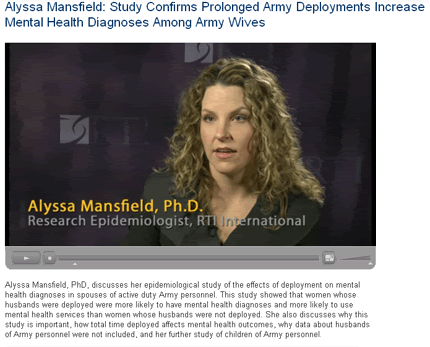
War isn't just tough on soldiers. Army wives whose husbands were deployed have higher rates of depression, anxiety, sleep disorders and other mental health issues than the wives of soldiers who stayed home, a new study shows.

Researchers looked at the medical records of more than 250,000 wives, accounting for most women married to active-duty U.S. Army personnel. Between 2003 and 2006, about 34 percent of the women's husbands deployed for one to 11 months, 35 percent deployed for longer than 11 months, while 31 percent of soldiers were not sent overseas.

Among wives of soldiers deployed for up to 11 months, researchers found almost 3,500 more diagnoses of depression, anxiety, sleep disorders and other mental health issues than among wives who[se] husbands stayed home.


Click on image above to see Mansfield discuss study.


Sunday, May 18, 2008

Combat PTSD or Adjustment Disorder? Saving Money, Not Lives, Floated at One VAMC

Last year, a firestorm erupted when it was found that 24,000+ OEF/OIF veterans had been booted out of the military with Personality Disorder discharges. PD (once labeled "Section 8") discharges are a quicker and more cost-efficient way of dealing with service members who are exhibiting problematic behavior.

The problem, of course, was that some of the discharged were combat-injured Purple Heart recipients who may have instead been coping with PTSD, a fact that would allow them access to VA health care benefits to treat their condition.

This week, we've moved from the military's diagnoses of Personality Disorder over PTSD to a Texas VAMC PTSD program coordinator advising that Adjustment Disorder diagnoses should be handed out over that of PTSD. The reason given? Saving money.


Tuesday, February 19, 2008

Military PTSD Diagnosis Now Proof Enough for VA -- For Some

Kelly Kennedy, Air Force Times:

The Department of Veterans Affairs has scrapped a policy requiring combat veterans to verify in writing that they have witnessed or experienced a traumatic event before they can file a claim for post-traumatic stress disorder — but only if the military has already diagnosed them with PTSD.

“This change provides a fairer process for veterans with service-connected PTSD,” Sen. Daniel Akaka, D-Hawaii, said in a written statement. “[It] leaves claim adjudicators more time to devote to reducing the staggering backlog of veterans’ claims.”

In the past, a veteran has needed written verification — a statement from a commander or doctor, or testimony from co-workers — that he or she was involved in a traumatic situation to receive disability compensation from VA if they had not already been diagnosed by the military during a disability retirement process. But PTSD is the only condition that a veteran must “reprove” to receive disability benefits from VA.

“They don’t have to reprove their diabetes,” said Mary Ellen McCarthy, special projects counsel for the Senate Veterans’ Affairs Committee. “They don’t have to reprove a leg injury. I have never seen any other condition diagnosed in service [for which] people had to reprove their injury.”


Friday, November 16, 2007

NPR: Army Personality Disorder Discharges Rocket 40% in Iraq War Era

Yesterday, an unsettling update on personality discharges by ace reporter Daniel Zwerdling on NPR's All Things Considered:

New Pentagon figures released to NPR show that since the United States invaded Iraq, officers have kicked out far more troops for having behavior issues that are potentially linked to post-traumatic stress disorder than they did before the war. ...

NPR asked the U.S. Army and the U.S. Marine Corps to disclose how many troops have been discharged by their commanders in recent years and why. The Marine Corps has not provided statistics. But an Army chart, which NPR recently received, shows that since the United States invaded Iraq:

— Commanders have discharged almost 20 percent more soldiers for "misconduct" than they did in the same period before the war;

— Commanders have discharged more than twice as many soldiers for "drug abuse" (a subset of the "misconduct" category);

— Commanders have discharged almost 40 percent more soldiers for "personality disorder."

In all, the Army has kicked out more than 28,000 soldiers since the war in Iraq began on the grounds of personality disorder and misconduct.


Wednesday, September 19, 2007

Veterans Work to Ease the Stigma of Combat PTSD

From the Marine Corps Times, a look at the great work done and immense strides made by returning vets when it comes to destigmatizing PTSD. If anyone can move the military culture in a more healthy direction, they can:

The concept of getting rid of a stigma can be a little nebulous, but experts on a post-traumatic stress disorder panel offered up some concrete changes that could help people overcome years of stereotypes.

“Mental health issues are in many ways the top issue of veterans of our generation. It needs to be treated like a pulled hamstring,” said Paul Rieckhoff, founder of Iraq and Afghanistan Veterans of America, at a forum sponsored by the Military Officers Association of America and the U.S. Naval Institute.

And he said he thinks the military is ready for that change. “Beyond all the macho and hard-headed culture, I think we understand we have to perform,” Rieckhoff said. If service members get the help they need, they’ll perform much better on the battlefield, he said. But convincing them that a trip to mental health won’t ruin their careers can be the toughest issue.

Click on 'Article Link' below tags for more...

In the interest of education, article quoted from extensively.

Continuing:

Marine Col. Keith Pankhurst, Combat/Operational Stress Control Program Coordinator for the 4th Marine Aircraft Wing, said it wasn’t very long ago that he believed Marines who had PTSD just didn’t have what it takes to serve.

“I would have been the first to say, ‘What kind of weakness is that?’” He said. “It took a lot of education to overcome that attitude.” But upon seeing a rise in alcohol abuse, drug use, domestic violence, misconduct and high-risk behavior that can lead to things like car accidents, he said, he realized there was a problem. “We felt, as leaders, there was something we could do about this problem,” he said.

There is reason to be hopeful:

Navy Capt. Morgan Sammons, special assistant for mental health/PTSD issues at the Navy Bureau of Medicine and Surgery, said he expects the wars in Iraq and Afghanistan to change the way the U.S. thinks about mental health. “We are at a truly epical moment in history right now,” Sammons said. “In no prior conflict has any society paid as much attention to the behavioral health care of fighting men and women as we are today.”

However, he said that if health care workers continue to label mental health issues as a “disorder,” the stigma won’t go away. Moreover, the problems ultimately are about adjustment, family and work problems, and abuse issues. “It’s essential to address those,” he said.

Leaders could help by telling the troops PTSD is not a sign of weakness, as well as integrating mental health care into the general health care process — rather than have it in a stand-alone building.

Combating stigma is far from over, however:

Charles Gittins, a former Marine who is now an attorney, represents service members fighting inappropriate military discharges. He said service members fear asking for help because they know that so many have been discharged for personality disorders or bad behavior, and they face losing health benefits related to PTSD or trying to find employment with a bad mark on their DD214s.

He talked about service members discharged from the military for behavior problems such as driving under the influence or becoming belligerent with a senior NCO. “You start scratching the surface and you find they suffered some kind of trauma in Iraq or Afghanistan,” he said. “That relatively minor misconduct separates them from the ability to receive veterans’ care.”

He does not argue that those service members shouldn’t be punished for bad behavior — only that the discharge policy should be rethought, especially if the service member has no prior history of bad behavior. For example, one commander allowed a Marine to resign in lieu of a discharge.

“It generally takes an enlightened commander to understand” that PTSD can cause behavior problems, he said.


Related Posts


Monday, September 10, 2007

Combat Traumatic Brain Injury Perplexes Caregivers, Strains VA System

From the Associated Press:

Thousands of troops have been diagnosed with traumatic brain injury, or TBI. These blast-caused head injuries are so different from the ones doctors are used to seeing from falls and car crashes that treating them is as much faith as it is science. "I've been in the field for 20-plus years dealing with TBI. I have a very experienced staff. And they're saying to me, 'We're seeing things we've never seen before,'" said Sandy Schneider, director of Vanderbilt University's brain injury rehabilitation program.

Doctors also are realizing that symptoms overlap with post-traumatic stress disorder, and that both must be treated. Odd as it may seem, brain injury can protect against PTSD by blurring awareness of what happened. But as memory improves, emotional problems can emerge: One of the first "graduates" of Vanderbilt's program committed suicide three weeks later.

"Of all the ones here, he would not have been the one we would have thought," Schneider said. "They called him the Michelangelo of Fort Campbell" — a guy who planned to go to art school.

Click on 'Article Link' below tags for more...

In the interest of education, article quoted from extensively.

Continuing:

Most TBIs are mild, and most of these patients recover within a year. But one-fifth of the troops with these mild injuries will have prolonged or lifelong symptoms and need continuing care, the military estimates. Nearly all of the moderate and severe ones will, too.

Though the full number of those suffering from TBI is still unknown, the problem is straining the U.S. Department of Veterans Affairs. Until now, "they were dealing with a cohort of aging veterans with diabetes, heart disease, lung disease," said Dr. Jeffrey Drazen, editor-in-chief of the New England Journal of Medicine and a VA adviser. Now, these young, brain-injured troops need highly specialized care, and how much it will help long-term is unknown, he said.

People with TBI have frequent headaches, dizziness, and trouble concentrating and sleeping. They may be depressed, irritable and confused, and easily provoked or distracted. Speech or vision also can be impaired. Some sufferers have been misdiagnosed with personality disorders. Others have lost jobs because of unrecognized and untreated symptoms.

"It's the so-called invisible injury. It's where a troop takes 10 times the normal time to pack his rucksack ... a complicated injury to the most complicated part of the body," said Dr. Alisa Gean, a neurosurgeon at the University of California, San Francisco. Diagnosing it is imprecise — damage rarely shows up on CAT scans or other tests. Treating it is even more difficult. Lacking a cure, doctors focus on symptoms — headaches, anxiety, vision problems, etc. But they lack good treatments for some of these, too, and are considering some experimental approaches being pushed by private companies with little proof they work.

Many troops get no care at all. Some are sent back to fight with their brain injuries undetected, especially if they had no obvious wounds.

Please read the rest of this informative report to meet two soldiers who are currently coping with TBI.


Related Posts


Wednesday, July 25, 2007

Veterans Issues in Sharp Focus Today in Hearings, Reports and Lawsuits

Lots going on today:


Join me at ePluribus Media for an exclusive online Q&A with Melissa Kasnitz and comments posted by Jeff Peskoff.

Click on 'Article Link' below tags for details...

The House Veterans Affairs website has an audio stream available of the hearing -- unfortunately, C-Span does not appear to be carrying this important hearing. Nonetheless, it looks (or rather sounds) like a blockbuster gathering -- and important -- hearing, so it would be well worth your time.

Today's hearing includes the following witness list:

Panel 1
Jason W. Forrester, Director of Policy, Veterans for America
Jonathan Town, Veteran
Joshua Kors, Journalist
Paul Sullivan, Executive Director, Veterans for Common Sense

Panel 2
Tracie Shea, Ph.D., Psychologist, Post Traumatic Stress Disorder Clinic Veterans Affairs Medical Center Providence, RI, U.S. Department of Veterans Affairs
Dean G. Kilpatrick, Ph.D., Distinguished University Professor Director, National Crime Victims Research and Treatment Center Medical University of South Carolina and Member, Committee on Veterans’ Compensation for PTSD Institute of Medicine and National Research Council The National Academies
Sally Satel, M.D., Resident Scholar, American Enterprise Institute

Panel 3
Ira R. Katz, M.D., Ph.D., Deputy Chief Patient Care Services for Mental Health, Veterans Health Administration, U.S. Department of Veterans Affairs accompanied by Ronald R. Aument, Deputy Under Secretary for Benefits, Veterans Benefits Administration, U.S. Department of Veterans Affairs and Paul J. Hutter, Executive in Charge, Office of General Counsel, U.S. Department of Veterans Affairs
Colonel Bruce Crow, Chief, Department of Behavioral Medicine, Brooke Army Medical Center, and, Clinical Psychology Consultant to The Army Surgeon General

For those who need a refresher: Satel, a psychiatrist and adviser to President Bush on mental health issues views who appears in Panel 2, came up with this gem (among many others):

"I'm not saying PTSD doesn't exist, but it's gotten out of hand. I mean, if you see a lot of action and then you come home you have a hard time walking your dog by the bushes at night, maybe you just avoid the bushes."

Panel 1 will set the tone with the appearance of Purple Heart veteran of Iraq, Army Spc. Jonathan Town. Here's a little about him:

Since his discharge in 2006, Town has not only dealt with the emotional scars of war, but he has also found himself at the center of a national debate on mental health care for veterans as a crowd as diverse as singer Dave Matthews [video] and members of Congress has questioned how 22,000 veterans were diagnosed and discharged since 2001.

In fact, Stars & Stripes reported updated personality disorder discharge figures last month:

Since October 2001, the services have discharged 24,723 troops under the character and behavior disorders policy. In 2006, 3,937 servicemembers were dismissed under the policy, up about 8 percent from 2005 but just above the 3,899 servicemembers dismissed in 2002.

Back to Town:

In Town's case, the discharge came two years after he was injured in an attack. In the fall of 2004, a 107 mm rocket ripped through his unit's headquarters in Ramadi, exploding two feet above Town's head and knocking him unconscious.

The rocket blast left Town with hearing loss, headaches, memory problems, anxiety and insomnia. For his wounds, he was awarded the Purple Heart.

But when he returned to the states seeking treatment for those very wounds, the Army quickly discharged him, asserting his problems had been caused not by the war but by a personality disorder that predated his military career. ... "When you see bits and pieces of actual people or people bleeding to death or anything, it's very unsettling. It's something you'll never be able to forget. Period," Town told ABC News' Bob Woodruff.

[UPDATE July 28, 2007]: Listen to Westwood One's America In the Morning show for an interview with Jonathan Town and reporter Joshua Kors.

ABC News ran a report by Bob Woodruff last week that renewed interest again on the issue of combat troops being given personality disorder vs. post-traumatic stress disorder diagnoses/discharges.


Woodruff (who you might recall did some ground-breaking reporting on the traumatic brain injury, or TBI, issue earlier this year) conducted a two-month investigation, interviewing 20 soldiers discharged with personality disorder for the piece.

And today, we have this hearing in response.

[UPDATE Oct 6, 2007]: This House Committee on Veterans Affairs page links to all of the day's testimony.

------------

In addition to this hearing, another important veterans affairs event is going to begin at 11:15 EST -- the final meeting of the Dole-Shalala Presidential Commission on Care for America's Returning Wounded Warriors. From their press release [MS Word doc]:

PRESIDENT'S COMMISSION ON CARE FOR AMERICA'S RETURNING WOUNDED WARRIORS TO HOLD FINAL MEETING TO DISCUSS AND VOTE ON RECOMMENDATIONS TO THE PRESIDENT

WEDNESDAY, JULY 25th IN WASHINGTON, D.C.

WHAT: The Commission will hold its final public meeting to discuss and vote on
recommendations to the President concerning care for America’s returning injured and wounded servicemen and women. The Commission held its first public meetings on April 14th and has since conducted 23 site visits and held seven public meetings.

WHEN: Wednesday, July 25th, 2007
Commission meeting begins at 11:15am EST
There will be a media availability about 30 minutes after the conclusion of the Commission meeting, at approximately 1:00-1:30pm EST

WHERE: The Ronald Reagan Building & International Trade Center
Atrium Ballroom, 14th Street and Pennsylvania Avenue, N.W., Washington, D.C.

About the President’s Commission on Care for America’s Returning Wounded Warriors: The nine-member Commission was established by the President to “conduct a comprehensive review of the care America is providing our wounded servicemen and women returning from the battlefield.”


Related Posts


Monday, July 23, 2007

Class Action Lawsuit Brought Against VA

Latest updates on this and related VA/Army lawsuits posted in "As Second Legal Attempt Fails to Force VA Hand on Disability Claims Processing, Army Sued Over Discharged Veteran PTSD Disability Ratings." -- Ilona Meagher, 12/17/08

From Associated Press:

Frustrated by delays in health care, a coalition of injured Iraq war veterans is accusing VA Secretary Jim Nicholson of breaking the law by denying them disability pay and mental health treatment. ... The class-action lawsuit against the U.S. Department of Veterans Affairs, filed Monday in federal court in San Francisco, seeks broad change in the agency as it struggles to meet growing demands from veterans returning home from Iraq and Afghanistan.

Suing on behalf of hundreds of thousands of veterans, it charges that the VA has failed warriors on several fronts -- from providing prompt disability benefits, to adding staff to reduce wait times for medical care to boosting services for post-traumatic stress disorder.

The lawsuit also accuses the VA of deliberately cheating some veterans by allegedly working with the Pentagon to misclassify PTSD claims as pre-existing personality disorders to avoid paying out benefits. The VA and Pentagon have generally denied such charges.

Click on 'Article Link' below tags for more...

From the Los Angeles Times:

[A]ttorneys for the plaintiffs say the VA is "structurally unsuitable" for dealing with post-traumatic stress disorder, which the lawsuit [pdf] calls "a signature problem of veterans" of the current ongoing wars. ... About 1.6 million men and women have served in the two countries. A recent report by a special Pentagon Task Force found that 38% of soldiers and 50% of National Guard members coming home from Iraq or Afghanistan have mental health issues, ranging from PTSD to brain injuries.

Only 27 of the VA's 1,400 hospitals around the country have inpatient PTSD programs, the plaintiffs' lawyers said. "A number of veterans have committed suicide shortly after having been turned away from VA facilities either because they were told they were ineligible or because the wait was too long," the lawsuit states.


From NBC-11 [San Jose/San Francisco/Oakland]:

The proposed class includes all veterans with stress disorder, stretching back to those from the Vietnam War, as well as those who served in Iraq and Afghanistan.

One of the groups' attorneys, Sid Wolinksy of Berkeley-based Disability Rights Advocates, said, "This lawsuit is the first class action lawsuit to directly challenge the VA's unconscionable backlog of claims and the endless waiting time disabled veterans face in receiving appropriate mental health care from the VA." ...

"Since the Iraq and Afghanistan wars began, the VA has betrayed our veterans," said Paul Sullivan, executive director of Veterans for Common Sense, based in Washington D.C. "Instead of hiring more doctors and claims processors, the VA instituted new policies that block veterans' access to prompt mental health care.

"While we are reluctant to file suit against the VA, it is the VA's anti-veteran policies that leave us no other option than to fight for what our veterans earned after fighting on the front lines in Iraq and Afghanistan," Sullivan said.

The eight officials named in the lawsuit:

  • R. JAMES NICHOLSON, Secretary of Department of Veterans Affairs; UNITED STATES DEPARTMENT OF VETERANS AFFAIRS
  • JAMES P. TERRY, Chairman, Board of Veterans Appeals
  • DANIEL L. COOPER, Under Secretary, Veterans Benefits Administration
  • BRADLEY G. MAYES, Director, Compensation and Pension Service
  • DR. MICHAEL J. KUSSMAN, Under Secretary, Veterans Health Administration
  • PRITZ K. NAVARA, Veterans Service Center Manager, Oakland Regional Office, Department of Veterans Affairs; UNITED STATES OF AMERICA
  • ALBERTO GONZALES, Attorney General of the United States
  • WILLIAM P. GREENE, JR., Chief Judge of the United States Court of Appeals for Veterans Claims
Of the lawsuit, Melissa Kasnitz, managing attorney of DRA says:

This class action does not seek money damages, nor does it address the claims of any individual veteran. It seeks systemic relief for the flawed system of providing heath care and benefits to veterans. Currently, there is a backlog of over 600,000 cases in the veterans benefit system, and veterans with PTSD are not able to promptly get treatment for mental health problems, despite a statute that requires free healthcare for two years after service. We are asking to the courts to order VA to fix these problems.

Continuing from AP:

[G]overnment investigators warned as early as 2002 that the VA needed to fix its backlogged claims system and make other changes. Yet, the lawsuit says, Nicholson and other officials still insisted on a budget in 2005 that fell $1 billion short, and they made "a mockery of the rule of law" by awarding senior officials $3.8 million in bonuses despite their role in the budget foul-up.

Today, the VA's backlog of disability payments is now between 400,000 and 600,000, with delays of up to 177 days to process an initial claim and an average of 657 days to process an appeal. Several congressional committees and a presidential commission are now studying ways to improve care. ...

The lawsuit cites violations of the Constitution and federal law, which mandates at least two years of health care to injured veterans. The veterans groups involved in the lawsuit are Veterans for Common Sense in Washington, D.C., which claims 11,500 members, and Veterans United for Truth, based in Santa Barbara, California, with 500 members.

Related Documents

If you are a veteran and wish to add your name to the lawsuit:

Disability Rights Advocates (DRA) is interested in hearing from veterans with Post Traumatic Stress Disorder who served in Iraq and/or Afghanistan. We are investigating the experiences of these veterans as they seek benefits through the Department of Veterans' Affairs.

We are seeking information on how the existing system serves veterans, including whether or not they are satisfied with the speed that their claims are addressed and the outcomes. We also are interested in hearing from veterans about the quality of care they receive at VA facilities.

We encourage any Iraq or Afghani veterans with PTSD who are interested in sharing their experiences to contact us. You can call, write, or email us at: Disability Rights Advocates, 2001 Center Street, Fourth Floor, Berkeley, CA 94704, (510) 665-8644; veterans@dralegal.org. Collect calls will be accepted.

All information will be kept confidential.

Additional comments, and a visit by Melissa Kasnitz of Disability Rights Advocates, in my Daily Kos and my exclusive Q & A at ePluribus Media.

If you have an account over there, feel free to leave your questions/concerns for her; or leave them in comments here. I'll be happy to forward them to to DRA for you.


Related Posts


Tuesday, July 17, 2007

Personality Disorder Discharges Under the Gun

Last week while I was in Seattle [video up of my University Bookstore book signing], ABC News had a report by Bob Woodruff [video] that renewed interest again on the issue of combat troops being given personality disorder vs. post-traumatic stress disorder diagnoses/discharges.

Woodruff [who you might recall did some ground-breaking reporting on the traumatic brain injury, or TBI, issue earlier this year] conducted a two-month investigation, interviewing 20 soldiers discharged with personality disorder for the piece.

From ABC World News:

Since his discharge in 2006, [Spc. Jonathan] Town has not only dealt with the emotional scars of war, but he has also found himself at the center of a national debate on mental health care for veterans as a crowd as diverse as singer Dave Matthews and members of Congress has questioned how 22,000 veterans were diagnosed and discharged since 2001 [the figure has jumped to 24,723 according to Stars & Stripes].

In Town's case, the discharge came two years after he was injured in an attack. In the fall of 2004, a 107 mm rocket ripped through his unit's headquarters in Ramadi, exploding two feet above Town's head and knocking him unconscious.

The rocket blast left Town with hearing loss, headaches, memory problems, anxiety and insomnia. For his wounds, he was awarded the Purple Heart. But when he returned to the states seeking treatment for those very wounds, the Army quickly discharged him, asserting his problems had been caused not by the war but by a personality disorder that predated his military career.

Interview with Dave Matthews:


Click on 'Article Link' below tags for more...

In the interest of education, article quoted from extensively.

Continuing:

Since 2001, more than 22,000 servicemen and women from all branches of the military have been separated under the personality disorder discharge, according to figures provided by the Department of Defense. ...

Servicemen and women undergo mental and physical screenings when they enter the military and again before they deploy. "Either the military didn't see it or they ignored it," [Russell K. Terry, founder of the veterans' advocacy organization, Iraq War Veterans Organization] said.

"We do histories and physicals on every recruit that comes in, but people may not always tell us everything," [Col. Elspeth Cameron Ritchie, a psychiatry consultant to the U.S. Army surgeon general] said.

Another soldier tells his story:

Donald Louis Schmidt of Chillicothe, Ill., was being treated for posttraumatic stress disorder after his second combat tour in Iraq. His commanders at Fort Carson later decided he was no longer mentally fit and discharged him with personality disorder. "They just slapped me with that label to get me out quicker," Schmidt said. He said superiors told him "'Everything will be great. Peachy keen.' Well, it's not."

The discharge left Schmidt ineligible for disability pay and benefits. He was also required to return more than $10,000 of his $15,000 reenlistment bonus, but he said no one explained that to him until it was too late. "If I didn't have family, I'd be living on the sidewalk," Schmidt said.

"It's not right that they would do this to him after him going to war for us," Schmidt's mother, Patrice Semtner-Myers, said. "They threw him away. They're done with him. He's no use to them anymore so they say, 'We're done. … Thanks for nothing.'"

Much of these details had been reported on previously [January coverage here and here] when the same diagnosis was given to Steven Green, the soldier charged with raping an Iraqi girl and then killing her and her family in Al Mahmudiyah. However, ABC News added some additional legs to this story when it found a whistle-blower:

On the day he was discharged in the fall, Town met with Jeff Peskoff, a civilian employee in the personnel office at Fort Carson in Colorado, and learned he owed the Army $3,000 to repay his enlistment bonus. "At some points it looked like he wanted to cry and at some point he looked like he wanted to rip my head off," Peskoff said.

Peskoff, who served 10 years in the Army, including a tour of Iraq, recently quit his job in disgust and is now speaking publicly for the first time. "If you have a combat tour and you are getting labeled as a personality disorder, there is something wrong. It's a lie," Peskoff said. "It's a quick way to get rid of that body and bring in another body. And it's a quick way to save money."

In the span of several months, Peskoff said he processed the personality disorder discharges of Schmidt, Town and hundreds of other combat veterans he believed were actually suffering physical and psychological trauma because of the war. "They [Army officials] are basically washing their hands of them," Peskoff said.

Fort Carson officials declined to talk to ABC News about this story. The Government Accountability Office is currently investigating Fort Carson as part of a larger study of mental health services for veterans.

Please continue on [scroll down] to the ABC News piece to read about the incredible stuff Dave Matthews is doing to spread the word on this issue. Town's story not only inspired him -- and in turn 23,000 of his fans -- but it affected elected officials on Capitol Hill as well:

Town's story also inspired 31 senators, including four presidential candidates, to write to Defense Secretary Robert Gates calling for an investigation into the military's use of the personality disorder discharge. "We are concerned over continuing reports from veterans' services organizations, the media and individual U.S. service personnel that personality disorder discharges have been implemented inappropriately and inconsistently," the letter said.

Sen. Kit Bond, R-Mo., said, "We want to make this something that is widely understood and gain the momentum for necessary changes to the system." Just today, six senators including Bond and Barack Obama, D- Illinois, introduced an amendment to the National Defense Authorization Act that would temporarily suspend personality disorder discharges for combat veterans until there is a comprehensive review of the current procedures.

Gates and other Defense Department officials declined to speak to ABC News, saying the issue was under review by the veteran care commission headed by Democrat Donna Shalala and Republican Bob Dole.

After all the recent attention focused on Town, the Department of Veterans Affairs recently began treating him and paying disability benefits. Matthews was asked whether his actions had helped Town. "I think the push, the publicness of the whole thing had some bearing on that, and if it did, it's great that it did. But there are still a lot of other soldiers that need to have the same attention paid on their behalf."

At home in central Illinois, Donald Schmidt is waiting.

As mentioned upstream, Stars & Stripes reported updated personality disorder discharge figures last month:

Since October 2001, the services have discharged 24,723 troops under the character and behavior disorders policy. In 2006, 3,937 servicemembers were dismissed under the policy, up about 8 percent from 2005 but just above the 3,899 servicemembers dismissed in 2002.

For anyone interested in doing some advocacy work on this issue, you may be interested in this comment left at ABC News:

Again ... I am the mother of the 2nd solider that got interviewed by ABC nightline, I am going to start an support/protest group for these soliders that are getting this phony discharge.... If you care, help me. I want the soldiers to know the American People care and are behind them 1000 percent. Don't let this go by just gasping and not doing anything.Stand up with me and do something. These soliders are feeling ashamed and embarassed and rejected. Don't let them feel betrayed. My son is Donald Schmidt, and I am one mad mother. I will fight this to my death and I need your help. Email me at semtner60@yahoo.com. We need to organize and let the government know they must represent us, the American people, mothers, fathers, brothers and sisters. Help me get this together to show Congress and President Bush we will not settle for this treatment. Again email me at semtner60@yahoo. We must do this for our soldiers.Patrice Semtner-Myers.PS Jeff Peskoff please contact me @ semtner60@yahoo.com


Related Posts


Tuesday, May 22, 2007

Army to Expand Efforts to Educate Officers on PTSD

From the Kaiser Network Daily Health Policy Report:

Representatives from Veterans for America on Wednesday said Army commanders have agreed to expand efforts to educate officers about post-traumatic stress disorder and to review the records of some soldiers with the condition who allege that Army physicians misdiagnosed them, the AP/Salt Lake City Desert Morning News reports. Some soldiers have said that Army physicians misdiagnosed them with personality or substance use disorders, rather than PTSD, and that, as a result, the Army dishonorably discharged them without health benefits.

According to Veterans for America representative Steve Robinson, Army commanders have agreed to take "corrective action" against individuals who have acted improperly toward soldiers with mental health problems. In addition, Maj. Gen. Jeffrey Hammond of the 4th Infantry Division at Fort Carson has agreed to review the records of about 40 soldiers who allege that the Army discharged them improperly, Robinson said.

Based on the review, the soldiers could have their records revised and their health benefits restored, according to Robinson. He said, "I believe the Army has made a dramatic turn. ... I think we're going to see a cultural sea change, and I think we just have to continue to monitor it to make sure that it happens" (Slevin, AP/Salt Lake City Deseret Morning News, 5/17).

Click on 'Article Link' below tags for more...

A few more snippets from AP:

Soldiers working with [Veterans for America] who have PTSD say that they haven't been given enough one-on-one counseling to recover and that the Army has offered to diagnose a personality disorder to give them a quicker, honorable discharge.

But personality disorders are considered a pre-existing condition, cutting them off from military health coverage and possibly making it harder to find a job. Robinson's group claims that some soldiers have been criticized for their job performance, despite getting inadequate treatment. ...

Problems range from misdiagnoses of personality disorders to soldiers who were dishonorably discharged for substance abuse without being offered treatment first, [Robinson] said.


 Related Posts


Wednesday, April 18, 2007

Important GAO Request Made By Senators Seeking Answers on PTSD-Deployed Troops

The issue of returning troops dealing with PTSD and other psychological burdens back into the combat zone has been a story that I've been following (and been angered by) for a long time. This latest move by Senators Obama, Boxer, McCaskill, Harkin, Lieberman, and Bond is a long-needed next step after a lot of energy and eyes have been directed at the problem (Sen. Boxer especially has been a key person on this one).

Follow the timeline of this issue by clicking on any of the links under 'Related Posts', and click on senator names above to send them your thanks for moving this oversight forward.

From the The Swamp, Chicago Tribune's Washington bureau blog:

A batch of senators led by Barack Obama (D-Ill.) is asking congressional investigators to probe the Defense Department's treatment of soldiers who suffer mental-health ailments after returning from Iraq and Afghanistan.

In a letter set to be sent today, the senators -- Obama and fellow Democrats Barbara Boxer (Calif.), Claire McCaskill (Mo.), Tom Harkin (Iowa), independent Joe Lieberman (Conn.) and Republican Kit Bond (Mo.) -- tell the General Accounting office they're concerned by reports alleging soldiers with post-traumatic stress disorder and other mental health problems have been denied care by superior officers and instead deployed for new tours oversees.

The letter says some of the senators voiced those concerns to the Defense Department earlier but have yet to hear a response. The senators ask the GAO to brief them first on "upsetting" allegations of mental health treatment -- or lack therof -- for soldiers at Fort Carson, Colo., and then expand to include "system-wide mental health deficiencies within the DOD."

Click on 'Article Link' below tags for full letter...

The letter:

April 18, 2007

The Honorable David M. Walker
Comptroller General
Government Accountability Office (GAO)
441 G Street, NW, Room 7125
Washington, DC 20548

Dear Mr. Walker:

We are writing to request that the General Accounting Office (GAO) undertake a review of Department of Defense (DOD) screenings, diagnoses, referrals and treatment of service members who may have Post Traumatic Stress Disorder (PTSD) and other mental health conditions related to their service in Iraq and Afghanistan. Several of us previously wrote the DOD requesting an examination of command practices and reports of biases and misdiagnoses in the treatment of mental health-related injuries such as PTSD and other deployment-related health problems, including Traumatic Brain Injury (TBI), but have not yet received a response.

The stigmas associated with PTSD and other mental health needs are no less potent within the military than in the civilian world. Indeed, reports from soldiers suffering from PTSD suggest that the stigma is worse, with some military commanders appearing to minimize the significance of PTSD and other mental health needs; or suggesting that a service member is malingering to avoid redeployment. There are allegations of commanders at Fort Carson, Colorado denying soldiers access to mental health care and instead ordering them redeployed for additional tours in Iraq. We have also heard of cases in which service members with PTSD are diagnosed as having "personality disorders" that the Army considers "pre-existing," thus depriving otherwise eligible combat veterans of disability benefits and much-needed mental healthcare. Because the stakes for our service members' and their health are so high, we must move quickly to investigate and correct any deficiencies.

We have come to learn about a number of upsetting allegations at Fort Carson. Therefore, for the purposes of an expedited review, we request to be briefed initially by GAO on these immediate cases. We ask that you subsequently focus your inquiry not only on Fort Carson but on system-wide mental health deficiencies within the DOD.

With the significant burdens already being placed on our service members and their families with multiple extended deployments, we must ensure that they are not further burdened with any humiliation, stigmatization or other minimization of genuine mental health needs. Our service members are risking their lives for our nation's security; it is our moral obligation to care for them. We therefore ask the GAO to assess:

1) Known cases of improper discharges or misdiagnoses and patterns of systematic stigmatization employed by military commanders regarding the mental health needs of service members throughout the chain-of-command at Fort Carson and across DOD departments;

2) The growing number of discharges for personality disorders, and whether or not such discharges are being improperly used when service members should in fact be given a mental health diagnosis that DOD does not consider preexisting.

3) The overall number of misdiagnosed cases of PTSD, other mental health conditions, and TBIs (at Fort Carson and force-wide);

4) DOD progress in implementing previous mandates to develop force-wide criteria and procedures for screening, diagnosing and referring mental health cases for follow-up treatment;

5) The efficacy of the DOD's current mental health safety net and treatment capabilities: for example, what current mechanisms are available to service members in the event of misdiagnosis?;

6) The steps and resources required to implement one-on-one, face-to-face mental health screenings for all returning service members;

7) The number of service members, men and women, reporting mental health concerns related to sexual assault during deployment; and whether current DOD personnel training and diagnostic guidance is sufficiently responsive to the needs of both men and women.

We seek to ensure that the DOD has the resources necessary to diagnose and treat service-connected injuries that impact the mental health of U.S. service personnel. It is vital that the U.S. military ensures it is treating the mental health needs of our forces with the same priority and resource investments it is devoting to physical injuries. If you would like to discuss this request, please contact [redacted].

Thank you for your assistance in this matter.

Sincerely,

_____________________

Barack Obama

_______________________

Barbara Boxer

_______________________

Tom Harkin


______________________

Christopher Bond

_____________________

Joe Lieberman

_______________________

Claire McCaskill


Cc: Gordon England
Deputy Secretary of Defense


Pete Geren
Acting Secretary of the Army


Related Posts


Tuesday, January 16, 2007

Personality Disorder -- Or Combat PTSD?

A recent post on the fact that 22,000 OEF/OIF troops have been discharged with personality disorder -- the same diagnosis given to Steven Green, the soldier charged with raping an Iraqi girl and then killing her and her family in Al Mahmudiyah -- stimulated quite a bit of interest. One of the questions raised: Are troops being given personality discharges in place of a diagnosis of combat-related PTSD?

Click on 'Article Link' below tags for more...

First a bit more on the Green case via Newsweek:

Green's case has helped to spur a closer look at the Army's standards for recruitment and training. Green enlisted and passed basic training at a time when the Army was under terrific pressure to bring in new soldiers and had relaxed its entry requirements. In 2005, about the time Green was accepted, the Army raised the limit on the so-called Category 4 recruits it would allow, the designation for soldiers with the lowest scores on its aptitude test. (Green's score is not known.) The Army has also been handing out more waivers—including case-by-case exceptions for criminal offenses—which increased by 3 percent last year. Basic training has slipped as well. In years past, basic was geared to "wash out" those unfit for the stresses of military life. Now it has been reformulated to keep as many recruits as possible. "What you're seeing is the reverse of what made the Army so effective," says Sen. Jack Reed of the Armed Services Committee. ...

The most recent washout numbers show a dramatic decline in standards: currently only 7.6 percent of new recruits fail to get through their first six months of service, down from 18.1 percent in May 2005, according to the latest Army figures. "That's a heck of a drop," says Leo Daugherty, the Army's command historian at Fort Knox. "The young man who got in [Green] should never have gotten in the Army. He slipped through the system." The Army says it has adapted basic training to lessons learned in Iraq and Afghanistan, and helps soldiers to improve their weaknesses. "We will get rid of those individuals who have no business being a soldier," says Col. Kevin Shwedo, director of operations, plans and training for Army Accessions Command. "We're not going to quit on a soldier when they're trainable. That's a big difference."

How about quitting on soldiers who do not appear to have had serious behavioral problems prior to enlistment but are now suffering from combat PTSD following their deployment to a war zone? Does the military stick with them?

From the Austin American-Statesman:

Soldiers suffering from the stress of combat in Iraq are being misdiagnosed by military doctors as having a personality disorder, lawyers and psychologists say, which allows them to be quickly and honorably discharged but stigmatizes them with a label that is hard to dislodge and can hurt them financially.

Though accurate for some, experts say, the personality disorder label has been used as a catch-all diagnosis to discharge personnel who may no longer meet military standards, are engaging in problematic behavior or suffer from more serious mental disorders. For returning veterans, the diagnosis can make it harder to obtain adequate mental health treatment if they must first show they have another problem, such as post-traumatic stress disorder. "It's an absolute disgrace to military medicine," said Bridgette Wilson, a former Army medic who is now an attorney in San Diego serving mainly military clients. "I see it over and over again, the dramatic misuse of personality disorder diagnosis. It's a fairly slick and efficient way to move some bodies through."

And stories coming out of Fort Carson, Colo., are far from comforting:

A government worker at Fort Carson in Colorado who has access to personnel records and who spoke on condition on anonymity for fear of losing his job said Army psychologists there have diagnosed some soldiers with a personality disorder after a single evaluation lasting 10 minutes to 20 minutes. Several soldiers at Fort Carson interviewed by Cox Newspapers said they have been given or offered the diagnosis in a handful of meetings lasting less than an hour.

The personality disorder diagnosis can result in a soldier getting an honorable discharge within days, which can be appealing for many returning from Iraq. The timing of many of the discharges, in some cases within months after soldiers have returned, appears to violate the military's rules, which say a personality disorder diagnosis should not be made if a soldier is experiencing "combat exhaustion or other acute situational maladjustments."

Personality Disorder is defined as "a deeply ingrained, abnormal behavior pattern that appears during childhood or adolescence." While a combat-related diagnosis for PTSD requires the military to invest in the continuing care of the veteran, a diagnosis of Personality Disorder does not.

A review of four soldiers' medical records at Fort Carson and records from a soldier at another post show that they were diagnosed with post-traumatic stress disorder before or after their discharge.Recommending a discharge on the basis of a personality disorder is a faster process than discharging someone for mental health problems of another nature. It requires only one military psychologist's finding, and the paperwork usually takes only a couple of days.

A diagnosis of post-traumatic stress disorder, on the other hand, must be handled by a medical review board, which must confirm that the condition stems from combat, a process that usually takes several months.

Dr. Joseph Bobrow, a former chief psychologist at Kaiser Hospital in San Francisco, said a personality disorder is one of the most difficult diagnoses to confirm, particularly when there is cumulative trauma. "I think it's ludicrous to make a diagnosis of personality disorder in a 20- to 40-minute interview," he said. "Even if you do a complete battery of psychological testing and intensive and informed clinical interviews over a week, some of those results can be and are contested in a court of law."

Some of the soldiers at Fort Carson say they had been told by Army psychologists that the Department of Veterans Affairs would take care of them if their troubles persisted. A personality disorder, however, is considered a pre-existing condition, not one related to a soldier's service, and Veterans Affairs can treat but not give disability benefits in these cases.

Many soldiers who sought mental health counseling after returning from Iraq, like former Spc. Donald Schmidt of Chillicothe, Ill., say they learned only after their discharge that they must repay part of their re-enlistment bonus based on the portion of time they did not serve — more than $10,000 in Schmidt's case.

Getting a Personality Disorder discharge also may make finding employment more difficult as employers examine the veteran's records and learn of behavioral problems noted on discharge papers.
In her 13 years in practice, San Diego attorney Wilson said she has seen dozens of Marines from nearby Camp Pendleton and soldiers from other posts separated for a personality disorder when the real reason, in her view, has been to punish a soldier, avoid paying disability benefits for a more serious condition or get rid of someone deemed undesirable.

Though some of her clients have personality disorders, she said, most who received the diagnosis and discharge had minor behavioral problems or were diagnosed with bipolar disorder or severe depression by either military or civilian psychologists. About three-quarters of her clients who have been diagnosed with a personality disorder, she said, weren't given any psychological test. Rather, she said, the diagnosis was based on a roughly 45-minute interview.

One troubling case:

For nearly a year after his return from Iraq in August 2005, former Pvt. Jason Harvey had gone without any follow-up evaluations at Fort Carson after screening positive for possible post-traumatic stress disorder and a traumatic brain injury, his records show.

After a suicide attempt in May, records show that the 23-year-old was diagnosed with depression and post-traumatic stress disorder, but in late June the Army tried to discharge him with a personality disorder. Harvey said he was told by a staff psychologist in a joint meeting with his commander that if he did not agree to an honorable discharge, the commander would pursue a punitive discharge. "They played me like a fiddle," Harvey said, adding he was wrongly told the medical retirement fell under the same category as post-traumatic stress disorder. In fact, it is a nonmedical discharge.

Also at Fort Carson, after two tours in Iraq, Schmidt, 22, told a psychologist he was feeling violent impulses as a result of marital difficulties. The decorated soldier is on guard constantly and "quick to anger" when he had not been that way before, said his mother, Patrice Semtner-Myers. Schmidt said his Army psychologist, Dr. Michael Pantaleo, made the diagnosis after several meetings lasting between 15 and 30 minutes each and never asked him questions about his behavior before joining the Army. Pantaleo did not return calls seeking comment.

Schmidt was discharged "without a dime in his pocket," his mother said. "The soldiers are often too stupid to know what they've done" when they accept the disorder or seek it, Wilson said. "They go out and discover the state police department really isn't interested in someone discharged with a personality disorder or find they have trouble getting security clearances."

Some military psychologists appear to be violating guidelines in the Diagnostic and Statistical Manual of Mental Disorders, the psychiatric manual used by the military. If a soldier complains of mental problems after returning from combat, a personality disorder is supposed to be ruled out for an unspecified amount of time because some of its characteristics, such as problems interacting with others and substance abuse, overlap with some of the hallmarks of post-traumatic stress disorder.

The Pentagon "is not familiar with the rules, or they are choosing to ignore them," said Paul Sullivan, director of programs for Veterans for America, a Washington-based nonprofit.

Every branch deals with these types of discharges differently:

Determination of personality disorder

Medical guidelines for each service:

Army: Requires a psychologist's findings.

Navy: Vague language; not clear that determination must come from a mental health professional or command.

Marines: Similar to Army rules but two forms of documents required. Same doctor must render findings on a Marine's impairment and on written nonmedical evidence to show examples of inability to function in the corps.

Air Force: Alone in requiring oversight where commanders fail to act on appropriate findings. Commander must have decision reviewed by discharge authority.

This is an issue that clearly deserves a closer look.


 Related Posts

Thursday, January 04, 2007

Fort Carson Visited by Congressional Staffers Today, Tomorrow

Last week, NPR reported on on the fall-out of a 6 month Fort Carson, Colo., investigation: the Army plans to court-martial one of the troops who spoke out on soldier intimidation and harrassment directed at those complaining of symptoms associated with PTSD. Sheesh.

Today comes more fall-out as congressional staffers are scheduled to arrive on base to do a bit of investigating of their own:

Three U.S. senators who raised questions last month over Fort Carson's treatment of soldiers with Post Traumatic Stress Disorder, will send staff members to the post Thursday and Friday to review its program for diagnosing and treating PTSD among Iraq combat veterans.

Staffers from the offices of Sens. Barack Obama (D-IL), Barbara Boxer, (D-CA), and Kit Bond, (R-MO) will arrive Thursday morning for the fact-finding tour. Four of Colorado's congressional delegation will also send staffers on the tour. They include representatives from Sens. Wayne Allard and Ken Salazar and Reps. Mark Udall and Doug Lamborn.

Obama, Boxer and Bond voiced concern over the Fort Carson program following a National Public Radio program Dec. 4, that interviewed several Fort Carson soldiers who said they were not provided with proper medical treatment for PTSD after returning from Iraq with symptoms of mental and emotional disorders.

Click on 'Article Link' below tags for more...

Additional details from the Rocky Mountain News:

Fort Carson's top medical officials have insisted that their staff is not mistreating soldiers. "We are seeing the soldiers, treating them well and providing the care they need," said Col. John Cho, a surgeon and commanding officer of Fort Carson's Evans Army Medical Center.

The visit will include briefings and interviews with Fort Carson medical officials and rank-and-file soldiers. ... Several Fort Carson soldiers complained that they were harassed by junior officers and noncommissioned officers after seeking doctor's appointments for mental and emotional problems after coming home from Iraq. Some said they were denied permission to obtain appointments to see Army doctors for PTSD symptoms. Others said they were threatened with disciplinary action, and some said they were given discharges for personality disorders or patterns of misconduct.

Certain discharges can leave soldiers ineligible for veterans medical care and other benefits. Fort Carson had diagnosed 577 cases of PTSD in 2006 through early December and expected the number to surpass 600 for the year. That compares with only 32 cases in 2002, before the Iraq war began.

Cause for concern:

A recent General Accountability Office report criticized the Army and other branches of the military for inconsistent diagnosis and treatment of PTSD. The Department of Defense "cannot provide reasonable assurance that service members who need referrals for further mental health or combat operational stress reaction evaluations receive them," the report stated.


 Related Posts


Tuesday, January 02, 2007

22,000 Returning Vets Discharged With Personality Disorder

From the Salt Lake Tribune:

Since 2001, the military has discharged more than 22,000 service members from its ranks for "personality disorder," a classification once referred to as a "Section 8," according to the Department of Defense. Kathleen Gilberd, a counselor with the San Diego-based Military Counseling Project, said many service members discharged because of personality disorders, medical issues and other grounds are in fact struggling with post-traumatic stress.

About one-third of service members seeking medical treatment from the Veterans Health Administration have reported symptoms of stress or mental illness, according to a June report from the VA. Of those, about half had possible post-traumatic stress, the report said. Though those figures would appear to make combat stress the largest medical condition suffered by veterans of the current wars, the ailment is not handled the same as other injuries.

Click on 'Article Link' below tags for more...

The piece goes on to explain that if a trooper was seriously injured, losing an arm or a leg for example, then they would be ordered to Walter Reed Army Medical Center or another U.S. military medical facility. They would have to remain there until a treatment oversight board gave the green light to return to service or make a success transition to civilian life.

Even if the soldier wants to deal with his or her problems on her own, tough luck. That's not how it works with physical injuries. It's a different matter with psychological injuries, however.

But because many post-traumatic stress symptoms do not appear until months after a service member's return from combat, those with the disorder don't get the same kind of "tough love." Instead, when symptoms - including "occupational instability" - appear, service members like Smith often are discharged for failing to maintain military standards, Gilberd said.

"Often what we find is folks who are showing symptoms of post-traumatic stress disorder, symptoms which are treated as misconduct," Gilberd said. "So they are discharged by reason of misconduct, usually with other-than-honorable discharge."

Sometimes, veterans advocates say, that leaves former service members ineligible for treatment by the VA.

The article introduces the reader to Walter Smith, a veteran who served in Iraq only to come home to his dark struggles with combat PTSD. Police had to intervene once in 2004 when he held a gun to his head; he'd sought help from the VA over and over again with no relief; and he now sits in jail awaiting trial for the March 26, 2006 drowning murder of the mother of his children. Another unfortunate incident to add to the PTSD Timeline.

Wayde Broberg, Smith's former roommate and a fellow member of the Utah-based company of Marines called to duty for the invasion of Iraq in the spring of 2003, ... said he and Smith hung out with a group of about eight Marines, all of whom saw heavy fighting in Iraq and all of whom suffered from post-traumatic stress. "In our little circle of pals - we hung out together, we fought together - none of us still go to the VA because it's a waste of time," Broberg said. "Wally was the only one still trying to go."

Broberg said Smith "tried 100 different times" to get help from the Veterans Affairs medical system. "Probably two or four times a month, he'd go up to the VA," he said. "He didn't get what he was looking for."

Susan Huff, a spokeswoman for the George E. Wallen VA Medical Center in Salt Lake City, where Smith and his fellow Marines say they sought treatment, would not respond to questions about individual cases but said the number of veterans being assessed for post-traumatic stress has increased 75 percent over the past year.

With the crush of returning troops coming in for care, the ability to help every one of them is reduced.

The VA Office of Inspector General concluded in a recent report that post-traumatic stress disorder treatment at the VA "is woefully inadequate." Paul Rieckhoff, director of the Iraq and Afghanistan Veterans of America, put it another way: He called the lack of support the Utah Marines appear to have received for their illnesses "par for the course."

"There's a joke in the veterans' community: If you don't have post-traumatic stress disorder before you arrive at the VA, you'll have it before you leave," Rieckhoff said, "because you'll get so aggravated with dealing with all the red tape." ...

"There needs to be a proactive system, not one that waits for problems to develop," he said. "We can pay for the transitional care, pay for screenings and pay for a proactive approach now, or we can pay for jail cells, lawyers and trials later on."

A very sad state of veterans affairs.


 Related Posts


Monday, January 01, 2007

Resolution: No More Troops Sent Back w/PTSD

An LTE from a friend in yesterday's Southtown Economist:

In this veteran's opinion this is about time: U.S. Sen. Christopher Dodd is asking newly appointed Secretary of Defense Robert Gates to ensure that soldiers debilitated by post-traumatic stress disorder (PTSD) and other mental illnesses are not sent back into combat.

Think about this: VA doctors have diagnosed military personnel unfit to serve. And the VA has granted some of these men and women 70 percent disabilities for PTSD and other mental problems. But yet these men and women are being called back up to go to Iraq. I do not care if it is a Republican or a Democrat who brings an end to this practice just as long as it stops.

To me it seems unacceptable and perhaps very reckless to ask these heroes to go back into combat when they have been deemed mentally unfit by medical professionals. Plus it put our troops at risk.

Dale Peters
Darien

I couldn't agree more with Dale's sentiments.

Keeping returning veterans who have been diagnosed with PTSD from having to return to the combat zone should be one of our New Year's Resolutions.

Click on 'Article Link' below tags for more on Dodd's actions...

Lisa Chedekel in the Hartford Courant:

U.S. Sen. Christopher Dodd is asking newly appointed Secretary of Defense Robert Gates to ensure that soldiers debilitated by post-traumatic stress disorder and other mental illnesses are not sent back into combat.

"If experienced VA doctors diagnose military personnel with incapacitating disabilities, such as severe PTSD, it would seem counter to our national security interests for the military services to somehow disregard these evaluations for less thorough assessments performed by military officials," Dodd wrote in a letter Tuesday to Gates. "It seems unacceptable and perhaps even reckless to ask our servicemen and women to entrust their lives to soldiers deemed mentally unfit by medical professionals."

Much like NPR's Fort Carson investigation moved Sens. Boxer, Bond, and Obama to push for hearings on reported intimidation of troops who dared come forward with mental health issues, this movement by Sen. Dodd can also be directly linked to tenacious reporting, this time by the Hartford Courant. (The Courant has done a remarkable job of reporting on combat PTSD in 2006.)

Continuing:

One of the soldiers, Damian Fernandez, 24, of Waterbury, was diagnosed with severe PTSD and rated 70 percent disabled by the Department of Veterans Affairs after returning from Iraq in 2005. When he received a letter from the Army last month ordering him to report for duty Jan. 14, he became suicidal and was admitted to a lockdown unit at the Northampton VA Medical Center in Massachusetts, where he remains. The Army is now reviewing his medical records.

Dodd asked Gates to exempt Fernandez from being recalled.

Fernandez's mother, Mary Jane Fernandez, had appealed to a number of state elected officials in recent weeks to intervene on her son's behalf. She has said she is stunned that the Army would want to redeploy her son, who suffers from paranoia and depression and has threatened to hurt himself and others.

While military families are stressed and struggling to keep their loved ones with combat PTSD alive and well, whose problem should it be when the military attempts to redploy such a soldier who has received a PTSD diagnosis from the VA?

[A]n Army spokesman told The Courant that mental and physical disabilities, including PTSD, are not an "automatic exemption" from serving. The spokesman, Lt. Col. Bryan Hilferty, said the Army does not have a system for checking veterans' disabilities before sending out the call-up orders, and the onus is on the soldiers to provide documentation that their medical conditions preclude deployment.

How's that for supporting the troops?


Related Posts


Previous/Older Posts Return Home

Archives
2011: Jan Feb
2010: Jan Feb Mar Apr May Jun Jul Aug Sept Oct Nov Dec
2009: Jan Feb Mar Apr May Jun Jul Aug Sept Oct Nov Dec
2008: Jan Feb Mar Apr May Jun Jul Aug Sept Oct Nov Dec
2007: Jan Feb Mar Apr May Jun Jul Aug Sept Oct Nov Dec
2006: Jan Feb Mar Apr May Jun Jul Aug Sept Oct Nov Dec
2005: Sept Oct Nov Dec

Legal Notice

The information presented on this web site is based on news reports, medical and government documents, and personal analysis. It does NOT represent therapeutic prescription or recommendation. For specific advice and information, consult your health care provider.

Comments at PTSD Combat do not necessarily represent the editor's views. Illegal or inappropriate material will be removed when brought to our attention. The existence of such does not reflect an endorsement.


This site contains at times large portions of copyrighted material not specifically authorized by the copyright owner. This material is used for educational purposes, to forward understanding of issues that concern veterans and military families. In accordance with U.S. Copyright Law Title 17 U.S.C. Section 107, the material on this site is distributed without profit. More information.
