x

Friday, November 30, 2007

VFA Releases Report on the Treatment of America's Wounded Warriors
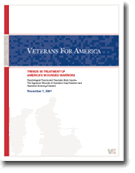
Released earlier this month, the Veterans For America 24-page Trends in the Treatment of America's Wounded Warriors report examines both psychological trauma and traumatic brain injuries. From VFA:

VFA investigators have visited every demobilization site in the United States and overseas, where they have monitored the quality of treatment, family support, rehabilitation, and other services that should enable a wounded servicemember to readjust to civilian life.

VFA has found that medical care for mental health and TBI is often inadequate or poorly delivered, and when a servicemember is discharged, decisions are often made by the military that negatively affect veterans for the rest of their lives.

VFA has also found that little consideration is given to TBI or PTSD in the military justice system despite the fact that these wounds are known to cause improper behavior. Lack of capabilities to treat these injuries, inadequate adherence to the Congressional inquiry process, and the inability or unwillingness to treat PTSD and TBI as wounds of equal legitimacy as physical injuries are some problems that require improved military leadership.

This report incorporates VFA investigative findings with open-source DoD and other reports and articles to provide a comprehensive picture of the state of care for America’s wounded warriors.

Click on 'Article Link' below tags for more...

In the interest of education, a few snippets of report below.

Continuing:

Almost 1.6 million American service members have deployed to OIF and OEF, and over 525,000 have deployed more than once. The demographics of these men and women are fundamentally different from those who served in America’s previous conflicts. The average age of an active component service member deployed since September 11, 2001, is 27, and the average age of someone serving in the National Guard or Reserves in Iraq or Afghanistan is 33. In contrast, the average age of an American service member serving in combat in Vietnam was 19.

Most service members in previous wars were single men who deployed only once. Today 60 percent of those deployed have family obligations; ten percent of those deployed are women; 16,000 women who have deployed are single mothers. As of October 29, 2007, at least 3,839 U.S. service members have died in Iraq and 453 U.S. service members have died in Afghanistan. Tens of thousands of service members have suffered physical wounds. Hundreds of thousands more have sustained mental injuries and/or mild traumatic brain injuries, many of which have not been properly diagnosed.

Of those who have given their lives in OIF or OEF, 47 percent have left spouses and/or children behind. Two hundred and twenty-nine thousand veterans of OIF and OEF sought treatment from the Department of Veterans Affairs between 2002 and December 2006. According to military mental health experts, if current trends continue, over 75 percent of Soldiers and Marines in Iraq will be in a situation where they could be seriously injured or killed. Nearly two-thirds of them will know someone seriously injured or killed.

Thirty percent of Soldiers and Marines in high combat situations (those who spend over 56 percent of their time off base) will develop a mental health problem, such as depression or post-traumatic stress disorder (PTSD); for members of the National Guard, the rate rises to 49 percent. A crisis in the DoD mental health treatment system compounds these problems. ...

Members of the Guard and Reserve who have served in Iraq and Afghanistan also deserve special attention. Our country never expected to use these troops as heavily as we have in Iraq and Afghanistan; consequently, after having been deployed, sometimes multiple times, these troops are experiencing rates of mental health problems 44 percent higher than their active duty counterparts. Based on available evidence, VFA believes that a considerable percentage of members of the Guard and Reserve have undiagnosed—and hence untreated—service connected TBI’s.

Since our country did not expect to use these service members to the degree that we have, we do not have sufficient programs in place to help these service members when they come home. Among other disconcerting signs, when compared to active-duty service members, members of the Guard and Reserve are half as likely to file a VA claim and are twice as likely to have their claim rejected. Urgent action is required to ensure that the service-connected mental health and TBI needs of these warriors are met.

Women comprise about 10 percent of the U.S. force in Iraq and Afghanistan. This is markedly higher than has served in previous U.S. conflicts. For instance, women comprised less than 0.01 percent of U.S. forces in Vietnam. In addition, more than 16,000 single mothers have served in our recent wars. These new realities are, again, challenging existing DoD and VA structures. For instance, the VA only has two inpatient facilities devoted solely to treating service-connected PTSD for female veterans.

Download full report [pdf].


 Related Posts

Labels: , , , , , , , ,

Thursday, November 29, 2007

Losing Inches: Heavy Gear Compressing Veterans' Spinal Disks

While not PTSD-related, quite interesting information on how combat is changing the physical body of troops. From the St. Paul-Minneapolis Pioneer Press:

After 16 months in Iraq, Minnesota National Guard members who came home this summer expected aches and pains. They did not expect to shrink.

Brian Hesse figures he lost an inch or so - a consequence of the heavy body armor and the gear he toted on convoy and security missions. The armor alone weighed more than 30 pounds. And then there was the 4-pound helmet, the 7.5-pound loaded M-4 rifle, the 10 pounds of extra ammunition and other necessities.

"I shrunk," the 25-year-old from Minnetonka said, "and got a bit wider. It's like my body said, 'OK, I need a wider base.' "

It's no myth. Some returnees and their doctors agree they did get shorter - if at least temporarily. The 60 to 90 pounds of gear around their torsos, shoulders and heads likely caused their spinal discs to compress, making the soldiers shorter and causing back pain.

Guard officials expected the 2,600 members of the state's returning 1st Brigade Combat Team to suffer from a host of physical ailments. While less dramatic than gunshot wounds or brain injuries caused by blast exposures, musculoskeletal injuries are easily the most common health problems for Iraq returnees.

"A good chunk of what we're seeing is actually overuse that we would really anticipate would get better in a short period of time," said Dr. Michael Koopmeiners, who directs community clinics for the Minneapolis VA Medical Center.

The key question , now that returnees have been home for three months, is how many are in fact developing chronic problems and how many are getting better.

Click on 'Article Link' below tags for more...

In the interest of education, article quoted from extensively.

Continuing:

About 1,300 Minnesota National Guard members returned home from Iraq and Afghanistan before the return of the 1st Brigade Combat Team. Of those, 716 were referred for health care services after completing their reassessments, according to the Minnesota National Guard. The majority reported "nagging injuries" to their joints and muscles, the Guard reported.

Nationwide, more than 96,000 National Guard members and reservists have completed reassessments since October 2006, and 49 percent reported health problems unrelated to combat wounds, according to the U.S. Defense Department.

Low back problems are most common, Koopmeiners said, followed by neck, shoulder, knee and ankle injuries. The risk appears even greater for the 1st Brigade Combat Team, whose 16-month deployment in Iraq is the longest of any U.S. military unit. Research has shown that deployment length increases injury risk.

"The longer they're deployed," Koopmeiners said, "the more likely that they have injuries, especially to the musculoskeletal system." ...

The high number of returnees with joint and muscle pain poses two questions for military leaders.

First, there's the age-old question of combat load: Body armor and weapons may be getting lighter, but the net weight isn't changing much. Many soldiers are now wearing extra armor plates to protect their sides, throats and groins.

A 2004 study of an Army unit in Afghanistan estimated that riflemen were carrying equipment that equaled 36 percent of their body weight during combat and 55 percent of their body weight during patrols. The recommended load is no more than 30 percent of body weight.

Some soldiers using mortars or heavy weapons carried nearly 100 percent of their body weight at times, the study found.

"Can you imagine walking around carrying yourself, all the time, day in and day out?" asked Charles Dean, a retired Army colonel who led the study. "It would definitely have an impact."

Second, there's the question of lasting injury: Will muscle and joint pains heal with time? Or will they become chronic? Guard officials are hoping the health screenings and reintegration events persuade returnees to confront physical problems before they are aggravated. Even if pain goes away, it could resurface in the future.

"That's one of those things we're going to notice again five or 10 years down the line," said Maj. Gen. Larry Shellito, adjutant general to the Minnesota Guard. "That's why I would like for us to deal with it up front."

Wartime operations put soldiers in awkward positions, said Michelle Peterson, a physical therapist at the Minneapolis VA. Patients include machine-gunners who sat in uncomfortable turrets atop vehicles and infantrymen who pointed their weapons in ready positions for hours.

VA therapists also speculate that Iraq's sandy, loose terrain contributed to back problems because it was poor footing for the weighed-down soldiers.

Peterson has treated many soldiers who ignored their pain and injuries while in Iraq. She understands their thinking - not wanting to be held back from duty while their buddies and units are fighting - but said the choice can have a toll.

"When you're active duty, you might view pain as a weakness," she said. "So you don't admit to having pain, and by doing that, you further injure yourself."


 Related Posts

Labels: , , , , , , , , ,

20/20: ABC News Uncovers Soldiers and Drugs Story

Mental health experts say that a correlation -- a comorbidity -- exists between PTSD and drug abuse. In that vein, tomorrow night on ABC News, 20/20 covers the issue of some of today's soldiers turning to drugs, as some had in the Vietnam, to ease the experience of war. Throughout the week, the network's chief investigative correspondent, Brian Ross, and his counterparts have begun sharing some of the data and stories they collected over the past few months:

In the third year of a joint project with the nonprofit Carnegie Corporation, six leading graduate school journalism students were again selected to spend the summer working with the ABC News investigative unit.

This year's project involved an examination of whether, as happened in the wake of the Vietnam War, Iraqi war veterans were turning to drugs as a result of the trauma and pain of war. The U.S. military maintains the percentage of soldiers abusing drugs is extremely small and has not increased as a result of Iraq.

The students' assignment was to get the unofficial side of the story from soldiers, young men of their own generation.

An introduction to the investigation:


Click on 'Article Link' below tags for more...

For educational purposes, articles quoted from extensively.

From High at the Mountain Post, the first installment in this week's series of ABC News reports:

They were prepared for war. They were prepared to die for their country. But Fort Carson soldiers say they weren't prepared to come home and fight a different battle -- addiction to illegal drugs.

Many of this country's bravest men and women who volunteered to defend America in a time of war have come home wounded -- physically and mentally -- and are turning to illicit drugs as they adjust to normal life, according to soldiers, health experts and advocates.

"Lots of soldiers coming back from Iraq have been using drugs," said Spc. William Swenson, who was deployed to Iraq from Fort Carson. "Right when we got back, there were people using cocaine in the barracks; there were people smoking marijuana at strip clubs; one guy started shooting up," he said.

Fort Carson, just outside Colorado Springs, is home to 17,500 active duty personnel. Four thousand eight hundred service members are currently deployed in the "sand box," as soldiers call Iraq and Afghanistan. ABC News spoke to more than a dozen soldiers who described widespread abuse of illegal drugs at Fort Carson by service members back from the war. ...

Fort Carson's leadership declined to discuss substance abuse issues with ABC News despite numerous interview requests. Fort Carson also said it could not comment on the individual cases of the soldiers we interviewed, citing privacy concerns.

In interviews with ABC News at the Pentagon, however, the U.S. Army strongly denied there was an increase in drug abuse among soldiers deployed to Iraq. According to Dr. Ian McFarling, acting director of the Army Center for Substance Abuse Programs, less than one half of one percent of soldiers in Iraq have tested positive for illegal drugs.

"That's a testament to the kind of leadership we have is that they believe that that's not the place that they should be doing drugs," said Dr. McFarling.

But Dr. McFarling said that once soldiers return from Iraq, the positive rate for drug tests doubles to more than one percent. In addition, Dr. McFarling said five percent of soldiers back from Iraq seek help for substance abuse issues from clinical providers.

The U.S. Army does offer treatment for soldiers dealing with drug abuse, and Fort Carson has a busy Army Substance Abuse Program. But some soldiers are forced off post because Fort Carson offers no inpatient services; others get treatment in the community to avoid the stigma associated with seeking help, soldiers and advocates said.

Since the Iraq war started in 2003, Colorado Springs hospitals and counseling services have seen a dramatic increase in active duty soldiers seeking treatment for substance abuse. Penrose-St. Francis Health Services went from treating no active duty soldiers for substance abuse before the war to between 30 and 40 now, said Phillip Ballard, the hospital's inpatient psychiatrist.

According to Ballard, "Now that we have larger numbers than the military facilities can treat…it falls upon the civilian community to treat those patients."

Veterans' advocacy groups charge that the problem of substance abuse is much greater than the Army wants to publicly acknowledge, and it's growing. "I've met with veterans from coast to coast, and I will tell you that there is a catastrophe on the horizon," said Paul Sullivan, director of Veterans for Common Sense.

Three thousand fifty-seven veterans of the Iraq and Afghanistan wars were potentially diagnosed with a drug dependency from fiscal year 2005 through March 2007, according to figures provided to ABC News from the Veterans Health Administration. From 2002 through 2004, only a total of 277 veterans were diagnosed with drug dependency, the numbers show.

From Part Two, Tale of Three Medics:

When Spc. Matthew McKane listens to questions, he tilts his head to one side. When he answers, his speech is plain and matter-of-fact. A boyish grin occasionally creeps across his doughy cheeks and plays at the edges of his mouth, like a kid who got caught sneaking a cookie.

If only it were that simple. As a medic in Iraq, the 22-year-old McKane saw the ravages of war firsthand and found he couldn't deal with it. McKane said he turned to self-medication by using drugs to numb the senses, and he was not alone. Now McKane fears he will soon be discharged from the Army because of his drug use. Another medic, Spc. Jeffrey Smith, has already been kicked out for drug use and other misconduct charges and says he is dealing with his psychological trauma without medical or veterans' benefits. And yet another Army medic, Sgt. James Worster, is dead from a drug overdose in Iraq.

Their stories are not unique. Many soldiers turn to drugs as a way to cope with psychological trauma from the war, according to advocates, health professionals and combat veterans. "I guess the stress just overpowers your decision making. You just [need] a little bit to get away from reality," McKane said. "You make stupid decisions."

He arrived in Baghdad in June 2006 and a day later was working in the emergency room.

His first patient was an elderly Iraqi woman who had been shot in the kneecap by a .50-caliber machine gun that "basically like blew her whole bottom leg out," McKane said. McKane's friend and fellow medic, 26-year-old Jeffrey Smith, described the setting as "complete insanity." ...

Smith said to escape from the daily chaos and stress, if even for a short time, many soldiers working in the hospital began to abuse Ambien, Percocet and Prozac, as well as prescription painkillers available on the black market in Baghdad. But eventually even those drugs weren't enough for some.

On Sept. 18, 2006, McKane said he and fellow medic Sgt. James Worster decided to use propofol, a powerful general anesthetic used to keep patients knocked out while on life support.

"[It was] us just being stupid, and just trying...a different coping mechanism, dealing with stress," McKane said. "All I remember is we passed out. And I remember waking up like hours later and looking over at my friend, just to see, you know, just to talk to him about the whole thing. And I noticed he wasn't on his bed anymore, and he was on the floor laying on his back."

Worster was dead from an overdose of propofol, McKane said. According to McKane, "All I remember is me standing up there after it happened…getting the glares from everybody in the hospital. I felt like I was never going to make it out of Iraq…I felt the only way to get out was to commit suicide."

It was Worster's second tour in Iraq, his widow Brandy Worster, 26, said. In between his deployments, Brandy said her husband saw a psychologist two to three times a week and took an antidepressant medication.

"He had a lot of problems from the first time [in Iraq] he never really got over," Brandy said. "[He] dealt with things from children that were our son's age to adults, whether it was Iraqis or other soldiers, probably seeing the worst he's ever seen."

Brandy blamed her husband at first, she said, but eventually the blame turned to acceptance and a need to move on. She said she tries to "give good memories" to their son, Trevor, who will be four years old this fall.

"I can understand why soldiers sometimes take something, so [they] don't have to think about it," she said. "They're having to deal with all of this and not have any ways to combat what they are seeing."

From Part Three, Hidden Wounds Lead to Drugs:

As more U.S. service members return home from Iraq and Afghanistan after witnessing the horrors of war, more will turn to drugs and alcohol to cope. That's according to mental health experts who say there is a strong correlation between Post-Traumatic Stress Disorder, or PTSD, and substance abuse. PTSD is an anxiety disorder that afflicts people who have been through a traumatic event.

Dr. Phillip Ballard, a psychiatrist at Penrose-St. Francis Health Services in Colorado Springs, Colo., said he has seen a significant increase of soldiers from nearby Fort Carson seeking inpatient treatment for substance abuse.

"PTSD has as part of its core diagnosis the use of substances as self-medication for the relief of depression, anxiety, whatever feeling they may have," Ballard said. "Sometimes it's considered to be a weakness or a less than manly thing to ask for assistance or ask for help so they do the best they can do with what they have available...they use the chemicals and drugs they've used in the past to numb feelings up."

Between 30 and 50 percent of people with post-traumatic stress disorder will also abuse substances, according to Ballard. As many as half of all PTSD patients treated in the Veterans Health Administration also have a substance abuse problem, according to the Department of Veterans Affairs' own information.

That is potentially a big concern since as many as one out of every four soldiers, or 28 percent, in combat brigade teams could be at risk for developing PTSD, according to a Department of Defense Task Force on Mental Health report from June 2007. Almost 40 percent of soldiers who have returned home report psychological symptoms, according to the report.

Col. Elspeth Ritchie, the psychiatry consultant to the U.S. Army Surgeon General, acknowledged that post-traumatic stress is a risk factor for the abuse of drugs and alcohol, but said that the Army has not been able to quantify how strongly the two are linked. The Army maintains that there has been no increase in the rate of illegal drug use among soldiers since the beginning of the wars in Iraq and Afghanistan.

ABC News was able to interview numerous U.S. service members who say they turned to drugs to help cope with their PTSD symptoms.

Gamal Awad, a former major in the U.S. Marine Corps, said he smokes marijuana to help cope with PTSD. Awad was first diagnosed with PTSD by a Marine psychiatrist after the 2001 attack on the Pentagon during which he said he picked severed limbs out of the rubble. Despite the diagnosis and his ongoing treatment for PTSD, Awad was still deployed to Kuwait and Iraq, which he said made his condition much worse.

"I was having suicidal thoughts...I would go out on convoys with the purpose to die. I just wanted to be hit by an IED or get shot. We'd get hit with, you know, mortar rounds or rockets, I wouldn't take cover. I would just stand there," said Awad.

Awad said military doctors prescribed him a range of antidepressants and sleep medication, but he fell into a spiral of depression and misconduct that led to his discharge from the Marines. A civilian doctor then prescribed marijuana, which is legal in California for medicinal use, to treat Awad's PTSD symptoms.

"It's the one thing that's given me some sort of peace, some sort of sleep for more than three or four hours, and it's medical marijuana," Awad said. ...

Col. Ritchie said she was unaware of cases of soldiers turning to drugs to cope with the trauma of their experiences in Iraq. "That has not been my experience," said Col. Ritchie. "My psychiatrists and social workers who see soldiers report to me of their experiences with soldiers all the time, and none of them are seeing that particular explanation."

Col. Ritchie said in her experience, soldiers more commonly turn to drugs to recreate "the intensity, the adrenaline high" that they got during combat.

Psychological trauma and drug use, however, are nothing new for combat veterans, said Steve Holsenbeck, a former psychiatrist at Fort Carson who served in the military from 1973 until 1993. Many of this nation's homeless are veterans of previous wars who are still grappling with psychological issues from their service, he added.

"I suspect we'll see a lot of what we continue to see from Vietnam," Holsenbeck said. "I think it's going to look exactly like it looked then and like it looked after the Crimean war and after probably the battles between Spartans and Athenians. You're going to see people who are veterans, who came back; everything piled up on them; they got addicted to alcohol or drugs, lost their employment; they lost their families; they end up on the street."

Follow links for each article to read them in full, and to access a variety of multimedia presentations that go along with each story.

Be sure to watch 20/20 Friday night for more.

Related Posts

Labels: , , , , , ,

Wounded and Waiting: Videos that Bring Sacrifice to Light

Kathie Costos has created another series of bracing and poignant videos along with a new PTSD group on YouTube for anyone wishing to share related multimedia clips. These videos are heartfelt tributes that reflect the real burdens and costs of war borne by the individuals who fight and the military families who support their warriors. As such, please bear in mind that they may be difficult for some especially close to the situation to view.

Kathie Costos' Wounded and Waiting, Part I:


Click on 'Article Link' below tags for more...

Wounded and Waiting Part II:


This next video is for the song 'Fall In/Wounded Soldier' from singer/songwriter Melanie Dekker's CD, 'Revealed':


And, lastly, a tribute video to all of the soldiers and their sons and daughter, set to the tune 'Son of a Soldier':


 Related Posts

Labels: , , ,

Wednesday, November 28, 2007

Upcoming House Veterans' Affairs Committee Hearing on Veteran Suicide and Homelessness

Passing along word of an important hearing to be held by the House Committee on Veterans' Affairs at 10 a.m. on December 12, 2007. I have been asked to testify before Congress to discuss Stopping Suicide and Ending Homelessness: Mental Health Challenges Within the Department of Veterans Affairs, and have accepted the generous invitation.

Will pass along further details as I have them on related Washington, D.C. events we are planning.

From the Committee's press release:

Chairman Bob Filner (D-CA) announced that the House Committee on Veterans’ Affairs will hold a hearing to examine current mental health care available to our nation’s veterans by the Department of Veterans Affairs (VA). The hearing will focus on two recent reports: a National Alliance to End Homelessness study which showed that one out of four homeless are veterans and a CBS News report that found the rate of suicide among veterans is double that of the general population.

“These two reports only highlight what we do not know about our veterans,” said Chairman Filner. “I think the report on homeless veterans underestimates the reality of the number of America’s heroes that are on the street tonight. The tragedy of homeless veterans is that we know what we need to do to prevent it, but neither the military nor the VA bureaucracy is ready to do this. What is worse is that we know the repercussions of not acting.”

The hearing will focus on recent statistical data from private sources as a platform to discuss comparative data from the VA on these issues. Witnesses invited will include members of the media, scholars from the mental health care profession and representatives from the VA. The hearing will take place in December.

Click on 'Article Link' below tags for more...

Continuing:

“One homeless veteran living on the street is one too many,” said Mike Michaud, Chairman of the House Veterans’ Affairs Subcommittee on Health. “VA has very good homeless veterans programs, but the need is still great. We must understand the factors, including mental health and Post-Traumatic Stress Disorder, that cause veterans to represent a disproportionately larger segment of the homeless population in our country. We must find solutions to get these heroes back on their feet.”

“When we hear a report that the suicide rate for veterans is double that of the general population, and that the Department of Veterans Affairs isn’t even keeping track of the problem, clearly we need to ask some serious questions,” said Harry E. Mitchell, Chairman of the Oversight and Investigations Subcommittee. “Our veterans deserve better, and so do their families.”


Related Posts

Labels: , , , , , ,

Christian Science Monitor's In-depth Military Chaplain Series a Worthy Read


A really informative 6-part Christian Science Monitor series is soon coming to a close, and well worth a read. For those who grew up in the era of M*A*S*H, who can forget the soothing salve of the unit's beloved Father Mulcahy?

These important caregivers are much-need, but unfortunately severely-strained (each deployed chaplain has a client base of about 1,000 troops to minister to). These professional souls do some of the most exigent work providing comfort and support in and out of the field to our warriors. Wonderful to see this work appreciated and recorded by CSM:

They carry no guns, yet US military chaplains are considered a force multiplier in the war theater. Today, in Iraq and Afghanistan, the military expects chaplains to meet the spiritual needs of troops. But it also recognizes their importance in everything from counseling the young soldier crying in his bunk over a Dear John letter to being a leveling moral presence among troops trained to fight and kill. Reporter Lee Lawrence spent three months with dozens of military chaplains in Iraq and Afghanistan. She profiles six of them in a weekly series.

Click on 'Article Link' below tags for series snippets...

In the interest of education, article quoted from extensively.

From Part I:

[Navy Chaplain Michael] Baker found himself navigating far more difficult waters. Word came that a 20-year-old lance corporal had committed suicide. He shot himself with his M-16 rifle while on duty at one of Habbaniyah's guard posts. Baker got there right away. While the doctor tended to the victim, the chaplain focused on the other young marine on guard, who was ricocheting from shock to grief to what Baker terms the "would'ves, should'ves, could'ves."

When Baker went to the guards' barracks that evening, he found three of the young man's closest friends reeling from another shock. As Baker recounts the event his delivery is clipped, his eyes stern: A senior noncommissioned officer had visited the guard detachment and told them they could get through this and needed to realize that their deceased comrade was right then burning in hell. "[They] basically had this bombshell dropped on them," says Baker, whom the marines collared, wanting to know whether their buddy was truly in hell.

The chaplain was "flabbergasted" at the NCO imposing his religious views. Like all military chaplains, he must negotiate a volatile no man's land between church and state by serving as clergy in a secular institution. As such he is the military's "subject matter expert on religion," an authority he needs to exercise without imposing his own religious views on others.

The case here was clear: The marines approached him for his opinion. And he gave it to them in the hope that it would mitigate their hurt.

"From my understanding, God did not make any of us on earth the ultimate judge, jury, and executioner," he told them. "And if I am correct, I should be the only theologian attached to this Marine unit.... Ultimately, God is your friend's judge," declared Baker, who rebelled against the fire and brimstone approach of his childhood church and chose the Methodists' God of grace.

While chaplains are not to proselytize, they are however charged with imposing their "prophetic voice" and calling to task those, regardless of rank, who act immorally, unethically, or otherwise destructively. Chaplains pragmatically pick their battles. Though Baker believed the battle in the guards' quarters that day was important, he stated flatly afterward, "I am waiting to cool down a bit. I am still sort of simmering."

Far more pressing, was the question: What kind of memorial, if any, should mark the young man's passing? "The Marines are very code-of-honor driven," said Baker, "and for somebody to take his life, it's outside the code."

The ramifications become apparent in the days following the suicide. Two marines in "battle rattle" – helmet, antiballistic sunglasses, bulletproof vest – manning a checkpoint at one of the entrances to nearby Fallujah know about the suicide and express the kind of ambiguous emotions Baker hears from many in the ranks.

"He deserves credit for signing up and coming out," says the taller of the two, his hands resting on the M-16 slung across his chest. "But it's tough being here – it's easier to pull the trigger."

They don't think their dead comrade should be awarded the honor of a marine killed in action. But asked if the unit should refuse any memorial at all, their heads snap up. "He deserves something," the tall one says adamantly. His mate nods in agreement.

Back at Habbaniyah, outside the small guard booth at the main gate, Lance Cpl. Brandon Jones voices another view. Behind him stretches the same brown landscape that his dead buddy, until recently, scoured for eight-hour shifts. Corporal Jones was the closest to the marine who died, but he hadn't picked up that anything was amiss. The suicide, Jones says, didn't alter the fact that his buddy was always the first to step up for a task and to do it double-time. Told that the memorial ceremony might be altered, Jones looks pained. "He was a good marine," Jones argues. "Once a marine, always a marine."

From Part II:

[Forward Operating Base] Salerno is on "light discipline." At night, soldiers open and shut doors quickly and, outside, use red flashlights, undetectable by Taliban in the surrounding hills. It's at this time – when stars by the hundreds pop out of the pitch-black sky – that the phone room is at its busiest. Soldiers line the long narrow space, chairs pulled up to open carrels, heads tilted forward in attempts at privacy.

Here, anger often spits out through clenched teeth. The person in the next carrel may not hear but, at the other end, the words come through clear and hurtful.

[Capt. Shareen] Fischer recalls a paratrooper who sought her out because "he'd been talking really rough to his loved one ... degrading her. He started to see her self-esteem go down," and the relationship grew increasingly tense.

Fischer says she reminded him that "this is a critical time: She's taking care of the children and trying to keep everything stable back in the rear. You need to encourage her and praise her." As the soldier changed his tune, the tension eased and the relationship improved.

Because the Army assigns chaplains to a unit rather than a base, Fischer spent two years with the battalion before deployment. "That comes in handy," she laughs, "because I'm building relationships with the paratrooper, the spouse, the children, the dog – everybody!"

But, in deployment, she only gets one side of every story. "So I'm only going to deal with that one side. 'What can you do? What changes can you make? Let's not focus on your spouse. Let's focus on you,' " she tells soldiers.

In the mess hall, in bunkers during a rocket attack, hanging out by the pool table, soldiers gripe about extended tours, and some deride decisions made in Washington. But it isn't despondency over the war or its prosecution that propels them to knock on a chaplain's door at 2 in the morning. It's the Dear John letter. It's news of infidelity. It's a wiped-out bank account because a girlfriend went on a spending spree to cheer herself up – "mall therapy" with the serviceman's checkbook.

The military has recognized this and, says Dennis Orthner, a professor at the University of North Carolina who researches military families, the Army in particular has "ramped up family support services, largely led by chaplains." Divorce among Army personnel – with the exception of female enlisted soldiers – has dropped since 2004, and he believes it's due in part to the Army's investment in families and "an enlightened chaplain corps."

The crucial area for couples, in his view, is communication. "Couple communication is what drives the relationship quality," says Professor Orthner.

This is where Oprah and military meet. A RAND Corporation report this year said the effect of marriage on performance and retention of service members "may have significant implications for national security." The key isn't whether service members are married, but whether their marriages are healthy.

Be sure to read the entire compelling series.


 Related Posts

Labels: , , , , , ,

VA Continues to Fall Behind in Claims Processing Time

From McClatchy News Service:

The Department of Veterans Affairs fell further behind this year in its attempts to give veterans timely decisions on their disability claims, new records show.

The latest numbers are in an annual report the VA prepares for Congress detailing a range of short- and long-term goals for its disability, health and other benefit programs. Overall, the agency either has fallen behind or has made no progress in improving its performance in more than half of what it lists as its key goals.

In the benefits measure the VA has said is ''most critical to veterans'' -- the speed of processing disability claims -- the agency lost ground for the third year in a row. Moreover, McClatchy has found that the VA put a positive spin on many of its numbers and in two instances provided Congress with incorrect or incomplete figures.

The agency said it took an average of 183 days to process a claim in fiscal 2007, longer than in any of the five years tracked in the report. Processing exceeded its 2007 goal of 160 days and its long-term goal of eventually reducing processing time to 125 days.

Click on 'Article Link' below tags for more...

In the interest of education, article quoted from extensively.

Continuing:

When it was asked about its processing speed last year, for example, the VA told McClatchy that hiring new workers would help it increase production and decrease its backlog of claims in 2007. In fact, processing time increased by an average of six days, and the backlog of pending claims rose from 377,681 to 391,257, the agency's records show.

The VA said this week that it was aggressively tackling the issue, hiring more than 1,000 workers, boosting overtime and revamping training. The agency also said it was receiving more disability claims than it had at any time in recent history, and that it had received more than it had expected in 2007. ...

In many sections of the report, the VA looks past the missed goals to put the best face on its efforts. The VA reports that 95 percent or more of outpatient visits are scheduled within 30 days of patients' desired dates, a fact it's touted to Congress repeatedly. The agency's inspector general, however, found this year that only 75 percent of the visits it examined took place within 30 days. The VA said it didn't agree with that finding and was examining the issue.

`TRANSPOSITION ERROR'

The VA also claimed that customer-satisfaction ratings by inpatients at VA hospitals are 10 points higher than ratings from private-sector hospitals. In fact, the number the agency used as a comparison is wrong, and as a result the advantage for VA hospitals is half as big as the VA claims.

The VA told McClatchy on Monday that the mistake was made by a "transposition error and we will be fixing that as soon as possible."


 Related Posts

Labels: , , ,

One Iraq Veteran's Mission to Help Returning Peers

From the Fort Worth Star-Telegram:

Joel Chaverri has seen combat, having participated in the 2004 attack on Fallujah, Iraq, the scene of some of the most bitter street fighting involving U.S. forces since Hue in Vietnam. He knows the readjustment that a young man must go through when he leaves behind that kind of carnage.

So when Chaverri left the Marines and returned to North Texas, he accepted a job with the Department of Veterans Affairs. His mission: to go out and tell young combat veterans that it's OK to ask for counseling.

"I tell guys, 'You don't have to have a PTSD diagnosis or have a disability rating,'" Chaverri, 25, said. "'You don't have to have a disorder.' Our brochures never use the word PTSD. We offer readjustment counseling."

Click on 'Article Link' below tags for more...

In the interest of education, article quoted from extensively.

Continuing:

Established in 1979, Vet Centers around the country cater to former service members who have either post-traumatic stress disorder or lingering problems related to their service. Anyone who reads Doonesbury will recognize what they do through the character named Elias.

The Vet Centers in Fort Worth and Dallas do not prescribe medication, and they are not affiliated with the Department of Veterans Affairs' medical system nor its mental health operation.

"We just do talk therapy," said Michael Coulter, the team leader of the Fort Worth Vet Center, an Air Force veteran and a licensed master's social worker.

Close to 400 veterans are receiving help from the Fort Worth Vet Center, most of them men in their late 50s to mid-60s who fought against the North Vietnamese and Viet Cong. But 25 percent of the new clients coming in the door are young veterans, back from campaigns against militants in Afghanistan or Iraq. That percentage is rapidly growing, and it's even higher in the six-state region encompassing Texas, where almost half of the new clients are young veterans.

Chaverri reaches them by going to National Guard and reserve units, university counseling centers and veterans service offices in a 52-county area of North Texas. Without an active-duty base nearby, he must be "creative" in reaching out.

"I never know where these guys are going to be," he said. "I have to make sure that the people the veterans are going to contact know about the Vet Center. ... Despite all the VA briefs I got coming off active duty, I never heard about the Vet Center."

The VA has hired 100 veterans of the conflicts in Afghanistan or Iraq to do the same for its 207 Vet Centers across the country, and it plans on hiring more in the coming years. Vet Centers have also added bereavement counseling for the immediate families of troops killed in action.

Vet Center locator.


 Related Posts

Labels: , , , ,

Tuesday, November 27, 2007

PTSD Researchers Ecstatic About MDMA?

This is another issue that's been floating around for a bit, but I'm only now getting to posting on it: PTSD researchers are now testing the efficacy of the hallucinogenic drug MDMA, or ecstacy, to treat post-traumatic stress. The Washington Post Magazine ran an article ("The Peace Drug") on the issue this past weekend:

PTSD is usually triggered by combat, rape, childhood abuse, a serious accident or natural disaster -- any situation in which someone believes death is imminent, or in which a significant threat of serious injury is accompanied by an intense sense of helplessness or horror. Not all or even most trauma victims develop PTSD, but enough do so that nearly 24 million Americans, or 8 percent of the population, have suffered from it at some point in their lifetime. It is estimated that in any given year, more than 5 million Americans have active PTSD -- a costly problem in humanitarian and economic terms. Drug and alcohol abuse are all-too-frequent consequences of PTSD, as is loss of productivity and the need for expensive, long-lasting medical treatment.

The ever-lengthening Iraq war will count among its other costs a legacy of thousands of veterans in need of psychiatric treatment. The government estimates that already more than 50,000 soldiers -- about 4 percent of those who have been deployed to Iraq and Afghanistan -- have been treated for symptoms of PTSD. Many more might actually have it: Military studies put the number at 12 to 20 percent of those returning from Iraq and 6 to 11 percent of those returning from Afghanistan. And the news gets worse.

"Vets with PTSD are particularly costly to the [Veterans Affairs] system," says Linda Bilmes, a lecturer in public policy at Harvard's Kennedy School of Government. "They constitute 8 percent of the claims, but 20 percent of the payments." Bilmes, who has studied the ongoing costs of the wars, estimates that treating Iraq vets with PTSD over the next 50 years will cost taxpayers $100 billion. This is based on findings that one-third of vets with PTSD will remain unemployable, and all suffering with PTSD will have a much higher than normal likelihood of needing treatment for physical ailments. And that's just the direct costs to the budget. "Assuming that the war continues, though with lower deployments, through 2017," she says, and assuming the rate of PTSD isn't being underreported, the cost of lost economic productivity to the U.S. economy will be in excess of $65 billion.

Click on 'Article Link' below tags for more...

In the interest of education, article quoted from extensively.

Continuing:

THE CAPSULES RESIDE IN A SAFE, armed with an alarm and bolted to the floor of Mithoefer's office, a 1950s-vintage cottage on the road between downtown Charleston and Sullivans Island. It's been tastefully remodeled to create a softly lit, high-ceilinged sanctuary in the back, scattered with art and furnished with, among other things, the ever-so-slightly inclined futon where Donna got crooked.

The elaborate security is occasioned by what is inside the capsules: MDMA, a synthetic compound that is a chemical cousin to both mescaline and methamphetamine. Unabbreviated, MDMA is a real mouthful -- 3,4-methylenedioxymethamphetamine -- but it is far better known by its street name, ecstasy, millions of doses of which are synthesized in criminal labs from the oil of the sassafras plant. At one point, Mithoefer recounts, agents of the Drug Enforcement Administration, there to inspect the security arrangements, inquired about the therapist who rents the office adjoining the safe room.

"I guess they were concerned she might drill through the wall into the safe and steal the MDMA," Mithoefer says. "Though there's such a small amount in there, and it's so readily available on the street in such large quantities, I don't see how that would be worth the effort, even if she were so inclined."

Mithoefer became a psychiatrist in 1991, after a decade as an emergency room doctor -- he had found himself less interested in the bodily traumas his patients suffered than the psychological traumas that so often preceded their appearance in the emergency room. He's got that mellow, empathic vibe that they just can't teach at therapy school. He always seems moments away from a sympathetic chuckle, an understanding murmur or a sage observation. A fit 61, with a brown ponytail and relaxed dress code, Mithoefer has become the accidental point man of a movement to revive medical research into psychedelic drugs. His Food and Drug Administration-approved PTSD study that began with Donna Kilgore in April 2004 is now nearly completed, with 18 of 21 subjects having undergone the double-blind sessions. Two Iraq veterans with war-related PTSD, the study's first, are cleared to begin. Close behind are similar studies in Switzerland and Israel. At Harvard's McLean Hospital, researchers are set to evaluate MDMA therapy as a way to alleviate acute anxiety in terminal cancer patients. In Vancouver, Canada, the effectiveness of an ongoing program to treat drug addiction with another potent psychedelic drug, ibogaine, is under scrutiny. There is a proposal, based on case histories, to study the ability of LSD to defuse crippling cluster headaches.

All of these studies are directly or indirectly funded by a surprisingly robust organization whose roots stretch back 40 years to the psychedelic movement of the 1960s. Before Harvard lecturer Timothy Leary started channeling aliens and urging college kids to turn on and drop out, an intense cadre of doctors and researchers had come to believe that psychedelic drugs would revolutionize psychiatry, providing those with a wide spectrum of psychological problems -- or even just ordinary life difficulties -- the ability to, basically, heal themselves.

But Leary's bizarre career, which morphed from doing research on psychedelics to cheerleading their widespread abuse, obscured whatever medical potential the drugs may have had. Instead, authorities focused on the risks, and often exaggerated them. Richard Nixon famously called Leary "the most dangerous man in America." After a slow start, regulators and legislators cracked down hard. Millions of dollars in enforcement efforts were unable to end abuse of psychedelic drugs, but they effectively stamped out sanctioned research into their healing potential.

A small group of psychedelic researchers and therapists willing to break the law continued their work clandestinely. A much larger group did not flout the law, but waited in the wings and is now emerging. Experience had convinced these therapists that psychedelics, along with significant risks, had potential for even more significant benefits.

This may have been especially true of MDMA. ...

THE PROMISE OF A BLOCKBUSTER TREATMENT, one that doesn't just address symptoms but defuses underlying causes, is a particularly seductive vision right now. A report issued last month by the National Academy of Sciences' Institute of Medicine emphasizes the uncertain effectiveness of current PTSD treatments, and the urgent need of returning soldiers who will suffer from it.

To a non-scientist, the very preliminary results of Mithoefer's study would suggest that MDMA might be just what the doctors ordered. Of the subjects who have been through both the MDMA-assisted therapy and the three-month post-experiment follow-up tests, Mithoefer reports, every one showed dramatic improvement.

But scientists are a cautious lot. "It's potentially nice to hear those things," says Scott Lilienfeld, an associate professor of psychology at Emory University. But until results are statistically analyzed and peer-reviewed for publication, "you can't really judge them. The plural of anecdote is not data." Especially with a drug that has considerable risk, Lilienfeld cautions, it pays to be skeptical.

A.C. Parrott, a psychologist at Swansea University in Britain who has devoted a large part of his career to studying the dangers of MDMA, is far more than skeptical. "MDMA is a very powerful, neurochemically messy and potentially damaging drug," he says. The government "should never have given it a license for these trials. Certainly I would not give it a license for any further trials."

But one of the nation's premier PTSD researchers, Roger K. Pitman, a professor of psychiatry at Harvard Medical School, disagrees. Morphine is a powerful, potentially damaging drug, Pitman says, "and we use it to treat the pain of cancer patients. Sound medical reasons should trump."

Current treatment for PTSD is "partial at best," he says. "There's a lot of room for improvement, and we need to be looking for novel treatments."

Though Pitman calls the MDMA study "a fringe hypothesis" -- "I've never heard anybody talk about it at any PTSD meeting I've ever attended in 25 years" -- he also observes that, based solely on a description of the preliminary results, "this seems worth further study. A lot of new ideas meet with rejection and skepticism, and we need to be careful not to be prejudiced against something just because it seems wacky. If it has a 5 percent chance, or even a 1 percent chance, of being effective in treatment of PTSD, it's worth pursuing."

Read the rest.

Writer Tom Shroder had a follow-up online chat at WaPo:

Blacksbug VA: Tom,

I enjoyed reading "The Peace Drug" and I thought it was well-balanced. Having observed various aspects of the MDMA story over 30 years, what is your opinion on where it is going from here? For the sake of argument, let's assume studies demonstrate impressive efficacy in assisting psychotherapists to help treat PTSD. Can you see, for example, specialized clinics/training centers sprouting up across America in 10 years? Do you see the military (here and elsewhere) "buying in" to MDMA-assisted psychotherapy as an option for treating soldiers with PTSD? Or will MDMA remain "fringe" at best?

Tom Shroder: I think the key, as always, is what the scientific studies demonstrate. If the current phase II studies have very positive results, which they certainly appear headed for, and a many-times larger phase III study, with hundreds of subjects and dozens of therapists all across the country also demonstrated -- for the sake of argument -- spectacularly positive results, then yes, I do believe that MDMA would become part of the treatment arsenal for PTSD. If it works as some hope, the fact that very limited use of the drug -- a handful of sessions -- can effect lasting change in the underlying psyche of PTSD sufferers and untangle the knots that cause their symptoms would make it an extremely appealing option. But it's a long way from a phase II clinical study and that eventuality. There are very many drugs that appear promising in phase II studies only to falter later on.

_______________________

New York, NY: MDMA will be almost certainly be invaluable to thousands of people some day, but it does break my heart to see these initial guinea pigs getting the short end of the stick, with no chance of continuing treatment. I guess it's better than nothing, although the relapse rate over the years might end up being quite high for them -- making the study look bad -- when all it would take would be one or two treatments every other year for several years or so and they might be cured.

Is there any provision in Dr. Mithoefer's study to follow these people over the years, to observe how they fare? Or are they waiting until Phase III trials to do that sort of thing?

Tom Shroder: A followup on the subjects who have been through the study so far is happening now, which means that some subjects have been post-treatment for more than three years, Donna Kilgore in the story was subject 1, so she's been the longest. And she was only allowed two treatments -- the study was since modified to allow three MDMA treatment sessions.

_______________________

Amherst, Ohio: The VA for years has been looking for a miracle cure for PTSD to erase the money spent for PTSD claims, do you fear as I do this might be looked at for just that purpose?

Tom Shroder: First of all, the VA and the Pentagon have had nothing to do with this research. But to the larger point of your question, it seems to me a backward way of looking at it: The only reason this treatment would save the VA money would be if it actually works. Then that would be a very good thing, no? PTSD, as it became clear to me when I was interviewing the subjects mentioned in the story, is a particulary cruel disorder. When Donna Kilgore told me that she could put her finger on her arm and feel like she was touching a corpse, I nearly wept for her right then and there. So making them feel whole again is a very good thing indeed. And Spending less tax money on people who are cured -- also very good thing..

_______________________

No VA: I'm curious to know if there are any follow-up studies on the long term effects of the use of these drugs? Especially with large numbers of young soldiers returning from Iraq and Afghanistan, we have to ask not just if the benefits of these drugs will outweigh the suffering in the short term, but also if they will need long term treatment, and what that might mean for their health.

Tom Shroder: This is an important issue, and it emphasizes what Dr.Mithoefer always cautions: Phase II trials are very early in the process of determining if a drug is beneficial. In the case of MDMA, if it proves effective, then it will take years to determine the best way to use it -- and how treatment with MDMA will unfold over the years. Will some people be cured outright and forever? Will periodic MDMA sessions be necessary to maintain the benefits? Could unforseen problems arise with long-term therapeutic use? None of these questions have even begun to be answered.

NPR also has an interview up with Shroder.

Meanwhile, Israel is conducting trials. And since 2005, researchers in South Carolina have been conducting this controversial research. From a February 2005 Guardian article:

American soldiers traumatised by fighting in Iraq and Afghanistan are to be offered the drug ecstasy to help free them of flashbacks and recurring nightmares.

The US food and drug administration has given the go-ahead for the soldiers to be included in an experiment to see if MDMA, the active ingredient in ecstasy, can treat post-traumatic stress disorder.

Scientists behind the trial in South Carolina think the feelings of emotional closeness reported by those taking the drug could help the soldiers talk about their experiences to therapists. Several victims of rape and sexual abuse with post-traumatic stress disorder, for whom existing treatments are ineffective, have been given MDMA since the research began last year.

Michael Mithoefer, the psychiatrist leading the trial, said: "It's looking very promising. It's too early to draw any conclusions but in these treatment-resistant people so far the results are encouraging.

"People are able to connect more deeply on an emotional level with the fact they are safe now."

Finally, the issue of trying to determine the efficacy of MDMA to treat PTSD has been around for a while, as witnessed by the following video featuring the late Peter Jennings of ABC News. [He and Bob Woodruff team up together for a 43-minute documentary on the subject, available here.] I don't have air dates for either, but they're informative and worthy of including.


Clinical information on MDMA/PTSD treatment.


Related Articles

Labels: , , ,

Monday, November 26, 2007

You Tube Speaks Out Again: Let's Help Our Vets

It may be long in coming, slow in arriving, but Americans are finally beginning to realize that our defenders can use some defending, too. And so, many are rising to the challenge and spreading the information, asking for others to join with us to care about our veterans. Gives me great hope, and though these are only videos, the sentiment behind them should shore up our courage to continue advocating for what's right.

These clips are varied, but the message is the same: America cares about you, and we're ready to cover your back dear soldier, sailor, airman and Marine. First up, an impassioned and informed call from Just A11en that has gotten a lot of views on YouTube and has raised awareness with many:


Click on 'Article Link' below tags for more...

But, of course, it's not just about awareness. It's also about action. There's no point in knowing about a problem, if you don't find something -- big or small -- to do to help fix it.

For each of us, that action item will be different. For some, it might be volunteering time at a local VA, for others it might be crafting poetry or film or music to spread the message of the great need that exists for more to come into the issue and help solve it.

It might be as simple as donating a few dollars to organizations that are doing the hard work of lobbying Congress and advocating for the needs of our troops. Or it might be sending out a care package or two.

Whatever it is -- just be sure to do.

The next few short clips are questions posted for the upcoming CNN YouTube GOP presidential debate. The first one, especially, is near and dear to my heart.

From warriortransition:


By pfknick:


This young lady, French Lops, is already way ahead of the curve:


Finally, a sweet and sexy shout-out to our troops by Ann Spade:

This was originally supposed to be a shout out to a Marine platoon who served in Iraq. I'm not sure if they are all still there, but I know one isn't for sure. GSgt. Kyle Swanson requested a special shout out around this time last year.

Though Kyle will never get to see the video, I wanted to create it in the same fashion I would normally... one that drew Kyle to my channel in the first place. I had so many things I wanted to do to make it more special and needed more time. As I learned (the hard way)... there is no "perfect" timing.

Thank you to everyone who served and are serving in our armed forces.


Related Posts

Labels: , , , , , , , , ,

Wounded Veteran Asked to Repay Sign-up Bonus? Call 800-984-8523

From Newsday:

Several New York veterans have been asked to repay part of their signing bonuses after war injuries prevented them from completing their tours of duty in Iraq and Afghanistan, Sen. Charles Schumer said.

Hundreds of veterans nationwide may have been affected by what the Army characterizes as a mistake, said Schumer (D-N.Y.), who along with lawmakers including Sen. Hillary Rodham Clinton (D-N.Y.) has called for legislation to guarantee that signing bonuses won't be reduced. ...

The issue surfaced earlier this month when a soldier who was partially blinded by a roadside bomb in Iraq told media outlets that the Army asked him to repay $2,800 of his $7,500 enlistment bonus because he had only completed about a year of his three-year service.

Former Pfc. Jordan Fox, 21, of Pittsburgh, received the bill in late October and a week later received a notice that he could be charged interest if he didn't make a payment within 30 days.

Click on 'Article Link' below tags for more...

In the interest of education, article quoted from extensively.

Continuing:

Army officials said the incident was a mistake, and told Fox he did not have to repay the bonus. Soldiers who are injured or become ill while on active duty can keep all sign-up bonuses due them, the Army said.

"This is an anomaly," Army spokesman Lt. Col. Rob Cain said yesterday. "It shouldn't have happened. It doesn't pass the common sense test."

The Army is conducting a review to determine how many wounded veterans have been asked to repay part of their bonus or have not received their full bonus. Cain said wounded veterans whose bonuses have been revoked should call the Wounded Soldier and Family Hotline at 800-984-8523 or e-mail wsfsupport@conus.army.mil.

"There is a policy in place to protect these soldiers," he said. "It's going to be corrected."

Interview with Jordan Fox, on FOXNews:


I've seen press reports of soldiers who've been given personality disorder discharges also being forced to repay their recruitment bonus. For example, from a January post on a Newsweek piece:

Many soldiers who sought mental health counseling after returning from Iraq, like former Spc. Donald Schmidt of Chillicothe, Ill., say they learned only after their discharge that they must repay part of their re-enlistment bonus based on the portion of time they did not serve — more than $10,000 in Schmidt's case.

While this issue does not fall under the PTSD category specifically, it does fall under something that I call disillusionment.


Related Posts

Labels: , , , , , ,

Sunday, November 25, 2007

Talking About Combat PTSD on the Suicide Prevention Show

I recently had the chance to sit down for a 30-minute interview with a local team of great hearts and minds, the hosts of The Suicide Prevention Show. The show airs this morning at 9:30 a.m. on WLBK-1360 AM [DeKalb County, IL]. It's also already available online, so everyone can listen in at their own leisure.

A big thanks to Citizen Mike, Chuck Siebrasse, and Tamara Sutton for making me feel welcome and for producing such an important community show for their listeners. They've had other informative guests on, so head over to their show archives if you can.

Labels: , ,

Saturday, November 24, 2007

Military Spouses Challenge Presidential Candidates to Attend February Veterans Issues Forum


Military Spouses for Change is a "non-profit, non-partisan organization created to promote the rights, interests, and needs of service members, veterans, wounded warriors, and military families by educating the public and empowering military spouses."

They are laying down a compelling challenge:

As much as individual presidential candidates talk about health care plans or personal values, the fact remains that we are electing a war president. We are electing a president who will probably spend the bulk of his or her first term managing military conflicts and performing extensive foreign policy damage control. In 2008, the next President will inherit at least two wars and the costs of those wars, internally as well as internationally, will continue to grow long after the last service member comes home.

Consequently, Military Spouses for Change is inviting the presidential candidates from both parties to Fort Hood, Texas (Killeen), on February 1st, to talk about foreign policy, our military, our veterans, our wounded warriors, and our military families. ...

This kind of event has never been done before and it needs to be done now. Not only because Americans on both side of the aisle need to be reminded (before Super Tuesday) that we are electing the next Commander-in-Chief, but also because our service members and their families deserve to be addressed and heard by the people who wish to be elected in that position.

Click on 'Article Link' below tags for more...

From the MSC press release sidebar:

This forum is NOT about being for the war in Iraq or against the war in Iraq. This is about the fact that there IS a war in Iraq (as well as Afghanistan) and there are CONSEQUENCES to that war--consequences for our service members, for their families, for our country. We believe the candidates should have to talk about how they plan to identify and deal with these consequences.

How do we help our military and veteran families receive the help they need emotionally, medically, and/or financially? What are our obligations and responsibilities to them as a nation once they have fulfilled their obligations and responsibilities to us? What can and/or should we be doing to help our returning warriors successfully reintegrate into peacetime society?

These issues need to be a part of the national discourse about the war in Iraq because the war in Iraq does not end when a service member comes home.

We would like voters all over America to be mindful when selecting their nominee for President that his or her choice will have a significant impact on the lives and well-being of millions of service members, veterans, wounded warriors, and military families, including children.

This Forum can help all of us, military, veteran, and civilian alike, make the most informed choice.

Continuing from the press release:

We also think this country’s large veteran community should know which candidates truly value the military and veteran vote (if not for moral reasons, then for practical reasons). There are approximately 1.4 million active duty service members in America and 1.2 million in the National Guard/Reserves. If you include the spouses, that comes to a total of 4.1 million votes.

Meanwhile, according to the U.S. Census Bureau, 1 in 8 adults were veterans (26.4 million) in 2003. If we assume that at least half of those adults were married, then we have approximately 39 million vet couples giving us a total of almost 43 million American adults who are currently serving in the military, have served in the military, or are married to someone serving or who had served. That is not an insignificant number.

As an organization and as military spouses, clearly U.S. foreign policy is important to us. But the American public has an interest in this as well, not only for fiscal reasons (e.g., we have spent 447 billion dollars on the war in Iraq alone), but for national security reasons. ...

What do the candidates propose to do for our returning wounded warriors and their families? How do we effectively identify their mental, physical, social, and financial needs and how do we effectively meet those needs?

The suicide rate is the highest in almost 30 years and the propensity to serve is at a 20 year low. Consequently, the Army and Marine Corps are relying on reenlistment and recruiting bonuses that will cost nearly 2.5 billion dollars next year.

Iraq is the defining electoral issue of 2008. Nothing can be done domestically until we have settled our foreign affairs in such a way that does not require a large military presence in hostile countries. Yet because Texas is not an early primary state, it does not warrant the attention of the Presidential candidates. Nonetheless, we cannot imagine an event more powerful than these candidates answering questions posed to them by the very people whose service and sacrifice allow forums such as these to exist.

Shouldn't we ascertain which candidates are the most qualified (from both parties) to lead our nation and our military prior to Super Tuesday? And shouldn't this be done in front of an audience of service members, veterans, wounded warriors, advocates, and their families?

If you have any questions or are interested in being involved, please contact:

Carissa S. Picard
President
Military Spouses for Change
csp@militaryspousesforchange.com

I, for one, would love to see this take place.

MSC has a handy bipartisan Candidate Comparison page, which includes links to each campaign's website. From there, it would be easy enough to check out where they stand on the issues, and then perhaps click over to a few (or all) to ask them to seriously consider participating in this first-ever forum.

Who will be the first to say 'yes' to our nation's military families?


Related Posts

Labels: , , , , , , , , , ,

USA Today: OEF/OIF Combat Traumatic Brain Injury Tops 20,000 Cases

In early January of this year, as the time for final editing of Moving a Nation to Care was quickly coming to a close, I was doing one last quick scan of my galley copy. Opening it to the Preface's first page, first paragraph, out jumped what was at the time a glaring typo: a sentence stating that 20,000 of returning Afghanistan and Iraq veterans had been diagnosed with traumatic brain injury.

The publicly available figure at the time was around 2,000, and you can imagine how quickly I got on the horn to my publisher to ask that we make sure to correct the error. What a difference a year makes. From USA Today:

At least 20,000 U.S. troops who were not classified as wounded during combat in Iraq and Afghanistan have been found with signs of brain injuries, according to military and veterans records compiled by USA TODAY.

The data, provided by the Army, Navy and Department of Veterans Affairs, show that about five times as many troops sustained brain trauma as the 4,471 officially listed by the Pentagon through Sept. 30. These cases also are not reflected in the Pentagon's official tally of wounded, which stands at 30,327.

Click on 'Article Link' below tags for more...

In the interest of education, article quoted from extensively.

Continuing:

The data came from:

• Landstuhl Army Regional Medical Center in Germany, where troops evacuated from Iraq and Afghanistan for injury, illness or wounds are brought before going home. Since May 2006, more than 2,300 soldiers screened positive for brain injury, hospital spokeswoman Marie Shaw says.

• Fort Hood, Texas, home of the 4th Infantry Division, which returned from a second Iraq combat tour late last year. At least 2,700 soldiers suffered a combat brain injury, Lt. Col. Steve Stover says.

• Fort Carson, Colo., where more than 2,100 soldiers screened were found to have suffered a brain injury, according to remarks by Army Col. Heidi Terrio before a brain injury association seminar.

• Marine Corps Base Camp Pendleton, where 1,737 Marines were found to have suffered a brain injury, according to Navy Cmdr. Martin Holland, a neurosurgeon with the Naval Medical Center San Diego.

• VA hospitals, where Iraq and Afghanistan veterans have been screened for combat brain injuries since April. The VA found about 20% of 61,285 surveyed — or 11,804 veterans — with signs of brain injury, spokeswoman Alison Aikele says. VA doctors say more evaluation is necessary before a true diagnosis of brain injury can be confirmed in all these cases, Aikele says.

Soldiers and Marines whose wounds were discovered after they left Iraq are not added to the official casualty list, says Army Col. Robert Labutta, a neurologist and brain injury consultant for the Pentagon.

"We are working to do a better job of reflecting accurate data in the official casualty table," Labutta says.

Earlier in the month, USA Today's Gregg Zoroya also reported on a disturbing trend related to the mission-driven and 'buddy, I have your back' mentality -- honorable qualities, to say the least -- of our troops fighting overseas. Apparently, these positive attributes may be making the job of TBI diagnosis a bit more tricky:

Troops in Iraq and elsewhere have tried to avoid being pulled out of combat units by cheating on problem-solving tests that are used to spot traumatic brain-injury problems, military doctors say.

New versions of the tests were sent into Iraq late last month to prevent the cheating, says Air Force Lt. Col. Michael Jaffee of the Defense and Veterans Brain Injury Center in Washington, D.C.

"With highly motivated individuals, be they athletes, be they our servicemembers in harm's way, there is a motivation to stay with the unit and stay on the job or stay in the game," he says. The tests, administered by medics in the field, are the military's primary means of uncovering subtle signs of brain injuries from exposure to blasts.

Reports of cheating began surfacing in Iraq during the summer, says Col. Brian Eastridge, a trauma surgeon who supervises medical care in Iraq and Afghanistan from his office in Baghdad.

Troops had obtained copies of an older version of the test and memorized key words used to gauge short-term memory, Jaffee says. Those who fail areas of the test undergo more sophisticated exams for diagnosing brain injury. If symptoms persist, soldiers are sent home. If symptoms get better in days or a few weeks, patients can be sent back into combat, doctors say.

At the Landstuhl Regional Medical Center in Germany, cheating was found in a handful of cases about four months ago, says Army Col. Stephen Flaherty, the hospital's chief of surgery. Landstuhl is where all troops evacuated from Iraq or Afghanistan suffering from illness, injury or wounds are delivered before going home.


Related Posts

Labels: , , , , , , , , ,

Two Years in the Life of One Returning Soldier

A detailed piece from the Dayton Daily News:

For two years Elizabeth Bowen watched her husband, Ryan, endure more than 40 surgeries, frequent nightmares and the devastating effects of Post Traumatic Stress Disorder. ...

It was Oct. 26 and Ryan already had been in Georgia for six weeks, much of it spent waiting for word from the Army medical board that would determine his level of disability for injuries he received when a roadside bomb exploded under his tank in Baghdad during his second tour.

The 24-year-old Army specialist had just said goodbye to friends heading to Iraq for a third tour. "Some of these guys I've known since the first time," he said. Back in his hotel room, his mind began racing. He started pacing, hyperventilating.

Then he began to cry.

Click on 'Article Link' below tags for more...

In the interest of education, article quoted from extensively.

Continuing:

Sept. 16, 2005

Bowen was the gunner in the last of three M1A1 Abrams tanks patrolling a dangerous section of Baghdad. "There are two guys behind the berm. Keep an eye on them," barked a soldier in the first tank.

The first two tanks passed safely. Bowen's didn't. He awakened in the dirt, pinned beneath a critically wounded soldier.

Bowen, a 2001 Tecumseh High School graduate, was seriously injured, too — with a lacerated liver and a compression fracture in his back. But he was aware enough to know he didn't have on protective body armor. And he had no weapon.

"I was thinking, 'I can't afford to get shot,' " he recalled. "I was talking to myself the whole time: 'You're going to live. You're going to live. Everything is fine.' "

Despite a large shrapnel wound to his left thigh, he was able to move behind a chunk of the destroyed tank. As he scanned for insurgents, his leg gave out. For 10 minutes, not sure of what was around him, he played dead. Finally, Bowen heard the voice of a soldier who had been in one of the other tanks. They'd returned to help the wounded. ...

Elizabeth had no training for what she was about to endure.

On the day her husband nearly died, she didn't hear from him for about 12 hours. When he finally called after 7 that evening, he was heavily sedated — and in Balad. There he underwent surgeries for a perforated liver and ruptured kidney, then spent 11 days at a military hospital in Germany. Elizabeth wouldn't see him again until he was moved to the U.S. Army Garrison at Fort Gordon, Ga.

His medical problems were far from over. His damaged liver developed pockets of infection, causing bile to leak into his stomach — a problem that initially went undetected. Feeling her husband would be better off home in Fairborn with family nearby, she worked to have him moved to Wright-Patterson Medical Center. ...

From that first surgery through this past July, Bowen underwent 40 surgeries at Wright-Patterson, an unusual arrangement given that Bowen isn't in the Air Force. "Normally, we would not see an Army person assigned to an Air Force facility for two years," said Lisa Kliebert-Witt, a public affairs spokeswoman for the 88th Medical Group at the base.

Even Col. Thomas Palmer, the medical center's deputy commander, got to know the young soldier well.

"He'd always come down there and ask if I needed anything," recalled Bowen, who was awarded the Bronze Star Medal and Purple Heart. "One day I was joking around about the little TVs because I couldn't see that good. My eyesight was blurry. And I woke up from one surgery and there's a big TV right there, with a remote."

But the two years Bowen spent moving toward medical retirement would be marked by frustration with long bureaucratic delays, missed Army paychecks and frequent changes in mental health doctors — many of whom would have to leave on their own overseas deployments.

Bowen and his wife would see the best of the military system and the worst. And military officials would see the worst of him.

As is often the case with severe injuries, PTSD also may rear its head. For Bowen, it was no different.

Bowen displayed classic symptoms: Trouble sleeping. Sudden anger or irritability. Difficulty concentrating. Nightmares haunted his sleep. In one recurring dream, he was being shipped back to Iraq and had to argue with his commanders that he couldn't go because he was injured.

Elizabeth said Ryan would sometimes go days without sleeping. Doctors prescribed Seroquel, a powerful sedative. He was also on antidepressant Zoloft. Even so, she watched him spiral into a deep depression. It fell to her to get him out of bed in the morning, and to make sure he was taking all his medications.

Bowen began drinking more, often during the day while his wife was in Springfield, where she worked as a pharmacy technician. "I never had nightmares when I was drunk," he explained.

Elizabeth's grandmother, Cyrena Henson of Fairborn, was disturbed by the changes she saw in Ryan. The "pleasant, happy-go-lucky person" she remembered had lost his sparkle.

Please read the rest -- there is much, much more.

Labels: , , , , , , , ,

Friday, November 23, 2007

Another Georgia Family Searches for Missing Iraq Veteran Son

[UPDATE December 1, 2007]: The female Oregon soldier, Sgt. Julie Stendahl, mentioned below has turned herself in to military authorities; she was, in fact, planning to stage her own disappearance. Additionally, another soldier, Raymond Roussel of Augusta, Maine has gone missing as well since this post was published. Details in extended.

It's Thanksgiving weekend, and at least one military family marks another year since their recently-returning Iraq veteran loved one has gone missing without a trace. Jason Roark, who I wrote about last year, is still missing following his November 9, 2006, disappearance.

Meanwhile, in Georgia again, another veteran, Gary Chronister, has gone missing. And in Oregon, a female soldier who was to deploy to Iraq at the end of October has gone missing, although one local newsroom has apparently gotten a reply to an inquiry they made to her MySpace page believe to have been made by her.

Please take a moment to pass along the details below (compiled from press accounts as linked) to others in online and offline communities you frequent; perhaps something can be turned up to help these families during a time of what must be much anxiety.

From the Atlanta Journal-Constitution and Macon Telegraph:

Georgia - Gary Leighton Chronister, 33

Missing since: Saturday, November 10, 2007, at 5 a.m.

Last known whereabouts: Chronister's mother believes Gary left the apartment they share on Lake Tobesofkee and headed straight up I-75 to Cobb County. On Monday night, her son's 10-year-old green Ford Ranger was found at a QuikTrip gas station on Cobb Parkway in Acworth.

Description and details: [photo] He is white, 6 feet 1 inch tall and about 250 pounds, according to a sheriff's office description. He may be driving a 1997 teal green Ford Ranger with a bronze section along the bottom and a Lake Wildwood sticker on a cracked front windshield. The Bibb County license plate number is AEW8427.

Chronister served in Afghanistan and Iraq, returning from Iraq in September 2003. Shortly after, his mental health began deteriorating. Before Iraq he was "a happy-go-lucky, fun guy. He was very engaged with his nieces and nephews," she said. After Iraq, he withdrew more and more. Lately he has been obsessed with "cleansing the toxins from his body. He felt the toxins caused his mental illness," Futrell said.

Contact: If spotted, contact police or the Bibb County Sheriff's Office at 478-746-9441. If found in the metro Atlanta area, he should be taken to the emergency room of the Atlanta VA Medical Center, 1670 Clairmont Rd., in Decatur.

Click on 'Article Link' below tags for more...

From FOX News and the Walton Tribune:

Georgia - Jason Roark, 26

Missing since: Thursday, November 9, 2006

Last known whereabouts: Captured on surveillance video at a Gwinnett County motel.

Description and details: [photo] The Special Forces soldier served two tours of duty in Iraq before he went missing. Roark was an assistant manager at Snellville's Texas Roadhouse and had phoned his mother the day before his disappearance to tell her about an upcoming promotion he was excited about.

Contact: A trust fund has been set up to help locate Jason and to pay a reward for anyone who has information that helps locate him. Contributions to the reward fund can be made by contacting Westside Bank at 770-445-1855 ext. 301. Anyone wishing to find out more about the case or to pass on any information can go to info(at)TexasEquuSearch.org or by phoning 1-877-270-9500, Gwinnett County Police at 770-513-5347 case number 06-11-8592 or private investigator Bob Poulnot at 770-995-1275.

From WCSH - NBC Channel 6:

Maine - Raymond Roussel, 27

Missing since: Monday, November 26, 2007

Last known whereabouts: Seen driving away from his Augusta home.

Description and details: [photo]
Roussel served in Iraq and lived next door to his parents in Augusta.

Contact: If spotted, contact the Augusta police department at 626-2370


Related Posts

Labels: , ,

Veterans Service Organizations Praise Democratic Congressional Leadership

From Stars and Stripes:

Veterans service organizations are thrilled with a $43.1 billion appropriations bill that Congress is set to pass next month for the Department of Veterans Affairs.

The funding level for veterans programs and facilities is almost 20 percent higher than demoralized Republican leaders left behind a year ago. The $6.9 billion increase will allow VA to hire 1,800 more claim processors, beef up medical staffs and modernize long-neglected hospitals and clinics.

“I can’t praise the Democratic leadership enough for what they’ve done with addressing the budget that was handed to them the day they took office,” said Steve Robertson, legislative director for the American Legion.

The 109th Congress adjourned last December without passing a VA appropriations bill. It left the department operating under a “continuing resolution” with VA spending frozen at its fiscal ’06 level. In taking control of the 110th Congress, Democrats immediately raised VA funding for fiscal 2007 by $3.5 billion. They then turned to veterans groups for guidance on setting the VA budget for ’08.

Click on 'Article Link' below tags for more...

In the interest of education, article quoted from extensively.

Continuing:

As usual, four major organizations — Veterans of Foreign Wars, Disabled American Veterans, Paralyzed Veterans of America and American Veterans (AMVETS) — prepared an “independent budget” to guide lawmakers. The American Legion followed up, also as usual, with its own budget wish list.

But then Democrats last spring did something very unusual. To the delight of advocacy groups, they used the budget guidance from vet groups to set their budget blueprint, making VA funding a clear priority.

“In the 20 years I’ve been working in Washington,” said Robertson, “this is the first time that [Congress] met or exceeded every recommendation that was made by both the Independent Budget and the American Legion. It’s unprecedented.” ...

In separate phone interviews before Thanksgiving, Democratic Sens. Daniel Akaka (Hawaii) and Rep. Bob Filner (California), chairmen of the veterans’ affairs committees, cited the VA funding increases as the clear highlight of their first year holding their committee gavel.

“The key thing is resources have been put in place to do the job,” said Filner. He described a VA health system “stretched to its limit” by an aging veteran population and the special challenges of veterans returning from Iraq and Afghanistan with post-traumatic stress and traumatic brain injuries.

“Typical for this administration, they weren’t prepared to deal with it,” said Filner, who seldom passes on an opportunity to fire a partisan shot. “Here we are four to five years into the war and they still don’t have enough PTSD people or [experts] to consult on suicide. It’s just ridiculous.”

Both chairmen said they continue to emphasis to colleagues, and to Bush administration officials, that care of veterans must be seen as a “cost of war.” Therefore VA budget increases must be part of any wartime supplemental budget bill passed to fund continued wartime operations.

Though Akaka and Filner helped to secure sharp increases this year in VA funding, they also chair the committees responsible for authorizing new programs and raising current benefits. Their success in that role has been established. Akaka confirmed that two major bills, which were cleared by his committee and are flush with initiatives to improve veterans’ health care and other benefits, might not be enacted until 2008.

Please read the rest for further details.


Related Posts

Labels: , , , , , , , , ,

Thursday, November 22, 2007

Thanksgiving During Wartime

Time has been so very short on this end, and it's late (or is that early?) as it is. It's time for peaceful slumbers, something I know that half a world away many of our troops are not blessed with tonight. Many on the home front are equally sleepless, missing loved ones at every toss and turn.
Before I retire for a few hours of sleep, I'd like to take the opportunity to send out my thanks to everyone who has joined with so many of us in advocating for more attention to the plight of our returning troops, and for more action in getting resources and help where it's most needed.

It's been a great honor to work with you these past two years, though I wish the work wouldn't be necessary for any of us to do. Yet, we do it because we love our country, and we love our fellow brothers and sisters serving in uniform in our name.

What follows in extended are some of the words and reflections on Thanksgiving during wartime found in today's newspapers. May you and yours be together today in safety and peace.

And for those who are far away from home, thank you for your sacrifice today and every day.

Click on 'Article Link' below tags for more...

The Denver Post [opinion, Gail Schoettler]:

Today, I'm grateful for all the Americans who've served in Iraq and Afghanistan. I'm also worried that we aren't doing all we can to thank them for their service and all too often their deaths, terrible wounds, and mental anguish.

I'm thankful for the families of American servicemen and women who endure long separations and, again all too often, the agony of caring for veterans whose lives have been radically changed by massive and irreparable injuries. This Thanksgiving, whether or not we agree with the rationale for these wars, Americans should pledge that all our armed forces will receive our thanks through the benefits and help they deserve.

Fort Carson, in Colorado Springs, has been the launching point for thousands of soldiers heading to Iraq and Afghanistan. Many Fort Carson soldiers have died and thousands more have received horrific injuries. While we read of their deaths and memorial services, we hear all too little about the lasting effects on soldiers and their families of injured brains and maimed bodies. One story in a local newspaper cannot do justice to a lifetime of care and suffering they and their families will endure.

Meanwhile, life for most of us goes on virtually uninterrupted. We don't have victory gardens or sugar rationing or even long lines at the gas station. The daily slaughter in Iraq and Afghanistan has become almost commonplace, something we note but don't spend much time thinking about. We can enjoy this Thanksgiving Day, munching turkey and trimmings with family and friends, not worrying about the next roadside bomb or sniper's bullet.

But too many other Coloradans don't have that luxury. Their lives have been forever disrupted by the horrors of war. We owe them all that our country can provide to compensate for their sacrifices on our behalf.

The Boston Globe [opinion, Larry Minear]:

"AMERICANS ARE a grateful people, ever mindful of the many ways we have been blessed. On Thanksgiving Day, we lift our hearts in gratitude for the freedoms we enjoy, the people we love, and the gifts of our prosperous land." Thus begins this year's Thanksgiving Proclamation by President Bush.
more stories like this

Blessings notwithstanding, the divisions within the American family seem distressingly deep this year, the lack of meaningful dialogue about our freedoms excruciating. The most evident indicator of our lack of national consensus is the wide divergence of perceptions and prescriptions regarding the war in Iraq.

The American family is also having trouble developing consensus on other key issues such as healthcare, immigration reform, and global warming. Earlier this month we celebrated the fifth consecutive Veterans Day on which American military personnel were dying in Iraq. Yet most of the day's ceremonies did little to bridge the divides in public opinion regarding US presence and policy, strategy, and tactics.

The war is taking a staggering yet still largely unrecognized toll. A recent Globe survey found that 91 percent of the soldiers canvassed said "yes" to the question, "Were you changed as a person by the war?" ...

The politicization of compassion not only degrades the sacrifices made but also thwarts genuine dialogue on the issues of the war. Consensus-building is difficult when the president offers citizens and the wider world the choice only of being "for us or against us." Congressional "debates" are equally unreal.

Lost in this dialogue of the deaf are voices of veterans who have paid their dues in Iraq and Afghanistan. In keeping with US military tradition, most have not allowed political views to undercut their service on the front lines. "President Bush is my commander-in-chief," says one member of the Mississippi National Guard. "As long as I'm in the army, whatever he says goes."

Yet upon returning home, many express strong opinions about their experience and the nature and shape of American involvement. Divided in their views, many still join in expressing a common longing that the American people engage more deeply in the issues of the war.

A member of the Utah National Guard, writing home to friends in the United States at the conclusion of a year in Ramadi, offered a sentiment with the potential to spark the missing national dialogue.

Speaking of his fellow military personnel in Iraq, First Lieutenant Lee Kelley wrote, "We're not all walking idealist cliches who think your ability to work where you want and vote and associate with whom you want are hinged completely on our deployment to Iraq. But you know what? Our work here is part of a collective effort through the ages that has granted you those things. So don't forget about us, because we can't forget you."

The MSU Reflector [opinion, Stephen Tillotson]:

Thanksgiving seems to be a truly American holiday because it celebrates the bountiful supply of food and resources for which our country is known. These things helped build and sustain the United States from its first days and its first wars so that this country could be as great as it is today.

Inevitably, this type of discussion leads to a patriotic mention of America's troops who are fighting to protect our country and ensure the many freedoms we enjoy. You might be thinking that Veterans' Day was only about a week ago and all this patriotism is getting a bit redundant. Well, in a recent news report I read, at least 28,500 troops have been wounded in Operation Iraqi Freedom. Numbers are often unimpressive, but when I realize my hometown has a population of about 30,000, that number of wounded troops carries much more weight.

If you think about it, these wounded soldiers have to endure rehabilitation and surgeries just to gain some sense of normalcy. Many of these soldiers will have disfigured faces or amputated limbs.

Some may have a permanent limp while others may have to use a wheelchair. Trying to have a normal, productive life while having to deal with such physical obstacles is not easy, no matter what people say. Recovering from a bomb attack that blows off a leg or an arm is hard enough, but not being able to work because of it is even harder.

Not every wounded soldier is prevented from working, but even those soldiers who can work may have to pay extra medical bills while supporting a family. There is no reason our soldiers should have to struggle financially because they decided to fight for their country.

We try to put hero labels on all of these men and women who put their lives on the line for American and we forget that they have everyday lives and families to worry about. There are so many political arguments about the war in Iraq thrown all over television, but I seldom hear the bravery and sacrifice of our soldiers being mentioned. These politicians in their crisp suits tend to forget that there would be no war without soldiers to fight it.

So if you're a politician or a mailman or a college student at Mississippi State, remember our troops at Thanksgiving. Be thankful that there are men and women who care enough about their country to fight for it.


Related Posts

Labels:

Wednesday, November 21, 2007

Poem: PTSD -- 1st Person

Recently, I came across the following poem by a blogger who goes by the name of Universal. The lines were written after talking with a friend coping with combat PTSD, and the links are the original ones created by the author. Thank you for letting me reprint and share it here with others, Universal.

I can't sleep, can't feel
Anything.
Time passes in chunks now --
A month passes for me
Like someone else's day.

Zombies don't have rhythms;
I go wherever my trance
Takes me.
Today I panic in a store,
Where danger doesn't lurk.

Click on 'Article Link' below tags for more...

Maybe if I stay awake, there
Won't be any nightmares tonight.
But I can't go without rest forever.
It's over, finished. So why am I
Sweating? Why am I still afraid?

Today I saw most of my family
For the first time in a year.
Nothing felt real; everybody was a
Stranger I am supposed to know.
"Dissociation," I think a doctor said.

No bumps, no bruises. No broken limbs.
But my mind is shattered, along with my
Soul.
I don't know how to tell you that, don't
Know how to put the genie back in the bottle.

When my emotions got shut off, I didn't get to
choose which ones I wanted to keep;
They all left; they are all gone.
And it feels like there is an invisible hand
Keeping me frozen on my bed.

I used to care about how I looked, but now
All I can think about is what I saw, what I
Experienced; nothing seems to matter beyond
That. I will do anything -- anything at all --
To keep from repeating that time.

I think more now, talk less. Months of numbness
Are followed by a week of depression and tears.
I am weak, frail, imperfect.
Broken.
My identity then irrevocably altered.

Do I want help, you ask.
How are you going to help me?
You weren't there; you don't know
What I saw, what I did.
What was done to me.

How does one 'undo' a scorched mind?
Deep within me a voice mumbles 'help;'
But you'll never hear that. All you will
See is my distant, fixed stare and my
Clenched jaw. I can't take the chance.

How long will it be before you
Give up on me? I know it's coming;
I'm resigned to my fate. Resigned to a
Lot of things, actually. Here, in my bunker,
In Hell.

[UPDATE Nov 24, 2007]: A PBS NewsHour segment that ran last week exploring veterans taking a poetry class at West Point.


Related Posts

Labels: , , , , , , , ,

JAMA: Mental Health Longitudinal Assessment of Returning Iraq War Veterans Study

Last year, a March 2006 Journal of the American Medical Association article outlined the results of a study conducted for the Department of Defense by a team of Walter Reed Army Medical Center researchers. Last week, details of a follow-up study conducted by the same WRAMC team arrived once more in JAMA, shedding light on the health of our returning troops in the months following their combat deployments.

A full review of the study in extended. Details from PBS News Hour, November 14, 2007:


Click on 'Article Link' below tags for more...


Background

A month following the start of combat operations in Iraq, the Department of Defense implemented a post-deployment survey program of its combat veterans. Each service member was (and is still) required to complete the Post-Deployment Health Assessment (PDHA) form. At the same time, troops are to also receive a face-to-face assessment by a physician, physician assistant, nurse practitioner, or independent duty corpsman/medical technician.

From the Deployment Health Clinical Center website, the purpose of the screening is to:

  • review each combat veteran’s current health
  • study the mental health or psychosocial issues commonly associated with deployments
  • track special medications taken during the deployment
  • make note of possible deployment-related occupational/environmental exposures
  • discuss deployment-related health concerns
It continues:
Positive responses require use of supplemental assessment tools and/or referrals for medical consultation. The provider will document concerns and referral needs and discuss resources available to help resolve any post-deployment issues. The original completed DD Form 2796 will be maintained in the individual's permanent medical record. A copy (paper or electronic) will be sent to the Army Medical Surveillance Activity (AMSA).

The data collected by AMSA is then integrated into the Defense Medical Surveillance System (DMSS) database – and that database was the source of data for the initial Hoge study.

In February 2006, a month prior to the initial study's release, the DoD announced the coming implementation of an additional mental health screening program using the Post-Deployment Health Reassessment (PDHRA) form. Service members would now be required to participate in an additional health screening, which would take place three-to six months after arriving home. The results of this second screening are the focus of this follow-up study.


Study Authors

The November 14, 2007 Journal of the American Medical Association (JAMA) article (Longitudinal Assessment of Mental Health Problems Among Active and Reserve Component Soldiers Returning From the Iraq War) was written by Charles S. Milliken, MD (Division of Psychiatry & Neuroscience, Walter Reed Army Institute of Medical Research); Jennifer L. Auchterlonie, MS (US Army Center for Health Promotion and Preventative Medicine); and Charles W. Hoge, MD (Division of Psychiatry & Neuroscience, Walter Reed Army Institute of Medical Research).


Value and Goal of Study

The authors explain the reason and value for the follow-up study stating, “The [initial] article also raised concerns that mental health problems might be missed because of the early timing of this screening. It cited preliminary data showing that soldiers were more likely to indicate mental health distress several months after return than upon their immediate return.” In addition to measuring the mental health state of returning troops, the study aimed to discern the "association of screening with mental health care utilization."


Study Participants and Window

Dr. Milliken and his colleagues used the data available from the records of 88,235 U.S. soldiers -- both in the active military component and the National Guard/Reserve -- who'd served in Iraq and had completed both a PDHA and PDHRA upon their return. The Marine population was excluded from this study because the branch had not yet fully implemented use of the second screening during the study period, which was between June 1, 2005 and December 31, 2006. Six months was the median between the two assessments.


Study Questions and Analysis

Researchers looked at the following issues concerning the PDHA/PDHRA self-screening programs:

  1. What percentage of Iraq War veterans had significant mental health problems, and show higher rates at second screening vs. first?
  2. Are there differences in mental health rates between veterans still on active duty and reserve component veterans who've since returned to civilian life?
  3. Are soldiers agreeing to and receiving referrals for alcohol problems?
  4. How many who've received a mental health problem referral get care?
  5. What is the rate of improvement in mental health from first screening to 3-to-6 month follow-up, and is improvement due to referral and care received as a result of such referral?
In both screening forms [which have been updated in September 2007; this study used the original version of the forms], two questions are used to determine risk factors for depression: one examining depressed mood (“felt down, depressed, or hopeless”), the other anhedonia (“little interest or pleasure in doing things”).

Four questions are included to screen for PTSD of the key domains of PTSD (re-experiencing trauma; numbing; avoidance; and hyperarousal); an affirmative response to 2 out of the 4 questions was taken to mean the troop was considered to be at risk for PTSD. Additionally, four more questions are proffered exploring suicide, interpersonal relationships, and interest in receiving care. The PDHRA adds a 2-item alcohol screen and categories for military substance abuse and employee assistance program referrals.

[See the PDHA and PDHRA forms for more detail.]


Study Results

More mental health concerns and significantly higher rates of referrals were reported on second screening via the PDHRA vs. initial screening via the PDHA. Even with the increased PDHRA screening program, most soldiers seeking mental health care help had gone in themselves 30 days after screening vs. being officially referred by the military for such treatment. Not surprisingly, the study found "no direct relationship of referral or treatment with symptom improvement."

On the upside, 49 to 59 percent of those who screened positive for PTSD symptoms on the first screening had improved by second screening. On the downside, a 4-fold increase in interpersonal conflict concerns was cited. In addition, alcohol treatment referrals were low compared to reported alcohol concerns.

Study population:

  • 90.8% men
  • 58.2% married
  • Mean age: 30.4 years
  • 56,350 active component
  • 31,885 National Guard/Reserve
Soldiers requiring mental health treatment based on screenings:

  • Active component: 20.3%
  • Reserve component: 42.4%
Returning troops expressing interpersonal conflict concerns:

  • Active, PDHA: 3.5%
  • Active, PDHRA: 14.0%
  • Reserve, PDHA: 4.2%
  • Reserve, PDHRA: 21.1%
Returning troops citing PTSD-related concerns:

  • Active, PDHA: 11.8%
  • Active, PDHRA: 16.7%
  • Reserve, PDHA: 12.7%
  • Reserve, PDHRA: 24.5%
Returning troops having overall mental health concerns:

  • Active, PDHA: 17.0%
  • Active, PDHRA: 27.1%
  • Reserve, PDHA: 17.5%
  • Reserve, PDHRA: 35.5%
From the study's comment section:

This study suggests that the mental health problems identified by Veterans Affairs clinicians in more than a quarter of recent combat veterans may have already been present within months of returning from war. The combined DoD screening identified 20.3% to 42.4% of soldiers as requiring mental health treatment, consistent with rates reported among recent veterans seeking care at Veterans Affairs facilities. This emphasizes the enormous opportunity for a better resourced DoD mental health system to intervene early before soldiers leave active duty. ...

Although soldiers’ rates of PTSD and depression increased substantially between the 2 assessments, the 4-fold increase in concerns about interpersonal conflict highlights the potential impact of this war on family relationships and mirrors findings from prior wars.

Furthermore, although stigma deters many soldiers from accessing mental health care, spouses are often more willing to seek care for themselves or their soldier-partner, making them important in a comprehensive early intervention strategy. At present, however, spouse-initiated treatment is hindered by lack of parity of access. Unlike other routine health care that is readily available to active soldiers and their families on-post, family–member mental health care is generally only available through the civilian TRICARE insurance network, a system that has been documented to be inadequately resourced, inconvenient, and cumbersome.

In addition, researchers noted the unique difficulties of transitioning National Guard and Reserve forces whose rates of PTSD increased dramatically on second screening:

Although active component soldiers have ready access to health care, for reservists, standard DoD health insurance benefits (TRICARE) expire 6 months and standard VA benefits expire 24 months after return to civilian status. More than half of the guard and reserve soldiers in this sample were beyond the standard DoD benefit window by the time they took their PDHRA. Although stigma concerns may suppress reporting on the PDHRA among active soldiers, for guard and reserve soldiers, securing ongoing health care may be a more prevailing concern. Other potential factors unique to reservists may be the lack of day-to-day support from war comrades and the added stress of transitioning back to civilian employment.

Full report available at JAMA.


Selection of Press Coverage Given Study


Related Posts

Labels: , , , , , , , , , ,

Sunday, November 18, 2007

DoD/VA Recovery Coordinators Now Being Sought for Military Medical Centers

From Stars and Stripes:

Defense officials plan to have new counselors, charged with guiding wounded troops through the complex military and veterans health systems, in place and working with patients early next year.

Veterans support groups called the move an important first step, but said making sure the new recovery coordinators can fight on behalf of troops and families will be key in the success of the program.

“They have to be able to bust through the bureaucracy and have the authority to manage these cases,” said Jeremy Chwat, vice president for policy at the Wounded Warrior Project. “This will only be as good as the authority they are given.”

The new posts were one of the top recommendations from the President’s Commission on Care for America’s Returning Wounded Warriors, put in place after complaints arose about the quality of troops’ care at Walter Reed Army Medical Center earlier this year.

Click on 'Article Link' below tags for more...

In the interest of education, article quoted from extensively.

Continuing:

The coordinators are designed to be a “lifelong resource” for patients and their families, Davis said. Along with navigating Tricare paperwork and military chain-of-command issues, they’ll be responsible for coordinating post-military service care as well.

The initial hires will get between $89,000 and $124,000 a year, but candidates must have prior experience in health care management.

Annette McLeod, whose husband, Cpl. Wendell McLeod, was severely injured in Kuwait during a mission in July 2005, praised the creation of the new post. She testified before Congress earlier this year on her ongoing fights with defense and VA officials to get her husband’s medical care and military benefits in order.

“If they had someone in that job while my husband was at Walter Reed, I would have shed less tears and had less heartache,” she said.

“At the very least, I would have known I wasn’t alone. I was lost in that system, and I would talk to anyone willing to listen. They need someone who is able to navigate it, read the whole map and see where families need to go.”

Paul Rieckhoff, executive director of Iraq and Afghanistan Veterans of America, said he hopes those numbers are expanded quickly.

“We have seen in the past what happens to VA employees when their workload becomes too great; people fall through the cracks,” he said. “Walter Reed and the many other facilities will need many more recovery coordinators to effectively implement the changes and provide the results that the commission is looking for.”

Officials will be seeking individuals with a background in health care administration, likely candidates already in the VA or military medical systems, Davis said.

Details on the DoD/VA agreement and specifics on the job itself:

Under this agreement the first group of federal recovery coordinators will be provided by VA in coordination with DoD and will be assigned to select military treatment facilities throughout the nation. They will support existing military service and veteran programs and care providers by coordinating needed services between DoD and VA and state and private and voluntary organizations, while serving as the ultimate life-long resource for wounded, ill and injured and their families who may have concerns about federal services or benefits.

Job announcements for the new positions have been posted, with the first 10 federal recovery coordinators scheduled to be hired by Dec. 1. Plans call for the new employees to be trained and in place at the military’s major health care facilities during January 2008. ...

The coordinators will have a background in social services or nursing and will work closely with the clinical and non-clinical case management teams to develop and execute federal individual recovery plans. Those plans, developed for the severely wounded, injured or ill, specify what services are needed across the continuum of care, from recovery through rehabilitation to reintegration to civilian life. The coordinators also will work closely with family members to take care of their services and needs.

The coordinators will have access to and support from the DoD’s under secretary of defense for personnel and readiness and VA’s under secretary for health, as well as the commanders of facilities where service members and veterans receive treatment.

These federal recovery coordinators are in addition to other programs that have been established by the military services.

Vacancy announcements available from the VA.

Labels: , , , , , , ,

Edwards, Obama and Clinton on Combat PTSD

Last week, Sen. John Edwards unveiled a $400 million five-point plan to help returning troops and their families cope with post traumatic stress. While not the only presidential candidate to set his sights on this issue, the Edwards plan is the first to be prominently unveiled as the presidential race heats up. From AP:

Under Edwards' plan, veterans could seek counseling for post-traumatic stress disorder outside the Veterans Health Administration system; the number of counselors would increase; and family members would be employed to identify cases of PTSD. ...

"I strongly believe we must restore the sacred contract we have with our veterans and their families, and that we must begin by reforming our system for treating PTSD. We also must act to remove the stigma from this disorder," Edwards said in prepared remarks his campaign provided to The Associated Press. "Warriors should never be ashamed to deal with the personal consequences of war."

Let's take a deeper look at these points, as well as what fellow presidential candidates Barack Obama and Hillary Clinton are doing -- or planning to do -- on this issue.

Click on 'Article Link' below tags for more...

John Edwards
From the Edwards campaign website:

Senator John Edwards strongly believes we must restore the sacred contract we have with our veterans and their families, and that we must begin by reforming our system for treating PTSD. As president, Edwards will enact the following five-point plan for PTSD:

Give service members more time at home
The ideal "dwell-time" between deployments is twice as much time at home as on tour. Inadequate dwell time leads to higher levels of PTSD, as soldiers have too little time to recuperate, aggravating any mental stress from service in the field. The Bush Administration has extended tours to 15 months, with troops given too little time at home in between deployments. Troops have also been redeployed with PTSD—a problem even the Bush Administration has described as "daunting and growing." As president, Senator Edwards will avoid deployment patterns likely to lead to higher levels of PTSD. He will also avoid reckless military decisions like a so-called "preventive war" with Iran that could hurt our troops and their families. [Veterans for America 2007; DOD Task Force on Mental Health, 2007].

Improve resources, training, and outreach
We must refocus our attention on PTSD and remove the stigma that too long has been associated with the disorder. A warrior should not be ashamed to get treatment for the personal consequences of the experience of war. Too often, however, veterans have a difficult time getting counseling because there are not enough trained counselors in the TRICARE and VA networks. Veterans also sometimes avoid getting care within the networks because of the stigma associated with PTSD. Edwards will act to remove the stigma from PTSD, increase counseling resources within the TRICARE and VA networks and will permit veterans to access counseling outside of the networks. Edwards will also improve training for health personnel to recognize and treat PTSD and establish uniform standards for mental health care. Finally, he will ensure outreach is extended to family members, who can help recognize symptoms of PTSD and help their loved ones get the help they need.

Aggressively resolve the claim backlog
The VA currently has a backlog between 400,000 and 600,000 claims, and wait times for initial determinations of up to 6 months. This means that veterans with PTSD have to suffer longer. Edwards will adopt an aggressive, goal-oriented approach to processing the backlog. As president, he will process the entire backlog that exists when he takes office by Memorial Day 2009, and will cut the average processing time in half. [CNN 2007].

Provide a comprehensive medical examination
Too often, veterans receive their first medical examination months or even years after they leave the service, which makes it difficult to ascertain whether an injury is service-related, creating difficulties and inefficiencies later. As president, Edwards will create a new system providing each service member with a comprehensive, standardized medical examination immediately upon leaving the service, and will link that examination with the disability rating. Both will be included in a new "Homefront Redeployment Plan" every veteran will receive.

A national chain of care
Once our service members become veterans, we have to make sure the system doesn't fail them. As president, Edwards will create a new national chain of care to ensure that no veteran again falls through the cracks. Because many veterans receive treatment outside the VA system, this chain will coordinate treatment and benefits in outreach centers and clinics in every county where a veteran resides, both within and outside the VA network.

Edwards on other veteran-specific issues.

Barack Obama
From the Obama campaign website:

As a member of the Senate Veterans' Affairs Committee, Senator Obama is committed to helping the heroes who defend our nation today and the veterans who fought in years past. A grandson of a World War II veteran who went to college on the G.I. Bill, Senator Obama has reached out to Republicans and Democrats in order to honor our commitment to America's veterans. ...

In 2005, the Department of Veterans Affairs announced it would contact veterans with severe PTSD and ask them to prove that they deserved their disability payments. This review of disability claims was highly disruptive to veterans still suffering serious health effects from their military service. Senator Obama fought this review. He and Senator Dick Durbin (D-IL) passed legislation to limit it and helped publicly pressure the agency to finally abandon the effort in November of 2005.

Senator Obama also worked with Senator Bill Frist (R-TN) to pass an amendment ensuring that all service members returning from Iraq are properly screened for Traumatic Brain Injury (TBI). TBI is being called the signature injury of the Iraq war. The blast from improvised explosive devices can jar the brain, causing bruising or permanent damage. Concussions can have huge health effects including slowed thinking, headaches, memory loss, sleep disturbance, attention and concentration deficits, and irritability.

Obama actually has a better track record on PTSD than his campaign website seems to reflect. For example:

U.S. Senators Barack Obama (D-IL) and Christopher Bond (R-MO) sent the following letter to Secretary of Defense Robert Gates, requesting a full accounting of service members’ psychological injuries, including Post-Traumatic Stress Disorder (PTSD), since October 2001. The senators also requested a detailed report on how the military monitors other psychological injuries. Recent media accounts indicate that the number of service members seeking care for PTSD from the Veterans Administration (VA) increased 70% over a 12-month period, or an increase of some 20,000 cases. In addition, reports of the total number of cases of PTSD treatment at the VA since 2001 – 50,000 cases – far exceed the number of wounded documented by the Pentagon.

In the letter, Obama and Bond request information including the total number of PTSD among active duty service members; the total number of other reported psychological injuries; the procedures and referral mechanisms for service members to seek counseling while in combat; the number of mental health staff deployed in Iraq and Afghanistan; the number of mental health staff for each major mobilization and demobilization site; the incentives in place to attract additional behavioral health specialists; and the total annual expenditure on mental health care for active duty service members.

In addition:

Six senators have requested an investigation into what they call “upsetting allegations” that the Army gave personality-disorder discharges to 18 Fort Carson, Colo., soldiers diagnosed with post-traumatic stress disorder or traumatic brain injuries.

“There are allegations of commanders at Fort Carson, Colo., denying soldiers access to mental health care and instead ordering them redeployed for additional tours in Iraq,” states a letter to the Government Accountability Office. “We have also heard of cases in which service members with PTSD are diagnosed as having ‘personality disorders’ that the Army considers ‘pre-existing,’ thus depriving otherwise eligible combat veterans of disability benefits and much-needed mental health care.”

The letter, dated April 19, is signed by Senators Barack Obama, D-Ill.; Barbara Boxer, D-Calif.; Christopher Bond, R-Mo.; Joe Lieberman, I-Conn; Tom Harkin. D-Iowa; and Claire McCaskill, D-Mo. It was also sent to Deputy Defense Secretary Gordon England and Acting Secretary of the Army Pete Geren.

“I’m especially troubled by reports of some DoD commanders downplaying the serious mental health conditions confronting service members returning home from Iraq,” Obama said in a statement, “and then redeploying those troops without proper treatment. It’s time for a full accounting of how many of our troops are affected by post-traumatic stress disorder, other service-connected mental health conditions and traumatic brain injuries.”

Additional Obama-related posts (impressively, there are many).

Hillary Clinton
From the Clinton campaign website:

As a member of the Senate Armed Services Committee, Hillary has championed legislation to improve the lives of our veterans and their families. She worked to provide access to TRICARE for National Guard and Reserve members. She authored the Heroes at Home Act that will begin to help service members struggling with post traumatic stress disorder and traumatic brain injury. She worked with others in the Senate to pass legislation to increase the military survivor benefit from $12,000 to $100,000.

As president, she will honor three fundamental commitments: First, every member of our armed forces will receive a fair shot at the American dream when their service is over. Second, every veteran in America will have health care. Third, every veteran will receive the benefits they have earned and the assistance they need - right from the start.

Details on her Heroes at Home legislation, introduced June 15, 2006:

Senator Clinton’s bill proposes four key initiatives to assist military service members of Operation Iraqi Freedom (OIF) and Operation Enduring Freedom (OEF) with readjustment to work, the problems of posttraumatic stress disorder (PTSD) and other mental health issues, and traumatic brain injury (TBI). The bill, which is supported by the National Military Family Association and the Wounded Warrior Project, also provides support to their family members. ...

The Heroes at Home Act, which Senator Clinton plans to offer as an amendment to the Department of Defense Authorization bill currently on the Senate floor, centers around Department of Defense (DOD) and Department of Veterans Affairs (VA) partnerships with employers and community organizations in acknowledgement of the fact that despite more services and resources being offered at DOD facilities, VA hospitals, and Vet Centers, returning service members are often reluctant to go to traditional mental health clinics due to stigma and concerns about confidentiality and their military careers. ...

Specifically, the Senator’s legislation would require the Secretary of Defense to build upon an existing Mental Health Task Force by partnering representatives from the public and private sectors to identify the readjustment and mental health needs of returning National Guard and Reserve members in their transition to the civilian workforce after deployment. The bill would also establish an Assistance Center for employers, employee assistance programs, and other organizations to provide them with best practices and education for ensuring the success of Guard and Reserve members in resuming civilian work.

Under the legislation, demonstration grants would be awarded to organizations in community setting for providing PTSD and other mental health education and assistance to National Guard and Reserve members and their families, since many of these troops return to local communities scattered across the country far away from military bases and VA hospitals.

The legislation also calls for a study on the long-term physical and mental health consequences and rehabilitation needs of traumatic brain injured service members. To further assist the mushrooming number of traumatic brain injured service members and their families, this legislation would establish a TBI Family Caregiver Training Curricula for health professionals at DOD and VA hospitals, who would use the curricula to teach family members important skills for caring for their loved ones suffering from TBI when they go home.


 Related Posts

Labels: , , , , , , ,

Helpful Guides for Returning Troops and Military Families

We continue to hear of the difficulty of navigating -- much less updating -- the mammoth health care bureaucracies military families depend on both during and after deployment. There are, however, a number of online resources one can turn to for some help. Here are just a handful:

  • Our Hero Handbook - A Guide for Families of Wounded Soldiers [pdf] - A 74-page guide produced by Walter Reed Army Medical Center. The booklet shares not only specifics on getting around the hospital grounds and tapping into area services, it also provides information on long-term support options and list of phone numbers and addresses anyone might find useful.

  • Taking Care of America's Armed Forces Families Benefits Guide [pdf] - A 28-page guide produced by the Department of Defense for National Guard and Reserve service members. Explains TRICARE coverage along with legal, child care, and life insurance options. A whole host of other services and benefits outlined. Lots and lots of helpful website links to tap into further information.

  • Federal Benefits for Veterans and Dependents Booklet [pdf]- A 170-page guide produced by the Department of Veterans Affairs. A comprehensive benefits guide.

  • U.S. Veterans Healthcare Benefits [pdf] - A 32-page guide produced by MilitaryHandbooks.com. Includes general information on VA benefits and services.

  • A Survivor's Guide to Benefits: We Take Care of Our Own [pdf] - A 21-page guide by the DoD's Casualty and Mortuary Affairs Operations Center. Offers information on help provided by Casualty Assistance Officers, copies of important documents and additional resources.
This is hardly a comprehensive list; if you find other useful links, please share them in comments. See also PTSD resources.

Labels: , , ,

CNN: Waging War on the VA

This weekend, CNN's Special Investigations Unit airs another in its Broken Government series, this one on the struggles some returning troops face in receiving adequate Veterans Affairs disability compensation for severe injuries sustained in the Middle East. PTSD is also touched upon.

The program reveals flaws in the current VA disability system, many of which have been reported for years, that affect all who must navigate it.

Meet Iraq war heroes who barely escaped death, sacrificed limbs and then came home to a broken bureaucracy that let them down. Marine Sgt. Ty Ziegel, Army Maj. Tammy Duckworth, and Army Sgt. Garrett Anderson share the intimate details of their survival on the battlefield, and the war they would end up fighting on their soil. CNN's Chief Medical Correspondent Dr. Sanjay Gupta investigates the shocking reality of what happens to so many wounded warriors once they return from the battlefront in Waging War on the V.A.

Waging War on the VA will re-broadcast tonight at 8 pm and 11 pm EST; videos are up, however, on YouTube and I've included those in extended.

Click on 'Article Link' below tags for the rest of the program...

In the interest of education, article quoted from extensively.

Background of one profiled, from CNN:

Ty Ziegel peers from beneath his Marine Corps baseball cap, his once boyish face burned beyond recognition by a suicide bomber's attack in Iraq just three days before Christmas 2004. He lost part of his skull in the blast and part of his brain was damaged. Half of his left arm was amputated and some of the fingers were blown off his right hand.

Ziegel, a 25-year-old Marine sergeant, knew the dangers of war when he was deployed for his second tour in Iraq. But he didn't expect a new battle when he returned home as a wounded warrior: a fight with the Department of Veterans Affairs.

"Sometimes, you get lost in the system," he told CNN. "I feel like a Social Security number. I don't feel like Tyler Ziegel."

His story is one example of how medical advances in the battlefield have outpaced the home front. Many wounded veterans return home feeling that the VA system, specifically its 62-year-old disability ratings system, has failed them. ...

[H]e spent nearly two years recovering at Brooke Army Medical Center in Texas. Once he got out of the hospital, he was unable to hold a job. He anticipated receiving a monthly VA disability check sufficient to cover his small-town lifestyle in Washington, Illinois.

Instead, he got a check for far less than expected. After pressing for answers, Ziegel finally received a letter from the VA that rated his injuries: 80 percent for facial disfigurement, 60 percent for left arm amputation, a mere 10 percent for head trauma and nothing for his left lobe brain injury, right eye blindness and jaw fracture.

"I don't get too mad about too many things," he said. "But once we've been getting into this, I'm ready to beat down the White House door if I need to."

"I'm not expecting to live in the lap of luxury," he added. "But I am asking them to make it comfortable to raise a family and not have to struggle."

Within 48 hours of telling his story to CNN this summer, the Office of then-VA Secretary Jim Nicholson acted on Ziegel's case. The VA changed his head trauma injury, once rated at 10 percent, to traumatic brain injury rated at 100 percent, substantially increasing his monthly disability check.


1


2


3


4


5


Related Posts

Labels: , , , , , , , , ,

Friday, November 16, 2007

NPR: Army Personality Disorder Discharges Rocket 40% in Iraq War Era

Yesterday, an unsettling update on personality discharges by ace reporter Daniel Zwerdling on NPR's All Things Considered:

New Pentagon figures released to NPR show that since the United States invaded Iraq, officers have kicked out far more troops for having behavior issues that are potentially linked to post-traumatic stress disorder than they did before the war. ...

NPR asked the U.S. Army and the U.S. Marine Corps to disclose how many troops have been discharged by their commanders in recent years and why. The Marine Corps has not provided statistics. But an Army chart, which NPR recently received, shows that since the United States invaded Iraq:

— Commanders have discharged almost 20 percent more soldiers for "misconduct" than they did in the same period before the war;

— Commanders have discharged more than twice as many soldiers for "drug abuse" (a subset of the "misconduct" category);

— Commanders have discharged almost 40 percent more soldiers for "personality disorder."

In all, the Army has kicked out more than 28,000 soldiers since the war in Iraq began on the grounds of personality disorder and misconduct.

Click on 'Article Link' below tags for more...

In the interest of education, article quoted from extensively.

Continuing:

Some mental-health specialists are especially worried that commanders and military medical staff are abusing the diagnosis of "personality disorder," which commanders have used to discharge some soldiers who were also diagnosed with PTSD.

Psychiatrist Jonathan Shay, who has been studying combat veterans for more than 20 years at the Department of Veterans Affairs and other institutions, criticizes the use of personality disorder partly because it's a "deeply stigmatizing diagnosis," he says. Shay says that when the military diagnoses soldiers with personality disorder, it is saying, in effect, that fighting in the war didn't cause their mental health problems.

"It's saying, in essence, you're rotten and have been rotten since childhood," he says.

If true, Shay wonders, why didn't Army doctors diagnose such a serious and deep-rooted psychological ailment when they were recruiting the prospective soldier?

Shay says the Army's statistics, showing that discharges for "personality disorder" have increased in recent years by almost 40 percent, suggest that the military may be abusing the diagnosis because doing so is convenient.

Under the Army's rules, it takes a commander months to expel soldiers on the grounds that they can't function due to PTSD — and the military has to pay the soldier disability benefits. But if a psychiatrist diagnoses a solider with a "personality disorder," the base can discharge him or her in less than two weeks without paying any disability.

"It troubles me that it appears that sometimes, mental-health professionals are ready to be the willing servants of the command," Shay says. He worries that military doctors are telling commanders, in effect, "'If you want me to get this kid out quickly, I'll do it. It doesn't matter how much I have to bend my own conscience or bend the facts to do it.'"

NPR submitted requests to five spokesmen at the Pentagon and U.S. Army to interview a top official about these issues. These requests were not granted.

Listen to the full report via NPR.

A few days ago, Illinois Congressman Phil Hare chimed in on the personality disorder discharge issue:

Congressman Phil Hare calls it a disgrace and apologizes about the lack of benefits some recent war veterans are getting. ... Since it's pre-existing, the government is off the hook in paying for medical treatment for mental illnesses.

This happened to 23-year-old Louie Schmidt of Chillicothe. He served two tours of duty in Iraq, seeing some of the most gruesome acts of violence. He was honorably discharged last October for a pre-existing personality disorder, something that never popped up on any of his previous evaluations. Congressman Hare first heard about these cases in a Veterans Affairs Committee meeting.

The 17th District Democrat said, "I sat there almost in disbelief that this could be happening to people we put in harm's way. I can't think of anything more disrespectful to our troops than to do this." Congressman Hare wants to place a temporary moratorium on personality disorder discharges and get an outside agency to investigate.

"It's all part of the defense appropriation bill which could go before the President in as early as a week."

Congressman Hare estimates this diagnosis can save the Department of Defense $12.5 billion.

More background and examples in an October St. Louis Post-Dispatch article:

After two combat tours in Iraq on a "quick reaction team" that picked up body parts after suicide bombings, Donald Schmidt began suffering from nightmares and paranoia. Then he had a nervous breakdown. The military discharged Schmidt last Oct. 31 for problems they said resulted not from post-traumatic stress disorder but rather from a personality disorder that pre-dated his military service.

Schmidt's mother, Patrice Semtner-Myers, says her son was told that if he agreed to leave the Army he'd get full benefits. Earlier this month, however, they got a bill in the mail from a collection agency working for the government, demanding that he repay his re-enlistment bonus, plus interest — $14,597.72.

Schmidt, 23, who lives near Peoria, Ill., is one of more than 22,000 service members the military has discharged in recent years for "pre-existing personality disorders" it says were missed when they signed up.

"They used these guys up, and now they're done with them and they're throwing them away," Semtner-Myers said. Her frustration extends to Capitol Hill, where the stage is being set for a confrontation between Congress and the Pentagon.

Rep. Bob Filner, D-Calif., chairman of the House Veterans Affairs Committee, calls the treatment of these troops "disgraceful."

"If they have personality disorders, how did they get in the military in the first place?" Filner asks. "You either have taken a kid below the standards, in which case you've got obligations after you send him to war, or you're putting these kids' futures in danger with false diagnoses. Either way it's criminal." ...

"These young people are being lied to and manipulated," he said. "We deny them proper classification so they can't get benefits, then they get this bill for a prorated signing bonus."

In the Senate, Missouri Republican Christopher "Kit" Bond, along with Sen. Barack Obama, D-Ill., is leading an effort to force the Pentagon to change its practice. Bond says it appears worse than the scandal earlier this year over poor conditions at Walter Reed hospital.

"This is a very sad story," Bond says. "We are fortunate enough to bring many severely wounded soldiers and Marines home, but we're not dealing with their mental health problems. They need help, not a discharge because some phony pre-existing condition is brought up."

William Wooldridge, 37, of Blytheville, Ark., re-enlisted shortly after the Sept. 11 terrorist attacks. He says he made the grade by losing 44 pounds in eight weeks by a combination of running and dieting. But intense fighting combined with family problems — his wife left him while he was in Iraq — sent him into a mental tailspin.

"We're doing 20-24 hour days, sleeping underneath our trucks, people trying to kill us and blow us up," Wooldridge said. "Then I got a letter saying I didn't have a reason to come home — and I just cracked."

Back in the United States, he continued to have blackouts, hear voices and have nighttime hallucinations of terrorism and children dying. The Army discharged him, citing a pre-existing personality disorder, even though several doctors diagnosed him as having post-traumatic stress.

"They told me the best way to handle it was to go along with a personality disorder discharge, that the (Veterans Administration) would take care of me. So I signed it and went to the VA, and the VA said, 'You were discharged with a personality disorder; you don't get any benefits.'

"I was no longer of any use to them."

Wooldridge says the military recently decided it had overpaid him for a period of time and is deducting $137.85 a month from his Social Security payments. He says he's unable mentally to hold a job.

"This is not the way I want to be," he says, "but it's the way I am."

Wooldridge appealed to the discharge review board in St. Louis, arguing that soldiers with conditions brought on or aggravated by service are supposed to be eligible for service-related assistance. He eventually got $2,635 in monthly benefits restored — but not his self-pride.

"If there's really that many people who were dysfunctional going into the military, this country is one dysfunctional mess," he said.

Col. Bob Ireland, an Air Force psychiatrist and flight surgeon, is the Pentagon's program director for mental health policy. He says as many as 100,000 service members have been diagnosed with personality disorders in the past six years. Discharges take place only where the disorders "are genuinely interfering with the ability of the unit to function," he said. ...

Patty Harvey's son, Nick Harvey, 26, of Costa Mesa, Calif., was discharged from the Army after fighting in Iraq and has spent time in a variety of hospitals and now at home, often in what his mother describes as "almost a catatonic state."

Military doctors said he had a pre-existing personality disorder, meaning reduced benefits, but his mother disagrees.

"It's obvious what happened — he gets into a war zone, the bombs are flipping him out, and all of a sudden he's an entirely different person. Before, he partied with his friends, was a surfer, played guitar like you couldn't believe. Now he has fears about everything, he has fears about the food he eats, he has fears about people poisoning him.

"He stays home every day. ... If this kid doesn't have PTSD, I don't know who does. But they won't give him the diagnosis unless I continue to fight, and I'm running out of fight."


 Related Posts

Labels: , , , , , , , , , , , , ,

Study: Asthma-PTSD Link Found

From HealthDay News via Forbes:

A study of male twins who served in Vietnam has uncovered a strong link between asthma and post-traumatic stress disorder (PTSD). Columbia University researchers, reporting in the Nov. 15 issue of the American Journal of Respiratory and Critical Care Medicine, found that those who suffered the most from PTSD were more than twice as likely to have asthma.

"This is very good data," said Keith A. Young, co-director of the Central Texas Veterans Health Care System Neuropsychiatry Research Program. "One of the things that is very clearly delineated by this study is that there truly is an association. This association has been seen with other anxiety disorders before, and there were some hints with PTSD, but this is the best. This kind of sets it in stone."

The challenge now is to find out whether this is a cause-and-effect relationship. Previous studies have indicated a more general link between anxiety disorders and asthma, but this study focused specifically on PTSD, a disorder that involves nightmares, flashbacks and panic attacks linked to "triggers" that develop after exposure to combat or other extremely disturbing events.

Click on 'Article Link' below tags for more...

In the interest of education, article quoted from extensively.

Continuing:

This study looked at 3,065 male twin pairs listed in the Vietnam Era Twin Registry. The twins were either identical (meaning they shared all the same genetic material) or fraternal (sharing only half their genetic material). Such twin studies are useful to science, because they can help tease out genetic and environmental influences.

The twins in this study had all lived together as children and had all served on active military duty in Vietnam. There were no significant differences in history of combat exposure or cigarette smoking. The overall prevalence of asthma was 6 percent and was about the same in identical and fraternal twins.

Twins who suffered from the most PTSD symptoms were 2.3 times more likely to have asthma when compared with those who suffered from the least PTSD symptoms. The increased risk was about the same for both fraternal and identical twins, suggesting an environmental underpinning rather than a genetic one.

"If there had been a strong genetic component to the link between asthma and PTSD, the results between these two types of twins would have been different, but we didn't find any substantial differences between the two," lead researcher Renee D. Goodwin, an assistant professor of epidemiology at the Mailman School of Public Health at Columbia University in New York City, said in a statement.

No one knows what the mechanisms are behind the association. It's possible that some sort of traumatic stress could trigger both PTSD and asthma, or one condition could contribute to the other.

"In my mind, the most likely thing that would relate these two is childhood stress," Young said. "It's very well-known that children who are a under a lot of stresses can grow up to have a different mental health outcome than their twin."

According to the study authors, understanding the association better may help PTSD prevention efforts by suggesting ways to modify environmental risk factors.


 Related Posts

Labels: , , , , ,

Thursday, November 15, 2007

CBS Evening News Veteran Suicide Investigation Follow-up

The second installment to Tuesday's groundbreaking veteran suicide investigation aired last night.


Click on 'Article Link' below tags for partial transcript...

In the interest of education, article quoted from extensively.

From CBS Evening News:

There were calls in the Senate today for the Department of Veterans Affairs to take immediate action to deal with the hidden epidemic of suicides among veterans. That's after our CBS News investigation revealed that, in 2005 alone, 120 of those who have served in the military took their own lives every week - more than double the suicide rate for those who haven't served.

Now the question is whether the VA is willing or able to deal with it, CBS News chief investigative correspondent Armen Keteyian reports.

The failure of the VA to track the alarming number of suicides nationwide among those who have served in the military appears to be part of a broader pattern - and a bigger problem. Veterans' rights advocate Paul Sullivan was a data analyst for the VA from 2000 to 2006.

"I don't think they want to know. We call it the "don't look, don't find" policy," he said. "The VA doesn't collect data, then they don't have to do anything about it."

The mental health numbers the VA does report reveal an agency under siege: 100,000 vets now seeking help for mental health issues. That’s 52,000 for post-traumatic stress disorder alone.

And now, in addition to these reports criticizing the VA’s treatment and spending practices come two more blows: of nearly 90,000 Army vets who served in Iraq in 2005 and 2006, a study released yesterday found 28.3 percent experienced mental health problems, while the report - due out tomorrow - says while veterans are 11 percent of the general population, they now make up an estimated 25 percent of the homeless.

"When you raise your right hand and put on that uniform, you assume you're going to be taken care of,” said Paul Rieckhoff, founder of the Iraq and Afghanistan Veterans of America.

Reickhoff is an Iraq War veteran who says despite all of the good doctors and good intentions, “the VA system is not at all prepared. This country has not ramped up resources to meet this flood of people coming home.”


Related Posts

Labels: , , , , , ,

Another Fort Drum Soldier, AWOL to Seek PTSD Care, Arrested

From the Associated Press:

A soldier who served two combat tours in Iraq was arrested Wednesday for leaving the Army without permission more than a year ago to seek treatment for post traumatic stress disorder.

At a news conference hours before his arrest, Sgt. Brad Gaskins said he left the base in August 2006 because the Army wasn't providing effective treatment after he was diagnosed with PTSD and severe depression. "They just don't have the resources to handle it, but that's not my fault," Gaskins said.

Tod Ensign, an attorney with Citizen Soldier, a GI rights group that is representing Gaskins, said the case is part of a "coming tsunami" of mental health problems involving Iraq and Afghanistan vets. Last month, the Veterans Administration said more than 100,000 soldiers were being treated for mental health problems, and half of those specifically for PTSD.

Click on 'Article Link' below tags for more...

In the interest of education, article quoted from extensively.

Continuing:

Gaskins, 25, of East Orange, N.J., was taken into custody at a Watertown cafe by civilian police officers from Fort Drum and two local police officers, Ensign said. The lawyer said he had been on the phone with military prosecutors working out the details of Gaskins' surrender when the soldier was arrested. ...

An eight-year Army veteran, Gaskins served two tours in Iraq and a peacekeeping tour in Kosovo. He said his mental health began deteriorating during his second tour in Iraq, which began in June 2005, when his job was to conduct road searches and locate improvised explosive devices.

He said after returning to Fort Drum in February 2006, he began suffering flashbacks and nightmares, headaches, sleeplessness, weight loss and mood swings that took him from depression to irrational rages. Military doctors sent him to the Samaritan Medical Center in Watertown, where he spent two weeks and was diagnosed with PTSD. When he later asked his commanders about returning to Samaritan, they told him it would delay any chance he had at obtaining a medical release, Gaskins said.

At the time, the Fort Drum mental health facility had a staff of a dozen caring for approximately 17,000 troops, Ensign said. Gaskins said that because he had been unable to get proper help, he requested a two-week leave and went home to New Jersey, where he has been living since. The base has expanded its mental health facility staff to 31 in the past year, with plans to add another 17 staffers, Abel said. "Is there a need for more — yes," he said.

Gaskins said he hasn't been able to get a job because of his PTSD, and that he and his wife have separated. He said he has only supervised visitation rights with his two children.

Citizen Soldier previously represented Spc. Eugene Cherry, another Fort Drum soldier who had faced a court-martial and a bad conduct discharge after going AWOL to get treatment. The Army softened its stance and gave Cherry a general discharge in July.

Cherry and Gaskins are far from the only soldiers who've gone AWOL in order to seek care for PTSD. Two others quickly come to mind: Jacob Hounshell and Suzanne Swift.

How many others are there?


Related Posts

Labels: , , , , , , ,

Study: At Least 1,500 OEF/OIF Veterans Homeless

This is news that broke last week, which I'm only having a chance to add now for future reference. From The Times:

A study published last week shows that US military veterans make up one in four homeless people in America, even though they represent just 11 per cent of the general adult population, and younger soldiers are already trickling into shelters and soup kitchens after completing tours in Iraq and Afghanistan.

While it took roughly a decade for the lives of Vietnam veterans to unravel to the point that they started showing up among the homeless, at least 1,500 ex-servicemen from the present wars have already been identified.

The National Alliance to End Homelessness, based the findings of its report on numbers from Veterans Affairs and the Census Bureau. Data from 2005 estimated that 194,254 homeless people on any given night were veterans.

Full report [pdf], two-page OEF/OIF snapshot [pdf].

Click on 'Article Link' below tags for more...

CNN's Situation Room talks with Sen. Jim Webb about the problems facing returning veterans, including homelessness:


In the interest of education, article quoted from extensively.

From the National Alliance to End Homelessness:

We analyzed data from the Department of Veterans Affairs and the Census Bureau to examine homelessness and severe housing cost burden among veterans. This report includes the following findings:

  • In 2006, approximately 195,827 veterans were homeless on a given night—an increase of 0.8 percent from 194,254 in 2005. More veterans experience homeless over the course of the year. We estimate that 336,627 were homeless in 2006.
  • Veterans make up a disproportionate share of homeless people. They represent roughly 26 percent of homeless people, but only 11 percent of the civilian population 18 years and older. This is true despite the fact that veterans are better educated, more likely to be employed, and have a lower poverty rate than the general population.
  • A number of states, including Louisiana and California, had high rates of homeless veterans. In addition, the District of Columbia had a high rate of homelessness among veterans with approximately 7.5 percent of veterans experiencing homelessness.
  • We estimate that in 2005 approximately 44,000 to 64,000 veterans were chronically homeless (i.e., homeless for long periods or repeatedly and with a disability).

Lack of affordable housing is the primary driver of homelessness. The 23.4 million U.S. veterans generally do not have trouble affording housing costs; veterans have high rates of home ownership and appear generally well housed. However, there is a subset of veterans who have severe housing cost burden.

  • We estimate that nearly half a million (467,877) veterans were severely rent burdened and were paying more than 50 percent of their income for rent.
  • More than half (55 percent) of veterans with severe housing cost burden fell below the poverty level and 43 percent were receiving foods stamps.
  • Rhode Island, California, Nevada, and Hawaii were the states with the highest percentage of veterans with severe housing cost burden. The District of Columbia had the highest rate, with 6.4 percent of veterans paying more than 50 percent of their income toward rent.
  • Female veterans, those with a disability, and unmarried or separated veterans were more likely to experience severe housing cost burden. There are also differences by period of service, with those serving during the Korean War and WWII more likely to have severe housing cost burden.
  • We estimate that approximately 89,553 to 467,877 veterans were at risk of homelessness. At risk is defined as being below the poverty level and paying more than 50 percent of household income on rent. It also includes households with a member who has a disability, a person living alone, and those who are not in the labor force.

These findings highlight the need to expand homeless prevention and affordable housing programs targeted at veterans. Further the findings demonstrate that ending homelessness among veterans is a vital mission that requires the immediate attention of policymakers.

VoteVets' Jon Soltz reflects on the news:

There are a number of wonderful groups doing all they can to find these veterans and get them into housing. But that's not enough. The real point to this tragedy is buried in the AP story:

"The Iraq vets seeking help with homelessness are more likely to be women, less likely to have substance abuse problems, but more likely to have mental illness - mostly related to post-traumatic stress, said Pete Dougherty, director of homeless veterans programs at the VA."

The VA finds that, overall, 45 percent of participants in the VA's homeless programs have a diagnosable mental illness. We know from previous studies that greater than 30 percent of Iraq veterans coming home have some PTSD. Those studies were done before third deployments and 15 month extensions. And, remember, sometimes PTSD takes years for manifest itself. So bank on the number with PTSD being higher by war's end and in years after.

And yet, the process for mental screening is deficient, as are the number of qualified people within the DoD and VA health systems to diagnose and treat PTSD. This doesn't even address the severe VA underfunding that simply keeps veterans from getting the care they need.

It was just reported this month that two VA hospitals in Florida were turning veterans away, because they couldn't deal with the load. The money crunch, as well, has the agency pinching pennies and setting the bar for PTSD, and full disability, very high. I had a soldier call me last year requesting a memorandum from an eyewitness officer from Iraq that could validate the soldier had in fact been in combat, despite the fact that the army had already concluded that this soldier was suffering from PTSD! These are the hurdles that are set up.

So, here's how it goes. A veteran goes to the VA, if they can get in, because something is just not right in their mind. Instead of PTSD, they're told they have "adjustment disorder" or a preexisting mental condition, neither of which allows them to collect disability. They don't get the right treatment, allowing their mental condition to worsen. They simply cannot hold down a job, they don't get disability, and, not surprisingly, they cannot afford a place to live and become homeless.

There is no blood test that can tell if you have PTSD. It's not a simple injury to find -- an injury to your psyche. And, until this administration gets serious about greater funding and a real strategy to deal with this coming tsunami, it doesn't matter how many wonderful charitable groups are out there, trying to find and house homeless veterans, because we'll just be dealing with the result -- homelessness -- rather than the root cause - PTSD.

Oh, and by the way, the president is vowing to veto the Labor-HHS bill which includes $3.4 billion for the Substance Abuse and Mental Health Services Administration (SAMHSA), which provides mental health and suicide prevention services, and $23.6 million for the military veterans that comprise a quarter of America's homeless population in the Homeless Veterans Program.

The alarm is blaring, but who is listening?


Related Posts

Labels: , , , , , , , , , ,

Wednesday, November 14, 2007

Groundbreaking CBS News Investigation Into Veteran Suicide 'Epidemic'

Many thanks to CBS News for their five-months long effort at tracking hard-to-find veteran suicide data down. While individuals (including myself in the form of the PTSD Timeline and Kathie Costos in the form of her multimedia presentations) have attempted to track and record incidents of such suicides over the years, we don't have the resources or manpower to do the need for the information justice. Only mainstream news organizations -- and government institutions -- do.

Thank you, CBS, for your attention to this matter.

The families who agreed to be interviewed for this report deserve our respect and help. They have had a most difficult road, and continue to do the heavy lifting of breaking down barriers to getting their story out. It's up to the rest of us to band around them and help to push for more change in the military culture. We must ensure troops receive proper combat stress management training from boot camp onward, along with a full reintegration support program following combat deployments for veterans and their families.

CBS Evening News First Look:


Click on 'Article Link' below tags for additional video, transcript and info...

In the interest of education, article quoted from extensively.

Last night's CBS Evening News:


Partial transcript:

They are the casualties of wars you don’t often hear about - soldiers who die of self-inflicted wounds. Little is known about the true scope of suicides among those who have served in the military. But a five-month CBS News investigation discovered data that shows a startling rate of suicide, what some call a hidden epidemic, Chief Investigative Reporter Armen Keteyian reports exclusively. ...

Keteyian spoke with the families of five former soldiers who each served in Iraq - only to die battling an enemy they could not conquer. Their loved ones are now speaking out in their names. They survived the hell that's Iraq and then they come home only to lose their life.

Twenty-three-year-old Marine Reservist Jeff Lucey hanged himself with a garden hose in the cellar of this parents’ home - where his father, Kevin, found him. "There's a crisis going on and people are just turning the other way,” Kevin Lucey said.

Kim and Mike Bowman’s son Tim was an Army reservist who patrolled one of the most dangerous places in Baghdad, known as Airport Road. "His eyes when he came back were just dead. The light wasn't there anymore," Kim Bowman said. Eight months later, on Thanksgiving Day, Tim shot himself. He was 23.

Diana Henderson’s son, Derek, served three tours of duty in Iraq. He died jumping off a bridge at 27. "Going to that morgue and seeing my baby ... my life will never be the same," she said.

Beyond the individual loss, it turns out little information exists about how widespread suicides are among these who have served in the military. There have been some studies, but no one has ever counted the numbers nationwide.

"Nobody wants to tally it up in the form of a government total," Bowman said. Why do the families think that is? "Because they don't want the true numbers of casualties to really be known," Lucey said.

Sen. Patty Murray, D-Wash., is a member of the Veterans Affairs Committee. "If you're just looking at the overall number of veterans themselves who've committed suicide, we have not been able to get the numbers,” Murray said.

CBS News wanted the numbers and did the heavy lifting to get them.

[I]t submitted a Freedom of Information Act request to the Department of Defense asking for the numbers of suicides among all service members for the past 12 years.

Four months later, they sent CBS News a document, showing that between 1995 and 2007, there were almost 2,200 suicides. That’s 188 last year alone. But these numbers included only “active duty” soldiers.

CBS News went to the Department of Veterans Affairs, where Dr. Ira Katz is head of mental health. "There is no epidemic in suicide in the VA, but suicide is a major problem," he said. Why hasn't the VA done a national study seeking national data on how many veterans have committed suicide in this country? "That research is ongoing,” he said.

So CBS News did an investigation - asking all 50 states for their suicide data, based on death records, for veterans and non-veterans, dating back to 1995. Forty-five states sent what turned out to be a mountain of information.

And what it revealed was stunning.

In 2005, for example, in just those 45 states, there were at least 6,256 suicides among those who served in the armed forces. That’s 120 each and every week, in just one year.

Dr. Steve Rathbun is the acting head of the Epidemiology and Biostatistics Department at the University of Georgia. CBS News asked him to run a detailed analysis of the raw numbers that we obtained from state authorities for 2004 and 2005.

It found that veterans were more than twice as likely to commit suicide in 2005 than non-vets. (Veterans committed suicide at the rate of between 18.7 to 20.8 per 100,000, compared to other Americans, who did so at the rate of 8.9 per 100,000.)

One age group stood out. Veterans aged 20 through 24, those who have served during the war on terror. They had the highest suicide rate among all veterans, estimated between two and four times higher than civilians the same age. (The suicide rate for non-veterans is 8.3 per 100,000, while the rate for veterans was found to be between 22.9 and 31.9 per 100,000.) ...

Sen. Murray said the numbers CBS News uncovered are significant: “These statistics tell me we've really failed people that served our country."

Do these numbers serve as a wake-up call for this country? “If these numbers don't wake up this country, nothing will,” she said. “We each have a responsibility to the men and women who serve us aren't lost when they come home."

An update: The chairman of the Senate Veterans' Affairs Committee, Sen. Daniel Akaka, D-Hawaii, responded to the CBS News story Tuesday.

“The report that the rate of suicide among veterans is double that of the general population is deeply troubling and simply unacceptable. I am especially concerned that so many young veterans appear to be taking their own lives. For too many veterans, returning home from battle does not bring an end to conflict. There is no question that action is needed."

Data specifics:

Forty-five states provided us with raw suicide numbers. Of those, 40 states provided us “cross classified” resident suicide data for the years 2004 and 2005, which we used to statistically calculate rates of suicide for the entire country. (“Cross-classified” is the type of format necessary to run adjusted rates of suicide.)

We asked the acting head of epidemiology and biostatistics at the University of Georgia, Steve Rathbun, to calculate the rate of suicide for 2004 to 2005. Rathbun adjusted the rates of suicide for age, gender and any potential error in the gathering of the raw data by the states. The results reflect that potential margin of error by showing a range in the rates of suicide among veterans.

Veteran population numbers were obtained by CBS News from the Department of Veterans Affairs and general population numbers came from the U.S. Census Bureau.


Results for 2004

Overall Rates
Veterans: 17.5 to 21.8 per 100,000
Non-Veterans: 9.4 per 100,000

Male Rates
Veterans: 30.6 to 38.3 per 100,000
Non-Veterans: 18.3 per 100,000

Female Rates
Veterans: 10.0 to 12.5 per 100,000
Non-Veterans: 4.8 per 100,000


Results for 2005

Overall Rates
Veterans: 18.7 to 20.8 per 100,000
Non-Veterans: 8.9 per 100,000

Male Rates
Veterans: 31.5 to 35.3 per 100,000
Non-Veterans: 17.6 per 100,000

Female Rates
Veterans: 11.1 to 12.3 per 100,000
Non-Veterans: 4.5 per 100,000

Additional family interviews appear in a companion CBS News HealthWatch piece:


A CBS Eye-to-Eye report with Veterans for Common Sense's Paul Sullivan, part of which was in the main package:


Be sure to return to the main page for more video links and information.


Related Posts

Labels: , , , , , , , ,

Dixon Elks Lodge Veteran's Dinner: Pictures and Remarks

So much has been happening over the past few days on the national news front as far as combat PTSD is concerned, but offline responsibilities have taken me away from taking a look at much of it myself.

After sharing my pictures and remarks from a local event I attended last night honoring our area troops and veterans, I'll begin chipping away at the mountain of studies and reports that have come out since last week. Thanks for your patience.


I'd like to send out my deep appreciation to the members of the Dixon [IL] Elks Lodge #779 for hosting such a fine evening last night. What an honor to speak to a crowd of veterans from WWII to Iraq, and to have received such a warm wave of applause -- many even standing, which moved me greatly -- in addition to the positive comments they shared with me following my remarks.

I was taken aback and so humbled. Thank you...

I also want to thank Mike and Kim Bowman, parents of Tim Bowman, for coming out to see me. We chatted for hours about their son, a local veteran who committed suicide following his safe return from a tour in Iraq (his case was one that was presented last night in a compelling CBS news piece that I will post on next).

Military families like the Bowmans, the Omvigs, the Luceys, the Schulzes, Laura Kent, and so many others have done a supreme service in coming forward to educate us on their experiences and losses. We are greatly indebted to them.

A big dollop of personal thanks as well goes to Dick Pierce, a local Vietnam veteran who lobbied his lodge to extend the invitation to me (the Dixon Lodge previously honored me by ordering copies of Moving a Nation to Care and donating them to the local National Guard -- another Dick-inspired lobbying effort).

Dick has worked the past two years to educate this civilian novice to the best of his abilities by taking me on tours of local VA centers, Chicago's Jesse Brown VAMC, bringing me in with him to meet with public officials, and putting me in direct contact with area National Guard unit leaders who have helped to bring their plight further to light for me.

Thank you doesn't seem like enough, but thank you.

I so appreciate your generosity of spirit towards me, but even more especially towards all others in the area that you have helped and continue to help throughout the years. No one works harder on the issue of getting veterans the care they deserve than Dick. He walks the walk like no other, personally checking in on and driving veterans to check-ups and doing a whole host of other things for his peers locally and nationally, not to mention taking the time to take a civilian like me under his wing and cheering them on like a proud Papa.

Thanks, 'Dad,' for that incredibly warm introduction last night.

Click on 'Article Link' below tags for my remarks and more pics...


View all photos from last night at Flickr.

My remarks:

dixonelks_08[Thanks given for introduction, to Elks Lodge leaders, and members in attendance.] It’s a great honor to have been asked to say a few words here with you today.

I treasure being an American.

But for a revolutionary moment half a century ago, I almost didn’t get the chance to experience all the gifts that this country offers its citizens. If not for a fateful late October day in 1956, I would have lived a much different life. I would have missed out on the opportunity to have been born into freedom, to have grown up in peace and prosperity, to have the right to cast a vote, to speak openly and to move freely. I could have easily been born under oppression.

But my father had a burning desire. A desire shared by people all over the world still today. The people of Afghanistan possess it. The Iraqis do as well. The longing to live in a free nation and to live in a world where justice and opportunity and liberty thrive is eternal and universal. It flows through our veins just as surely as forefathers far and wide have spilt blood in hot pursuit of it. My father’s desire for self-determination was no different.

And it would lead him and my mother to America.

dixonelks_21In 1995, just as Ronald Reagan had in 1981 and 1986, Illinois’ then-Governor Jim Edgar proclaimed October 23rd Hungarian Freedom Fighter Day. During the ceremony, my father was chosen to receive a commemorative plaque on behalf of Chicago’s Hungarian-American community. He accepted it proudly, yet stoically – just like a soldier. He’d had a lot of practice.

As a young boy he witnessed World War Two and the Nazi occupation from his family farm in the Hungarian countryside. As a teenager, after the conclusion of the war, he found himself under repressive Soviet rule. Conscripted into the Hungarian Army when he was 20, my father served in antitank artillery for two years beginning in 1953.

But it would be 1956 that would change his life’s direction – and mine – when he picked up arms and joined others in a quest for freedom on the streets of Budapest. The Hungarian Revolution had begun. What started as an afternoon’s peaceful student protest, by nightfall quickly developed into a national armed conflict with the mighty Soviet Union. Without hesitation, my father joined his fellow countrymen and women in liberty’s cause. And they won.

For ten glorious October days Hungary was free. Oh, the cheers as they watched the Ruskies pulling their troops out of Budapest! To their horror, however, freedom would soon slip from their grip. Fresh Soviet forces reclaimed the city in a bloody month which killed thousands and sent many others to prison. My father realized, after having cast his lot with the freedom fighters, that November would be his last in the nation of his birth. He and my mother fled to the West with a wave of others landing on the shores of America.

dixonelks_16He again became a soldier in 1958. This time, he wore a United States Army uniform. Imagine. Within a brilliant burst of 5 years, my father went from living a life of modest opportunity and great oppression to serving in the greatest military on earth as a combat engineer, stationed in Germany – with Elvis Presley no less.

[Laughter]

At 28, his two years of service behind him, he came home.

To America.

Growing up my sisters and I often heard my father say, “You can always tell how a government feels about its people by looking at how it treats its soldiers.” Certainly, that impression came from the unique perspectives he had of serving on both sides, in both armies – East and West – during the Cold War.

He was proud to wear the American uniform, he was proud to have been able to serve this country, his country. And even as a young girl I remember sneaking into the special closet in our home that contained his pressed and preserved uniforms and looking at them with wonder. I even slipped into them once (don’t tell my dad), and I remember the power that the uniform possessed.

Over the weekend, I attended Northern Illinois University’s Veterans Day Ceremony, and ROTC Department of Military Sciences Chairman LTC Craig Engel spoke about the special aura of the United States military uniform. He said:

“The act of donning a military uniform is a deeply symbolic act. It always has been, and it likely always will be. It is an act that experiences a deep and selfless commitment to the idea we call America. When ordinary men and women step into the uniform of this nation, they commit themselves to the performance of an extraordinary duty, which may entail the highest and most fearsome call. By undertaking this duty to sacrifice for others one may never know -- or for those with whom one may not agree -- our veterans have taken the idea of a free nation and turned it into the reality of a free nation.”

Answering the call as so many of you here have, selflessly giving up your time with family and friends, putting the safety of your body and the peace of your mind on the line for all of us in order to serve in uniform is the greatest sacrifice any human being can make for another. Meanwhile, as a mere civilian and citizen who reaps the rewards of those personal sacrifices on my behalf, I must honor those gifts and pay down that debt – if it is ever even possible -- with my attention, my respect, and my actions on your behalf.

dixonelks_20Civilians, now more than ever, need to consider what role we can play on the home front. We must ensure that those troops serving overseas and those veterans who’ve blessedly returned home have everything that they need to achieve their mission while they are away and successfully pick up their lives once more when they return home. We must ensure that military families are cared for and about while their loved ones are away and when their loved ones return as well.

That’s why I’ve been so thrilled to see all of the incredible efforts made on behalf of our military families by communities such as Dixon’s. I’ve been honored to have met with Mayor Jim Burke as he works to find bridges between community resources and the military needs of the local National Guard population. Our National Guard soldiers have been asked to do more today than at any other time in our nation’s great history. And they have answered the call admirably.

Let me share one example of their special sacrifice and experience with you. Florida National Guardsman John Crawford was among the first to cross over into Iraq from Kuwait in March 2003. He returned to pen a New York Times bestseller, The Last True Story I’ll Ever Tell, revealing one frustration unique to the weekend warrior serving in the Middle East:

We crossed the berm the same day as the army’s Third Infantry Division, leading the invasion of Iraq. [But] when the Third Division was sent home, our National Guard unit was passed around the armed forces like a virus: the 108th Airborne, First Marine Expeditionary, 101st Airborne, and finally the Armored Division. They were all sent home, heroes of the war. Meanwhile, my unit stayed on, my soul rotting, our unit outlasted by no one in our tenure there. The Florida National Guard, forgotten, unnoticed – at one point the government even declared that we had been pulled out of Baghdad and brought home, although all around us the capital of our enemy seethed.

No longer serving primarily stateside, National Guard and Reserve presently make up 40 percent of frontline forces in Iraq and over 50 percent in Afghanistan. Some states have had 75 percent of their Guard activated; and they, along with the Reserve, are serving in combat roles on foreign shores at the highest rates in U.S. history. Joining them in these changed roles are the members of the Air Force and the Navy who are increasingly serving in ground combat roles. Everyone’s in the Army now.

How are those left behind handling the change?

dixonelks_19Compared to those in the reserves, the Air Force and the Navy have more experience with extended overseas deployments. Families are familiar with loved ones shipping out for months at a time, and they have access to large bases (comparatively) brimming with support options. But fashioning a similar safety net for National Guard and Reserve families may be a more difficult proposition.

Missing is the same support network at the ready to help spread-out families navigate the haze of combat deployment and later the maze of reintegration following. And employers may not appreciate long employee absences. That’s why efforts by Mayors and other local leaders like Jim Burke across the country and in our own communities is so important and necessary. That’s why active participation by veterans groups and organizations like the Dixon Elks Lodge are so vital. It is more than simply good to see these relationships develop between military and local community, it is necessary, too.

America's veterans – both our weekend warriors and our active-duty component have answered the call to duty. It is right and good for us to honor their service today, and every day. Since 1919, when President Woodrow Wilson declared the 11th day of November as Armistice Day, communities of all size and type have come together just as we are today to honor our veterans.

I’m proud to be an American. And I’m proud to be the daughter of a U.S. Army veteran. And I’m humbled and honored to have been able to share my reflections with you today.

dixonelks_30Thank you, dear soldier, sailor, airman and Marine for your love of country, and duty to its citizens. Your long line of sacrifice is not in vein, in fact it is one of the greatest of gifts one man – or woman – can give to another, for everyone’s life is finite and limited.

None of us will get even one more.

And so, the act of volunteering to serve and to perhaps even lay down one’s precious own life for another is, indeed, the truest sign of the human heart. It is also the truest mark of what we call ‘hero’ found in our mortal, fragile world. I salute all of our heroes today who wear or have worn that magical military uniform that is no less wondrous to me today as an adult than it was to me when I was a child peering into my father’s special closet.

This civilian thanks you for donning it, and thanks you for protecting our nation in it. May you and your family be blessed all the days of your lives in return for the sacrifices you have borne by having worn it.

[Applause]

dixonelks_10Thank you to Sharon Kay Dirck, Exalted Ruler, for inviting me to speak, and Trustees Ronda Hicks and Dennis Dempsey, Leading Knight Lloyd Bollman, and Chaplain Laurin Williamson for making me feel welcomed and cared for.

It was an incredible evening.

Labels: , , , ,

Sunday, November 11, 2007

Los Angeles Times Photographer Offers Heartbreaking Update On Marlboro Marine

At the end of April 2006, I returned home from a few days of down time with my husband to a surprising email from a small New York publishing firm. Ig Publishing said that they were interested in putting out a book on combat PTSD. Would I write it?

The following month I set about fashioning a proposal for what would eventually become Moving a Nation to Care and began reaching out to possible interview subjects for the project.

It didn't take me long to know without any hesitation whose story I needed to open the book with: James Blake Miller, aka the Marlboro Marine. I'd begun covering the issue of combat PTSD and our returning troops in September of 2005 and Miller made a deep impression on me when he came forward only a few short months later, in January 2006, to tell the world of his struggle with PTSD.

He was so honest about his experience in the many interviews he gave, and so clearly carried no other agenda than simply wanting to help destigmatize the diagnosis he'd been given. Dr. Robert Roerich, who eventually contributed Moving's foreword, was in touch with Miller at the time that I was working on my proposal and contacted him on my behalf.

Miller agreed to an interview, writing, "I'm interested only if it's going to be a positive outlook on PTSD and it is aimed at helping our veterans, and others, who have it. I want to tell the story, not for the sake of telling it, but to try to change how things are perceived and maybe to alter the labeling."

That was at the end of May 2006.

Within weeks, Miller's life began to unravel and he sent out a public plea for privacy, which I honored. Into the summer, as I worked on my book, I emailed him a few times with updates on its progress, but never pushed him to return contact. He never did, and that was okay. I couldn't imagine a book on combat PTSD without his story, however; he had played such a vital role in trying to educate us since returning from Iraq.

And so, for Moving's first chapter, I did my best to piece his story together from the existing reports and interviews he'd given. In the chapter notes, I explained all of this, and wrote a special note to Miller, saying, "I hope, Blake, that you are pleased with the direction and mission of the final product; I did try to stay true to your desire to tell the tale in order to help and not hurt our troops and their families."

Since then, I've kept an eye out for any updates on Miller, often thinking to myself that no news is good news. At least it meant that he was alive, if not necessarily well. Today, Los Angeles Times photographer Luis Sinco delivers a heartbreaking 3-part multimedia update on Miller that is essential viewing.

Indeed, he has been struggling with his PTSD, and he could use our prayers -- as can those soldiers and military families today working to come to terms with all they have been through.

Click on 'Article Link' below tags for more...

As an introduction, the following is extra material I'd submitted in Moving a Nation to Care's manuscript, grafs that didn't make it into the final book due to size limits. Please read on for Sinco's update in today's Los Angeles Times.

The Journey to War

Lance Corporal James Blake Miller trained at North Carolina’s Camp LeJeune with the 1st Battalion, 8th Marine Regiment of the 2nd Division. The Tarawa division (named for a famous WWII Marine battle in the Pacific) had participated in the Cuban Missile Crisis. In 1983, the 1-8 lost 223 members in the Marine barracks bombing in Beirut, Lebanon, the biggest Corps hit since they took Iwo Jima decades earlier.

Today’s modern 1-8 first deployed to Iraq as part of Task Force Tarawa during the initial invasion, losing 18 Marines in the taking of Nasiriyah from March 23-29, 2003. Its second deployment, in June 2004, was with the 24th Marine Expeditionary Unit, Miller in tow.

Edgy about the journey before him, Miller channeled that energy into his smoking. A pack-and-a-half habit rose to two-and-a-half packs at deployment; and once in the ‘Sandbox’ of Iraq, it shot up to five-and-a-half packs a day. The company’s medic later said of Miller’s habit, “I tried to get him to stop – the cigarettes will kill him before the war. I get on him all the time. But this guy is a true Marlboro man.”

The 1-8’s first assignment was setting up lookouts for the telltale white trucks favored by the insurgents for transporting and planting their roadside bombs and firing their mortars in Anbar Province. The Marines were specifically tasked with protecting Haditha Dam, which churned out 1/5 of the country’s electricity.

The duty made Miller feel like he was doing something important for the Iraqi people. For the most part the enemy remained faceless, and Miller and crew were coasting along comparatively well. They lost guys here and there to snipers or IEDs or even accidents, but they had time to pass out candy and have a few laughs with the local kids, too.

But the fairly idyllic time would soon fade to black.

When the 1-8 got its orders for the Fallujah invasion on November 5, 2004, sandstorm swirling around them, everyone knew it would be a ferocious clash. Five Iraqi interpreters bailed out. Looking back on it, Miller said, “It puts butterflies in my stomach right now. I don’t know if you can describe it.” He grasped around a little more, and then gave up, “I don’t think words can.” No one had stepped foot inside the Sunni stronghold in months – but they were going in.

The evening set for assault nearing, the young Marines found themselves involved in intense training exercises. Miller remembers it all as a blur. Though stressed, the gathering of men for the mission from the various companies that had been spread throughout Iraq resulted in some happy reunions.

Miller, for example, ran into Demarkus Brown, a 22-year-old friend from infantry school days. The African-American from Virginia who had jokingly introduced himself to Miller when they had first met saying, “What’s up, cracker?” was a welcome sight.

Love of music and shared experience had bonded the two and ensured they would become fast friends. They were glad to see each other. It would be the last time they would share a laugh; the last time they would do anything together, for that matter.

Brown, a machine gunner known for an ever-present smile and love of the Marines, would be killed by enemy action on November 19, 2004. He was 22. He joined over 100 other American troops to perish in Anbar Province that cold November.

A southerner brought up in the Christian faith, Miller was conflicted about the battle that loomed large before him. Brought up to believe killing was a sin, his orders were to destroy life in a city, ironically, famous for its 130 mosques. His company was specifically charged with pounding Al Hydra Muhammad Mosque (thought to be the insurgency’s command center).

Miller phoned his adoptive grandmother on the brink of the assault, asking her, “How can people go to church and be a Christian and kill people in Iraq?” She later explained, “He was raised where that’s one of the Ten Commandments, do not kill. I think it’s hard for a soldier to go to war and have that embedded in them from small children up, and you go over there and you’ve got to do it to stay alive.”

Coming Home

A lot of Vietnam vets suffered from PTSD, but nobody took the time to understand or help them. Now some of those guys are living on the street. You look at their situation, and you think about what they did for their country and where they are now … and it hurts. -- Lance Cpl. James Blake Miller

James Blake Miller left the Middle East and returned to his Kentucky home in February 2005 a hero. On the second day of the Fight for Fallujah, Miller had taken his first cigarette break following an intense nightlong rooftop fire fight. Cigarette dangling from his lips and the blood and grime of war on his face, Luis Since – an embedded photographer with the Los Angeles Times – shot a picture that would make Miller famous. His superiors had wanted to send him home, out of harm’s way, yet Miller refused to leave his friends on the field of battle.

He would be happy to be home. But in many ways, his days at war were far from over. Almost immediately, he began having nightmares. Pumping his trigger finger repeatedly, he tried to fight off the ghosts of Iraq. Still they followed him into the daylight hours. One day, he peered out of his wife’s college dorm room window to see an Iraqi body lying on the ground. He was anxious, easy to anger and frequently “blanking out.” He sought help, and a military doctor spotted the signs of PTSD.

Yet in early September 2005, he was reactivated and sent to recover bodies and help police New Orleans in the wake of Hurricane Katrina. “I really didn’t want to go … there was a possibility we would be shooting people,” he told San Francisco Chronicle reporter Matthew B. Stannard. “We could be going into another (urban warfare) environment just like Iraq, except this would actually be U.S. citizens.” It would be like “Fallujah 2, right here in the states,” Miller feared.

Tensions mounted on board the USS Iwo Jima where his unit was stationed as they waited out Hurricane Rita. “I was coming out of the galley, when this sailor made a whistling noise that resembled the sound of a rocket-propelled grenade,” Miller remembered. “I don’t know why he did it … but something just triggered and I flipped out.” He assaulted the sailor in a blacked-out rage.

On November 10, 2005 – exactly one year to the day his famous photo made its way around the world – Miller received an honorable but early discharge from the Marine Corps. He started VA counseling and soon began speaking out about his PTSD.

Throughout the first half of 2006, Miller gave interviews describing one young man’s experience of war. Once more he received the attention of a nation, but this time it was as conflicted about Iraq as he was. Letters and gifts and visits came from strangers simply wanting to tell him, “It will be all right.”

June 2006 became a blur of activity. He and his wife, Jessica, who had been married with few frills a year earlier were now showered with a lavish wedding donated by a grateful community and well-wishing strangers alike. Even Luis Sinco, the Los Angeles Times photographer whose camera froze a moment and face in Fallujah, was there. It was almost a full-circle moment that provided some closure. Almost.

Miller’s best man was missing as were his other Marine brothers. They were heading back to Iraq. For the Marine who would not leave his battle buddies behind when given the chance in Fallujah: another psychological burden as they returned to battle without him. And for his mates: more exposure to the trauma of war.

Within a few days, citizen Miller was on the road as well, heading off to Washington, D.C. Honored by the National Mental Health Association for speaking out candidly about his combat-related PTSD, he met with Rep. Mike Michaud [D-Maine], ranking member of the House Veterans’ Affairs Health Subcommittee. Chronicle reporter Matthew B. Stannard wrote of a conversation between the two men:

As they left, Michaud urged Miller to continue to speak out – to lawmakers, to VA officials, to his fellow veterans. "You shouldn't underestimate yourself as one individual, what you can accomplish. You telling your story is really powerful."

It's the kind of thing Miller has heard often over the past five months: that telling his story to the world is helping other vets who lack his ability to speak out despite the pain and the pride. He always appreciates the kind words, but wonders if the people who say it aren't missing the point.

"It's not what I can do to help people," he would say. "It's what everybody else can do."

In the interest of education, article quoted from extensively.


From the Los Angeles Times:

James Blake Miller was in a world of pain, and I figured I should be by his side.

A veterans' treatment program in West Haven, Conn. -- arguably the best in the nation -- offered hope. Moe Armstrong, a pioneer in vet-to-vet counseling, had heard of the Marlboro Marine's troubles and sent him feelers about coming for a visit. Despite my reservations about getting too involved, I had flown from Los Angeles to Kentucky to help Miller grab this lifeline. I coaxed him into my rental car and we headed north. ...

I had taken a photo of Miller for the Los Angeles Times during the battle of Fallouja in November 2004. He was leaning against a wall, a cigarette dangling from his lips. To my surprise, the image became iconic, capturing a sense of the front line in a young Marine's face. It appeared in dozens of newspapers and on TV broadcasts, giving Miller a moment of fame.

Back home, he had struggled to put Iraq behind him. He was medically discharged from the Marines, suffering from post-traumatic stress disorder. He suffered flashbacks, drank heavily and retreated into a shell.

We had stayed in touch, casually at first. Then something deeper had developed between us. I was one of the few people who could reach him, who understood what he had been through.

I'd flown east in June 2006 after Miller's wife called me, asking for help. During the long drive to Connecticut, it began to sink in that despite our 25-year age difference, Miller and I had a lot in common. We both had religious upbringings. We both went to public schools and ran with reckless crowds. We'd both found acceptance through sports. ...

We talked about the dissonance we felt. We existed in our own postwar world, forever changed by the experience. Meanwhile, everyone around us seemed distracted by trivialities -- the price of gas, a sex scandal in Washington, a paparazzi photo of Britney Spears without panties.

Fueled by coffee and Marlboros, we crossed six state lines and covered 870 miles. At dawn we arrived in West Haven. It was pouring rain. ...

Over the next month, I stayed by Miller's side as he began to reveal the things that weighed so heavily on his mind. At his request, I sat in on most of his therapy sessions. He said my presence put him at ease, but I never put down my camera, never stopped documenting the story.

Miller told Harkness how empty and confused he had felt when combat ended. How he had placed the barrel of an M-16 assault rifle in his mouth on the outskirts of Fallouja one day, taken a deep breath and reached for the trigger.

"What made me so special that I deserved to stay here and my buddies didn't?" Miller asked, speaking of friends who had died. "At one point, I was almost mad at them. How could my buddies leave me like that? We came together. We were supposed to leave together. I don't know how you can disconnect that feeling."

He told us about an event that haunted him. From an observation post in Fallouja, he had seen a head pop up amid the wreckage of several cars. It was a free-fire zone. He squinted into his rifle scope, saw a patch of dark curly hair and squeezed the trigger.

Later, Marines advanced on the scene and found a dead boy, 6 or 7 years old, his curly hair mottled by bits of brain and blood. There was more, he said -- terrible things he couldn't divulge. Not now. Maybe never. ...

By mid-October 2006, Miller had again slipped into depression. Memories flooded back as the second anniversary of the Fallouja battle approached. As the death toll mounted in Iraq, he worried about his buddies who had again deployed to the Middle East.

Marriage counseling proved difficult; sessions often ended in stony silence. Vaguely familiar facial features reappeared in Miller's dreams: a mole, thick beards and curly black hair. Then, body parts exploding.

Jessica became frustrated. They didn't talk. They stopped having sex. One night later that month, Miller called me, sounding depressed. I offered to come see him. By the time I arrived, Jessica had moved out. They next met at a law office in Pikeville. The smoke from Miller's cigarette hung thick in the air. The couple sat across a wide table and agreed to proceed with a divorce.

So much for happy endings, I thought, recalling their wedding.

As Miller and I drove back to West Virginia, news crackled over the radio. The Democrats had routed the GOP in the midterm congressional election. Public sentiment about Iraq had soured, and Defense Secretary Donald H. Rumsfeld, the architect of the war, was resigning.

Miller had mixed feelings. "That's good news, I guess," he said. "But it should've happened a long time ago. Everybody that's dead now. I mean, what's the point?"

It was Nov. 9, 2006 -- two years after I took the famous picture of Miller and a year after he left the Marines. In his empty apartment, Miller took his wedding picture from the wall and replaced it with a Meritorious Mast, a certificate detailing his valor in combat. He drank beer for comrades living and lost.

He spoke the names of the dead: Brown, Gavriel, Holmes, Ziolkowski.

"I didn't cry then, and I won't now," Miller said. "I just can't." ...

It took a while to get to know Miller. But I've come to appreciate his intelligence, generosity and dignity. He is a talented musician and skilled mechanic. I try to relate to him as a brother, even though I'm older than his father.

He has helped me sort through the craziness of Fallouja. I can't stop the war, but Miller has given me a chance to make a difference -- by helping him. And maybe myself. Often, I wonder if I've done enough. Can I let go now? Can I ever let go?

The experts tell me I may be in it for the long haul. ... Blake, son, I know it sounds crazy, but my mind always takes me back to that distant rooftop in Fallouja, where I snapped your picture. I think of that sunrise, bright and warm, and how lucky we were to see it.

My deepest thanks to Sinco, and evergreen prayers for Miller. And read more in Part 1 and Part 2 of Sinco's full recounting.


Related Posts

Labels: , , , , , ,

Friday, November 09, 2007

NIU Veterans Day Ceremony Calls Upon Nation to Care for Its Heroes

niu_vetsday2007_22This morning, I attended a very moving early Veterans Day ceremony held at Northern Illinois University. Usually, the yearly remembrance is slated for the 11th hour on the 11th day of the 11th month; but, due to the national holiday falling on a weekend, NIU held its ceremony today.

September and October's long Indian Summer has delayed the dropping of our leaves, many of which are brilliantly peaking at the moment. The sun shone, the weather was crisp but clear, and the fall colors combined to create a photographer's dream canvas.

Photos and transcript of the morning's reflections by NIU Veterans Club President and Iraq War veteran SSG John Galan, Naval veteran and Club Advisor Jon Lehuta, and NIU ROTC Department of Military Sciences Chairman LTC Craig Engel below the fold.

Click on 'Article Link' below tags for more...

[View all photos at Flickr.]


Transcript of comments made today (apologies that Galan's first few minutes are not available; I was so busy taking pictures that I was late in turning my audio recorder on):

SSG John Galan: [...] "I think it's imperative that our citizens realize when they see us that we represent not just a nation, a free nation, we represent more than ourselves. We represent all of our brothers and sisters in arms that haven't made it home. We are compelled to do their memory justice.

niu_vetsday2007_17It makes me angry when I hear that people of our nation are able to say exactly who's won various honors like the Nobel prize, quote sports statistics, but they can't name people like Michael Murphy or Randall Shughart or Gary Gordon -- people who have since Vietnam gotten the Medal of Honor. They pass out awards every year, but there's been only five who have received the Medal of Honor. Now there's Paul Smith.

The most recent was Michael Murphy, a lieutenant, that was a Navy Seal who died in Afghanistan in 2005. He was awarded by President Bush on October 22nd. While it got some media attention, it's not where it should be in the minds of our citizens. That's something that I believe all of you are going to make a difference in changing by doing things like being here this morning.

When I get angry [about this], it galvanizes my resolve to correct those inequities. Moments like these make me proud. I can remember that patriotism is more than just a bumper sticker and it's more than just a bromide.

With that, I'd like to introduce our next speaker: a veteran of the Navy, our faculty advisor who has done a very wonderful job for the Veterans Club, and a good buddy of mine, Jon Lehuta.

[applause]

Jon Lehuta: Good morning, and thank you for coming.

Looking through the crowd, I see a lot of the same old faces. I'm afraid I'll be preaching to the choir again; but, that's OK because I'm pretty sure the choir's going to listen. Those of you who know me, know that I'm not going to waste your time trying to convince you that veterans deserve recognition, that they deserve aftercare, health care, after what they've sacrificed.

niu_vetsday2007_28Most of you know of their heroism because you've come face-to-face, you've known heroes. You've met them face-to-face, you know them as people, as friends, your comrades-in-arms. I wish I could stand up here today and say that we're doing a great job of taking care of our injured veterans, people returning home. But we're not.

There are still long waits at the VA. We see the increases in demand that are well documented would seem to indicate an increase in the veterans' budget, but that hasn't happened. At least not at a substantial extent.

Recent studies indicate that 1-in-3 of our returning veterans seek psychiatric help when they get back. Fully half of those are diagnosed with post-traumatic stress disorder. So we have a huge, huge number of our soldiers who need help. Not just our soldiers from Iraq.

1-in-4, 1-in-4 of our homeless in this country turn out to be veterans. Their actual numbers in the population are 1-in-11, so they're probably double the homeless rate for our veterans. We may be able to link that back to post-traumatic stress disorder, I don't know. But the numbers are still there.

Our system is letting them down badly.

I've heard stories where soldiers are being charged for their food in the hospital while they're healing from their wounds. I've heard stories where people are being charged $250 now to basically be admitted to the VA system. Reservists are losing their homes and their businesses because of the shortfalls in pay. They had better paying jobs before they went into service.

The numbers game is being used by our administration to split the magnitude of the problem, to lessen them. ...The Disabled American Veterans disputes the administration's claim of just 30,000 wounded in Iraq and Afghanistan. Quote, "That 30,000 number is a fantasy. 202,000 have filed claims for VA disability. A quarter of a million have turned to the VA for treatment. Our government is trying to do the war on the cheap."

I could go on.

We think the need for a strong after-care system should be a no-brainer. But it seems it's not the case with our leaders. In response to this well-documented increase in demand, the administration's new choice for VA secretary is characterized by VA Watchdog.org as a budget-cutting bureaucrat...This is certainly not the time for a cost-cutting bureaucrat as VA secretary.

Look it up, and then be heard.

It may be cynical for me to suggest that politicians only do things for votes; but, it's all proven in large blocks of unhappy voters could motivate them. We need to become that large block. We need to do our homework and [...] our leaders when they are not providing the level of support we need.

niu_vetsday2007_32We know what heroes are. We know who they are, and what they deserve. We should be making that call. We need to be staying active in our veterans organizations. If nothing else, maintain the membership and be counted as a voting veteran. Those things are noticed.

And ultimately, we need to do what we need to do to get a number of problems solved out here. We need to do what it takes. If we need to become one issue voters -- something I generally try to avoid; but, dammit, these kids deserve a lot better than they're getting right now -- then that's what we need to do.

Let's get hot and do that.

In closing, I just have one quick quote. This is also from VA Watchdog.org. (If you do want to become active and engage in some of these issues, that's a good place to start.) They have a quote here:

"Caring for a dead veteran is easy. Bring a wreath, say a few words and walk away. Caring for a living veteran requires time, money and a life-long commitment. Every Veterans Day, our politicians show they don't know the difference as they visit a cemetery instead of a VA Hospital."

Thank you.

[applause]

Galan: Our next speaker is Lt. Col. Craig Engel from the NIU ROTC program.

[applause]

LTC Craig Engel: Ladies and gentlemen, thank you for joining me on this Veterans Day as we honor the men and women throughout our nation's history who chose to serve their country in a military uniform. The act of donning a military uniform is a deeply symbolic act. It always has been, and it likely always will be. It is an act that experiences a deep and selfless commitment to the idea we call America.

niu_vetsday2007_30When ordinary men and women step into the uniform of this nation, they commit themselves to the performance of an extraordinary duty, which may entail the highest and most fearsome call. By undertaking this duty to sacrifice for others one may never know -- or for those with whom one may not agree -- our veterans have taken the idea of a free nation and turned it into the reality of a free nation.

America's veterans have answered the call to duty, and that is why we honor their service today. That is why we should honor their service each day. Since 1919, when President Woodrow Wilson set aside the 11th day of November as Armistice Day, which was officially made a federal holiday in 1938, Americans in communities large and small have gathered together just as we are today to honor our veterans.

We congregate in parks, we assemble in community halls, we kneel on grave sites, we march along parade routes. We do these things as a way of thanking veterans for their service to our nation. Among our grandfathers, our mothers, our brothers, our daughters , some defended freedom with their vary lives. Most have defended freedom with their precious time. They devoted two or 10 or 30 years to the idea that freedom is worth the time in a life that is lived but once, and for that we owe them our gratitude.

On this Veterans Day, when I think our rich heritage of men and women in uniform who have been the strength of our nation the name Robert Walton, Jr. comes to mind. 1st Lt. Walton served in World War I with N Company of the 82nd All-American Division, 328 Infantry Battalion. On October 9, 1918, Walton and his men had been fighting for six hours outside the town of Verne, France. The town was held by numerous German machine gun posts.

Imagine, if you will, the toll of six hours of fighting had taken on the 328 Infantry Battalion. They must have been exhausted; yet, Lt. Walton, believing so strongly in his men and their duty, volunteered to lead 16 of them on a night patrol. These Americans worked at clearing the town of the enemy from 11 o'clock at night until the next morning. They captured 65 prisoners and two machine guns.

Then, with three other soldiers, young Robert Walton entered an enemy trench and captured 23 more prisoners. Walton refused to listen to his natural instincts telling him to play it safe, to take a much-deserved rest. Instead, he gathered up his courage and entered that trench, leading his men into severe danger because his duty required it.

For his actions he was awarded the Distinguished Service Cross and France's Croix de Guerre with Palm. 1st Lt. Robert Walton is just one example of everything that is good and right about America's armed forces.We expect our soldiers to be strong in heart, mind and character. You can see that same inner strength when you talk to one of our nation's veterans and ask them why he or she served.

It is an enduring quality.

niu_vetsday2007_31You will see in their eyes their blaze of patriotism, you will see it today if you look. This strength is truly the strength of America. It transcends the power of military equipment, no matter how impressive. The strength of America comes from the extraordinary commitment of ordinary Americans to serve something bigger than themselves. Quite simply, the idea that freedom is a reality worthy of the most dedicated of efforts.

On Veterans Day, we honor the service of past generations. But we also look to future generations. Today's veterans, custodians of the cherished memory, have also made it their duty to support those now in uniform. [They are] the continuity between the generations. They uniquely know what it means to serve. They have a clear-eyed grasp of what those who are serving need so that they can do their duty.

Soldiers carry heavy rucksacks. They face challenges of extreme heat, numbing cold, stresses and long hours that take every ounce of their stamina as they do their duty. Our soldiers, supported by their families -- the Army civilians -- epitomize the very best of America. Working together with their sister services, they are a team of teams.

Their efforts do not go unnoticed.

Our nation's veterans are watching over them, looking for opportunities to lend a hand. Our veterans understand that we have been in an area of persistent conflict with an adaptive enemy fueled by extremist ideology. Our veterans advocate for a strong defense, for the best equipment, training and leadership. They fight for health care and benefits for those who have served, and when necessary, hold the military and our government accountable.

Veterans know the hearts and minds of today's soldiers. They know the misery of marching for hours through cold rain and they know the joy of seeing and touching American soil after long overseas service.

From one generation to the next, certain elements of war may change. Uniforms have fewer buttons and more velcro. Computers are everywhere. The Army is transforming so that it can fight and win in a full spectrum of conflict with counter insurgents to major land war. But one thing remains the same: the heart of the American soldier.

Soldiers still believe in the cause for which they have served and are still willing to risk everything for those to their left and right and for those back home. Our veterans remember what it is like to be part of a closely-bonded team. It matters little if their tour of duty was associated with combat, for not all see combat, but all serve. More important, there is something about service which brings diverse members close together.

For that one special period in the time of a life, whether it was on a frosty hillside in Korea or a money maneuver area in Germany during the Cold War, men and women in the spring of life breathe in a common experience of service and will never be the same. That's one reason why our veterans have a vested interest in what our Army does today.

They may not know all the specifics and new programs like Future Combat Systems, the Army's modernization program of networked manned and unmanned systems that will enable our soldiers to dominate in complex environments. Nor may our veterans be completely up on the improvements we're making to treat catastrophic battle injuries, but they do know that the Army's going through a period of very significant change.

niu_vetsday2007_29They know of our obligation to care for those that have served us. As Abraham Lincoln said in his second inaugural address, "We have a duty to care for him who shall have borne that battle, and for his widow and his orphan."

Our veterans realize our Army is out of balance, and that our soldiers and families are stressed by lengthy, repeated deployments. Many of our support systems, including health care, education and family services were designed for a pre-9/11 peacetime Army. And they are straining under the pressure of six years of war.

The Army is doing all we can to repair and rebuild these support systems. Initiatives like the Army's Warrior Transition Brigades in our hospitals, help wounded warriors and their families contend with injuries, recover, and the possible transition into civilian life and into the Department of Veterans Affairs for health care and benefits.

The Army is acting to restore the balance and reserve the strength and capability of our all-volunteer force. Through our new family covenant, the Army is saying to its soldiers and families: We are listening and we're taking action to help.

The covenant commits the Army to provide families a strong, supportive environment where they can thrive. It means actually improving housing, better health care and child support services for families. As one Army wife said, the covenant solidifies the Army's commitment to building a partnership with Army families.

These programs and efforts to care for soldiers and their families would not be as effective as they are without the support of veterans. Here are just a few examples of how veterans are making a difference in our lives, and the lives of our soldiers in our community:

Bill Reagan, for the VFW Post #452 in Montgomery, organized that post's "Armed and Ready" seminar for soldiers returning from overseas. The purpose of Armed and Ready is to make veterans receive what they are promised. The post provides information to soldiers on education and other benefits, assist them in filing claims, and afford soldiers the opportunity to network for job search and other career guidance. Armed and Ready is underway at several VFW posts in Northern Illinois.

Another example of veterans taking care of soldiers is Bob [...] at Post #1197 in Batavia. He organizes the post's monthly care packages drive, where the post sends out 30 packages to soldiers overseas in Iraq and Afghanistan. These packages let soldiers overseas know that they are not forgotten.

Also not forgotten are the disable veterans here in our community. Mark [...] of VFW Post 2164 in Wheaton organizes "Hines Blind," where the post brings out blind veterans from the Edward Hines VA Hospital in the west suburbs to Wheaton to enjoy monthly bingo games. Sitting side-by-side with members of the post helps them enjoy some fun and friendship.

These are a few examples of local veteran support to their comrades overseas and stateside. As Mr. Paul [...], commander of the VFW in district 19 in Illinois stated, "Veterans take care of veterans." No one asked any of these veterans to do these things. There's no special law requiring them to extend their service to the nation. No one is paying them for their time and effort, and they are under no obligation to continue their service.

niu_vetsday2007_25No, our veterans do this because they understand what it takes to be a soldier. They know all too well the demands place on soldiers and their families, and that makes them all more determined to support our men and women in uniform. They have taken our Warrior Ethos to heart: These veterans still place mission first, they will never quit, and they will never leave a fallen comrade.

Those of us who still wear the uniform look to those of you who have gone before us with admiration and gratitude. On this day of honoring veterans, we remember all that you have done for our nation and all that you continue to do unasked.

We have all heard the phrase, "Thank a vet." The longer version might go something like this: If you love the freedoms this country has to offer, thank a vet. Most veterans will probably tell you that serving their country was a privilege and no thanks are necessary.

I would ask that each of us resolve to leave here today and personally find someone we know who has served, or is currently serving in uniform, and tell them how grateful we are for their selfless service. They have given so much of themselves to make this nation strong, and they leave us a legacy of which we can all be proud.

They leave us this wonderful reality that we call America. May God bless our nation and those who have served her.

Thank you.

[applause]

In addition to my applause, I shed more tears today during this ceremony than any other that I've attended over the years. I spoke with both Galan and Lehuta immediately afterwards but didn't get very far through my tears. Lehuta's discussion of the very issues that I've been honored and humbled to be working on with so many of you these past two years was unexpected and touched my heart deeply, as did the words of Galan and Engel.

Thank you to all of them -- and for all of our service members, veterans and military families -- for their sacrifice. I'm thinking of those unable to be with loved ones this weekend. And I'm sending a special thanks to NIU's Veterans Club for putting a wonderful Veterans Day ceremony together for us today.

It was an honor to be there with you all.


The NIU Veterans Club placed this plaque in 1956 at the site of today's ceremony. Inscribed are two lines from the following poem:

1775.
by John Greenleaf Whittier

No Berserk thirst of blood had they,
No battle-joy was theirs, who set
Against the alien bayonet
Their homespun breasts in that old day.

Their feet had trodden peaceful, ways;
They loved not strife, they dreaded pain;
They saw not, what to us is plain,
That God would make man's wrath his praise.

No seers were they, but simple men;
Its vast results the future hid
The meaning of the work they did
Was strange and dark and doubtful then.

Swift as their summons came they left
The plough mid-furrow standing still,
The half-ground corn grist in the mill,
The spade in earth, the axe in cleft.

They went where duty seemed to call,
They scarcely asked the reason why;
They only knew they could but die,
And death was not the worst of all!

Of man for man the sacrifice,
All that was theirs to give, they gave.

The flowers that blossomed from their grave
Have sown themselves beneath all skies.

Their death-shot shook the feudal tower,
And shattered slavery's chain as well;
On the sky's dome, as on a bell,
Its echo struck the world's great hour.

That fateful echo is not dumb
The nations listening to its sound
Wait, from a century's vantage-ground,
The holier triumphs yet to come,--

The bridal time of Law and Love,
The gladness of the world's release,
When, war-sick, at the feet of Peace
The hawk shall nestle with the dove!--

The golden age of brotherhood
Unknown to other rivalries
Than of the mild humanities,
And gracious interchange of good,

When closer strand shall lean to strand,
Till meet, beneath saluting flags,
The eagle of our mountain-crags,
The lion of our Motherland!

1875.


Related Posts

Labels: , , ,

Thursday, November 08, 2007

44% of Reserve Forces Dissatisfied with Labor Department Employment Discrimination Help

From AP:

The Labor Department faced questioning from a Senate committee on Thursday about its efforts to help reservists who have been denied their civilian jobs when they returned from active duty.

A Pentagon survey of reservists in 2005-6 found that 44 percent of returning troops said they were dissatisfied with how the Labor Department handled their complaints of employment discrimination based on their military status. That was up from 27 percent in 2004. ...

[More stats:]

Twenty-nine percent of those choosing not to seek help to get their job back said it was because it was "not worth the fight." Another 23 percent said they were unsure of how to file a complaint. Others cited a lack of confidence that they could win (14 percent); fear of employer reprisal (13 percent), or other reasons (21 percent).

This information is very important as far as PTSD is concerned.

We'll examine that along with survey highlights released by the Senate Health, Education, Labor and Pensions Committee, which show that "servicemembers are returning home only to realize that their deployment has put their healthcare, their benefits, and even their jobs at risk."

Click on 'Article Link' below tags for much, much more...

From the committee press release [pdf]:

Among post-9/11 returning Reservists and National Guard:

• Nearly 11,000 were denied prompt reemployment.

• More than 22,000 lost seniority and thus pay and other benefits.

• Nearly 20,000 saw their pensions cut.

• More than 15,000 didn’t receive the training they needed to return to their former jobs.

• Nearly 11,000 didn’t get their health insurance back.

• In 2006, 77% of reservists and National Guardsmen with reemployment problems reported not seeking assistance of any kind. (This indicates agencies’ failure to educate/reach out to returning servicemen to inform them of their rights.)

• Almost half of reservists (44%) and National Guardsmen who filed a USERRA complaint with the Department of Labor reported being dissatisfied with DOL’s handling of their case – up from 27% dissatisfaction in 2004 – and more than a third reported that DOL’s response was not prompt.

• 23% of reservists and National Guardsmen surveyed in 2006 who could not find a job post-deployment said that they were unemployed because their previous employer did not promptly rehire them as required by law.

• Almost a third of reservists (28%) surveyed in 2006 reported not receiving information on USERRA/reemployment rights during their activation or deactivation.

• The percentage of reservists and National Guardsmen who experienced difficulty getting reemployment assistance from government agencies rose from 2004 (27%) to 2006 (29%).

In April 2005, Northwestern University Professor Emeritus of Sociology Charles Moskos, one of the premier sociological observers of the U.S. military, penned a prescient essay.

Based on a 2004 Foreign Policy Research Institute conference presentation on the future of our National Guard and Reserves, Toward a New Conception of the Citizen Soldier reflected on the changes the War on Terror has visited upon our 'weekend warriors:'

Survey and interview data collected by the writer in OIF December 2003 found large differences in the morale of the active duty versus the reserve components. These differences have been widely affirmed in the intervening time.

Reservists were markedly more dissatisfied than the active force. But this was not because of the mission itself, but rather due to the reservists’ perception of inadequate training and poorer equipment compared to that of the active duty forces. The recurring theme was that reserve components were treated as “second-class” members of the Army.

In addition to the complaints about training and equipment, reservists mentioned the following:

1. Reservists frequently serve longer in theater than do active-duty soldiers and are less likely to know the end date of their OIF deployment.

2. Stop-loss affects reservists more than active-duty soldiers.

3. Promotions for reservists often get stalled because their home unit cannot promote them while they are activated for OIF and they cannot be promoted in OIF because they are reservists.

4. Advanced military schooling that would be available if they were still in their home unit is delayed and not likely to be properly available when they return to their home unit.

5. Civilian contractors received much higher compensation for doing work similar to that of reservists. Guards working for KBR, a Halliburton subsidiary, are said to receive three times more compensation for the same guard duty as do reservists. Civilian contractors often had better “BDUs” (battle dress uniforms) and boots than reservists.

6. Career reservists should be allowed to acquire retirement pay earlier even if prorated lower.

7. Those activated from the Individual Ready Reserve (IRR) rather than regular reserve units are typically used as fillers. In these cases the families of the activated IRR soldier do not have a local soldier support system. Some system should be developed where IRR families could come under the purview of the nearest military base.

Many of the above complaints feed later disillusionment with the military and their role in it, as Reserve and National Guard forces feel less valued than their active force counterparts.

While not mentioned in Moskos' list, the disillusionment can deepen if returning troops cannot return seamlessly to jobs they've been asked to put on hold to serve their country. One example of this disillusionment, from Moving a Nation to Care:

Lt. Brandon Ratliff, a six-time decorated executive officer of the Army Reserve's 909th Forward Surgical Team, was in a fight with the City of Columbus, Ohio. In September 2002, before leaving for Afghanistan, his employer of nine years, the Department of Health, offered him a promotion and raise that he understood would be waiting for him.

But when he returned in June 2003, he was told he had not officially accepted the offer and the position had been filled. "He felt he was being punished because he had gone to war," explained his mother, Susan Coats. "He felt really ostracized. He wasn't asking for parties. He wasn't asking for recognition. He was just asking to pick up where he left off."

While in Afghanistan, Ratliff rescued injured soldiers on the front line, but he couldn’t save himself once back in America. Angry at home front battles with his employer, Ratliff shot and killed himself on March 18, 2004. Before pulling the trigger, he sent an email to The Columbus Dispatch saying, “I didn't think that I'd have to fight over there and come back and fight these guys, too.”

The increasing dissatisfaction in this area found by the DoD survey is very troubling. Granted, Ratliff's case is a violent outlier.

Where one may resort to self-violence, others may act out in a variety of destructive or negative ways to deal with the stress of learning that serving one's country translates to loss of income and opportunity -- things that civilians who've stayed comfortably at home while advancing their careers and picking up their paychecks every week haven't had to face.

While this is hardly the only -- or even main -- reason for higher Reserve and National Guard PTSD numbers, it is likely a contributing factor. Numbers from this summer's Pentagon task force:

Servicemembers showing symptoms of post-traumatic stress disorder or other psychological problems within three months of returning from active duty:

- 38% of soldiers
- 31% of Marines
- 49% of National Guard members
- 43% of Reservists

See links below for more on the unique struggles of this vital component of our military forces.

[UPDATE Nov 10, 2007]: More from the Army Times:

One case has dragged on for seven years — and counting. Sen. Lisa Murkowski, R-Alaska, said a constituent who worked for the Indian National Health Service had no job after returning from military duty because the agency no longer existed.

When that happens to federal employees, the Office of Personnel Management is required to find them another job. The individual’s complaint has not yet been resolved by the Labor Department. He did find a job — but it’s 90 minutes by plane from his home to his office.

“Very unfortunate,” said Charles Ciccolella, assistant secretary of labor for veterans’ employment and training, noting that most complaints do not result in such problems.

He said this case is likely to be referred to the federal Office of Special Counsel. “I can assure you it’s going to be expedited,” he said.

But U.S. Special Counsel Scott Bloch said his office began getting e-mails from the service member in Alaska more than six months ago, and Labor was contacted. OSC was told in August that the case would be forwarded within a week, he said. That still has not happened.

Dollar Thrifty’s special efforts

An official from Dollar Thrifty Automotive Group testified about the efforts his company makes for reservists above and beyond the requirements of the USERRA law, such as making up any difference between military pay and company wages, and continuing health care coverage at the same cost during deployments. But workers of some other companies have not been so fortunate.

Retired Marine Reserve Lt. Col. Joseph Steve Duarte said his company fired him in 2003, nearly four months after he returned from Iraq. He got no help from the Defense Department’s office of Employer Support for the Guard and Reserve or the Labor Department, he said. So he hired his own attorney and sued his company at a cost of more than $12,000. The case lasted 13 months, but the company was found to have violated his USERRA rights.

He said the cost to his company, including attorney fees, judgments, and eight months of back pay and benefits to Duarte, and lost productivity for the company, has been estimated at nearly $1 million.

“They chose to ... spend a significant amount of money, hire a large law firm and fight a single military veteran while this country was still at war,” he said.

Former Army Maj. Tammy Duckworth, a wounded veteran who is now director of the Illinois Department of Veterans Affairs, said such job battles can leave veterans teetering on the brink of financial ruin and homelessness.

Illinois provides a $600 state income tax credit to companies for hiring veterans of the 1991 Gulf War and the current wars in Iraq and Afghanistan, she said, and the state helps transitioning service members in other ways, such as having veteran service officers go to veterans’ homes and talk to them about their USERRA rights.

But getting information from the Defense Department about when veterans are returning is difficult, she said. Sometimes, the first time they are in contact is when a homeless shelter calls her office about a veteran or when a veteran runs afoul of the law.


Related Posts

Labels: , , , , , , ,

Wednesday, November 07, 2007

Center for Deployment Psychology Offers 2-Week Course for Mental Health Providers

If you are an active duty, reserve or civilian behavioral health professional (or an intern, resident or other professional in training), you may be interested in attending one of The Center for Deployment Psychology's upcoming 2-week intensive programs.

Classes take place at the Uniformed Services University of the Health Sciences and National Naval Medical Center in Bethesda, MD, and Walter Reed Army Medical Center in Washington, DC. 2008 workshops: January 7-18, March 10-21, May 12-23

Details:

The 2-week intensive course covers topics in areas identified by military mental health professionals as particularly key to the care of service members and their families.

1. Deployment 101: examines the deployment cycle with attention to the unique culture, expectations and experience of military deployment including the reintegration with family and community upon return.

2. Trauma and Resilience: addresses issues of psychological trauma and resilience particular to the experience of combat deployment. This section also includes information pertaining to the assessment and treatment of PTSD and other problematic responses to trauma.

3. Behavioral Health Care of the Seriously Medically Injured: participants are introduced to issues that arise when providing behavioral health care to individuals suffering from serious medical injuries and traumatic brain injury.

4. Deployment and Families: explores the unique impact of military deployment on family members including children.

Limited to 30 participants, the program is free (civilians must pay for their own travel and expenses, while active duty and reserve component personnel may have their travel and per diem expenses covered). Download a registration form if interested in attending, and/or take a peek at course resources.

Click on 'Article Link' below tags for more...

More on the program via the APA:

As the number and duration of military deployments increase, so do the mental and behavioral health difficulties of service members and their families. To better meet the deployment-related mental and behavioral health needs of service members and their families, the Center for Deployment Psychology (CDP), an innovative Department of Defense psychology training consortium, has been established. The CDP is a tri-service Center funded by Congress, under the leadership of Congressman C.W. Bill Young.

The purpose of the Center is to train military and civilian psychologists, psychology interns/residents, and other behavioral health professionals to provide high quality deployment-related mental and behavioral health services to military personnel and their families.

Development of the Nationwide Organization

Designed in a "hub-and-spoke" framework, the CDP is headquartered at the Uniformed Services University of the Health Sciences (USUHS) in Bethesda, Maryland with Deployment Behavioral Health Psychologists (DBHPs) located at each of the ten Military Medical Centers that house APA-accredited Psychology Internship programs. Following a planning conference held in the Spring of 2006, the Center initiated activities in August when David Riggs, Ph.D., a nationally recognized expert in posttraumatic stress disorder, was hired as Executive Director.

Additional faculty members were hired soon after and the initial development of training materials began in September, 2006. In November of 2006, the CDP Headquarters staff occupied their permanent offices at the USUHS and plans to hold the inaugural training course in January, 2007 were finalized.

Innovative Training programs for Mental Health Professionals

The Center aims to accomplish its primary mission of training mental health professionals through a series of innovative education and training programs, training and consultation with existing military training programs and community outreach.

The core of the CDP training efforts is a 2-week long intensive training course that will be held four to six times per year at the USUHS, training approximately 25 professionals at each session. This will allow for highly specialized training of 100 to 150 mental and behavioral health professionals each year. The first of these training courses was conducted between January 8 and January 19, 2007.

Through a blend of lectures and experiential modules, participants who attend this course, titled Topics in Deployment Psychology, will have the opportunity to learn about the cycle of military deployment, the experiences of service members and families, and current research findings.

Participants have the opportunity to learn from military and civilian experts in the fields of trauma, physical medicine, neuropsychology, and military medicine, as well as hearing directly from military mental and behavioral health professionals who share their own experiences of the challenges and rewards of providing care in forward operating areas. The course presents information on current approaches to deployment medicine and mental health as well as the latest research finding on the long-term impact of military deployment on mental and behavioral health, including the incidence and prevalence of depression and post-traumatic stress disorder (PTSD).

Participants learn empirically validated approaches for assessing and treating PTSD, including a one-day introduction to Prolonged Exposure (PE) therapy which has been found very effective in treating PTSD. Further, because mental health professionals are called upon to provide care to severely injured military personnel including amputees and those suffering brain injuries, attendees to the course will learn to treat these challenging cases from internationally recognized clinicians and researchers in the areas of traumatic brain injury and amputee care.

Labels: , , , , , , , ,

Independently-Licensed VA Health Care Providers Reviewed Following Illinois Inquiry

This has been a simmering local story since September, now widening into a system-wide review. From the Chicago Tribune:

The Department of Veterans Affairs has limited the surgical privileges of three doctors at the troubled Marion VA Medical Center in southern Illinois, and it is reviewing the credentials of 17,000 other health-care providers for veterans across the country, VA officials told a Senate committee on Tuesday.

The department also announced it is dispatching an "assessment team" to investigate hiring, personnel and management practices at Marion. It will be the third investigation launched at the facility since August, when a computer analysis showed a spike in surgical deaths at Marion and prompted officials to suspend all inpatient surgeries there.

Testifying before the Senate Veterans Affairs Committee, VA officials called their response to the Marion deaths "swift" and their credentialing process for doctors "the envy of the health-care industry." But the top official present, Dr. Gerald Cross, also expressed "some concerns" about the agency's ability to keep tabs on doctors once they've been granted privileges to treat VA patients.

Click on 'Article Link' below tags for more...

In the interest of education, article quoted from extensively.

Continuing:

Sens. Dick Durbin and Barack Obama of Illinois requested the hearing. The two Democrats have pushed the VA repeatedly for information about the Marion facility, 15 miles east of Carbondale, where nine patients died in surgery from October 2006 to March 2007. That was more than four times the expected rate. ...

Under questioning from Durbin, the officials said they also have begun to review the qualifications of all 56,000 independently licensed health-care providers in the VA system. They flagged 17,000 of those providers, or about 30 percent, for further review because of their answers to questions on credentialing forms. For example, the director of quality standards for the Veterans Health Administration, Kathryn Enchelmayer, said her name was flagged because she once voluntarily surrendered a license in a state -- a practice she suggested is common for providers licensed in multiple states.

Durbin asked if that review suggests the deaths in Marion could be a sign of systemic problems in the VA's nationwide network of health-care facilities, but Cross downplayed the suggestion. "We're cautious people," he said, and out of caution "we chose to have this broad review."

The top Republican on the committee, Sen. Richard Burr of North Carolina, said he had asked the committee chairman, Sen. Daniel Akaka (D-Hawaii), to hold off on the hearing, calling it "premature and inappropriate when there's an investigation going." Durbin doesn't sit on the committee but was given permission to ask questions during the hearing.

"The more I learn about circumstances at the Marion VA hospital, the more questions I have about how the Veterans Affairs Department manages staffing and quality control at its hospitals across the country," he said.

From The Southern:

Dr. Gerald Cross (principal deputy undersecretary for Health at the Department of Veterans Affairs) and Tammy Duckworth (director of the Illinois Department of Veterans Affairs) also addressed the committee, but it was Steven McCarty's testimony that tells the tale of a hospital trip gone bad.

Texas native McCarty, a lance corporal in the U.S. Marine Corps Reserve who had recently served in Iraq as a fuel truck driver, said he was traveling through the Midwest last June with his family when he became violently ill. McCarty's parents recommended they make a quick stop at the Marion facility to get him checked out.

"Upon arriving at the emergency room, the doctor ran various tests, which included blood work and a CAT scan," McCarty said. "The results of these tests were negative. At this time, the E.R. doctor, who was a surgeon, admitted me and diagnosed my symptoms as possibly being appendicitis. He recommended removing the appendix and doing exploratory surgery. ...

McCarty said he underwent surgery June 15. He said he was told afterward that the appendix did not look as bad as physicians had expected. Two days after the surgery, McCarty said, his condition worsened.

"However, the doctors continued to follow the timetable for recovery and release after having appendicitis. At this point, one of the nurses told my parents that she would get me out of there if I were her son. She said the doctors did not know what was wrong with me. Seeing my deterioration, my parents began asking for specialists on June 18. They were told the specialists were part of the clinic and were not available to attend to hospital patients." McCarty said his parents spoke with the patient advocate at the hospital.

"We were told there was not a gastroenterologist but an infectious disease specialist was available," he said. "Four days after my surgery, my stomach still swollen and the other symptoms still there, an infectious disease specialist finally came to see me. Within minutes, he diagnosed me with dysentery and changed my antibiotic but could not explain my swollen stomach.

"I honestly looked like I was nine months pregnant. That night, my mom asked a nurse about this and she said she had never encountered a situation like this. Another nurse told us that she would never take her family to any doctors there." McCarty said his condition stabilized enough seven days after the surgery that he could travel.

"My parents asked for assistance in getting me quickly and safely home," he said. "The only assistance given was the cost of one ticket for the shuttle that runs from Marion to the St. Louis airport. When I was discharged, I was supposed to take the new antibiotic with me but was mistakenly given the old and less effective one."

The day after returning home to Texas, McCarty made a trip to the ER at Harris Methodist H.E.B. Hospital. New tests were conducted and it was discovered McCarty had a perforated colon.

"My waste was actually pouring into my abdominal cavity," he said. "I was taken into surgery that afternoon. Two sections of my colon had to be removed. Those two sections were in the same location as two of the laparoscopic incisions. Due to the severity of the infection, the wound had to be left open. After the surgery, the doctor told my parents I was lucky to be alive. If I hadn't been in such good shape and young, I would be dead." McCarty said he spent the next three weeks in the hospital and was discharged on July 11.

"I was attached to the wound vac for six weeks and now have both a colostomy bag and ileostomy bag. The doctors at Harris Methodist H.E.B. Hospital finally diagnosed the symptoms I had been experiencing since my service in Iraq as ulcerative colitis. The part of my colon that remains is not functional at this time.

"This has affected the quality of life for me and my family. This has prevented me from drawing unemployment and working. It is also hindering my advancement in the military," McCarty said. "I have no source of income and I am told it will take one year for the VA to process my disability requests. I have also applied for incapacity pay but have not received anything to date. The actions of the VA hospital in Marion have removed this Marine and countless other veterans from the war on terror. These wounds are not a result of insurgents; they are a result of incompetence on American soil."

Labels: , , , , , , , ,

Editorial: Overhaul VA Without Delay

From the Honolulu Star Bulletin:

MANY of the veterans returning home from Iraq or Afghanistan might seem to have escaped injury, but appearances can deceive. Too often, even the veteran doesn't realize the extent of the invisible wounds, once called "shell shock" and now known as post-traumatic stress disorder. The Department of Veterans Affairs can recognize the injury but has been slow to respond.

"Even though you don't see it physically, it's just as bad," Army Sgt. Hyun Kim told the Star-Bulletin's Susan Essoyan. Overwhelmed by the aftermath of the war and oblivious to the cause, Kim cut his wrists in April, a year after leaving Iraq. Only one-third of the veterans eligible for VA care are receiving it, according to Patrick Campbell of the Iraq and Afghanistan Veterans of America.

The seriousness of the problem surfaced earlier this year when a veteran seeking treatment for the disorder was found hanging from an electrical cord at his Minnesota home after being put on a waiting list at a VA hospital. A Washington Post series soon afterward exposed flaws in the system and miserable conditions at Washington's Walter Reed Army Medical Center.

Click on 'Article Link' below tags for more...

In the interest of education, article quoted from extensively.

Continuing:

A presidential commission headed by former Sen. Bob Dole and Donna Shalala, secretary of health and human services in the Clinton administration, called in July for comprehensive changes in the way soldiers and veterans injured in Iraq and Afghanistan receive medical treatment. Last month, a commission created by Congress two and a half years ago issued a more detailed report containing 113 recommendations.

Hawaii's Sen. Daniel Akaka, chairman of the Senate Veterans Affairs Committee, praised most of the Dole-Shalala commission's specific suggestions. However, he said the commission had been "given too little time" to adequately examine the problem.

When the Post called last month for "urgent action in overhauling the military's outdated system of treating its injured," Akaka wrote in an op-ed piece that the two-month timeline recommended by the Dole-Shalala commission and then by President Bush to revamp the VA's compensation system "would present an insurmountable challenge even under the most capable leadership."

In recent testimony to the House Veterans Affairs Committee, retired Lt. Gen. James Terry Scott, chairman of the presidential commission, said, "The VA as an institution has been hit about the head and shoulders so much that trying something new is sometimes resisted because they're afraid they'll be left holding the bag."

Congress needs to find a way to implement the changes needed for the VA to be restructured as soon as realistically possible.


Related Posts

Labels: , , , , , , , , , , ,

'Moving a Nation to Care' Featured in Rockford Register Star

My local paper runs a feature story on my work today. A very nice piece, which includes a Q & A and a couple of recently-taken photos.

From the Rockford Register Star:

Ilona Meagher had never met anyone with post-traumatic stress disorder. She didn’t have any family members returning from Iraq, and she didn’t have military training.

In other words, there was no particular reason Meagher, a former flight attendant who lives in Caledonia, would become a passionate advocate for American soldiers struggling to adapt to life after war.

Except she saw the issue for more than its statistics. She did more than read a newspaper article and think, “Such a shame.” Rather, this 41-year-old envisioned the families torn apart by soldiers who, unable to cope with their memories of Iraq, took their own lives.

Click on 'Article Link' below tags for more...

In the interest of education, article quoted from extensively.

Continuing:

Q: How does post-traumatic stress disorder affect soldiers differently today than it did in previous generations?

A: Biologically, there is a physical need for soldiers in combat to be able to protect themselves and defend their battle buddies. They do this by attacking the enemy.

That’s easy to do if the enemy is clearly marked and standing opposite you, pointing a gun at you. Traditional battlefront soldiers got an outlet to the stress that built up in their bodies. The act of literally squeezing the trigger of their weapon offers a very real physical release to stress that a lot of our soldiers today in Iraq and Afghanistan don’t get.

When an (improvised explosive device) blows up a convoy on the side of the road, who do you fire at? There’s no one there, and if the enemy is there, how do they know who they are? They’re not clearly marked; they’re wearing the same civilian clothes as the rest of the residents in the area. So, physically, today’s soldiers don’t have a way to release their natural, physical stress when they’re attacked.

Q: What is particularly tough about today’s battlefield for soldiers?

A: Mentally, it’s a whole different matter. Unlike Vietnam, where there was a lot of guerrilla fighting, a lot of Iraq’s firefights and attacks take place in urban areas. There are tons of innocent people milling around.

That means there’s a lot of collateral damage. And there are a lot more chances for mistakes to happen that can really do a number on troops. For example, if a car is racing toward you at a checkpoint, and it will not stop — troops have to defend themselves and fire at the vehicle. Sometimes, the vehicle is filled with families and not terrorists; they just simply misunderstood the instructions and wound up dead.

While this type of accident is stressful in the field, usually this is the kind of situation that ends up returning to haunt troops once they’re back home with their own families.

When things have quieted down, and they’re alone with their own thoughts, these are often the types of incidents that they can’t push down.

Q: How do you believe your work is making a difference to American soldiers?

A: I think the greatest need that my book fills is the need for troops and military families who are dealing with combat post-traumatic stress disorder to hear that at least some of us civilians are paying attention.

Many complain that they go off to experience the most powerful event in their lives, that they are fighting for their country, and then when they come back home, most of us seem to care more about Britney Spears or Paris Hilton. They don’t hear us talking amongst ourselves about the war. They don’t see us showing all that much concern about their issues and needs. It can be pretty demoralizing for them.

Q: Why should the American public care more about post-traumatic stress disorder?

A: Society has a responsibility to open its heart to these issues, but far too many of us are too busy living our lives as though we’re not at war. That attitude — which has been conditioned in us by our leaders who refuse to ask anything of the American people — can make military families feel abandoned. … Without a united effort by the majority of the citizens of this country, we’re just going to keep hearing of more and more troops slipping through the cracks.

Q: What has been the most rewarding aspect of your work?

A: Hearing from the troops and military families, as well as seeing that other citizens who don’t really have any skin in the game care enough to come into the fold with us. That’s really exciting to see.

I would love to find others, preferably in the area, who might want to help with the project because there’s always so much to do, and never enough of us to do it. There’s no money in it, the work is often thankless and difficult, but it is rewarding in so many ways.

Read the whole piece for more...

Related Posts

Labels: , , , , , , , , , , , , ,

Tuesday, November 06, 2007

Veterans Hospitals Begin Universal Patient Screening for Resistant Bacteria

You've likely heard about the drug-resistant staph infection that's caused quite a stir in schools throughout the country this fall. Reacting to pressure from Medicare, this month the nation's VA Medical Centers will begin screening all patients for this and other difficult-(i.e., expensive)-to-treat conditions.

From Bloomberg:

Medicare, the U.S. health plan for the elderly and disabled, will stop paying for treatment of some infections that arise in hospitals and are caused by germs such as MRSA, or methicillin-resistant Staphylococcus aureus, that are invulnerable to existing medicines. Treating resistant infections can cost as much as $300,000 for each case.

MRSA, once found primarily in hospital patients, now is surfacing among other people. Hard-to-treat infections in U.S. hospitals cost an estimated $20 billion annually nationwide. Beginning this month, about 160 Veterans Affairs Medical Centers will screen patients for the bacteria. The risk of losing Medicare payments is spurring other facilities to test for the lethal germs as well.

Click on 'Article Link' below tags for more...

In the interest of education, article quoted from extensively.

Continuing:

MRSA is found in about 4.6 percent of hospitalized patients, and now accounts for almost two-thirds of skin infections in emergency rooms, up from just 2 percent 35 years ago. About one in 20 patients hospitalized with the drug- resistant bacterium dies, according to government data published in July. Sales of antibiotics that work against MRSA infections will double over the next five years, to $2.5 billion, or 20 percent of the total market for antibiotics, according to New Brunswick, New Jersey-based drugmaker Johnson & Johnson.

The cost of caring for a post-surgical chest infection can range from a few thousand dollars to more than $250,000, according to an editorial published last month in the New England Journal of Medicine. Many hospitals are stepping up hygiene and hand-washing campaigns among doctors, nurses and other employees to combat the most common ways germs are spread. ...

Next October, Medicare will stop paying for chest infections after heart surgery and urinary tract infections that occur during a hospital stay. The U.S. health-care plan may also add bloodstream infections, which often occur in patients getting intravenous fluids, to the non-reimbursed list. Each bloodstream invasion can cost $4,000 for care.

The decision represents an added expense that many non-profit institutions, such as 450-bed Methodist Hospital in Minneapolis, can't afford to take on, said Leslie Baken, medical director of infection control for the facility.

It costs about $36,000 to treat most post-surgical chest infections while urinary tract infections can average $1,000. Buying MedMined's infection tracking system may cost the hospital about $120,000, she said.

Her hospital screens all patients for staph germs when they are admitted or transferred from one ward to another. U.S. Veterans Affairs Department hospitals are also starting a universal screening program for the germs, said Louis Rice, chief of the medical service at the Stokes VA Medical Center in Cleveland.

Labels: ,

Monday, November 05, 2007

Joshua Omvig Veterans Suicide Prevention Bill Signed by President

From the Associated Press:

President Bush signed the Joshua Omvig suicide prevention bill on Monday, providing improved screening and treatment for at-risk veterans. The law is named after a 22-year-old soldier from Grundy Center, Iowa, who committed suicide in December 2005 after he returned from Iraq. ...

The new law comes amid growing concerns over mental health issues borne by veterans who have seen combat in Iraq and Afghanistan. The VA Inspector General, in a report last May, said Veterans Health Administration officials estimate 1,000 suicides per year among veterans receiving care within VHA and as many as 5,000 per year among all living veterans.

Rep. Leonard Boswell, D-Iowa, who sponsored the bill, commended Omvig's parents for their sacrifice and support of the new law.

"While suffering this personal tragedy, they went on to help other veterans and their families and have advocated for improving all mental health services at the VA," Boswell said.

Click on 'Article Link' below tags for more...

From the Des Moines Register:

Under the bill, the government is directed to develop and carry out a comprehensive program aimed at reducing suicide among veterans. Mandatory training for staff would be put in place, and veterans would be offered mental health screening and referrals, at their request, for counseling and treatment.

Mental health care would be available on a 24-hour basis, including a toll-free hotline, and additional research conducted into suicide prevention among veterans, including for those who experienced sexual trauma in the service.

Family outreach and peer counseling is encouraged under the legislation, with a special emphasis on removing the stigma associated with mental illness and promoting skills for veterans in dealing with mental illness.

A great achievement by the Omvigs and their supporters -- and they have many, many of those. They have consistently brought real help to those who need it most through their work on the Joshua Omvig Memorial website and their highly-recommended Yahoo group, Support Loved Ones of Military Suicides (SLOOMS).

Thank you falls short, but I'll say it nonetheless.


Related Posts

Labels: , , , , , , , , ,

Idaho State University's Free TBI Education Programs

Idaho State University last week kicked off a series of TBI programs aimed at reaching those who typically have a harder time getting information and services: military families in rural areas of the country. The first telecast took place last Thursday, but there's still five more presentations on tap to choose from. [Visit their Fall 2007 Virtual Grand Round Series page to access program resources.]

From ISU:

The Idaho State University Institute of Rural Health will present free public presentations statewide on traumatic brain injury (TBI) in response to high numbers of military personnel coming home suffering such disabilities.

The IRH will present its seventh annual “Veterans with Traumatic Brain Injury VGR Series.” This six-week series of presentations will be telecast throughout Idaho at selected sites from Nov. 1 through Dec. 13. ...

The schedule for the presentations is as follows:

Nov. 1 – “The True Welcome Home” presented by Pat Rowe Kerr, state veterans ombudsman and director of Operation Outreach.

Nov. 8 – “Heart of a Hero: A Soldiers Return After TBI” presented by retired Lt. Col. Mary Kelly, Transition Assistance Advisor for the Idaho National Guard; Katie Anderson, Brain Injury Program director at the Idaho Elks Rehabilitation Hospital; and returning serviceman DeWayne Mayer and his wife, Jeannette.

Nov. 15 – “Returning Veterans and Their Families: What Every Family Member Should Know” presented by Sherry Stock, executive director of the Brain Injury Association of Oregon.

Nov. 29 – “Post-traumatic Stress Disorder and Traumatic Brain Injury: Current Issues” presented by Ariel J. Lang, Ph.D., associate professor of psychiatry at the University of California, and Dewleen Baker, M.D., associate professor of psychiatry at the University of California.

Dec. 6 – “Cognitive Rehabilitation after Blast Injury and Polytrauma” presented by Don MacLennan of the Minneapolis Veteran’s Administration Medical Center.

Dec. 13 – “Idaho’s Traumatic Brain Injury Virtual Program Center (TBI-VPC)” presented by Russ Spearman, project director of the ISU-IRH and Laura J. Tivis Ph.D., project manager of ISU-IRH.

Click on 'Article Link' below tags for details...


Continuing:

All presentations will be from 10 a.m. to noon MST (9 to 11 a.m. PST) at the following locations:

• Pocatello: ISU campus, Eli M. Oboler Library, Room B-35
• Idaho Falls: ISU campus, ISU/UI Higher Education Facility, Room 208
• Boise: ISU campus, ISU Boise Center, Room 156
• Twin Falls: College of Southern Idaho, Evergreen Bldg, Suite B-40, Room C-89
• Lewiston: Lewis and Clark State College, Sam Glenn Complex, Room SG-50.
• Coeur d’ Alene: North Idaho College, North Idaho Center for Higher Education, Suite 128

Seating at each location is limited so preregistration is required. For more information about the telecast, or to make reservations visit the Teleheath Idaho Web site. For assistance with making reservations or for further information, contact Donna Parker at (208) 373-1769 or tbi@isu.edu.

Good going, Idaho!

Labels: , , , , ,

'Army Family Covenant' Signed into Action

From the Army News Service:

Leaders at Army installations across the country joined the Army's top brass this week in pledging to support and honor Families as Soldiers continue the fight in the war on terrorism.

Secretary of the Army Pete Geren and Chief of Staff of the Army Gen. George W. Casey Jr. signed the official Army Family Covenant Oct. 17 at Fort Knox, Ky. They added their signatures again Tuesday in West Point, N.Y., as signings took place from Fort Riley, Kan., to Fort Eustis, Va.

The covenant represents a $1.4 billion commitment to improve the quality of life for Army Families. It formally recognizes the sacrifices made on the home front while the Army is at war and pledges to standardize funding for existing Family programs and services, increase the accessibility and quality of health care, improve Soldier and Family housing, ensure excellence in schools, youth services and child care, and expand education and employment opportunities for Family members.

Click on 'Article Link' below tags for more...

In the interest of education, article quoted from extensively.

Continuing:

"The health of our all-volunteer force, our Soldier-volunteers, our Family-volunteers, depends on the health of the Family. The readiness of our all-volunteer force depends on the health of the Families," said Mr. Geren on Oct. 17. "I can assure you that your Army leadership understands the important contribution each and every one of you makes. We need to make sure we step up and provide the support Families need so the Army Family stays healthy and ready."

Gen. Charles Campbell, commanding general of U.S. Forces Command, was on hand for the Fort Riley signing Monday. He said Family support systems designed pre-Sept. 11, 2001, were no longer adequate for an Army in a sustained war.

"Our Army is the strength of our nation," he said. "And the strength of our Army depends on the strength of the Army Family. We must incorporate the lessons learned from six years on the home front in supporting our Families. Their challenges have grown significantly. Our support of Army Families must adapt to this new normal."

Maj. Gen. Robert Durbin, commanding general of the 1st Infantry Division and Fort Riley, said the word "covenant" brought a much more significant meaning to the signing than the word "promise" conveyed.

"This covenant and the initiatives within this covenant that the Army has put forth show that we, in fact, have changed," Maj. Gen. Durbin said. "We are an Army at war and we are no longer an Army training for war. The demands and stresses placed on our Soldiers and Families are worthy of this covenant."

Brig. Gen. James E. Chambers, commanding general and commandant of the Transportation Center and School and Fort Eustis, asked the community to tell him what services aren't being provided and what needs to be improved during the Fort Eustis signing Monday, and said he asked his staff to come up with some quick wins to offer the community as near-term objectives.

He offered four suggestions and said more will be done in the future: free installation shuttle service, free Saturday matinee movies for children and free evening movies for adults, free outdoor pool access for Soldiers and their Families in the summer and increased organized sports leagues for children.

At Fort Benning, Ga., an Army Family Covenant signing Wednesday included a preview of the new post exchange before it opens later in November. Initiatives to improve the quality of life under the covenant at Fort Benning include: increasing the number of free child care hours for spouses of deployed Soldiers, waiving registration fees for youth sports programs, building new on-post child care centers, building new Soldier barracks, and more.

Labels: , , , ,

Sunday, November 04, 2007

Discussing Combat PTSD on Midmorning w/Kerri Miller, Mary Jane PoppOff Shows

Passing along news of my two upcoming radio interviews discussing combat PTSD this week. Minnesota Public Radio's Midmorning with Kerri Miller show has invited me on tomorrow morning. And on Wednesday afternoon, I'll appear on the Mary Jane PoppOff Show. Both have online streams. Details:

Monday, November 5

MPR's Midmorning with Kerri Miller :: PTSD on the rise
A recent study from the Department of Veterans Affairs shows that the number of Iraq and Afghanistan vets diagnosed with post-traumatic stress disorder is rising rapidly, and some say the VA is failing to meet the mental health needs of returning soldiers.

Guests
Audio of program available online.

------------------

Wednesday, November 7

KAHI's Mary Jane PoppOff Show
Begins 1:30 pm CST/11:30 am PST :: Listen live

Last month's NECN interview is now available online, too.

Labels: , ,

VA: About 6 Percent of OEF/OIF Vets Expected to be Diagnosed with TBI

Friday, the VA said that it believes about 6 percent of returning troops seeking care at its hospitals will be diagnosed with traumatic brain injury, or TBI. From Army Times:

A VA mandatory screening program that took effect in April has looked at 61,285 veterans of the wars. Of those, 19.2 percent were identified on the screening questionnaire as potentially suffering from traumatic brain injuries and were referred for more tests.

While evaluation continues, VA spokeswoman Alison Aikele said officials believe, based on a smaller sample, that the final result about 5.8 percent will be diagnosed with TBI.

Aikele said it is too soon to draw any conclusions from the screening because the program has been under way for only a few months. Until there is more screening and evaluation, VA officials do not want to jump to any sweeping conclusions about brain injuries, she said.

“We did not really know what to expect,” she said when asked if the number of confirmed TBI cases matched VA’s expectations.

However, the 5.8 percent figure appears low. The Defense and Veterans Brain Injury Center, a joint Pentagon-VA research effort, 14 percent to 20 percent of troops in previous conflicts have had traumatic brain injuries. The Center says there are reasons to expect a higher percentage among troops in the current conflicts because improved body armor has made them more likely to survive injuries that would have been fatal in previous wars, and because of the prevalence of roadside bombs and rocket-propelled grenades to attack U.S. forces. The blasts from such weapons can easily cause concussive brain injuries.

Landstuhl Regional Medical Center, usually the first non-combat zone stop for severely injured troops, initiated its own TBI screening program last year. From Stars and Stripes:

Landstuhl began screening every patient coming in from Iraq and Afghanistan for TBI in May 2006 after doctors noticed that many of them had inexplicable problems that later were diagnosed as TBI.

“We started to say we need to look at people in a systematic fashion,” Flaherty said.

Since then, 23 percent of the 10,000 patients screened for TBI have tested positive. About 98 percent of those have “mild” TBI, which by definition cannot be detected with most brain scanning technology.

Click on 'Article Link' below tags for much more...

In the interest of education, article quoted from extensively.

Continuing:

Landstuhl Regional Medical Center wants to hire 48 new employees to ramp up treatment of traumatic brain injuries, which affect up to 30 percent of servicemembers returning from Iraq and Afghanistan.

Hospital officials submitted the plan to develop an autonomous brain injury center to Europe Regional Medical Command last week. If approved, plans for the center would require authorization from the Army Surgeon General before moving forward. ...

“We hope to gather data that will allow us to advise on policies that will guide the commanders on the appropriate employment of their troops,” said Army Dr. (Col.) Stephen Flaherty, chief of the hospital’s trauma center. “The units themselves have made changes in how they employ their forces,” though there are no military-wide guidelines. ...

Right now, most doctors prescribe drugs to treat symptoms of the problems associated with TBI, from anxiety to aggressive behavior. However, scientists are trying to develop holistic drug therapies and treatments, “things that would go right for the injury mechanism instead of just treating the symptoms,” Hicks said.

The goal, she said, is to find drugs that can be administered shortly after the injury has been sustained to prevent the cascading effects of TBI from causing further damage. Landstuhl likely would not focus on those kinds of treatments because it receives patients from Iraq and Afghanistan hours, if not days, after they have been injured.

Right now, the hospital’s primary treatment for TBI is “brain rest” — a combination of pain management, limiting exposure to stimuli, and strictly controlling patients’ sleeping and eating habits, said Flaherty.

A decision on Landstuhl's ramped-up TBI care proposal is expected by the end of the year. Meanwhile, closer to home, problems with receiving adequate TBI and PTSD care for some returning veterans is highlighted in a study done for Minnesota's state legislature.

From the MSP Star Tribune:

A problem facing returning veterans is that some suffer from TBI or post-traumatic stress disorder (PTSD) or both, and they often do not get proper local treatment, said the study by consultant William Sheenan. He is a Willmar psychiatrist and former head of psychiatry at the Department of Neurosciences at the University of North Dakota in Grand Forks.

Although the federal Veterans Affairs Medical Centers in Minneapolis, St. Cloud, Fargo, N.D., and Sioux Falls, S.D., offer help to veterans with those problems, many vets prefer to get help locally. Others find it difficult to get time to travel to distant VA centers, Sheenan said.

"Our study ... confirmed that local -- and especially rural -- services for veterans returning with mental issues including TBI and PSTD are primitive or non-existent; the most common direction given to those seeking help was to [go to a hospital] emergency room," his report said.

He noted that more than two-thirds of the 21,071 U.S. troops killed or injured in the war resulted from improvised explosive devices that typically caused brain injury as well as other wounds.

"Even mild TBI can increase the risk of incomplete troop readiness and lead to chronic unemployment, substance abuse and suicide," said the 55-page report to the state Department of Veterans Affairs.

Today's Tacoma News Tribune offers a rich piece on TBI.

Read it in full for first-person accounts and to learn of efforts by Fort Lewis to help its returning soldiers heal, efforts which include a new TBI center at Madigan Army Medical Center:

Army medical officials acknowledge that their service was slow to recognize and respond to the growing numbers of soldiers at risk for mTBI as insurgent bombs struck with greater power and frequency across Iraq.

Research into the “civilian” form of mTBI – generally caused by concussions – shows that most people will fully recover over time with rest and by avoiding additional concussions.

But experts aren’t sure that injuries caused by blasts heal the same way. While much is known about the way the brain reacts to concussions caused by car accidents or sports injuries, researchers are only beginning to examine its response to explosions.

Recent studies suggest that blasts might slowly kill brain cells over months and years, leading to permanent loss of function. Those whose symptoms don’t go away, and the people close to them, have to learn to live with the condition. ...

Dr. Frederick Flynn, a longtime neurologist at Madigan and medical director of the new TBI center, notes that the Army has been dealing with soldiers with TBI for a long time – primarily those who suffer moderate to severe cases.

“Anyone would say in hindsight that we could have done better” in responding to the growing numbers, Flynn said. “But we are screening every single soldier who comes back for this specific problem.”

The new programs are part of the Army “Medical Action Plan,” which arose after media reports of problems at Walter Reed Army Medical Center in Washington, D.C. Combat medics early this year received new guidance for how to assess and treat soldiers who might have concussions. At Fort Lewis, soldiers returning from Iraq and Afghanistan are now required to complete an online questionnaire designed to find those at risk for mTBI.

The 3rd Brigade is the first major unit at Lewis to go through it. Through the end of October, 2,325 of the brigade’s 3,800 soldiers have done so. Of those, 1,000 were found to have likely suffered an mTBI and were recommended for secondary screening at Madigan, which consists of further tests of their cognitive abilities and an appointment to talk with a senior physician or a psychologist.

Of those 1,000, so far 205 soldiers have been referred to further treatment because they continue to suffer signs and symptoms. The figures include some of the 204 soldiers who were diagnosed with mTBIs while the brigade was in Iraq, brigade officials said. Flynn said all 3,800 soldiers in the brigade will be screened again in three to six months.

Finally, historical review of TBI appears in this month's American Journal of Psychiatry. Details:

Professor Edgar Jones, Dr Nicola Fear and Professor Simon Wessely's historical review ‘Shell Shock and Mild Traumatic Brain Injury – A Review’ has been published in the November issue of the American Journal of Psychiatry.

Working at the King's Centre for Military Health Research, Jones et al have written this review looking at the nature of shell shock, its clinical presentation, the military context, hypotheses of causation and issues of management and consider whether there are contemporary relevancies to the current signature injury of the Iraq and Afghanistan conflicts, known as Mild Traumatic Brain Injury (MTBI).

Professor Jones explains: "Mild traumatic brain injury is not a new disorder confined to Iraq and Afghanistan. Its symptoms and military context bear strong similarities with shell shock in World War One and post-concussional syndrome in World War Two. There are dangers not only in assuming that MTBI is novel but in characterizing it solely as an organic injury. The evidence of the last two World Wars is that brain injury often arises in a context of psychological distress, requiring us to consider the physical but also the mental health of those with concussive injuries."

A full copy of the review.


 Related Posts

Labels: , , , , , , , , , , , , ,

Study: Internet-based Cognitive Behavioral Therapy Shows Promise for PTSD Treatment

From HealthDay News:

Internet-based cognitive behavior therapy (CBT) treatment for post-traumatic stress disorder (PTSD) shows promise, according to a pilot study in the November issue of The American Journal of Psychiatry.

The study found that 25 percent of U.S. military personnel assigned to an Internet-based, eight-week program of self-management CBT no longer had PTSD diagnosis after treatment or at six-month follow-up, compared to 5 percent after treatment and 3 percent at six-month follow-up for those assigned to regular supportive counseling. ...

CBT helps patients process traumatic memories therapeutically, understand and manage symptoms, and correct unhealthy thoughts and behaviors. While CBT is effective, it requires substantial training and expertise to administer, according to background information in the study.

These findings suggest that rapid online delivery of effective CBT treatment for PTSD could be expanded to a large population.

"We felt that the Web-based treatment was highly innovative and particularly well-suited for groups of people who have experienced a single highly traumatic event and want to resume their normal life as quickly as possible," Robert Freedman, editor of the American Journal of Psychiatry, said in a prepared statement.

Click on 'Article Link' below tags for more...

Pros and cons of web-based CBT:

Advantages of Internet based CBT
1. anonymity
2. accessibility
3. avoiding the stigma of visiting a psychiatrist
4. treatment at any time and place
5. work at your own pace
6. review the material as often as as desired
7. reduction of therapist time
8. reach people through the Internet who might otherwise not receive treatment

Disadvantages of Internet based CBT
1. No control on using the intervention
2. treatment sessions can be postponed infinitely
3. really on your own
4. can seem quite impersonal to participants

Levels of therapist involvement
1. no assistance
2. contact by e-mail or telephone
3. face to face contact between sessions


Related Posts

Labels: , ,

Saturday, November 03, 2007

Fort Carson Prepares for Return of 4,000 Troops

An update on things happening at Fort Carson, the Army base which came under scrutiny last year for reportedly stigmatizing troops from seeking help for their post-deployment stress, and this year for reportedly discharging so many soldiers with personality disorder rather than PTSD.

In January, the 2nd Brigade Combat Team's 4,000 infantrymen return following a second intense deployment to Iraq, and Fort Carson is joining forces with local community resources to provide better transition help this time. This is a great, great development.

From the Colorado Springs Gazette:

Leaders at Fort Carson said Friday they’re expanding community outreach initiatives in a bid to more quickly identify war-related mental illness and family problems in the ranks. The expansion of the post’s Warrior Family Community Partnerships precedes the homecoming of nearly 4,000 soldiers who have spent the past year battling in Ramadi and Baghdad.

Fort Carson’s commander, Maj. Gen. Mark Graham, said he wants to work with police departments and schools to ensure that troops exhibiting signs of post-traumatic stress disorder or brain injury get help from the Army.

Graham said his officers are contacting experts nationwide in a bid to find better treatments for PTSD, which has been diagnosed in hundreds of Fort Carson soldiers since the Iraq war began in 2003.

“There’s not one medical solution to help our soldiers and our families get through this,” he said.

Driving the efforts is the upcoming return of the 2nd Brigade Combat Team of the 2nd Infantry Division, which is due home in January. Because the unit is on its second deployment and has seen intense combat, costing the lives of 42 of its soldiers, commanders expect a high rate of war-related mental illness that will tax the post’s staff of 37 mental health workers.

The demand when 2nd (brigade) comes back will be really dramatic,” predicted Col. Jim Terrio, the post’s top doctor.

Click on 'Article Link' below tags for more...

In the interest of education, article quoted from extensively.

Continuing:

Terrio and Evans Army Community Hospital commander Col. Kelly Wolgast said they’re expanding efforts to send soldiers to private physicians in Colorado Springs. Soldiers and their families can go to civilian doctors through the Defense Department’s Tricare health insurance program. Wolgast said Evans is also more than doubling the size of a unit that cares for injured soldiers, and will be able to house 600 troops as they recover from health issues ranging from gunshot wounds to PTSD.

Fort Carson came under fire last year after soldiers complained that their PTSD issues were mishandled. Similar complaints throughout the Army led to a revamping of how the service deals with mental illness, including a new program to teach every soldier in the Army about PTSD symptoms and available treatments.

Through 2006, the post had about 1,500 soldiers diagnosed with PTSD.

A few more details from KOAA-TV (NBC):

When the 2nd Brigade began returning home to Fort Carson a few years ago, a new issue came to light. They saw more soldiers suffering from post traumatic stress, and traumatic brain injury. Fort Carson leaders admit they weren't prepared for what they saw. Now, they're arming for the next wave of incoming soldiers.

Major General Mark Graham says, "We expect a surge when they come back in needed care." He says the mental health issues facing our soldiers has outgrown the gates of Fort Carson. He says, "There's more than just the medical side, there's the behavioral side. How are kids acting in school? Their dad or mom are on their 3rd deployment, how are they going to act?"

The army will reach out to schools, law enforcement, hospitals, and experts in the field of PTSD and TBI. Major General Graham says, "What we are doing now is taking a program developed locally, and expanding that out to make sure there isn't something that we missed."

Their mission is to arm the community, and soldiers with the weapons to fight the battle awaiting them. Army leaders say there aren't really numbers available yet, as to how many soldiers, nationwide, suffer from PTSD and TBI. They do say there are surveys taking place with soldiers overseas to get a grasp on how many returning soldiers may be dealing with mental health issues.

The first homecomings have already begun. From KOAA-TV (NBC):

"Just no words can compare." said Staff Sergeant Curtis Tobin when asked about how it felt to be back home. Tobin was surrounded by his children and wife. They hugged and shed a few tears of joy as they reunited.

The soldiers have been fighting mostly around Baghdad, according to Ft. Carson. When asked about what they missed most about the United States, they say things you might not expect. Captain Bo Dennis says, "The ability to choose things and to move about freely and go wherever you want." Ssgt. Curtis Tobin says, "I just want to take a hot bath." Capt. Peter Mahmood says, "Just do regular things, do family things, going out to eat, enjoying the time."

The brigade has lost 42 of its soldiers during this deployment and 68 were killed during its first deployment to Iraq.

From CBS-4 Denver:

Fort Carson on Tuesday welcomed home 40 members of the Second Brigade Combat Team who have been serving in Iraq.

The troops, who had been deployed for slightly longer than a year, arrived at about 5:30 a.m., and families were on hand to greet the soldiers with hugs and kisses. The soldiers were in Baghdad and were instrumental in securing parts of Sadr City. ...

Wives, husbands and children said they are just glad the men and women are home safe and sound after a long year. Phyllis Williams said the first thing her husband Master Sgt. Albert Williams wanted to do after arriving was to simply go home and be with his family.

"It's very difficult. I'm a full time working mom and I've managed to hold down the fort while he was away. It was a challenge," she said.

While the Second Brigade comes home, about 3,800 soldiers from the Third Brigade Combat Team will leave for Baghdad starting in December.

A feature on one of those returning from the Florida Times-Union:

Heading for their third deployment together in Iraq, Army Sgt. Robert Ratterman and two buddies have adopted a simple philosophy. "It's always plan for the worst and hope for the best," said Ratterman, a 27-year-old from Jacksonville who joined the Army in 2003. He and Sgt. Glen Anderson, 27, and Spc. Jeremy Scheeler, 24, have already been together on two 12-month tours in Iraq.

Their next, beginning soon, will be 15 months.

Ratterman brought the two friends and his girlfriend to Jacksonville this week from Colorado, where they are based in Fort Carson. After an amusement park visit and trips to the beach - both firsts for Anderson and Scheeler - the four will return to Colorado Saturday.

Ratterman, Anderson and Scheeler will then prepare for Iraq. They are not allowed to disclose when they are leaving, Ratterman said. Ratterman's first tour, in October 2003, began within a month of his assignment to Fort Carson after boot camp.

"Within just under a month of being there I was already in Kuwait," he said.

Ratterman, a mechanic,