Showing posts with label caregivers. Show all posts

Tuesday, April 27, 2010

Combat Clips: A Selection of OEF/OIF Veteran Statistics, April 2010

Quick looks at the latest news containing statistics of interest to returning veterans, military families and their caregivers.

First up, Kristin M. Hall for AP:

Brig. Gen. Stephen Townsend addressed the 101st Airborne Division with military brusqueness: Suicides at the post had spiked after soldiers started returning home from war, and this was unacceptable.

"It's bad for soldiers, it's bad for families, bad for your units, bad for this division and our Army and our country and it's got to stop now," he insisted. "Suicides on Fort Campbell have to stop now."

It sounded like a typical, military response to a complicated and tragic situation. Authorities believe that 21 soldiers from Fort Campbell killed themselves in 2009, the same year that the Army reported 160 potential suicides, the most since 1980, when it started recording those deaths.

But Townsend's martial response is not the only one. Behind the scenes, there has been a concerted effort at Fort Campbell over the past year to change the hard-charging military mindset to show no weakness, complete the mission.



Thursday, April 01, 2010

Finding Balance and Resilience 101: Free Workbooks and Guides for Veterans, Military Families and Counselors

Last summer, I crossed paths with Pamela Woll, MA, CADP.

A Chicago-based author and consultant in writing, training, and instructional development, Woll works on getting individuals and organizations to "recognize and build on resilience; understand the nature, neurobiology, and effects of stress and trauma; and promote successful recovery from the effects of embodied stress and trauma."

While her entire Human Priorities website is well worth more than one visit (so much good information to be found there), I'd like to point you to two sets of resources she's created specifically with veterans, military families and counselors in mind.


Thursday, January 14, 2010

Haiti: Natural Disaster Response Resources, Thoughts on Trauma and Children


Trauma is trauma.

Sometimes we inflict it. Sometimes it happens to us.

Sometimes it's both, as it is with combat veterans. While this blog focuses on military experience-derived injuries and stresses such as TBI and PTSD (clinical and encyclopedia definitions), traumas of all sort and stripe share one thing: surviving something life-threatening or outside everyday occurrence.

Being raped; a victim of an explosive hostage situation or other terrorist activity; in a severe auto, airplane or other vehicular accident; on the receiving end of domestic violence and/or abuse; serving in combat; or involved in a natural disaster like Haiti, for some may spark future PTSD symptoms.

We, however, are still in rapid response/logistical needs mode:

In extended, Red Cross tips for helping disaster victims and a piece on how many in the U.S. are affected by the tragedy.

For those lost and hurting, this little reflection:

Like a bird
Singing in the rain,
Let grateful memories
Survive in time of sorrow.

-- Robert Louis Stevenson


Saturday, November 14, 2009

NPR's 'Impact of War' Series Highlights Work of Soldiers Project Founder Judith Broder

A head's up: Give today's NPR's Weekend Edition Saturday a listen.

Last week, NPR introduced its month long look at the impact of war on military families -- the spouses and kids and parents doing time stateside while their loved one is deployed overseas.

Part of NPR's larger Impact on War project, its goals are to support member stations in collecting and sharing local stories, and "give a voice to the struggles and the triumphs of not just the military brass but the boots on the ground...and those affected by their absence during deployment and in death."

This morning on Weekend Edition Saturday, Gloria Hillard will introduce listeners to Dr. Judith Broder, founder of The Soldiers Project and recent Purpose Prize winner:

Broder saw a play in Los Angeles called The Sand Storm: Stories from the Front. Written by a Marine, it featured monologues of those who served in Iraq and Afghanistan.

"The most horrifying aspect of it was the sense that I got that these were really just ordinary everyday guys, and they had seen things and done things that just shattered their whole sense of themselves," says Broder. "And that they would all need help."

That's when Broder, a clinical psychiatrist, put her retirement plans on hold and founded the Soldiers Project. It provides free counseling not only to service members returning from war — but to their families as well.

Today, the Soldiers Project has more than 200 licensed therapists nationwide — all volunteers who have received specialized training in everything from combat-related traumas to military culture.

Be sure to listen in this morning (full audio should be online by 12:00 p.m. EST at NPR).


Thursday, November 12, 2009

Caregiver Clips: Military Combat Trauma Counseling Statistics, November 2009

This month's clips cover the current state and strain of military mental health counseling in the wake of last week's Ft. Hood shooting. First, from Emily Mullin, Scripps News Service:

Questions are emerging about how a few hundred military mental health counselors are treating thousands and thousands of men and women in the armed forces in Afghanistan and Iraq.

According to official Army figures, 308 military psychiatrists serve 1.4 million active-duty members. On average, 200 behavioral-health personnel - including psychiatrists and other mental-health counselors - are deployed in Iraq and about 30 in Afghanistan.

Dr. Nancy Sherman, a military ethicist at Georgetown University, said the military and mental health care systems in general are "very stressed."

"We are a military fighting two wars at once with a non-drafted army," she said. Sherman said there has been a shortage of military doctors throughout the wars in Iraq and Afghanistan and likely a scarcity of military psychiatrists and therapists.


Sunday, November 01, 2009

Combat, Trauma and Healing PTSD: A Collection of Educational Videos for Caregivers and Patients


Some top notch educational combat trauma and PTSD videos are available online, specifically aimed at patients/counselors. Above, from the Hazelden Foundation's "A Guide for Living with PTSD: Perspectives for Professionals and Their Clients:"

Through compelling client testimonials and expert guidance from renowned researchers at the Dartmouth Psychiatric Research Center and the Department of Veterans Affairs National Center for PTSD, this video educates clinicians, clients, and families on the history, epidemiology, challenges, and treatment of post-traumatic stress disorder (PTSD). Sample cognitive-behavioral therapy sessions between counselor and client model realistic applications of the concepts presented. Free online training with credits is available from the National Center for PTSD.


Sunday, May 10, 2009

A Military Mother's Day

spr09_02Happy Mother's Day!

The most wonderful of spring days to all of you who have put your time and love and energy into caring for your children, making sure they have the tools and confidence to go out into the world and live a full, healthy and productive life. For our military mothers, the pride of seeing her child -- now, all grown up -- in uniform, must be an enormous one.

On par with their first steps, or the day they graduated from high school, that first glance must make the heart swell. But, I imagine the heart may as well be wracked with anxiety at having a son or daughter deployed to a combat zone.

It's a range of emotion most Americans can't fathom.

Perhaps rivaled only by the feelings military spouses may have when their mate is shipped off, a mother whose child is at war holds her breath until their safe return. [A recent NYT piece on military mothers and wives being prepared for the return of their loved ones in the next few weeks is well worth a read.]

There are other mothers in this equation, too.

Mothers are serving overseas for the first time in large numbers while their children anxiously wait for them to come home.

Unfortunately, some will return home from Afghanistan or Iraq with physical or psychological wounds that require family caregivers to drop what they're doing, and rally around to comfort and care for their favorite service member.

Volumes have been written and spoken about the experience of our military families since the Global War on Terror began in earnest in 2001. It may feel as though you've heard everything you care to hear. Or, maybe you believe that most of the struggles they have had to bear have been alleviated with the past years' investigations and/or elections.

You would be wrong, I'm afraid.


Friday, December 19, 2008

Fort Campbell Braces For 101st Airborne Return, Prepares to Study Multiple Deployment Effecfs on Soldiers and Caregiver Staff

Fort Campbell is considered one of the main "crossroads" of our military campaigns in Afghanistan and Iraq, with troops ever revolving through its doors to and from service in the Middle East. The rapid tempo of its operations has applied special stress and strain on its community. By October 2007, the base had reported nine suicides in its ranks that year.

The home of the 101st Airborne Division, its commanding general squarely turned his attention on the crisis when three of those suicides took place in the span of just two weeks. At the time, Maj. Gen. Jeffrey J. Schloesser wrote in a letter to the post community: "This is unacceptable and it must stop. I want everyone associated with Fort Campbell to take pause, and to focus on what we can do as a community to reverse this trend."

Schloesser, now being deployed to Afghanistan, find his work must be picked up by acting senior commander for the 101st Airborne Division, Brig. Gen. Stephen Townsend.

On his promotion this past weekend, Townsend applauded the reintegration program, calling it "superb." That program will be tested as some 15,000 of Ft. Campbell's soldiers once more return home after serving for more than a year in Iraq and Afghanistan. Leaders are aggressively attempting to meet the challenge of caring for them.


Tuesday, November 11, 2008

Veterans Day: Thanks to Our Service Members and Their Caregivers


MCI_WWIMem2008-001My thoughts are with our veterans today. This year, we have many things to cheer. Veterans Day is being honored in record fashion across the country; the DoD has designated November 'Warrior Care Month' in an effort to increase awareness of its programs and services for its forces; and, in January, we will have a First Lady who promises to make rallying the country around our military families one of her top priorities:

Since Barack [Obama] began his campaign in early 2007, Michelle has met thousands of Americans, hearing their concerns and hopes for the future. As someone who knows the challenge of balancing work and family, Michelle has held roundtables with working women to hear about their struggle to do it all, particularly in a failing economy. In these discussions, Michelle heard the unique stories of military spouses, who work hard to keep their families together while their loved ones are away.

"We held a roundtable for military spouses at Fort Bragg," Michelle says. "It felt like the first time that many of these women had even been asked how they were doing. The tears and the stories went on and on. So we had another roundtable, and then another one."

If Barack is honored with the privilege of serving the United States as president, Michelle looks forward to continuing her work on the issues close to her heart-supporting military families, helping working women balance work and family, and encouraging national service.

"My first priority will always be to make sure that our girls are healthy and grounded," she says. "Then I want to help other families get the support they need, not just to survive, but to thrive. Policies that support families aren't political issues. They're personal. They're the causes I carry with me every single day."

I also wish to thank our caregivers today: the military spouses, kids, parents, brothers, sisters, friends, medics, doctors, nurses, military psychologists, VA counselors, PTSD and TBI researchers, veterans organizations, homeless shelters who provide a safety net for our veterans most in need, advocates, concerned citizens, friendly politicians, employers, volunteers and all others drawn to serve those who serve.


Tuesday, September 09, 2008

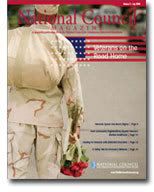
National Council Magazine Reports on Community Programs Providing Support for Military Families

Far too often the needs of our military families are still not being fully met by the overwhelmed traditional healthcare systems they rely on for their care. As a result, over the past few years, local organizations have sprung up all across the country, offering tailor-made support services and reintegration programs.

The trend is covered in full scope and detail in the current issue of National Council Magazine. Filled with first-person accounts, case studies, the latest PTSD data and much more, the National Council for Community Behavioral Healthcare's current quarterly issue is a rich resource...it's also available online as a free PDF download.


Tuesday, August 12, 2008

A Thank You to Those Who Care for Our Nation's Wounded

Though bowed,
You are not broken.
Though stretched,
You're strong, my friend.
You are resilient like a willow --
You'll find your spring again.
Though your branches
Now weigh heavy,
Your roots go deep and true.
This is just a change of season --
God has better plans for you.

-- Sharon Hudnell

Back in May, as has been the case since 1984 on each Friday before Mother's Day, we celebrated what's known as Military Spouse Appreciation Day. Spouse Buzz, a place where military spouses can connect with one another, hosted guest blogger Lieutenant General William Caldwell, Commanding General, U.S. Army Combined Arms Center and Ft. Leavenworth.

This is what he wrote at the time:

We’ve watched you nurse your wounded warriors back to health in military hospitals. You’re there, still full of hope, when Troopers with head injuries don’t recognize their family. You encourage them. You decorate their rooms. You read their favorite books to them. You are the first to notice when they can squeeze your hand again for the first time.

The spouse on the home front pays the bills, fixes the car, gets the kids to soccer practice, helps with the homework and building the kids pinewood derby car... you are our true heroes. You have unique experiences that only other military spouses can comprehend. ...

All military spouses know why their loved ones serve, and they share in their hardship and sacrifice and ask for little in return. It is humbling to those of us who wear the uniform to know that our best friends, our spouses, are serving along side us. Those of us in uniform serve because we love our Nation; our spouses do it for love of us. Our service men and women could not continue in this profession without your help, and for that we are eternally grateful…and so is our Nation.


Friday, August 08, 2008

Swift Warrior, Healing Heart: Hand2Hand Contact's Alison Lighthall Presents at the 11th Annual Force Health Protection Conference

This is a long, long delayed post on an extraordinary individual, doing heartfelt and much-needed work to bring the public's attention to combat PTSD. My greatest appreciation for her and her work, and apologies this took so long to get online.

Beginning tomorrow in Albuquerque, New Mexico, attendees of the 11th Annual Force Health Protection Conference (free conference to military and civilian alike) will be in for a great treat. Alison Lighthall, founder of Hand2Hand Contact, presents "10 Things You Can Do If You Only Have 10 Minutes: Healing Interventions That Can Be Done With Veterans Anytime, Anywhere."


Tuesday, July 22, 2008

Army's RESPECT-MIL Program Aims to Reduce Stigma by Screening All Care-Seeking Soldiers for PTSD

From Army News Service:

According to Army medical officials, the new Re-Engineering Systems for the Primary Care and Treatment of Depression and PTSD in the Military program is designed to help providers recognize warning signs and treat those disorders early while eliminating Soldiers' fears about the stigma of psychological illnesses and their treatment.

Program officials say RESPECT-MIL takes advantage of any visit Soldiers make to their assigned primary care physicians for any reason, turning those visits into opportunities to detect symptoms that could indicate that the Soldier is struggling with PTSD.

"The Army is doing a lot more as far as trying to reach out and find Soldiers who are having issues but are reluctant to seek mental health care due to the historical mental health stigma within the military," said Dr. (Maj.) David Johnson, a Schweinfurt Health Clinic psychiatrist.


Monday, June 02, 2008

Tennessee Caregivers 'Healing the Hidden Wounds' at Nashville Summit

bna2008_28 bna2008_13 bna2008_12 bna2008_08 bna2008_05

bna2008_02On May 21, Nashville Public Television, National Alliance on Mental Illness-Tennessee, and YMCA/Restore Ministries hosted a day long summit amidst the backdrop of magnificent Foundren Hall. The weather and the charm of the Scarritt Bennett Center grounds couldn't have been any more inviting. And those gathered couldn't have been any more gracious or interesting or sharp.

"Healing the Hidden Wounds," a symposium on veterans and combat related depression united the area's stakeholders for a day of networking, brainstorming, and drafting plans for actions taken after the event. Efforts like these are welcomed and go a long way in supporting the mental health and successful reintegration of returning veterans and their families.


Saturday, May 17, 2008

"Healing the Hidden Wounds" Symposium to Unite Nashville Military and Private Veterans' Caregivers

Happy Armed Forces Day, everyone.

On Thursday, I buttoned up my semester at NIU.

This weekend, I'm busy preparing for my upcoming "Healing the Hidden Wounds" veteran symposium presentation. Organized by Nashville Public Television, NAMI Tennessee and YMCA/Restore Ministries, the summit aims to raise awareness of existing resources for active duty personnel and veterans from all branches of military service and to begin forging partnerships between the Veterans Administration and community mental health agencies.


Friday, March 28, 2008

Virginia Heroes, Marlboro Marine, Vet Unemployment, DoD Study

Notable quick stops well worth a visit:

  • On Wednesday, 200 social service workers gathered at the Virginia is for Heroes regional conference held at Fort Monroe. A few helpful articles over there, especially "Tune In to Special Needs of Military Families [pdf] ," by Barbara J. Howard, M.D.

  • Jenny Eliscu offers a heart-tugging update on James Blake Miller, 'The Marlboro Marine,' in the latest Rolling Stone.

  • Following-up on yesterday's post, the Topeka Capital-Journal editorial board chimes in on news that unemployment in the younger veterans set had shot up to 23 percent in 2005 from 2000's 10 percent rate.

  • From last week: A University of Texas Health Science Center at San Antonio research consortium has been awarded $33 million from the DoD to study post-traumatic stress disorder (PTSD) in returning troops. Their main objective will be to "develop and evaluate the most effective early-interventions for detecting, preventing and treating combat-related PTSD."


Tuesday, March 25, 2008

New Age Treatments for a New Age of Warfare: Army Seeking Alternative, Holistic Therapy Research Proposals

Noah Shachtman at Wired (and cheers back to you, Noah, for the 'special thanks' mention and link to PTSD Combat) looks at the Army's obviously necessity-inspired opening-up of minds and pocketbooks regarding the use and exploration of alternative treatment options for wounded returning troops:

The military is scrambling for new ways to treat the brain injuries and post-traumatic stress of troops returning home from war. And every kind of therapy -- no matter how far outside the accepted medical form -- is being considered. The Army just unveiled a $4 million program to investigate everything from "spiritual ministry, transcendental meditation, [and] yoga" to "bioenergies such as Qi gong, Reiki, [and] distant healing" to mend the psyches of wounded troops. ...

The Defense Department "is dedicated to supporting evidence-based approaches to medical treatment and wants to support the use of alternative therapies if they are proven efficacious," notes a recently-issued request for proposals.

But many of these treatments haven't been held up to much rigorous scientific scrutiny before. So the Army is looking to hand out $4 million in "seedling grants" to "conduc[t] rigorous clinical studies" into all sorts of "novel approaches." Projects "containing preliminary data" will be eligible for up to $1 million. But even "innovative but testable hypotheses without preliminary data" could get as much as $300,000. Proposals are due May 15.

Full Defense Center of Excellence for Psychological Health (PH) and Traumatic Brain Injury (TBI) program announcement for the Military Psychological Health Research – Complementary and Alternative Strategies grant is available online as an MS Word doc. Grant instructions and application forms are available, too.


Thursday, March 06, 2008

Army Report: Civilian Psychologists Needed on OEF/OIF Battlefronts, Suicides Up, Stigma of Seeking Help Down

The Army's Mental Health Advisory Team V report arrived today chock-full of updated data on how our troops are fairing. From AP:

U.S. troops on the battlefield found it harder to get the mental health care they needed last year, when violence rose in Afghanistan and new tactics pushed soldiers in Iraq farther from their operating bases. A report the Army released Thursday recommends sending civilian psychiatrists to the warfront, supplementing members of the uniformed mental health corps.

Surveying a force strained by its seventh year of war, officials found that more than one in four soldiers on repeat tours of duty screened positive for anxiety, depression and other mental health problems. That was comparable to the previous year.

The report found more troops reported marital problems, an increased suicide rate, higher morale in Iraq, but a greater percentage of depression among soldiers in Afghanistan. "They do show the effects of a long war," said Col. Elspeth Ritchie, psychiatry consultant to Army Surgeon General Lt. Gen. Eric Schoomaker.

Added Maj. Gen. Gale S. Pollock, a deputy surgeon general: "I think the fact that they are doing as well as they are with the demands they are under speaks to a strength and resiliency of the men and women of America."

The report was drawn from the work of a team of mental health experts who traveled to the wars last fall. The experts surveyed more than 2,200 soldiers in Iraq and nearly 900 in Afghanistan.


Wednesday, March 05, 2008

Vietnam Veterans Reach Out to Today's Returning Troops

A few recent reflections on the invaluable role Vietnam veterans play in helping those returning from Iraq and Afghanistan today. The first, from the North County Times:

In combat, the older former warrior told the young Marines, "funny things happen." Weeks, months and even years after combat, he continued, those "funny things" can re-emerge as haunting nightmares, jittery paranoia or the root of any number of abhorrent and self-destructive behaviors.

"You cannot take a normal person and put them in that environment without it affecting them," the speaker, David Pelkey, told about 25 Camp Pendleton Marines who recently returned from Iraq. Pelkey, a Mira Mesa resident and a Vietnam veteran who served in the Army's 1st Cavalry Division, is the national director of American Combat Veterans of War, a nonprofit group founded seven years ago by Carlsbad resident Bill Rider, also a Vietnam veteran.

"We try to use ourselves as an example of what not to do in terms of denying the fact that you have been impacted by the war," Rider said about the program. While theirs is not the only program about post-traumatic stress, Rider said that American Combat Veterans of War is unique in providing firsthand advice from other veterans to the troops.

"We're here because we care about you, damn it, and there's something you don't understand that we do," said retired Marine Col. Al Slater, a Navy Cross recipient who also spoke to the returning troops. "We don't want your generation to go through the hell we did."


Friday, February 22, 2008

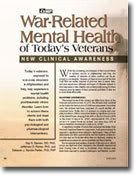
War-Related Mental Health Problems of Today's Veterans: New Clinical Awareness

This one is an oldie, but still a goodie.

Appearing in the July 2005 issue of the Journal of Psychological Nursing, this 11-page article is a good all-purpose clinical guide that can help us all better understand the diagnosis and treatment of combat PTSD. Download your own pdf copy to learn more about the following issues and more:

  • War-related Emotional Responses
  • Screening Questions for PTSD
  • Stressors Faced by Today's Soldiers
  • Medications Used to Treat PTSD


Previous/Older Posts Return Home

Archives
2011: Jan Feb
2010: Jan Feb Mar Apr May Jun Jul Aug Sept Oct Nov Dec
2009: Jan Feb Mar Apr May Jun Jul Aug Sept Oct Nov Dec
2008: Jan Feb Mar Apr May Jun Jul Aug Sept Oct Nov Dec
2007: Jan Feb Mar Apr May Jun Jul Aug Sept Oct Nov Dec
2006: Jan Feb Mar Apr May Jun Jul Aug Sept Oct Nov Dec
2005: Sept Oct Nov Dec

Legal Notice

The information presented on this web site is based on news reports, medical and government documents, and personal analysis. It does NOT represent therapeutic prescription or recommendation. For specific advice and information, consult your health care provider.

Comments at PTSD Combat do not necessarily represent the editor's views. Illegal or inappropriate material will be removed when brought to our attention. The existence of such does not reflect an endorsement.


This site contains at times large portions of copyrighted material not specifically authorized by the copyright owner. This material is used for educational purposes, to forward understanding of issues that concern veterans and military families. In accordance with U.S. Copyright Law Title 17 U.S.C. Section 107, the material on this site is distributed without profit. More information.