3000


A brief look at Ilona Meagher, author of Moving a Nation to Care: Post-Traumatic Stress Disorder and America's Returning Troops and editor of PTSD Combat: Winning the War Within.

As a recent incident over Christmas clearly shows, the holidays can be difficult for many returning veterans. The intensity of feelings and reactions is increased, and depression can often be most debilitating during what is supposed to be a season of cheer.
One explanation of this is found in today's Mail Tribune:
"The holiday period is a hard time for them," said Hood, head of the trauma rehabilitation program in psychology services at the U.S. Department of Veterans Affairs' Southern Oregon Rehabilitation Center and Clinics in White City. "Post-traumatic stress disorder and all trauma effects are directly related to memories of the past interfering with our normal, everyday functioning," she explained. "That happens by something going on in the environment bringing up or triggering the memory."
And no holidays compare with Christmas and New Year when it comes to generating memories, she said. "It can be anything — songs on the radio, the smell of cookies baking, Santa in somebody's office," she said. "Those memories may be good but just the fact your brain is working more on memories is going to make the other stuff come up," she added. "This time of year, we focus a lot on helping people get through the holidays and how to take care of yourself." ..
"Anger is the biggest issue they are dealing with," Hood said of her experience working with veterans. "That includes anger that things have changed, anger that they've come back and things aren't like they dreamed how it would be, and anger that they've changed. "A lot of them are angry that they no longer enjoy the things they used to," she added. "Many have a feeling of distance from their old lives, feeling a loss of connection."
 I have a number of updates that I'm late in sharing with you; will pass those along throughout the weekend as time permits. But, as kids get ready to lay out their yearly ration of cookies and milk for Santa this weekend, I can't help but wish the times could be just as innocent for the rest of us as it is for them yet.
To us, of course, the holidays are bittersweet again this year. My thoughts today are especially with the Omvigs and all of our troops who are not fortunate to be with loved ones this holiday season. You are in our thoughts and prayers and hopes for a better 2007.
To peace and safety and health and love.
Click on 'Article Link' below tags for related posts...
Related Posts
From the Los Angeles Times:
American soldiers who serve repeated tours of duty in Iraq are more likely to suffer from acute stress in Iraq, according to a mental health survey released Tuesday by the Army.
Overall, 13.6 percent of soldiers reported suffering from acute stress in late 2005, when the survey was taken. Among soldiers serving their first tours, 12.5 percent reported suffering such stress. But among soldiers on their second tour of duty, the number reporting acute stress jumped to 18.4 percent. "There is a sense that the yearlong deployments are challenging even if morale is good," said Lt. Gen. Kevin Kiley, the Army surgeon general. "The normal things -- births, first steps, birthdays -- those are missed. When soldiers are on second or third tours, my sense is they feel that a bit more."
The adverse effects of multiple, long deployments is a critical factor for military leaders as they consider increasing the number of soldiers in Iraq. If the White House orders a surge in troop numbers in a bid to control sectarian violence, the military likely would have to extend the tours of thousands of combat soldiers, keeping them in Iraq longer than a year. In addition, the number of soldiers on their third tour is likely to increase next year, with the return of the Army's Third Infantry Division to Iraq, marking its third combat deployment.
Paul Rieckhoff, the founder of Iraq & Afghanistan Veterans of America, an advocacy group, said he expects to see the numbers of soldiers reporting acute stress increasing, especially if troop levels rise. "It is a bad sign of things to come," Rieckhoff said of the report. "There is a tremendous mental health toll to this war. That toll is only going to continue as we repeatedly ask the same people to sacrifice again and again. It is not just the equipment being run down, it is the people."
This week, on Monday, December 11, we arrived at 25,000 (22,000+ wounded, nearly 3,000 dead) official U.S. military casualties in Iraq. Newsweek presents a powerfully narrated interactive photo journal, Glenn Kutler of icasualties.com providing a steady analysis of the grim numbers, examining trends since the start of the invasion in March 2003 in this stunning presentation.
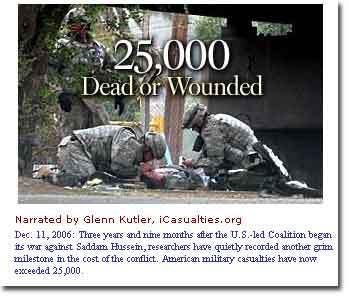
Kutler says that the killing of Saddam's sons was the first up tick on the insurgency. The UN mission bombing further shocked all involved; the reality of an organized insurgency was now apparent.
- 25,000 U.S. military casualties
- 22,057 WIA (as of 16 Dec 2006)
- 2,942 KIA (as of 16 Dec 2006)
- 22 days of initial fighting to take the country (April 9, 2003)
- Human cost to take country: 122 KIA (approx. 5 KIA/day)
- 5 month initial occupation following invasion
- 80% reduction in U.S. troop death rate during initial occupation (approx. 1 KIA/day)
- 96% of U.S. KIA since 'Mission Accomplished' speech
 I'll make my first "About Face" appearance tonight. Excited, because we had such a great time taping it last week; I'm anxious to hear it again myself, with an ear towards making a note of anything I forgot to say clearly (I already have a few of those on my list...). I'll have a chance to answer questions and clarify tomorrow morning when I join the "About Face" gang again for a live call-in wrap-up show.
From the Progressive Radio Network website:
3 PM PST/6 PM EST About Face with Dennis Stout
Post Traumatic Stress Disorder
This edition of About Face addresses post traumatic stress disorder (PTSD) that affects many veterans after returning from combat. Guests Ilona Meagher, editor of the weblog PTSD Combat, Dr. Robert Roerich, vice-president of the National Gulf War Resources Center, and Kay Shepherd of ePluribus Media discuss the nature of PTSD, how it affects veterans and their families and what can be done to assist in dealing with the problems PTSD causes.
 Tonight: December 16, 2006Tomorrow: December 17, 2006
Outgoing Chairman of the US Senate Committee on Veterans’ Affairs will go down in history as being the one to author the final piece of comprehensive legislation passed into law by the Republican-controlled Congress. The $3.2 billion Veterans Benefits bill (S. 3421) was introduced by Sen. Larry Craig [R-ID], and passed on the last day of the 109th Congress.
Improvements include:
The new law will allow the U.S. Department of Veterans Affairs to:"This change will allow veterans to stay closer to home and loved ones. I think that’s important," Craig said.
- proceed with major construction projects across the country
- improve mental health care access
- enhance telehealth outreach
- increase assistance to address homelessness
- improve protections for veterans’ personal information
- establish an Office of Rural Health
- create a pilot program that makes non-VA facilities – such as private nursing homes or community hospitals – eligible for state veterans' home per diem payments
- reimburse veterans homes run by state governments for costs of care provided to veterans with a 70 percent or higher service-connected disability
- veterans in those homes – veterans with service-connected conditions rated at least 50 percent disabled – will be able to obtain their medications from the VA
Among its many provisions, the bill adds $65 million to increase the number of clinicians treating post traumatic stress disorder (PTSD) and $2 million for additional blind rehabilitation specialists and increases the number of facilities where the specialists will be located. It also authorizes VA to designate six Parkinson's Disease Research, Education, and Clinical Centers of Excellence, and at least two Multiple Sclerosis Centers of Excellence.
By Diane M. Grassi in The Conservative Voice:
There is no longer a shortage of laws and regulations in place as existed during Viet Nam or during the Gulf War with respect to mandated healthcare screenings for returning soldiers. But a lack of political will by the Department of Veterans Affairs in concert with the DOD added to a lack of oversight by a lethargic U.S. Congress, has made life extremely difficult for soldiers with acute mental health problems or those hoping to avoid them by seeking help.
Multiple administrative dilemmas at play at once have impacted the quality of life for troops serving in Iraq and Afghanistan and upon their return. Immediately, due to a shortage of manpower, troops are now being re-deployed to battle as many as five times with less and less time to decompress between tours of duty. Were there not a need for so many bodies in the field, troops displaying emotional problems would be a liability and sent home for treatment.
Colonel Elspeth Ritchie, an expert in psychiatry for the Army’s Surgeon General has insisted that the DOD still prioritizes the mental health of service members. But she admitted that, “Some practices, such as sending service members diagnosed with Post-Traumatic Stress Disorder (PTSD) back into combat had been driven in part by troop shortage.” Absent of outwardly exhibiting symptoms of mental disorders such as PTSD, many troops fail to report their problems due to fear of retribution or are not aware there is a problem until they start acting out in other ways such as through drug or alcohol abuse.
Public Law 105-85, Section 762-767 enacted as part of the 1998 Defense Authorization Act was presented in 1997 in order to force the DOD to comply with both pre-deployment health assessment and post-deployment health assessment for returning soldiers as the result of healthcare problems them after the Gulf War. ... The 1998 law requires evidence that face-to-face interviews are done upon demobilization, but the DOD has refused to turn over such documentation to the Congress, for the past four years, in order to verify that it has been adequately done. Therefore, all of the regulations in the world are of little use unless there is implementation of said regulations. More>>
 From the Eugene Register-Guard:
Suzanne Swift, the soldier who faces a summary court-martial for being absent without leave for 123 days, is suffering from post-traumatic stress disorder, according to a document spelling out the facts that both she and the military prosecutor agree on.
Swift is the 22-year-old military police specialist from Eugene who said she dodged a second tour of duty in Iraq and went absent without leave last January because she couldn't face the possibility of a second round of the sexual harassment that dogged her first overseas tour. ... The preliminary agreement includes those details under the heading "relevant facts" while noting that the official investigation substantiated only the last incident.
Also under the relevant facts section: "Both the government and the defense agree that the accused has been diagnosed with post-traumatic stress disorder."
Swift was in Iraq for a year, from January 2004 to February 2005. She served in Karbala, a city south of Baghdad, as a driver and gunner. An officer who served with her told an Army investigator that Swift saw a great deal of hostile action there and performed well in engagements with the enemy.
A diagnosis of PTSD by an Army doctor means that a soldier is eligible for treatment of that condition, Choates confirmed. The maximum punishment Swift will face is 30 days in jail, forfeit of two-thirds of her pay for a month and reduction in rank from specialist to private. After that, she will finish out the remainder of her military service and be eligible for an honorable discharge.
 Reporter Nathan Comp of Madison's excellent Isthmus paper delivers a comprehensive piece on how local vets are transitioning back to life at home and dealing with the VA. Latest combat PTSD stats, too.
Comp also makes note of the work that ePluribus Media and I have been doing on the PTSD Timeline -- work difficult to cheer, but that we are pleased to see being used to inform others.
Hard to choose which grafs to highlight; here are a few:
Slowly, very slowly, Thomas Staskal is coming to grips with things he saw and did in Iraq. He is depressed, anxiety-prone and has an acute fear of crowds. Since returning home to the Green Bay area in November 2005, the 25-year-old Army reservist has lost three jobs and flunked out of college. Common things, like a flash of lightning, can induce the shakes.
“I used to have dreams where I was chased by the people I had to kill in Iraq,” he says, over doughnuts and milk at his east-side Madison apartment. “I no longer wake up from the nightmares, but the panic attacks are getting worse. One of the problems is that I’m angry, but I don’t know at what.”
Rarely is a soldier’s return seamless, but for battle-weary vets like Staskal, post-traumatic stress disorder can crash their landing in the civilian world. ... Staskal and his girlfriend moved to Madison in August, just before the start of the new school year. When he tried enrolling at the local VA hospital, he learned that transferring his file from Appleton would take 30 days. After that, he’d be put on the waiting list. Meanwhile, time was running out on the two years of VA benefits that reservists are given.
“If you are on active duty, there’s a lot more help,” says Staskal. “The reservists get shafted. I don’t function 100% and the Army should help me, but they’re not. You can’t just use us then leave us out to dry, which seems to be what’s happening.”
A big weekend coming up for me personally, a marker moment.
This past Sunday, Robert Roerich, MD (who graces my upcoming book, Moving a Nation to Care, with a compelling Foreword if I may say so myself), Kay Shepherd of ePluribus Media, and myself taped what I hope you agree is a solid starting point for our push to get the issue of combat PTSD not only on everyone's lips, but in their hearts and into their hands -- not minds, because what we now need is action -- as well.
Click on 'Article Link' below tags for all the details...
December 16, 2006 Now that all of the air date and time details have been confirmed, you are cordially invited to tune in this weekend to About Face with Dennis Stout -- a new radio program broadcast every Saturday on the Progressive Radio NetworkStreaming Sat. Dec 16 at 3:00 pm PST/6:00 pm EST.
Or archived here sometime after broadcast.
December 17, 2006 In addition to Saturday's hourlong show, I have been invited back by the About Face crew -- Dennis Stout, John Henry, and Mark Fleming -- this time for a live call-in segment set to air the following morning, Sunday, Dec 17, on Air America - 1480AM KPHX -- AAR's Phoenix affiliateStreaming Sun. Dec 17 at 11:00 am MST/1:00 pm EST.
Call-in: In-Studio : 602-258-8800 - Toll Free : 800-989-1480
First a little bit about the show, from 1480kphx.com:“About Face” is a program brought to you by the Phoenix Chapter of Veterans For Peace. ... The program “About Face” addresses the issues and concerns of our veterans returning home from the war and military. For example, we discuss issues such as the number of homeless veterans and programs that provide assistance, counseling, and training to help these heroes get another chance in life. We discuss the effects of PTSD and how sufferers of this disorder can get help.
What a need this program fills!
Mark Fleming (show co-host and the force behind the online journal Unsolicited Opinion) invited me to be their guest, even offering the chance to extend invitations to two others who might enrich our conversation on combat PTSD. Saturday's show will be the first time that news of my book hits the airwaves (you may remember my first podcast interview was back in February with my ePM colleague Kay Shepherd, the force behind the CJ initiative's podcasts).
Brief details from the PRN website:3 PM PST/6 PM EST - "About Face" with Dennis Stout
Post Traumatic Stress Disorder
This edition of About Face addresses post traumatic stress disorder (PTSD) that affects many veterans after returning from combat. Guests Ilona Meagher, editor of the weblog PTSD Combat, Dr. Robert Roerich, vice-president of the National Gulf War Resources Center, and Kay Shepherd of ePluribus Media discuss the nature of PTSD, how it affects veterans and their families and what can be done to assist in dealing with the problems PTSD causes.
We leave listeners with calls to support the Joshua Omvig Suicide Prevention Act (HR 5771) and the 'Lane Evans' bill, the Comprehensive Assistance for Veterans Exposed to Traumatic Stressors Act of 2005 (HR 1588), and my ePM collaboration work on the PTSD Timeline. You would think that with an hour we'd have plenty of time to cover everything, but boy did we only scratch the surface on this incredibly complex issue.
Thank you to the show's incredible hosts, Dennis and Mark (thank you for finding me, Mark) and John, too, who couldn't make it; and to 'Doc' and Kay, my gratitude for joining me on this first leg of an incredible journey. During the post-show wrap-up we all agreed the experience as a good one.
We hope you agree!
Please consider thanking "About Face" for this excellent new program, and consider supporting their further work with your advertising dollars (Call Mari Conner at 602-321-3875) or by kicking in a nickle or two to the show's sponsors: Veterans for Peace Phoenix
15825 S. 28th Place
Phoenix, AZ 85048
Hope to 'see' you this weekend!
P.S. And a very, very, very special thank you to Jim Starowicz, who is a one man media blitz machine...thank you, my good friend, for telling me about the About Face program, and for advertising my participation far and wide.
An additional ^5 and thank you to *everyone* at ePluribus Media working so hard behind-the-scenes to prepare the PTSD Timeline for the additional exposure it will receive this weekend. JeninRI, LeftyLimblog, kfred, standingup, HighAcidity, Cho (oh, who am I forgetting?!). You are the greatest backbone a project could ever wish for. My warmest thanks for scooping me up last year and making sure this issue would get the exposure it deserved.
Related Posts
Aftershocks from the NPR Fort Carson investigation, from UPI:
Three U.S. senators Thursday called for in investigation into mental health services for Army soldiers suffering from PTSD. Sen. Barbara Boxer, D-Calif., Sen. Christopher Bond, R-Mo., and Sen. Barack Obama, D-Ill., asked for an investigation into 'troubling allegations' that soldiers at Fort Carson, Colo., are being denied treatment for post-traumatic stress disorders, according to a report by National Public Radio.
NPR reported that two sergeants admitted they 'often refuse to allow soldiers under their command to attend mental health treatment sessions for PTSD. They said people claim PTSD from combat deployments as a means of avoiding being sent back to Iraq, or of getting out of the military.
'It is tremendously problematic that Ft. Carson officials take it upon themselves to make medical determinations without input from mental health professionals,' the senators said in a Dec. 7 letter to the assistant secretary of defense for health affairs, Dr. William Winkenwerder.
Specifically, they want to know the average time in days soldiers at Fort Carson have to wait after requesting their first appointment with a mental health care professional, and then for follow up appointments; how many soldiers have sought treatment; how many have been diagnosed with PTSD or traumatic injury, and how many of those have been discharged.
Disheartening events on Capitol Hill:
While their congressional aides scramble to prepare a package of vital veterans’ legislation, the House and Senate veterans’ affairs committee chairmen are pointing fingers over who doomed an omnibus benefits and construction bill for the Department of Veterans Affairs.
Sen. Larry Craig, R-Idaho, the Senate committee chairman, said the veterans’ bill is being held up because of the House veterans’ committee’s refusal to delete $600 million for a medical center for Charleston, S.C. The joint medical center was included in the House version of the bill at the urging of Rep. Steve Buyer, R-Ind., House committee chairman ...
“Veterans must have improved access to better care, which means a more thoughtful approach to building facilities, more highly trained clinicians, and the best equipment possible,” Buyer said. “To refuse a shared medical facility through collaboration in Charleston is to champion the status quo and settle for mere changes at the margin. Our veterans deserve better.”
Buyer said the Senate has “obstinately refused to support an innovative” project “despite intense negotiations.” With the sides clearly drawn and no talks underway, House and Senate aides are compiling a separate list of must-pass veterans legislation, such as the extension of some homeless programs and grants, that are about to expire. More>>
 Reaction streaming in to Monday's NPR investigation into charges that troops seeking help for PTSD were stigmatized and even abused by their peers and commanders. Former Iraq War vet and founder of Iraq and Afghanistan Veterans of America, Paul Rieckhoff, shares his at Huffington Post:
The last thing Iraq veterans need is to face a new battle with the military here at home. Ordering troops with severe PTSD to continue their duties is like making a person with a broken leg run a marathon. And punishing them for their disease is a total outrage.
It's time for the military to step up. Just last week, they finally released new guidelines for troops suffering from mental health problems in theatre. It's a good start, but just issuing another memo isn't going to make difference.
As usual, the change needs to happen on the ground. A mandatory counseling session for all service members coming home from a combat tour would go a long way towards reducing the stigma of mental health treatment. And would help soldiers like Tyler Jennings get help before it's too late.
Coming on the heels of NPR's compelling investigation, McClatchy Washington Bureau reporters Kevin G. Hall and David Montgomery deliver a significant piece today. Sharing a few grafs, but suggest taking the time to read it in full:
At Fort Leonard Wood in Missouri, swimming pools closed a month early this fall, and shuttle vans were sharply curtailed in an effort to trim spending. At Fort Sam Houston in Texas, unpaid utility bills exceeded $4 million, and the base reduced mail delivery to cut costs. Belt-tightening at the bases is only the beginning. As the United States spends about $8 billion a month in Iraq, the military is being forced to cut costs in ways big and small.Soldiers preparing to ship to Iraq don't have enough equipment to train on because it's been left in Iraq, where it's most needed. Thousands of tanks and other vehicles sit at repair depots waiting to be fixed because funds are short.
At the Red River Army Depot in Texas, the Fort Worth Star-Telegram reported in October that at least 6,200 Humvees, Bradley Fighting Vehicles, trucks and ambulances were awaiting repair because of insufficient funds. ... Tanks and helicopters are one thing; the toll on America's warriors and their families is another.
More than 73,000 soldiers returning from Iraq and Afghanistan have been diagnosed with post-traumatic stress disorder (PTSD) and with problems such as drug abuse and depression. That's enough people to fill a typical NFL stadium.
Internet blogs written by soldiers or their wives tell of suicide attempts by soldiers haunted by the horror of combat, civilian careers of reservists who've been harmed by deployment and redeployment, and marriages broken by distance and the trauma of war. "Back-to-back war deployments has changed both of us - to where it's as if a marriage does not exist anymore," wrote a woman calling herself Blackhawk wife on an Iraq war vets Web site. "We just go through the daily steps of life and raising children as best we can."
A mother of a returning soldier posted this: "Since he has been back, he has had 3 DUIs, wrecked his truck, attempted suicide, been diagnosed with PTSD" and is being kicked out of the Army. The length of the war in Iraq has strained all aspects of the armed forces, said Dov Zakheim, who was the Pentagon's chief financial officer from 2001 to 2004. "In 2003, I don't think anybody predicted it would go as long as World War II and the wear and tear on equipment would be as intense," said Zakheim, now a vice president for global strategy consultant Booz Allen Hamilton Inc. "When I left the department, we were spending less than $4 billion a month on Iraq. Now it's pretty much doubled."
The length of the Iraq war surpassed that of World War II last month. The costs of the wars in Iraq and Afghanistan and the global fight against terrorism are expected to surpass the $536 billion in inflation-adjusted costs of the Vietnam War by spring. That's more than 10 times the Bush administration's $50 million prewar estimate.
More >>
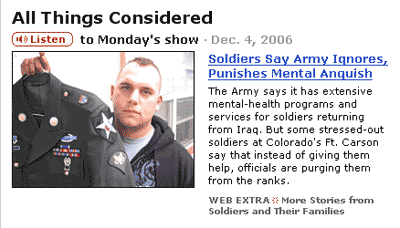
NPR broadcasts the findings of a 6-month investigation into charges that troops at Fort Carson, Colo., are being intimidated, stigmatized -- and worse -- if they say they have PTSD:
Dec. 4 · An NPR investigation at a major Army base shows that soldiers who return from Iraq with serious emotional trauma often do not receive needed care, and some are kicked out of the Army.
Troubling stats and stories from AP:
[T]he VA reports that slightly more than a third of 23,635 women veterans from Iraq and Afghanistan evaluated from 2002 to last August had a preliminary diagnosis of a mental disorder. Those numbers provide just a partial glimpse into the problem: Many women veterans, like men, don't go to VA hospitals or prefer to seek private help.
A second study released early this year also found that of more than 220,000 Iraq veterans, 23.6 percent of women had a mental health concern -- compared with 18.6 percent for men (an insignificant difference, according to Col. Dr. Charles Hoge, one of the study's authors).
Mental health experts say one of the biggest contributors to psychological problems for women in uniform is military sexual trauma -- a term that covers verbal harassment and physical assault, which is a strong risk factor for PTSD.
Studies conducted by the VA health system vary, but generally about 20 percent of women report a physical assault during their service, Westrup says. "Unfortunately, a huge aspect of that experience is guilt and self-blame and shame on top of stress," she adds. Last year, the Pentagon announced a new policy of confidentiality, so sexual assault victims can report the incident and get help but law enforcement and senior commanders are not immediately notified.
Compounding the emotional turmoil for women are wounds and ailments that range from life-changing -- the loss of limbs and brain injuries -- to temporary, such as infections and rashes. Some of the short-term health problems are likely tied to the harsh realities of war, where women can go weeks without a shower and spend months hauling gear and lifting heavy weapons in triple-digit heat.
The VA found 29 percent of the women veterans it evaluated returned with genital or urinary system problems, 33 percent had digestive illnesses and 42 percent had back troubles, arthritis and other muscular ailments. More>>
Special Note: "About Face," a new long-format Air America Radio talk show carried on 1480 KPHX in Phoenix, Ariz., has invited me to be their guest next Sunday, December 10. We'll be talking about combat PTSD, how our returning troops are doing, as well as the PTSD Timeline. I'll post air times as soon as I nail them down (the show is taped and then syndicated and broadcast at various times throughout the nation).
 After a 6-months long halt to my research for a brief diversion, ePluribus Media and I have returned our focus to the PTSD Timeline.
2006-11-28
Marine Arrested in Baby Son's Death
Associated Press
STATESIDE INCIDENT: 1 murder.
A 20-year old Marine who had been deployed to a training camp in Kuwait with the Ninth Communication Battalion from Camp Pendleton and who “was called back...to be with his ailing wife just before she died of childbirth complications was arrested on suspicion of murdering his newborn son.”
He had previously told a local TV station that he “felt overwhelmed as a single parent of two and struggled to accept his son. ‘I didn't know how to feel about him. The same day he was born, my wife died,’ he told KMPH in Fresno. ‘The feelings inside of me, I kind of wanted to push him away, but he's my son. My wife gave him to me.’”
His was jailed on charges of beating his 3-month old son. The death of his wife burdened him. He wrote on his personal web page, “For those of you who don't know, my beautiful wife ... died. Just because you see me smile and you see me laugh doesn't come close to the way I feel inside. I will never be as happy as I was until I'm with my wife again.”
2006-11-02
Margate soldier arrested for brandishing gun
Miami Herald
STATESIDE INCIDENT: 1 aggravated assault, battery, criminal mischief, and improper exhibition of a firearm.
A 25-year old Army soldier was “charged ... with assault after witnesses say he brandished a gun at some hotel guests. ... His girlfriend told police she tried to calm him down, but he took her money, smashed her belongings and threw her on the floor.
After police arrested [the] 24-year-old, he allegedly became irate and began hitting the plastic divider in the patrol car with his head. He was taken to a hospital where he received four stitches before being taken to jail.” It was not determined if this soldier had served in combat.
2003-09-16
Report: Flagstaff soldier committed suicide
KTVK-TV and AZFamily.com
COMBAT ZONE INCIDENT: 1 suicide.
A 27-year old Flagstaff, Ariz. native, the “third woman to die in Iraq,” committed suicide “two weeks after objecting to interrogation techniques being used on Iraqi prisoners. After reportedly saying she couldn’t carry out the interrogations, she asked to be reassigned and was directed to monitor Iraqi guards and interpret for Iraqi civilians.” She served with C Company, 311th Military Intelligence BN, 101st Airborne
November 5, 2006. Her death had been listed simply as a “non-hostile weapons discharge.”
Her parents were not told of her objections in Iraq, and were kept in the dark about the circumstances surrounding her daughter’s death. An Arizona Republic reporter sniffed out the real facts of the incident, and the suicide came to light in 2006.
2006-11-09
Ga. Iraq Vet Missing for Two Weeks
WXIA-TV Channel 11 News - Atlanta
STATESIDE INCIDENT: 1 missing person.
A 26-year old soldier who “served [two tours in Iraq] with an Army special forces psychological operations unit, where he helped craft the pamphlets dropped by U.S. troops during the early days of the war” went missing. Friends and family said it was out-of-character for him to disappear in such a way. His mother “says that although her son has suffered some depression and post-traumatic stress disorder since returning from Iraq in October 2005, she does NOT think that has much to do with his disappearance.”
2006-02-10
Soldier sentenced to prison
The Augusta Chronicle
STATESIDE INCIDENT: 1 disobeying a lawful order, sodomy, adultery and sex with an underage person.
A 22-year old Fort Gordon sergeant who had served in Iraq with Company A, 297th Military Intelligence Battalion was arrested and accused of having sexual relations with a 15-year-old minor. The soldier “and the victim had sexual relations in December and January ... and the sergeant was ordered in February by his commander to break off contact with the girl - an order he violated Feb. 10.”
2003-01-29
Ex-deputy charged with shooting Iraq veteran
Inland Valley [CA] Daily Bulletin
STATESIDE INCIDENT: 1 high-speed chase.
A former senior airman in the Air Force who had just returned from Iraq took part in a high-speed chase with Chino, California police. The incident became a nation story when a former sheriff's deputy shot the airman as it was captured on videotape. “The videotape of the Jan. 29 shooting, which has been widely broadcast by the media, was among the most compelling pieces of evidence produced by prosecutors.”
2003-08-06
Vet charged with trying to kill wife
Morris News Service-Alaska
STATESIDE INCIDENT: 1 charge kidnapping, first-degree attempted murder, two counts of third-degree assault, and second-degree assault.
A 24-year-old Army soldier who “served with the 82nd Airborne, 101st Division, 18th Air Assault, in two tours in Iraq during Operation Iraqi Freedom. In the 2005 Homer [AK] Veterans Day Parade, he rode in uniform in a vintage Army Jeep and was honored for his service by local veterans.”
At his indictment, he was charged with having “restrained his wife against her will and assaulted her, and that two accomplices ... helped him. [His] wife alleged she was taken to Skyline Drive, thrown around by the hair, punched and beaten, and then taken to the Homer Spit.
‘I was beaten some more and told that I was going to die,’ she wrote in the petition.”
2005-05-23
Family questions Army ruling that soldier committed suicide
Marinette/Menominee Eagle Herald
COMBAT ZONE INCIDENT: 1 suicide.
A 21-year-old Army specialist with Virginia National Guard's 3rd Battalion, 116th Infantry Regiment, 29th Infantry Division, based in Manassas, Va., died in Afghanistan from a self-inflicted gunshot wound to the head according to an investigative report issued by the U.S. Army Criminal Investigation Command in Virginia. His mother and other family members would not agree with the mode of death.
She said that “the Army has told her many conflicting things about her son’s death, starting from the day he died. On that day, the military issued a brief statement saying the soldier died from ‘non-combat related injuries.’ ... It's just gone back and forth so many times it's become very difficult for our family to have to endure all these things.”
2006-08-07
Bank raid suspect appears in court
Seattle Post-Intelligencer
FOREIGN INCIDENT: 1 armed bank robbery.
Three U.S. Army Rangers based out of Fort Lewis committed a “military-style” robbery with “military-style precision and planning,” recruiting two Canadians to help. “On the day of the robbery, the 192 soldiers of C Company, 2nd Battalion, 75th Ranger Regiment [one of the Army's elite special operations units] were given two weeks leave. According to FBI ..., the three Rangers along with [the two accomplices] hit the bank late that afternoon in "an extremely well organized and executed robbery.
Wearing dark-colored balaclavas over their faces, two or three entered from the east entrance and two from the west entrance. Two were carrying AK-47-style assault rifles with "banana style" magazines holding extra ammo. They kept watch as one robber counted time out loud. Another robber "jumped over the teller counter and the bandit barrier" and ordered the tellers to fill his bag with $50 and $100 bills.
Some of the robbers appeared to be wearing soft body armor under their clothing.” It was not completely clear if all three Rangers had served in Iraq, but their unit had only recently returned from an Iraq deployment.
2006-07-29
Sergeant's Disappearance Treated As Missing Person's Case
WCPO-TV Channel 9 News – Cincinnati
STATESIDE INCIDENT: 1 missing person.
A 24-year old soldier, who was the son of a Vietnam veteran and brother of another Iraq vet, “returned from Iraq in November of 2005 after a 13 month tour that put him on the front lines” only to go missing eight months after returning from the combat zone. He was last seen driving away from his home.
At the time, his mother said “she doesn't know anyone who would want to hurt her son and she can't rule out that he might try and hurt himself. She said her son had been demonstrating classic signs of post traumatic stress disorder since returning from his tour of duty.”
After a nation-wide alert and a sighting in Montana, the soldier eventually turned up in Washington State. “Garry was found ... with a full beard and mustache and living in the woods. ...His PTSD and experiences in the war have triggered this hero to go into "survival mode" and disappear. He was found coherent, tired and stating he was ‘looking for his men.’”
2006-02-10
MP from 29 Palms shot after killing prostitute
Hi-Desert Star (Yucca Valley, CA)
STATESIDE INCIDENT: 1 murder.
A 22-year old Twentynine Palms Marine decorated for former combat duty and a military police officer “was shot and killed by a police officer early Sunday morning after allegedly murdering a trans-gender prostitute. ... [P]olice believe [he] picked up a transgender prostitute he thought was a female, but was actually a male.” A citizen reported the crime, and the Marine fled the area. A high-speed helicopter police pursuit ensued.
“When [he] stopped his car, he got out but refused to comply with officers' orders. They fired a non-lethal weapon (such as a gun with bean-bag bullets) at him, but that failed to stop [him].” He was said to have run towards the officers with a drawn handgun; an officer shot him (although other reports state there was confusion over if the suspect or the officer fired the shot that killed the Marine.
In a study funded by support from the Department of Veterans Affairs and appearing in the December 1, 2006 issue of the American Journal of Psychiatry, researchers found:
Guanfacine, a medication commonly prescribed to alleviate symptoms of post-traumatic stress disorder, is no more effective than a placebo, according to a study led by researchers at the San Francisco VA Medical Center.
“There was no benefit at all, and there were several adverse side effects,” says lead author Thomas Neylan, MD, medical director of the PTSD treatment program at SFVAMC. “People with symptoms of PTSD should probably stay away from this drug and others of its type.”
The double-blind study compared the effects of guanfacine and an identical looking placebo pill on 63 male and female veterans at four VA medical centers in California and Hawaii. Twenty-nine participants were randomly assigned to take weekly doses of the drug, and 34 were assigned the placebo, for eight weeks.
At the end of the study, the effect of guanfacine on PTSD symptoms was “zero,” and there were no differences between men and women or older versus younger veterans. In addition, the subjects who took guanfacine had significantly more somnolence, lightheadedness, and dry mouth than those who took placebo. The study authors conclude, “These results do not support the use of alpha 2 agonists in veterans with chronic PTSD.”
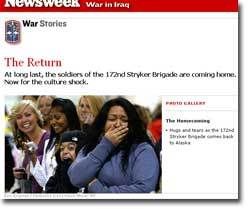 From Newsweek:
For Staff Sgt. Duane Leventry, the culture shock hit him full force in an Anchorage, Alaska, supermarket.
Shortly after returning home from 16 months in Iraq, he found himself staring at an aisle full of steak sauce and marinade, paralyzed by the sheer volume of choices. “I must have stood there for 10 minutes trying to figure out what to get,” says Leventry, who arrived home in Anchorage last Saturday, Nov. 25, to his wife Kelly and 3-year-old daughter Alexia. “Do I want this? Do I want that? It took us about two hours to get out of the store.”
For Spc. Shawn Mott, it happened on his first night home at a restaurant in Fairbanks, where the 172nd Stryker Brigade’s home base of Fort Wainwright is located. “The waitress walked up to me and I didn’t know what to do. I sat there for like 15 minutes going ‘What do I want?’” says Mott. “Having choices is overwhelming to me. All I ate in Iraq was chicken tenders and fries.”
After nearly a year and a half of combat duty, the returned soldiers of the 172nd are trying to adjust to life at home in Alaska. The Army has prepared the soldiers for the big things—how to watch for symptoms of posttraumatic stress disorder, how to reintegrate themselves into family life after what has been for some an unbearably long absence. But for the soldiers of the 172nd, who started arriving home last weekend, it’s the little things that have caught them by surprise.
First Arctic Wolves Return to Alaska After 16 Months in Iraq
By Brian Lepley and Spc. L.B. Edgar, AFPS
FORT RICHARDSON, Alaska, Nov. 27, 2006 – Two days after Thanksgiving, the families of the 172nd Stryker Brigade Combat Team had a lot to be thankful for as three planeloads of the “Arctic Wolves” returned from a 16-month deployment to Iraq.
Fort Wainwright welcomed more than 620 soldiers and Fort Richardson welcomed another 215 troops Nov. 25. More flights through this week and next were expected to get more than 3,720 Stryker soldiers back home by Dec. 5. For many of the returning soldiers, the homecoming was a bit of a déjà vu. Some 380 of the 172nd soldiers came home to Fort Wainwright in July before their unit’s deployment was extended four additional months.
More than 300 of the soldiers rejoined their units in Iraq, this time to conduct combat operations in Baghdad. They had previously been operating in the northern provinces of Iraq, mainly in Anbar, Rawaha and Mosul.
Next month, Leventry, 27, will leave the Army and intends to apply for the Anchorage police force. He never planned on a military career, but says the long, stressful deployments “definitely contributed” to his decision to leave the service. He was supposed to have gotten out in October but couldn’t because of the extension.
Shawn Mott, 26, still hasn’t decided whether to re-enlist. He is drained by his 16-month tour and says some of the worst stress of his time in Iraq came after the 172nd was suddenly transferred to Baghdad and had to deal with the resentment of other Army units already in the capital. Rivalries quickly developed between the members of the elite 172nd and the Fourth Infantry Division and the 101st Airborne. The Stryker soldiers were furious at their last-minute extension and felt they’d been diverted to Baghdad because the other units hadn’t done their jobs. The other units seemed to resent the swaggering, informal style of the Stryker soldiers. “It was a real culture clash,” Mott says. “Me and the Army don’t get along too well right now.”
For now, Mott is both reveling in his reunion with his fiancée, Nina Herrera, as well as dealing with feelings of “weirdness” at being out of Iraq. When Mott arrived in Fairbanks on Saturday after a 13-hour flight from Kuwait, there was no one to greet him: “There was no one to hug,” says Mott. “It was lonely.” More>>

Well, my stat counter currently has us at 19,957 unique, fascinating visitors. We will easily reach 20,000 as the day unfolds. Sure, our traffic won't ever reach Amazon proportions; but, it's quality, not quantity, that impresses me about this place! As with the 10,000th visitor post, I present some of our latest tire-kickers. Appreciate your coming by...
Click on 'Article Link' below tags for more...
Nice to see so many educational institutions coming around to pick through some of the data online here PTSD Combat. This is just a sampling of a few of the visitors recorded over the past seven days:
Education: Universities of Ohio State, Indiana State, North Carolina State, Kansas State, Northern Illinois, Western Illinois, Northern Kentucky, Long Island, California State-Long Beach, Salford (England), Minnesota, Oklahoma, West Virginia, Tennessee, Washington State, Wisconsin-Oshkosh, Texas-San Antonio, Marquette, Azusa Pacific, Wittenberg, Columbia, San Francisco, Pennsylvania State, Massachusetts-Dartmouth, Massachusetts-Amherst, Thomas Jefferson, Butler, Yale, Texas A&M, North Alabama, Victoria (British Columbia), Universite De Haute Alsace (France) and Bunkyo (Japan); State Universities Of New York, New Mexico and Montana, Indiana University Of Pennsylvania; Boston and Hamilton and Plymouth State and Quinnipiac and Chabot College; Oklahoma State Regents, Wyoming, Ocean State and Massachusetts Higher Education systems, City College of San Francisco, Manchester College Of Arts & Technology, St Clair College Of Applied Arts And Technology, Community Colleges of Catonsville, Santa Fe, Allegheny County, State Of Connecticut, and Caldwell; Schools; Hawaii Dept. Of Education, West Virginia Network For Educational Telecomputing, Georgia Institute Of Technology, New York City Technical College, Dallas Independent School District, Big Rapids Public Schools and the Georgia Public Library Service, Davis County Library.
Government: The U.S. House of Representatives and U.S. Senate Sergeant at Arms, Suffolk County Department Of Civil Service, DOT - Highway Bldg, Social Security Administration, and the States of Georgia and Florida.
Military/Veteran: Department of Defense (DOD), Army Information Systems Command, National Defense University, United States Military Academyand the U. S. Naval Oceanography Command Center; Forts Mcpherson and Jackson; Wright-Patterson Air Force Base; USO World Headquarters, Vietnam Veterans Of America Foundation and the Department of Veterans Affairs (VA)...and Canada's Defence Research Establishment-Ottawa.
Health: American Counseling Association, Mayo Foundation, Wayne State University Medical Center, Northwestern Memorial Hospital, Massachusetts General Hospital, Medical University Of South Carolina, Fraser Health Authority, Baptist Memorial Health Care Corporation, Schering-Plough Research Institute, Victim Support Lambeth (London) and Academic Medical Centre (Amsterdam).
News Organizations: Time Warner, News Corporation, CBS, Waco Tribune-Herald, Houston Chronicle.
Miscellaneous: Caribou Coffee Store, Philips Electronics North America, Abbott Laboratories, Exxon Mobil Corporation, Ford Motor Company, Equitable Life Assurance, Archer Daniels Midland, Deloitte & Touche, Bank of America, Lloyd Lamont Design, G W Graphics & Publish, Creative Type, Parsons Computers, Flare Industries, Mount Paran North Church Of God, Mclane Company, Inc., Accutrade, Inc.Triton Technologies, Inc., and the United Parcel Service.
Thanks for your support and interest -- one and all!
 Important program set to air on NPR's All Things Considered on Monday, Dec. 4:
Award-winning NPR News journalist Daniel Zwerdling reports on the military’s treatment of soldiers returning from Iraq who suffer from emotional problems, including Post Traumatic Stress Disorder (PTSD), in a special half hour investigative report on All Things Considered Monday December 4.
Soldiers who have come back from war to Fort Carson, Colorado, told Zwerdling that their officers and lower level supervisors have harassed and punished them and in some cases discharged them for seeking help for what they believe to be emotional problems triggered by their service in Iraq.
Zwerdling also interviewed some of the soldiers’ supervisors, most of them sergeants at the base, who admit to the treatment, telling Zwerdling that it’s true, that they are giving these soldiers a hard time, and explain the reasons why. Zwerdling obtained Army documents and talked to witnesses who corroborated the soldiers’ allegations.
Less than a year ago, Jennings was a hero, a Purple Heart recipient who'd re-enlisted for six years. But stationed on a remote highway outpost near Ramadi, he faced a daily onslaught of insurgents' roadside explosions. He saw a sergeant he knew "folded in three like an accordion" behind the wheel of a Humvee, alongside a soldier literally split in half and decapitated. He watched in horror as Pfc. Samuel Lee, a 19-year-old from Anaheim, Calif., committed suicide, shooting himself in front of his platoon.Once back at Fort Carson, Jennings says he suffered panic attacks, jitters, sleeplessness and flashbacks. He turned to drugs, alcohol and sleeping pills to ease his afflictions. When urine analysis tests came back positive, the Army began to process his discharge for "patterns of misconduct."
But the therapist he obtained off base says Jennings resorted to drugs as a way to cope with the horrifying memories of war, the people and places that trigger those memories, and his sense that an attack may be imminent, even in Colorado Springs. "It makes sense [that] one would turn to substances to treat the stress that goes with all the bad memories," says Gerald Sandeford, Jennings' licensed counselor.
Sandeford has diagnosed Jennings with post-traumatic stress disorder, or PTSD, which is among the mental health conditions affecting one in three troops returning from war.
"They're trying to throw me out of the Army because of this," Jennings says.
Other soldiers spoke of intimidation, too:
Ryan Lockwood, a former 2nd Brigade Combat Team private, returned from Ramadi in August 2005 after a yearlong tour. The 22-year-old says an Army captain issued an ultimatum after he displayed symptoms of PTSD."He threatened that if I tried to get a medical disability for my PTSD, he would make my life a living hell," Lockwood says from his home in McHenry, Ill.
From the second CSIndy piece, a brief graf on the rising rate of drunken driving arrests on Fort Carson. Self-medicating with drugs or alcohol often goes hand-in-hand with PTSD; I can't help but wonder if all of the military's 'sweeping it under the rug' and intimidation might have been a contributing factor as well:
Georg-Andreas "Andrew" Pogany, a former Fort Carson soldier who leads Operation Just One, a group that helps Iraq war veterans obtain confidential, free counseling, says local agencies should be gathering data to see if PTSD is causing a rise in social ills. "We know it is out there," he says. "But how will they know how and where to target resources -- how to help these soldiers -- if they aren't taking the time to track what happens when soldiers return? How will they prevent problems before they escalate?"One of those problems is drunk driving. The base acknowledges a rise in arrests, but does not necessarily connect the problem to PTSD -- although many doctors and therapists say alcohol abuse can be a symptom of untreated PTSD. ... Yet the drunk-driving arrests continue.
In the six months through June 30, Fort Carson had logged 75 drunk-driving arrests involving soldiers on base -- putting the base on pace to top arrest totals in each of the past three years. In fact, the 2006 total to date already surpasses the total arrests for soldiers and civilians on base in all of 2003.
CBS Evening News kicked in "Stressed-Out Soldiers:"
CBS News chief investigative correspondent Armen Keteyian reports that at least in one large military base in Colorado, soldiers are saying members of the Army Command are simply paying lip service, at best, to PTSD -- hindering their treatment and upending their careers. ...Kaye Baron is a clinical psychologist in private practice in Colorado Springs, Colo. Each week, she counsels up to 25 soldiers and their families who are either unwilling or unable to face their problems while on base. "I think it's a very big problem," says Baron. "They could potentially lose their promotion potential, or just feeling like they're not able to advance in their career. That it's kinda over for them."
Lt. Col. Eric Kruger, Commanding Officer of the 2nd Brigade Combat Team at Fort Carson, says he's concerned that soldiers aren't seeking help due to fears of fearing ridicule or reprisal. "It's a tremendous concern," he says. "You don't want a soldier not to seek help for anything. They're our No. 1 asset. Leaders have to engage that every day -- and in my experience here, we do.
Video available of the segment (look on the right top corner of the page for the embedded video player) or listen to military ethicist Nancy Sherman talk on PTSD.
Please help us track OEF/OIF combat-related PTSD incidents in ePluribus Media's PTSD Timeline.
UPDATE 12-05-06: Read post-show comments.
Related Posts


Archives
2011: Jan Feb