x

Tuesday, January 30, 2007

Military's New Mental Health Assessment Hotline Arrives February 12

From AP:

A new automated phone-in assessment program is the latest effort by the military to reach out to soldiers and family members who might not otherwise seek help for post-traumatic stress or other psychological issues. The program is similar to an anonymous mental health screening effort begun online last year. About 40,000 troops or their family members - roughly 7 percent of them in Iraq - have participated.

There's much concern among those in the military that seeking help will affect someone's career, so it's good to have more anonymous options, said Dr. Jay Weiss, a former Air Force psychiatrist in private practice in Louisiana who has treated Iraq veterans.

While seeking help via telephone and Internet is not ideal, it's "certainly better than nothing," he said. ... The phone-in program was introduced Monday at the Military Health System annual conference in Washington. It is expected to begin taking calls by Feb. 12. The calls will be conducted in English and Spanish and will operate 24 hours a day.

The toll-free number for the Telephone Self-Assessment will be (877) 877-3647. A companion anonymous online Mental Health Self-Assessment test is also available.

Labels: , , , , , ,

Friday, January 26, 2007

See 'The War Tapes' at IAVA's House Parties Tomorrow


If you haven't had a chance yet to see the award-winning documentary, The War Tapes, you might want to find the nearest house party and head on over tomorrow. Riveting. (Here's a little write-up from last summer and a few pics, too.)

And for those of you in New York City, check out a special IAVA benefit performance of Incumbo Theater Company's Pvt. Wars by James McLure on February 3, 2007. There will also be panel discussion with director, cast, playwright and IAVA members. General details, additional showtimes.

Labels: , , , ,

Thursday, January 25, 2007

War and the Soul Workshop - In Pictures

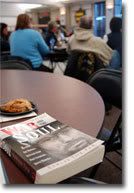
I attended the War and the Soul Workshop conducted by Dr. Edward Tick today, author of the highly recommended book War and the Soul: Healing Our Nation's Veterans from Post-traumatic Stress Disorder. If there is a direction we might move in to help our returning veterans spiritually find their way back home, I think this is it.

Click on 'Article Link' below tags for pictures and more...

On a beautifully crisp and clear winter day, Dr. Tick kicked off the first part of his four-day combat PTSD program at the University of Wisconsin-Parkside. David "Eight Eagles" Granados of the Earth Lodge Foundation joined Dr. Tick in the teaching of cleansing rituals used by a wide variety of cultures throughout the ages to help warriors successfully fold back into society after conflict.

Slides were used to bring the Greek period to life, a time ruled by the war gods Ares and Athena, and to take us back to Vietnam on a journey seeking closure and release.

One of the more moving moments of the day was Dr. Tick's request for veterans to stand for a moment to allow us to honor them and welcome them home. Two Marine, six Army, four Air Force and two Navy service members stood and introduced themselves. Collectively, they had served in Korea, Vietnam, the Cold War, Gulf War, and Iraq.


With Dr. Tick's help, and his Sanctuary/Soldier's Heart project, we can go far in making sure that veterans -- of all wars -- receive the welcome home and support that they truly deserve.

Please consider offering a small contribution to this foundation so that it may continue its important work. And take the time to view one of Dr. Tick's recent War and the Soul engagements...I guarantee you'll benefit greatly from his words and deeds.


Related Posts

Labels: , , ,

America's 'Ready' Brigade Not So Ready Due to Deployment Stress

From the Associated Press:

The four brigades in the Army‘s 82nd Airborne Division usually rotate the role of the nation‘s "ready" brigade, prepared to leave for anywhere in the world within 18 hours. But this summer, the 82nd may be forced to briefly give up its role as the home of the nation‘s quick-reaction force. It‘s the latest example of how the wars in Afghanistan and Iraq are pushing the Army to its limits. ...

The division‘s 3rd Brigade is now in Iraq. The 2nd Brigade was sent to Kuwait to move to Iraq, making it the only unit fulfilling President Bush‘s order to send an extra 21,500 troops to Iraq that had not been previously scheduled to serve there this year. But the 1st Brigade is scheduled to leave for Iraq this summer, around the time the 3rd Brigade returns.

"The reason we have a light, air-mobile force is to go anywhere fast, and you can‘t do that when you‘re committed to a theater of conflict," Thompson said.

Click on 'Article Link' below tags for related posts...


Related Posts

Labels: , , , , ,

Moving a Nation to Care: Reviews

Book reviews list for Ilona Meagher's Moving a Nation to Care: Post-Traumatic Stress Disorder and America's Returning Troops.

Click on 'Article Link' below tags for list...

Moving a Nation to Care was featured (with Haunted by Combat) in a 24-page book review essay [pdf] in the premiere issue of VA Board of Veterans' Appeals Veterans Law Review Vol 1 (2009):

Important and similar lessons can be learned from both books to help medical practitioners, veterans, veterans’ families, and the general public address the rising tide of PTSD victims. The authors of both books raise many areas where more research is needed before certain groups can be effectively addressed and treated. ...

Meagher’s book is a great resource for anyone who wants to learn more about PTSD and wants to figure out how he or she can help our returning veterans. It is also very useful for veterans returning from Iraq and their families to aid them in recognizing that other veterans are dealing with the same problems. While Paulson and Krippner’s book is targeted more towards medical practitioners seeking alternative ways to treat their mental health patients, they also purport to provide advice to veterans to help them through the therapeutic process.

Both books provide important lessons that can be learned by all parties involved in treating and addressing the needs of our returning military soldiers. The different areas each book identifies where more research is needed are useful for Congress and government agencies to consider when making policy decisions and determining where budgetary resources can most effectively be utilized.

August 8, 2008 - U.S. Army Corps of Engineers HECSA Library:

Since our nation has been at war, an increasing number of soldiers are returning from Iraq and Afghanistan suffering from depression, sleep and anxiety disorders, and overusing alcohol or drugs. This book presents the symptoms of PTSD so that they are easily recognizable and provides background especially oriented for those outside the military community to help them understand the origins and consequences of this complex problem.

Meagher uses the personal stories of soldiers to illustrate the devastating effects of PTSD on these individuals and their families. She also describes how the military health care establishment and Veterans Administration is falling short in the identification and treatment of this condition. Meagher's intention with this book is to bring this failing to light so that the American public will be moved to improve the treatment of the men and women who protect their freedoms.

This book can be found in HECSA Library.

December 15, 2007 - DeKalb Daily Chronicle:

Northern Illinois University journalism student Ilona Meagher is making a difference. Meagher not only published a book earlier this year on veterans struggling with post-traumatic stress disorder, but testified Wednesday at a congressional committee hearing. She discussed with members of Congress information she has collected during the past two years on soldiers who have committed suicide after returning from war.

Awareness of suicide among Iraq and Afghanistan veterans was heightened earlier this year when the Army said its suicide rate in 2006 rose to 17.3 per 100,000 troops - the highest recorded rate in 26 years. It's always refreshing to see someone like Meagher who is willing to take the reins and shed light on an issue that may have otherwise been hidden in the shadows.

December 4, 2007 - Jay Hazen, Reading Liberally:

Often the human costs of war are obscured at the time of conflict and well beyond, and it is happening again. My conservative uncle is a big fan of chain emails with pictures of flashy billion-dollar fighter jets twisting into formation for a tight little bomb pattern. This book is a reminder that for all the rhetoric of movement conservatism, responsible government makes more of a difference than an extra three F-22 Raptors in the lives of our military families.

November 13, 2007 - Kathie Costos, Wounded Times:

25 years ago there were very few of us taking on Post Traumatic Stress. We were just beginning to understand the term. ...Today we have networks across the country where people are taking action. From veterans of Vietnam to the Gulf War, to Afghanistan and Iraq, they are fighting for all veterans. We have people like me who ended up fighting the battles for our the war our husbands fought in. And we also have angels like Ilona out there. She didn't have "skin in the game" but what she has managed to do, very few have even come close to. Because she cared, men and women across the nation are becoming more aware of PTSD. ...

Ilona's love and compassion has reached countless people across this country and because of her, there are more understanding PTSD is not their fault. Amazing people like Ilona bringing this to the attention of the media and the conscience of this nation will be instrumental in removing the stigma of PTSD once and for all.

September 12, 2007 - Columbia Free Times, Dan Cook:

[T]he new book Moving a Nation to Care lays out in both statistics and personal stories the cost American troops are paying for the continued occupation in terms of post-traumatic stress disorder (PTSD).

In the book, author Ilona Meagher notes that 40,000 soldiers have already been diagnosed with PTSD and that “in today’s theaters of war, where troops are dealing with extended and multiple deployments, twenty-four hour operations with no opportunity to unwind, sleep deprivation, ever-changing mission goals and guerilla warfare conditions where enemies and civilians blend together, it has been estimated that cases of PTSD may be higher than in past conflicts.”

Retired naval commander Jeff Huber says the book “is a must read for anyone who understands that the worth of a nation is best measured by how it treats its wounded heroes.”

July 18, 2007 - BellaOnline, Tracey-Kay Caldwell:

What would it take to move our nation to care about our troops who are returning from war with post-traumatic stress disorder (PTSD)? Ilona Meag[h]er lays out the argument, trying to help us understand the issue, the lack of response we as a nation have shown, and the solutions to dealing with the issue. Meag[h]er takes us through the history of post-traumatic stress disorder, the lesson we have learned from each war, and how we are applying and how we are failing to apply those lessons in our current wars. She introduces us to soldiers like, Corporal Ken Dennis and Marine Private First Class Mathew G. Milczark who did not fall on the battlefield, but fell from their own hands; committing suicide, unable to come to terms with their war experiences.

We went to war unprepared to deal with the influx of returning veterans and their needs. According to Meag[h]er, “as of the end of 2006, one-in-four discharged Iraq and Afghanistan veterans (nearly 150,000) have filed disability claims, over 60,000 of which have been for mental health reasons.” We have failed to provide adequate funds for the Veterans Administration to deal with these disability claims. The Government Accountability Office in 2006 found that the Veterans Administration had based its budget requests not on the projected demand for health care services but on the amount the president was willing to request.

Senator Daniel Akaka, ranking member of the House Veterans’ Affairs Committee remarked, “This administration does not count caring for veterans as part of the cost of war.” Leader of the American Legion, Thomas L. Bock said, “this budget model has turned our veterans into beggars, forced to beg for the medical care they earned and, by law, deserve.” There are good reasons for providing mental health care for our veterans early on, while they have the best chance to recover.

According to Steve Robinson, Director of Veterans Affairs for Veterans for America, “If a 24-year old soldier with one child were to develop PTSD to the degree of unemployability, that soldier could receive compensation payments from the VA of over $2,400 a month for the remainder of his life. Over an average male lifespan, such costs could amount to more than 1.3 million, not counting inflation.”

Modern warfare creates stresses that increase the probability of suffering from PTSD. These stresses are from Time, using night vision goggles and other industrial age tools, soldiers are able to conduct around the clock operations, resulting in fatigue and sleep deprivation. Space, unlike traditional battlefields there is no front or rear lines; danger comes from all directions. Target, guerilla warfare conditions make it difficult to distinguish between the enemy and civilians.

PTSD specialist, Dr. Arthur Bank in discussing the transition soldiers have to make back to civilian life said, “ The biggest adjustment is going from 18-hour days, seven days a week, with no days off, to working a 40-hour week based on the clock.” Meager points out that, “Up through the Korean War the slowness of travel ensured a gradual re-entry for the soldier returning from combat. Plodding along by horse or train or ship meant that, instead of being thrown back into society without a chance to decompress and process their wartime experiences, soldiers could spend time dealing with what they had experienced in a safe and quarantined environment.”

Having made her argument for why we should care, Meag[h]er spends a chapter showing us how to make a difference. She provides resources for learning more, for communicating with veterans, for lobbying our politicians. She provides resources volunteering and making sure our veterans and their families have the information they need to cope with PTSD. This book is an excellent resource for anyone concerned about our returning Veterans.

July 12, 2007 - IAVA, Rob Timmins:

I’ve come across many books that deal with the wars in Iraq and Afghanistan and their aftermath. Recently though, I had the privilege of meeting Ilona Meag[h]er and read her book; a book that should be essential reading for anyone who wishes to help our returning veterans readjust back into society.

July 9, 2007 - Buzzflash, Mark Karlin:

Ilona Meagher is a product of the new citizen journalism.

Coming upon the plight of GIs with PTSD returning from Iraq, she decided to start an online account of the plight of troops with PTSD. In turn, this drew the attention of other blogs and websites. Eventually, she developed enough material for a compelling book that is a wake-up call to the nation to help those who served our country, but now are at high risk because of PTSD. In fact, estimates reach as high as 25% of our GIs returning from Iraq with varying forms of PTSD. ...

Behind all the false patriotic rhetoric in "support of our troops," Meagher documents how returning GIs with urgent mental health needs are being basically ignored.

Beyond the compelling subject matter of "Moving a Nation to Care," Meagher's book is evidence that citizen journalists are creating a new media that is more relevant, in many ways, than the mainstream media. ...

What makes "Moving a Nation to Care" particularly significant is that it is grounded in personal accounts of how many GIs with PTSD arrived at where they are. This is a well-researched book that combines facts, details and personal accounts into a compelling call for assisting our own victims of a fraudulent war.

Ilona Meagher truly supports our troops and cares about their well-being as they return to a country for which the Iraq War has been more faux jingistic sloganeering than real combat. Unlike Bush, Cheney and the self-serving pro-war, pandering GOP candidates for president, Meagher identified an injustice done to our troops and has sought to do something about it with the power of the pen.

That, our friends, is a true patriot.

July 4, 2007 - Bloomer [WI] Advance, Norma Hovland:

Suggested by a dear-friend, this book is a must-read for all patriotic Americans. An incident in the author's personal life prompted her to begin researching depression/suicide and, along the way, she found an all-too-frequent incidence of depression/suicide among returning Iraq veterans, setting off an alarm that pushed her to probe further.

Her interviews with many of these veterans and their families are shared with the reader and reveal serious gaps for treatment in a timely manner often with tragic results. The issues of an overstressed - - and underfunded - - VA Health Care System continue to escalate, burning out of control, and need to be addressed seriously by the powers-that-be.

During World War II, PTSD (Post Traumatic Stress Disorder) was often diagnosed as cowardice, a yellow streak, frequently resulting in an other than honorable discharge. However, Meagher's findings reveal that much has been learned in the ensuing years. Yes, PTSD is real and needs to be treated with empathy; our veterans deserve the best care possible. Indeed, it should be the American way, so let's rally behind the troops with actions and deeds toward healing and hope!

As Ilona Meagher readily admits, she is not schooled as a doctor nor a therapist, just an ordinary citizen concerned about our returning veterans, those suffering disabling injuries, PTSD and their families trying to cope. Or to heal from losing them, cutting short unfulfilled lives caused by the ravages of war, bringing to mind: There but for the grace of God go I....John Bradford

A thought for this Independence Day: As we celebrate this July 4th, let us be grateful to the veterans of all wars, many of whom paid the ultimate sacrifice to preserve our freedom. A copy of this book is being donated to our public library. Thank you, Ilona, for sharing your research and moving a nation to care.

June 16, 2007 - Daily Kos, Susan G:

With Friday’s news that a Department of Defense task force is recommending that additional funding be provided to the mental health of our active-duty soldiers and returning veterans, it is hard not to credit our own Daily Kos member ilona with a smidgen of credit for keeping progressive activists’ attention focused on one of the most overlooked aspects of the current Iraq conflict.

Her consistent calls for political action and her creation of the collaborative ePluribus Media PTSD Timeline have served as an inspirational model for dedicated citizen expertise. And now her time has arrived to move into a new medium with the publication of her book, Moving a Nation to Care.

Meagher’s slim but powerful volume brings together the many strands of information about PTSD she has tirelessly pursued for the past several years in a comprehensive and readable fashion. Opening with the gripping story of the famed "Marlboro Man" whose picture was blasted around the world during the battle in Fallujah—weary, tough and dirty—who came home suffering from PTSD, she moves on to delineate the fascinating history of soldiers suffering from what has been documented for thousands of years under varying names ("nostalgia," "combat fatigue," "shell shock"). She traces the history of diagnosis and treatment from Roman times to the Iraq and Afghanistan wars, tracking the varied explanations, treatments and stigmas associated with the disorder.

Throughout the book, as she moves on to describing such aspects as clinical diagnosis and what exactly is happening in the brain as it deals with the aftermath of serving in a war zone, she weaves the personal stories of the men and women currently suffering from PTSD, as well as the accounts of the survivors of those soldiers who have taken their lives in response to the unrecognized and usually untreated disorder. The long-term, life-changing fallout from PTSD are explored in detail.

Combined with the stigma of reporting mental health problems, the cursory self-reporting upon return to the United States—undertaken right when soldiers return home and face the prospect of being held on stateside bases for extra time for evaluation before returning to their families—the Veterans Administration has been struggling with underfunding to create something of an epidemic that’s running beneath the radar of public knowledge. The lack of VA staff and facilities, the shame returning vets often feel and the lack of a central record-keeping base are multiplying the problem, one that will haunt America long after the Iraq invasion is over.

Testimony to the long-reaching affects of PTSD are evidenced by the unanticipated uptick in Vietnam vets reporting to the VA that images and news about the current conflict are triggering new cases of the disorder in previously undiagnosed vets from the previous war. And while the traditional military services at least have nascent programs to help their members and their families cope with the aftereffects of serving in a war zone, the National Guard does not—and National Guard members in this war already suffer from being less well-trained and less supported even as they bear a larger brunt of frontline experience than in any other American conflict in history.

One of the most thought-provoking sections of the book considers how the speed of modern transport from battlefield to home has put extra pressure on those returning to adjust more quickly to the jolting transition to domestic life than ever before in history.

Moving a Nation to Care is a serious, reverent look at a difficult and nationally ignored problem. As lawmakers and VA staff struggle to deal with the life and death traumas of war on sufferers and family alike, it would be easy for citizens to feel powerless in a situation over which they perceive themselves as having little control. Meagher has spotted this possible paralysis and offered a wealth of contact information for organizations formed to help citizen activists find ways they can contribute to solving the problem. And despite the starkly depressing nature of the subject and the formidable challenge it presents, she has also offered up signs of hope...

Battle-scarred warriors reaching across generations to help fellow soldiers while healing themselves as well is a wonderful model for focused activism for all of us. Meagher deserves kudos of the highest order for providing insight into the PTSD experience and listing the tools for citizens to help. As a resource for anyone concerned with veterans or mental health issues in general, Moving a Nation to Care is unequalled in its simplicity and scope.

Meagher is currently on a book tour with her new work. Her schedule can be found at the Ig Publishing website. If we want to support the building of a true progressive infrastructure with a forum for new voices and subjects, I can think of no better place to start that with one of our own premier diarists, an independent publisher, a few book purchases and a visit to the author while on tour.

May 21, 2007 - Huffington Post, Taylor Marsh:

Even the bravest soldiers get PTSD.

He was known simply as "the Marlboro Man," the "Face of Fallujah." No one knew his name. Everyone was introduced to the myth. Back home he was simply known as Smokey. He was 20 years old when the photograph was taken. It was the real life version of a recruitment poster. But Marine Lance Corporal James Blake Miller, a member of Charlie Company, 1st Platoon, 8th Marines, was also a flesh and blood man underneath the bravura of the soldier everyone saw and was now worshiping, even wanting to be like.

How Miller became the myth is recounted in the first pages of Ilona Meagher's amazing book Moving a Nation to Care. It's not the story George W. Bush and the Republicans pushing escalation want to tell, but it's the reality of war, especially the Iraq war as it is being fought today. The real life recruitment story as seen through the picture that became synonymous with military heroism and self sacrifice long ago crumbled in on itself. "The Marlboro Man," "the Face of Fallujah," the war hero, Smokey, now has PTSD.

My uncle suffered from "battle fatigue." I'll never forget seeing him in the hospital with my mom when I was just a little girl. The once dandy of a man had shrunk to a shell of a human being. He flew bombing missions in WWII, my mom told me, with the never ending flights finally doing him in. Today battle fatigue is called PTSD. It is destroying our veterans and exploding inside families at alarming rates. Moving a Nation to Care tells the tale of what happens to our men and women who fight modern war. Battle fatigue has morphed into post traumatic stress syndrome, the soldier's illness that has the potential to deplete our armed forces like no man exploding bomb or EFP can.

Warfare has changed. It started with WWII when nighttime battles were ushered in. During Vietnam our soldiers were introduced to guerilla combat. Today in Iraq (and beyond), our fighting men and women are now barraged with 360 degree asymmetric hell. But especially in Iraq there is never any time to recoup from battles; no moment to regroup after a skirmish. Extended deployments have only made matters worse.

The other very real issue is that our soldiers are moving targets for everyone, because in the Iraq theater our soldiers don't know who is friend and who is foe. Being on guard 24/7 would deplete anyone's reserves and put your nerves on edge until you finally crack.

Now add female soldiers. As a strong proponent for women serving in combat positions, it's important to remember that women are indeed fighting and dying next to men, regardless of Mr. Bush saying they are not. According to Ilona's research, women suffer from PTSD at rates "twice that of men." Women deserve the right to fight in combat, as far as I'm concerned, but we need to know the costs they're paying when they choose soldiering.

Much needs to be done to bring PTSD out into the light, but we've come a long way from Patton's day, when artilleryman Paul G. Bennett said he couldn't stand the shelling any more and got a face full of one general's rage for what he was experiencing. ...The more we know about PTSD the more we can help. Ilona Meagher's book, Moving a Nation to Care is indispensable in the effort.

Mar 12, 2007 - Blurbs list

Feb 22, 2007 - ePluribus Media, Aaron Barlow:

Don' t expect a pretense of " objectivity" in this review. After all, Ilona Meagher has been writing on Post-Traumatic Stress Disorder (PTSD) for a year now on ePluribus Media. Many of us have been involved with her in the work on the PTSD Timeline (a searchable database of reported Iraq and Afghanistan Vet PTSD incidents), on her articles and blog posts, and even on her book. Though I have been concerned in only the most peripheral way, I have applauded the work at every step -- and I continue to do so with the publication of this book.

Still, I can promise two things in this review: an honest evaluation and a personal viewpoint. After all, Meagher's book is an attempt to move Americans to action on veterans' rights: She is honest in her concern and this is a book on a topic that has much more relevance to our individual lives, even those of us with no immediate family members in the military, than many of us might think. What happens to the members of our military matters to our lives, no matter who we are.

Before getting to the book, though, I want to share the opening verse to one of the saddest songs I have ever heard. It' s John Prine' s 1971 " Sam Stone" :

Sam Stone came home,
To his wife and family
After serving in the conflict overseas.
And the time that he served,
Had shattered all his nerves,
And left a little shrapnel in his knee.
But the morphine eased the pain,
And the grass grew round his brain,
And gave him all the confidence he lacked,
With a Purple Heart and a monkey on his back.

Thirty-six years later -- a generation and a half later -- and things are no better.

If anything, they are worse.

And the Veterans Administration, the one organization in a position to do anything about it, is being choked to death by the twin forces of increased need and decreased effective funding. Meagher, through the stories in this book, makes that abundantly evident.

Now, the Veterans Administration has a special place in the hearts of my own family. To us, it was a cherished organization. My grandfather, who lost a leg as a National Guard officer in World War I, worked for the VA almost from the day it was established in 1926, eventually serving as its chief legal counsel in Ohio. My father graduated from high school in Brecksville, OH -- site of the VA hospital where my grandfather worked. The VA took care of my grandfather until the day he died in 1959, long after he'd been able to work. The VA did so well by him that none of us could speak of it without a hint of awe.

For they really took care of him. He had dedicated his own life to the service of veterans -- and that dedication was repaid.

Tonight, I picked up my mother at the airport. In the car, I told her about this book, and about today's VA. She was shocked. She remembers the VA as it once was, the VA that had been her father-in-law's life-- not the sorry shadow of its former self that it has become. She also knows the way our country once treated veterans -- my father went to college (and met her) on the GI Bill. They bought their first house because of loans for veterans. Like many, however, she wasn't aware that veterans are no longer treated so well.

Meagher's book sets out to change that.

As Meagher writes, PTSD is nothing new. My other grandfather, a WWI artilleryman, hated high, shrill noises the rest of his life. His only injury came from mustard gas, but the psychic scars stayed with him the rest of his life. Once, some years after returning to civilian life, my father was hit by a car while riding a bike. He did a forward summersault and landed on his feet in a crouch with his hands in front of them as though holding a rifle -- shocking the people on the sidewalk. Neither of these men had severe symptoms that could be equated to PTSD (though their reactions were typical), but war was among " the things they carried" for the rest of their lives.

All veterans carry their wars with them. They cannot help it. We who remained at home need to respect that and provide much more for them than a pat on the back and commendation for a job well done. We really need to provide more for those who have been disabled by the war, physically, mentally, or both.

And that, though she concentrates on PTSD (one of today's most crying yet unmet needs), is the point of Meagher' s book-- whatever we think of a particular war, we owe it to the veterans to insure they have the services they need, and for the rest of their lives. They can' t drop the war; we can't drop them (though we have).

Meagher's book is in three parts. The first two use personal stories to provide an understanding of PTSD for those of us who have never experienced it or war. This first part really has two purposes, to show that although PTSD is nothing new, it is a serious problem indeed. The second gets into the complexities of PTSD in contemporary American society, explaining why PTSD is different for veterans today, given the particulars of the contemporary Iraq and Afghanistan conflicts. In the third part, she brings it home -- literally, discussing, among other things, the impact of quick transport, picking people up from Iraq one day and dropping them home the next -- without any time for adjustment. It's here, also, that she provides lists for the activism that she hopes her "call to arms" will make necessary in each of our hearts -- places to contact, things to do relating to easing the impact of PTSD. In many ways, these are the purpose of the book. The point is to give Americans -- all of us, but particularly the veterans facing PTSD and their families -- information on how to proceed both in dealing with the trauma and in forcing our government to deal concretely with the problem.

The style of Meagher's writing is breezy; there's no anger in the prose. Meagher lets the examples she presents speak for themselves -- and that's good. The outrage is in the violence that PTSD victims have experienced and then recreate (most often against themselves) -- and in the help that comes too little and too late, if at all.

If I have any criticism at all, it's the title of the book. Moving a Nation to Care is probably too timid. A title that really carries the anger that we should all be feeling about the treatment of our veterans, however, would never be accepted on bookstore shelves.

This isn't only a book that each of us should read: it' s a roadmap to what we all should be doing, if we have any respect for ourselves and for the people who are willing to do the dirty work that (whether we agree with the specific or not) they do at "our" request.

Buy it, read it, and get busy.

Feb 14, 2007 - Unsolicited Opinion, Mark Fleming:

[Ilona Meagher, editor of PTSD Combat, sent me an advance copy of her forthcoming book, Moving A Nation to Care: Post-Traumatic Stress Disorder and America's Returning Troops. Being a dutiful admirer of her work, I wrote the following review.]

Moving A Nation to Care: Post-Traumatic Stress Disorder and America’s Returning Troops is a timely and important reminder that war’s costs are often more subtle than the obvious dead and wounded casualties. Regardless of one’s view of the wisdom of any particular war, author Ilona Meagher clearly demonstrates that the psychological wounds of war require as much attention as the more visibly injured. Achingly illustrated with examples of soldiers’ experiences after returning from Iraq and Afghanistan, Moving A Nation to Care is a wake-up call to the wider public who may be tempted to dismiss the impact of post-traumatic stress disorder as something that veterans must simply "get over" upon returning to civilian life.

Post-traumatic stress disorder (PTSD) is nothing new; it has been a consequence of war since ancient times. Nor is it limited to combat veterans. Ms. Meagher quotes the National Center for PTSD which defines it as "...a psychiatric disorder that can occur following the experience or witnessing of life-threatening events such as military combat, natural disasters, terrorist incidents, serious accidents or violent personal assaults like rape." Any such trauma is likely to remain with individuals who experience them and affect their ability to function in society. But unlike accidents or even assaults, military combat occurs by the conscious decision of the nation. In going to war, society asks men and women to violate one of the most basic commandments: thou shall not kill.

In combat, the individual must be able to kill other human beings. Ms. Meagher shows how the modern American military trains soldiers to ignore this fundamental taboo. In the maelstrom of combat, when one’s own and one’s comrades lives are at risk, killing is a matter of survival. When the combat ends and the soldier returns to civilian life, the memories of those acts haunt many veterans, some more than others, often with tragic results. In contrast to the intensive training that conditions individuals to kill others, the military offers no opportunity for the soldier to decompress, no cleansing ritual to assist veterans in coming down from this extremely intense and even exhilarating experience.

Instead, individuals are left to fight their own personal wars as they relive and ponder their actions while the nation that sent them into combat holds on to an an image of war as noble and gallant. The all too vivid examples of drug and alcohol abuse, domestic abuse, murder and suicide in Moving A Nation to Care show that families, friends and the veterans themselves often pay the high cost of combat. If anything, the examples are overwhelming. I found myself dreading each new name because all too often the name introduced a story that ended in death. As difficult as reading these stories may be, however, the examples are necessary to bring attention to something society would rather ignore–the full cost of war.

Fortunately, Moving A Nation to Care is more than a litany of death and despair. It is also the story of activists–veterans and their families–like James Blake Miller, a veteran of the 2004 Marine assault on Fallujah. A photograph of Miller, battle weary, his face covered in dirt and blood, became an icon of Iraq combat, the "perfect image of a valiant and virtuous warrior". These days "...outspoken and open to a fault, suffering with PTSD, Miller no longer represents the mythic soldier. Yet his bluntness is the dose of reality we need...[he] asks us to consider the costs of war for the individual rather than endlessly, and mindlessly, perpetuating the myths of gallant battles and Teflon warriors." Captain Stefanie Pelkey, the widow of Captain Michael Jon Pelkey who committed suicide as a result of PTSD from his year in Iraq is another activist. So are Kevin and Joyce Lucey, whose son Jeffrey also took his own life after returning from Iraq. These dedicated individuals are helping tear down the Defense Department’s "wall of silence regarding PTSD" asking why, in preparing for war, was care for returning troops basically ignored?

For all that Ilona Meagher does in bringing this important issue to the public, even more significant, is the list of resources for concerned citizens presented in the final chapter. This chapter is Ms. Meagher’s effort to "move a nation to care". It offers sources for understanding the experience of war, how to communicate with returning veterans, opportunities for political action and page after page of organizations offering assistance and support to veterans and their families.

As a Vietnam veteran whose combat experience was mild compared to so many described in Moving A Nation to Care, I can appreciate its value. We returned from Vietnam to a nation unaware of PTSD. Many of us were ourselves largely unaware of PTSD. All we wanted was to get on with our lives, only to find that the war we thought we’d left behind had come home with us. Patient efforts by activists finally forced the nation and the Veterans Administration to begin addressing this problem. As the stories in Moving A Nation to Care illustrate, much work still remains if America is to fully heal the psychological wounds of war. Ilona Meagher’s thorough and well documented research is a valuable resource for all those who truly want to support the troops.

Have you read Moving a Nation to Care?
Review it at Amazon.com.


Related Posts

Labels: , ,

"Return to Honor" Reintegration Workshops

I received the following transition training workshop information from Martin Richardson of Freedoms Foundation of Valley Forge, PA. They will be conducting a series of free workshops, called Return to Honor, aimed at helping returning veterans and their families return to peaceful life following service.

Upcoming dates:
FEBRUARY 2-4, FREEDOMS FOUNDATION OF VALLEY FORGE
APRIL 27-29, FREEDOMS FOUNDATION OF VALLEY FORGE


Additionally:

All Return to Honor programs were designed as portable containers and can be conducted where needed. The Freedoms Foundation Staff and Return to Honor program director, Martin Richardson (mrichardson@ffvf.org) will be happy to assist with planning a Return to Honor program in your local area.

Click on 'Article Link' below tags for more...

Additional details:

Upcoming Workshops

February 2-4, 2007
FREE 3-Day Reintegration Workshop for Veterans and Their Families

RETURN TO HONOR is a three-day intensive, cognitive and experiential reintegration training designed by “those who have been there”. It is particularly geared to those who are suffering from the mental and emotional trauma of war including combat stress and focused upon their reintegration as healthy, productive members of the service/society.
What I wanted and needed when I returned is the following; I just didn't know it then.
• Someone to listen to my truth
• A way to process what I was denying
• Direction, where to go, what to do and how to continue
• Someone to speak the truth; my life is not the same and never will be
• A place to acknowledge what I was feeling
• How to communicate what I was feeling to family and friends
• Integrating who I was before I left, who I was during these events and who I am now
Return to Honor is a process from which to move through the experience for both the veteran and their family with other veterans. Return to Honor offers understanding, coping skills, re-alignment, and a renewed sense of purpose and mission.

Location: Freedoms Foundation of Valley Forge, PA

For more details and/or to register for either of these programs, go to www.freedomandhonor.org; contact Martin Richardson at 610-717-9977 cell
Or at the Freedoms Foundation 610-933-8825 x241.


Further details:

Re: Reintegration Workshop; After-Theatre Decompression Training for Veterans and their Families

Objective of Return to Honor Programs: The Return to Honor programs are conducted by the Freedoms Foundation of Valley Forge, (501c3) to support military troops in making healthy transitions after combat duty to maintain service readiness for active duty and return reservists and veterans to productive civilian life. Return to Honor will also provide on-going support mechanisms while collaborating with existing services.

Issue Addressed: Combat duty places extreme demands on the mind, body, senses, and emotions of military personnel. Prepared with hundreds of hours of training, the intensity and realities of war present a multitude of challenges which only become “real” in-theatre. These realities can create readjustment issues upon return such as the constant state of heightened alert, coping with killing, the deaths of comrades and innocent civilians as well as changes in family structures and roles. These and many other issues often do not appear until 60-90+ after returning home.

Return to Honor is a three-day intensive, cognitive and experiential reintegration training designed by a military therapist and conducted by “those who have been there” which includes education and integration with the family. Return to Honor is to be conducted several months after return to avoid combat stress and readjustment issues from developing into PTSD. The intensity of the military persons experience equally needs to be addressed by an intensive period of readjustment/decompression. Specifically, Return to Honor provides such a forum. Return to Honor was designed with a deep knowledge and understanding of the subject area, real world experience and expertise in a variety of modalities. The training integrates information, models and exercises which reduce the impact -- “trauma” experienced. Strategic bio-energetics techniques and coping skills are presented in a hands-on manner in conjunction with the groups’ dynamics to address the physical and emotional needs of each participant. These needs can range from inappropriate reactions set off by “triggers”, rage, loss of mission and values to employment and family tensions. Each participant is supported by an almost one-to-one ratio of veterans with in-theatre experience.

This workshop should not be considered therapeutic in the traditional sense nor is it designed to replace such services. However, the nature, time commitments as well as the accessibility of such traditional services fail to address the initial extreme impact of combat duty as well as are often conducted by those who have not be in-theatre.

Implementation: Return to Honor can be implemented in a number of ways. Return to Honor programs are conducted on the Freedoms Foundation main campus in Valley Forge PA. Additionally, programs can be supported around the country at alternative locations and/or on a military base. Due the intimate nature of the subject matter private settings provide an extra measure of safety and confidentiality for the participants.

Costs: The cost of the workshop is free to veterans and their families. The costs to conduct the Return to Honor initial 3-day program will vary depending on location, meals & lodgings and number of participants. Costs for strictly bring trainers to a site can be provided. The Freedoms Foundation of Valley Forge is seeking funding through private corporate donations, state funding and from the VA/DOD as well as working with direct funding by the military base. Coordination of efforts with a specific military base/veterans organization brings critical value propositions to the funding raising efforts. Donations are welcome by all and are a charitable donation. Marketing and sponsorship opportunities are also available.

For more information: please contact Nancy McGrory, Development Director, 610-933-8825 x241 or click on www.returntohonorworkshop.com

Thank you, Mr. Richardson, for this information -- and more importantly, this program.

Labels: , , , , ,

Wednesday, January 24, 2007

PTSD a Priority to New Marine Sergeant Major

From the San Diego Union-Tribune:

Camp Pendleton's Carlton W. Kent is the service's new sergeant major. He will serve as the point man for the Corps' commandant, Gen. James T. Conway, on everything from wartime deployments to health concerns for the enlisted. “My main focus is on the Marines and sailors in combat,” Kent, 49, said yesterday. He was chosen Friday for his new job.

Kent wants to maintain strong leadership for the enlisted ranks as the Corps aims to grow by about 5,000 Marines per year. He also cited a need to fully diagnose and treat service members' mental health problems, including post-traumatic stress disorder. “Some of these young Marines are seeing things that some people don't see in their whole lifetimes,” he said. “I know that PTSD is a priority . . . This issue of PTSD is personal to me, very personal because I have friends who have it.”

Sergeant major is the highest rank achievable by an enlisted service member.

Labels:

DoD Mental Health Task Force Update

Today's News-Tribune devotes 20 full column inches of real estate to the just-concluded two day DoD Mental Health Task Force meeting held in Tacoma, Wash. Columnist Mike Gilbert's blog offers a few details on one of the people to testify:

[In my report,] I went with retired Command Sgt. Maj. Thomas Adams' account because it was the first time he's told his story in public – a senior leader from one of the Fort Lewis Stryker brigades speaking bluntly about how emotionally tough it was for him and his troops. Adams said he is battling his own case of severe post-traumatic stress disorder and that it felt good to get what he had to say off his chest. He said he wants soldiers to know he's going to counseling.

"I'm not a walking time bomb," he said. "I just have some issues, because I didn't like all that stuff that was going on, and it's OK not to like that stuff. ... In our line of work, there's a lot of bravado. There's no bravado in killing people, nobody but a murderer truly likes to kill people."

UPDATE: Jan-24-07 11:22
The column is up; adding a few grafs below...

Click on 'Article Link' below tags for more...

From the News-Tribune:

A combat infantryman who led 4,000 Stryker soldiers through a bloody year in Iraq says the Army must do more to help its men and women cope with the harsh emotional realities of war.

For all their preparations for Iraq, Thomas Adams said the troops from his Fort Lewis Stryker brigade weren’t ready for the hurt of losing buddies, and of killing. And the retired command sergeant major said fear of being stigmatized as weak or unbalanced continues to keep many soldiers from seeking the help they need. “We had all the new equipment training, all the generals came down and told us how good we were, sprinkled holy water on us. We were the best,” Adams told the Department of Defense Mental Health Task Force, meeting Tuesday in Tacoma.

But we had not one class. … Not one professional came in and talked to us about what it was going to be like when we lose somebody for real.” Adams wasn’t pointing fingers. He said as the unit’s top noncommissioned officer, he should have thought of bringing in experts to prepare him and his fellow leaders in the 1st Brigade, 25th Infantry Division.

After 28 1/2 years of service, and his deployment to Iraq, Adams has retired. He also has PTSD. He came forward to speak of how the collateral damage, of unintentionally killing innocent women and children, affected him in ways he was not prepared to deal with.

“We killed 186 human beings needlessly,” Adams said. “I saw the looks on their faces every time they came back, and I was ill-prepared. What do you say to a guy who has killed a woman and a kid because the bad guy had hidden among them? “It’s crushing. … and I wasn’t prepared to do it.”

With his vast experience, Adams had concrete suggestions to offer the task force. Key among them is the need for training of line units and commanders in issues having to do with mental health.

Last month, the Mental Health Task Force met in Washington, D.C.

From the Army Times:

The Mental Health Task Force, established in June at the direction of Congress, is a 14-member panel made up of seven members from inside the Defense Department and seven non-defense health professionals. The task force will submit a final report in May 2007 with assessments and recommendations for improving the military’s mental health services.

The meeting [in Washington, D.C. was] the group’s fourth [last] year. The others have been field hearings in Texas, San Diego and the San Francisco area. The task force’s first planned meeting of 2007 has already been scheduled for Jan. 22 and 23 in Tacoma, Wash.

While the Washington state visit included a public hearing and comment period (online comments may still be submitted), the task force turns its focus this week to Fort Carson, Colo., conducting private interviews with some of the soldiers on base. (You may remember last month's explosive NPR report charging commanding officers at Fort Carson with intimidating troops attempting to seek mental health care.)

From the Rocky Mountain News:

Four members of the Department of Defense Task Force on Mental Health are visiting the Army post outside Colorado Springs to talk with active-duty soldiers, their families and key leaders about mental-health issues, including post-traumatic stress disorder, that have arisen since duty in Iraq, according to Army spokeswoman Cynthia Vaughan. ...

Lt. Gen. Kevin C, Kiley, Army surgeon general, has scheduled a Thursday press conference about behavioral-health issues, said 1st Lt. Gregory Dorman, a Fort Carson spokesman. However, Kiley will not discuss information or issues specific to the task force during the roundtable with members of the news media because the information is being gathered for the May report.

But, Steve Robinson, director of veterans affairs for Veterans for America, contended the Fort Carson interviews should be open because of the highly publicized allegations of inadequate mental health treatment, or denied treatment, for soldiers returning from Iraq. "What we are saying is that there are soldiers who should have mental-health services and drug-and-alcohol services who didn't receive them and were kicked out of the military for disciplinary issues," he said. Closing the interviews "has the appearance of the Army's trying to control the story," Robinson said.

Members of the task force have visited some 30 stateside and foreign military bases conducting interviews and hearings. Their next international visit will be later this month:

From Stars & Stripes:

Mental health experts from a Department of Defense task force will be in Kaiserslautern later this month to hear from troops and their families. The meeting is scheduled for 9:30 to 11 a.m. on Jan. 31 at Kaiserslautern’s Vogelweh Community Center.

“Members want to hear from beneficiaries about all aspects of mental health care, including access, quality — even the stigma associated with seeking this care,” according to a news release. “They are also interested in understanding how deployments impact children and spouses, and about care received from civilian practitioners.”

The meeting is designed to foster frank discussions between servicemembers, their family members and the task force, the release stated. The forum is not open to the public or media.

Following the task force's final report to be delivered in May, Secretary of Defense Robert Gates will have six months to formulate a plan based on the group's "assessment and recommendations for improving the effectiveness of mental health services provided to servicemembers," delivering it to Congress for approval and funding.


Related Posts

Labels: , , , , , , ,

Tuesday, January 23, 2007

The Search is On for Objective, Biological Test for PTSD

From Marine Times:

Rather than argue over whether a 15-minute survey can determine if service members suffer from post-traumatic stress disorder, researchers are trying to find biological ways to make the diagnosis. “We’re looking for an objective, independent, biological marker,” said Dr. Charles Marmar, who directs the PTSD facility for the San Francisco Office of Veterans Affairs, told the House defense appropriations subcommittee Friday.

The best bet so far is using brain imaging to look for areas of the brain with unusual activity, he said. ... A physical test could change the stigma of mental health issues. If a brain image could show PTSD, the illness is no longer invisible: The test could make the diagnosis objective because it would not depend on a service member explaining why he’s sick.

Click on 'Article Link' below tags for related posts...


 Related Posts

Labels: , , , , ,

Reporting on Today's Changing Journalism

Some quick links to share my coverage of the Journalism That Matters and National Conference for Media Reform gatherings in Memphis earlier this month. Most recent report at the top, filed just a few hours ago with ePluribus Media:

Will have more on the latest in PTSD news through the night...

Labels: , , ,

Wednesday, January 17, 2007

Special Report from N. Ireland on U.S. Combat PTSD Suicides

A special report from Channel 4 News broadcast out of Belfast, Northern Ireland. View the full report online (mature audiences only, please):

Labels: , , ,

Navy Psychologist Warns of Mental Health Provider, PTSD Training Shortfalls

From USA Today:

From his distant vantage point treating Marines at a base in Iwakuni, Japan, [Navy Cmdr. Mark] Russell, 46, has been speaking out for three years that the U.S. military faces a mental health crisis in the treatment of its combat veterans.

He has fired off memos to higher command and has gone public with his views, an unusual step for many in the military. Russell discussed his concerns in phone and Internet interviews. "We cannot provide the standard of care to treat PTSD via psychotherapy when we can barely keep up with new referrals and have to manage crises while filling in for the staffing gaps and vacancies due to deployment, attrition or no billeting," Russell says. "This is why I have been so outspoken."

Click on 'Article Link' below tags for more...

Russell testified at the Pentagon's Task Force on Mental Health hearings in San Diego recently, pointing to the following problems:

Mental health trauma is on the rise. Army studies show that more than a third of combat-deployed troops seek mental health care when they return home.

Training for mental health professionals is inadequate. A survey by Russell of 133 military mental health providers done from 2003-05 shows that 90% of the psychiatrists, psychologists and social workers reported no formal training or supervision in four PTSD therapies recommended by the Pentagon and Department of Veterans Affairs.

Staffing is down. Russell says vacancies remain for mental health providers in the Navy. In addition, psychiatrists and psychologists deployed overseas deplete resources at home, and burnout makes it hard to keep skilled therapists on staff, he says. His concerns were supported by a 2005 Army study showing one of three mental health providers deployed in the war zone report high burnout or low motivation or morale.

Klam says the Army and Navy have emphasized providing mental health counseling in war zones at an unprecedented level. As a result, he says, the military has a record of returning more than 98% of troops with emotional issues back to their units.


Related Posts

Labels: , , , , , , , , ,

Tuesday, January 16, 2007

WGTD Morning Show: A Discussion with Dr. Edward Tick on Combat PTSD

Thanks to new media, you don't have to be in Kenosha, WI Wednesday morning to catch an informative program on combat PTSD. Just tune into WGTD's online stream at 8:10 am CST/9:10 am EST (or check show archives following its airing).

Click on 'Article Link' below tags for more details...

Details:

KENOSHA - WGTD (91.1 FM) is owned and operated as a public service of Gateway Technical College and is an affiliate of Wisconsin Public Radio. "The Morning Show" airs every weekday morning between 8:10 and 9 a.m. Wednesday['s] guest will be Dr. Edward Tick, author of "War and the Soul: Healing our Nation's Veterans from Post-Traumatic Stress Disorder." Tick is a psychologist who treats PTSD in soldiers. He will be in southeastern Wisconsin at the end of January for several public presentations.

More information on the programs offered during Dr. Tick's visit available via Lake House Center, or download a handy PDF flyer.


Related Posts

Labels: , , , ,

DoD's 2005 Survey of Health Related Behaviors

Released on Friday, the DoD's 2005 Survey of Health Related Behaviors among Active Duty Military Personnel is now available.

From the DoD:
This is the ninth survey in the series of anonymous surveys asking active duty service members about various lifestyle and health-related behaviors. In addition to substance use, the survey also assesses national health status goals from the Department of Health and Human Services’ Healthy People 2010 objectives, nutrition and weight management measures, mental well-being of the force, and deployment issues. More than 16,000 service members, randomly selected to represent men and women in all pay grades of the active force throughout the world, completed the survey.

Click on 'Article Link' below tags for more...

First, some of the good news:

The findings show notable decreases in the use of cigarettes and illegal drugs since initiation of the surveys in 1980 and progress towards meeting selected Healthy People 2010 objectives. The 2005 survey, however, revealed rates of heavy drinking remain elevated especially among our young people, use of smokeless tobacco has increased, and even though most military personnel engage in moderate or vigorous exercise, more service members meet criteria for being overweight.

The 2005 survey indicates the majority of our U.S. Armed Forces, although under heavy work stress during the current wartime environment, use positive coping mechanisms to deal with stress.

According to Dr. William Winkenwerder Jr., assistant secretary of defense for health affairs, “These survey findings provide very useful information for the department to target programs that continue to enhance the physical and mental well being of our troops. I am pleased, and even a little surprised, that despite the stresses of war and ongoing deployments, nearly all indicators of service members’ health and well-being continue to be quite good compared with civilian populations.”

Regarding PTSD and the relationship between self-medication and mental health:

Rates of current (one month) Post Traumatic Stress Disorder (PTSD) symptoms in the DoD population as measured by a self-report screener were 6.7 percent for total DoD and ranged from 3.7 percent to 9.3 percent for each service. An estimated 8.1 percent met screening criteria for further evaluation for serious psychological distress.

“It is important to remember the results come from self reported data and may differ from information in official records or other data sources,”Winkenwerder noted. “These screening questions do not represent a formal clinical diagnostic evaluation, but suggest some of our personnel should be encouraged to obtain more evaluation.”

Personnel deployed in the past three years (i.e., from 2002 to 2005), compared to those who did not deploy, had higher rates of work and family stress; higher rates of heavy alcohol use, cigarette use, and illicit drug use; and a greater number meeting criteria for depression, anxiety and PTSD symptoms on the screening questions. In contrast, there were no significant differences in self-reported mental health measures among those deployed to OIF/OEF compared to those who did not serve in an operational theater.

Statistically significant relations were observed among heavy alcohol use, stress, and mental health issues. Compared with abstainers, heavy users of alcohol reported more problems with stress at work (41.1 percent vs. 28.4 percent) or in their family (24.7 percent vs. 15.3 percent); were more likely to meet screening criteria for anxiety (17.5 percent vs. 10.1 percent) and depression (31.2 percent vs. 19.1 percent); and reported more limitations in activities as a result of poor mental health (4.8 percent vs. 2.0 percent).

Heavy drinkers were also more likely than those who drank less to meet the criteria for further evaluation for serious mental disorders and reported to have a history of suicidal ideation or physical or sexual abuse.

However, because the survey is cross-sectional data, we are unable to ascertain which behavior (the heavy alcohol use or the mental health problems) came first, but this association points to potential intervention strategies in which reducing one would help reduce the other .(e.g., encouraging more positive coping strategies could both lessen use of alcohol and improve mental health).

Labels: , , , , , ,

Military Resources Strain a Disservice to Current and Former Vets?

Donna Teresa in today's Monterey Herald:

Joshua Amaya, son of Raul Thomas Amaya, a Navy Vietnam veteran, who served in the reserves in 1967-1968 and active duty in 1969-1970, who recently died, experienced some of the consequences of this war. Josh and his family were having trouble getting confirmation that a color guard and American flag would be available to honor his father at this funeral. He was told that during wartime, this service cannot be promised due to unavailability of personnel due to deployment in war and extremely full schedules covering other military funerals.

Amaya said the reasons were not acceptable. "(A)t first I understood, and then I thought about it," he said. "Why was my dad's service or anyone else's service less deserving of a military memorial service and a flag? This president asks for billions of dollars to continue this war, but... I couldn't get my dad an American flag for his funeral. He enlisted to defend our country just as those serving now are doing.

"My dad was there for his country, was it too much to ask that they be there for him? Will the support of our uniformed men and women stop when the war ends? These are the last acts of thanks to our veterans of all wars. Our country claims to care, but actions sometimes speaks louder than words." The local American Legion came to Josh's rescue and his dad received the military funeral he deserved.

Heartbreaking and maddening.

Labels: , , , , , , , ,

Personality Disorder -- Or Combat PTSD?

A recent post on the fact that 22,000 OEF/OIF troops have been discharged with personality disorder -- the same diagnosis given to Steven Green, the soldier charged with raping an Iraqi girl and then killing her and her family in Al Mahmudiyah -- stimulated quite a bit of interest. One of the questions raised: Are troops being given personality discharges in place of a diagnosis of combat-related PTSD?

Click on 'Article Link' below tags for more...

First a bit more on the Green case via Newsweek:

Green's case has helped to spur a closer look at the Army's standards for recruitment and training. Green enlisted and passed basic training at a time when the Army was under terrific pressure to bring in new soldiers and had relaxed its entry requirements. In 2005, about the time Green was accepted, the Army raised the limit on the so-called Category 4 recruits it would allow, the designation for soldiers with the lowest scores on its aptitude test. (Green's score is not known.) The Army has also been handing out more waivers—including case-by-case exceptions for criminal offenses—which increased by 3 percent last year. Basic training has slipped as well. In years past, basic was geared to "wash out" those unfit for the stresses of military life. Now it has been reformulated to keep as many recruits as possible. "What you're seeing is the reverse of what made the Army so effective," says Sen. Jack Reed of the Armed Services Committee. ...

The most recent washout numbers show a dramatic decline in standards: currently only 7.6 percent of new recruits fail to get through their first six months of service, down from 18.1 percent in May 2005, according to the latest Army figures. "That's a heck of a drop," says Leo Daugherty, the Army's command historian at Fort Knox. "The young man who got in [Green] should never have gotten in the Army. He slipped through the system." The Army says it has adapted basic training to lessons learned in Iraq and Afghanistan, and helps soldiers to improve their weaknesses. "We will get rid of those individuals who have no business being a soldier," says Col. Kevin Shwedo, director of operations, plans and training for Army Accessions Command. "We're not going to quit on a soldier when they're trainable. That's a big difference."

How about quitting on soldiers who do not appear to have had serious behavioral problems prior to enlistment but are now suffering from combat PTSD following their deployment to a war zone? Does the military stick with them?

From the Austin American-Statesman:

Soldiers suffering from the stress of combat in Iraq are being misdiagnosed by military doctors as having a personality disorder, lawyers and psychologists say, which allows them to be quickly and honorably discharged but stigmatizes them with a label that is hard to dislodge and can hurt them financially.

Though accurate for some, experts say, the personality disorder label has been used as a catch-all diagnosis to discharge personnel who may no longer meet military standards, are engaging in problematic behavior or suffer from more serious mental disorders. For returning veterans, the diagnosis can make it harder to obtain adequate mental health treatment if they must first show they have another problem, such as post-traumatic stress disorder. "It's an absolute disgrace to military medicine," said Bridgette Wilson, a former Army medic who is now an attorney in San Diego serving mainly military clients. "I see it over and over again, the dramatic misuse of personality disorder diagnosis. It's a fairly slick and efficient way to move some bodies through."

And stories coming out of Fort Carson, Colo., are far from comforting:

A government worker at Fort Carson in Colorado who has access to personnel records and who spoke on condition on anonymity for fear of losing his job said Army psychologists there have diagnosed some soldiers with a personality disorder after a single evaluation lasting 10 minutes to 20 minutes. Several soldiers at Fort Carson interviewed by Cox Newspapers said they have been given or offered the diagnosis in a handful of meetings lasting less than an hour.

The personality disorder diagnosis can result in a soldier getting an honorable discharge within days, which can be appealing for many returning from Iraq. The timing of many of the discharges, in some cases within months after soldiers have returned, appears to violate the military's rules, which say a personality disorder diagnosis should not be made if a soldier is experiencing "combat exhaustion or other acute situational maladjustments."

Personality Disorder is defined as "a deeply ingrained, abnormal behavior pattern that appears during childhood or adolescence." While a combat-related diagnosis for PTSD requires the military to invest in the continuing care of the veteran, a diagnosis of Personality Disorder does not.

A review of four soldiers' medical records at Fort Carson and records from a soldier at another post show that they were diagnosed with post-traumatic stress disorder before or after their discharge.Recommending a discharge on the basis of a personality disorder is a faster process than discharging someone for mental health problems of another nature. It requires only one military psychologist's finding, and the paperwork usually takes only a couple of days.

A diagnosis of post-traumatic stress disorder, on the other hand, must be handled by a medical review board, which must confirm that the condition stems from combat, a process that usually takes several months.

Dr. Joseph Bobrow, a former chief psychologist at Kaiser Hospital in San Francisco, said a personality disorder is one of the most difficult diagnoses to confirm, particularly when there is cumulative trauma. "I think it's ludicrous to make a diagnosis of personality disorder in a 20- to 40-minute interview," he said. "Even if you do a complete battery of psychological testing and intensive and informed clinical interviews over a week, some of those results can be and are contested in a court of law."

Some of the soldiers at Fort Carson say they had been told by Army psychologists that the Department of Veterans Affairs would take care of them if their troubles persisted. A personality disorder, however, is considered a pre-existing condition, not one related to a soldier's service, and Veterans Affairs can treat but not give disability benefits in these cases.

Many soldiers who sought mental health counseling after returning from Iraq, like former Spc. Donald Schmidt of Chillicothe, Ill., say they learned only after their discharge that they must repay part of their re-enlistment bonus based on the portion of time they did not serve — more than $10,000 in Schmidt's case.

Getting a Personality Disorder discharge also may make finding employment more difficult as employers examine the veteran's records and learn of behavioral problems noted on discharge papers.
In her 13 years in practice, San Diego attorney Wilson said she has seen dozens of Marines from nearby Camp Pendleton and soldiers from other posts separated for a personality disorder when the real reason, in her view, has been to punish a soldier, avoid paying disability benefits for a more serious condition or get rid of someone deemed undesirable.

Though some of her clients have personality disorders, she said, most who received the diagnosis and discharge had minor behavioral problems or were diagnosed with bipolar disorder or severe depression by either military or civilian psychologists. About three-quarters of her clients who have been diagnosed with a personality disorder, she said, weren't given any psychological test. Rather, she said, the diagnosis was based on a roughly 45-minute interview.

One troubling case:

For nearly a year after his return from Iraq in August 2005, former Pvt. Jason Harvey had gone without any follow-up evaluations at Fort Carson after screening positive for possible post-traumatic stress disorder and a traumatic brain injury, his records show.

After a suicide attempt in May, records show that the 23-year-old was diagnosed with depression and post-traumatic stress disorder, but in late June the Army tried to discharge him with a personality disorder. Harvey said he was told by a staff psychologist in a joint meeting with his commander that if he did not agree to an honorable discharge, the commander would pursue a punitive discharge. "They played me like a fiddle," Harvey said, adding he was wrongly told the medical retirement fell under the same category as post-traumatic stress disorder. In fact, it is a nonmedical discharge.

Also at Fort Carson, after two tours in Iraq, Schmidt, 22, told a psychologist he was feeling violent impulses as a result of marital difficulties. The decorated soldier is on guard constantly and "quick to anger" when he had not been that way before, said his mother, Patrice Semtner-Myers. Schmidt said his Army psychologist, Dr. Michael Pantaleo, made the diagnosis after several meetings lasting between 15 and 30 minutes each and never asked him questions about his behavior before joining the Army. Pantaleo did not return calls seeking comment.

Schmidt was discharged "without a dime in his pocket," his mother said. "The soldiers are often too stupid to know what they've done" when they accept the disorder or seek it, Wilson said. "They go out and discover the state police department really isn't interested in someone discharged with a personality disorder or find they have trouble getting security clearances."

Some military psychologists appear to be violating guidelines in the Diagnostic and Statistical Manual of Mental Disorders, the psychiatric manual used by the military. If a soldier complains of mental problems after returning from combat, a personality disorder is supposed to be ruled out for an unspecified amount of time because some of its characteristics, such as problems interacting with others and substance abuse, overlap with some of the hallmarks of post-traumatic stress disorder.

The Pentagon "is not familiar with the rules, or they are choosing to ignore them," said Paul Sullivan, director of programs for Veterans for America, a Washington-based nonprofit.

Every branch deals with these types of discharges differently:

Determination of personality disorder

Medical guidelines for each service:

Army: Requires a psychologist's findings.

Navy: Vague language; not clear that determination must come from a mental health professional or command.

Marines: Similar to Army rules but two forms of documents required. Same doctor must render findings on a Marine's impairment and on written nonmedical evidence to show examples of inability to function in the corps.

Air Force: Alone in requiring oversight where commanders fail to act on appropriate findings. Commander must have decision reviewed by discharge authority.

This is an issue that clearly deserves a closer look.


 Related Posts

Labels: , , , , , , ,

Monday, January 15, 2007

Back from Memphis - Journalism That Matters

After dealing with some technical difficulties that prevented me from posting while I was away in Memphis attending both the Journalism That Matters sessions [pictures] and the National Conference for Media Reform [pictures] from Thursday through Sunday, I'm finally back online...and boy do I have some updates to deliver!

Friday night I posted a quick commentary at ePluribus Media on the happenings in Memphis, focusing on the movement of traditional and independent editors and journalists, J School educators, media reformers and citizen journalists working together to improve the news reporting process in these times of great change.

The next day I covered the Press at War & War on the Press panel, which included Eric Boehlert, Sonali Kolhatkar, Geneva Overholser, Paul Rieckhoff, and Helen Thomas. Listen to the full audio recording of it, now available at the Free Press conference website, and look for my full post on the panel tomorrow.

Labels: , , , ,

Wednesday, January 10, 2007

Soldier’s Heart Veterans Return Retreats and Programs

Dr. Edward Tick has written one of the definitive books on the effect of war on its combat veterans. I can't recommend War and The Soul: Healing Our Nation's Veterans from Post-traumatic Stress Disorder highly enough. But Dr. Tick is not merely writing about the process of reintegration -- he's busy traveling the country (and world) bringing his message to those who need it most.

This past weekend, Dr. Tick and his wife Kate Dahlstedt (also a psychotherapist), conducted their first Soldier’s Heart Veterans Return Retreat in Albany, N.Y., their home base. Later in the month, Dr. Tick brings his important skills to the Midwest in a series of programs hosted by the University of Wisconsin-Parkside and the Lake House Health & Learning Center in Racine, Wisc.

Click on 'Article Link' below tags for more...

On this past weekend's retreat, from the Albany Times Union:

They had seen the hell of war and they had all been damaged by it in ways large and small, visible and not visible. Now they were coming together to heal. ... The wounds on display were raw and searing, close to the surface, whether the veteran fought five decades or five months ago. "This history keeps repeating itself, and we're saying we're not going to let it happen again," said Hugh Scanlen, 59, of Fort Davis, Texas, a gunner on an Army helicopter in Vietnam.

"I'm seeing vets from Iraq on the streets now and they're lost," he said. "I'm watching them go through what I went through, and that's not right."

Scanlen said he denied his own PTSD symptoms through two failed marriages and a string of personal problems before he began seeking treatment. "I'm here because we're not doing enough to help our troops coming back from Iraq now," said Scanlen, who hugged Ron and wrapped an arm around the shoulder of another Iraq vet named Peter.

Ron and Peter, who asked that their last names not be used, had come to the retreat reluctantly after prodding from their wives. Tears flowed as the women stood beside their men throughout Friday's heart-wrenching moments of catharsis. They described their husbands as depressed, isolated, irritable, unemployed, broken in spirit and adrift. They had urged their spouses to attend the retreat in an effort to get some help and to save their troubled marriages.

Other 'Soldier's Heart' programs are springing up across the country, in Washington and Indiana and Colorado, just in the nick of time.

Tick, author of "War and the Soul" and other books on problems facing veterans, predicted a surge of returning Iraq war veterans in need of treatment. He augments his treatment with nontraditional methods such as leading vets on healing journeys back to Vietnam and Iraq, or participating in Native American rituals and studying ancient Greek texts for enlightenment on archetypal healing paradigms.

Tick's holistic approach can be encapsulated in a new term he's coined for the far-reaching symptoms of PTSD. "Post-terror soul disorder," he calls it. "It is our culture that is disordered by war. It is a communal affliction," he said.

Details on southeastern Wisconsin's upcoming events with Dr. Tick:

Jan. 25, 2007: War and the Soul workshop from 9 a.m. to 4 p.m. at University of Wisconsin Parkside, Kenosha, WI. $75 tuition includes lunch. Call the univeristy (262) 595-2312.

Jan. 25: Public forum for veterans, family members and others from 6 to 8 p.m. at University of Wisconsin-Parkside Union Cinema. No charge. Call (262) 595-2312 for information.

Jan. 26: War and the Soul: Training for Clergy from 9 a.m. to noon at Lake House Health & Learning Center, 932 Lake Ave., Racine.$30 tuition or donation, with CEU certificate provided for clergy members.

Jan. 26: Potluck and Conversation with Ed Tick for veterans, family members and friends from 6 to 8 p.m. at Lake House Health & Learning Center, 932 Lake Ave., Racine. Bring dish to share if you are able. Donations welcome but not necessary. Call (262) 633-2645 to reserve or for information.

Jan. 27-28: "Reconciliation Journey, A Process of Healing for Veterans, Family and Community” healing experience and professional training from 9 a.m. to 5 p.m. Saturday and 9 a.m. to 4 p.m. Sunday at Lake House Health & Learning Center, 932 Lake Ave., Racine, WI. Tuition is $200 for professionals, with sliding scale for veterans and family if they cannot afford the full fee; 13 hours of CEUs will be provided for professionals at extra nominal charge. Call (262) 633-2645 to reserve your space or for more information.

Additional events can be found at Dr. Tick's Sanctuary: Mentoring the Soul website.


Related Posts

Labels: , , , , ,

Surge -- And Strain

An op-ed in today's Boston Globe:

General Peter Pace, chairman of the Joint Chiefs of Staff, says it would take two years just to recruit, train, and equip 10,000 new troops. Thus to accomplish a surge, the armed forces must look to existing units. Virtually all the nation's active-duty ground-force units, and many from the Guard and Reserve, have already spent a year or more in Iraq or Afghanistan. There are only two ways to get more brigades into Iraq: Extend the deployment of units that are already there, or accelerate the return of units that have been there recently. Temporarily increasing the force in Iraq by 20,000 is likely to require a combination of both. The Bush administration's surge could stress the Army and Marines to the breaking point.

For the individuals affected, extended tours and repeated deployments raise troubling mental-health concerns. Nearly 20 percent of Iraq veterans are already returning home with serious mental-health problems, including post-traumatic stress disorder and brain injuries that may go undiagnosed.

An Army survey released last month suggests that such problems will increase as more soldiers are required to serve in Iraq longer than planned. Soldiers cited the length of deployment and family separation as the top non-combat sources of stress in their lives. Repeated deployments made things much worse; 18 percent of soldiers with at least one earlier deployment said they were under acute stress, compared with 12 percent of those who are on their first tour in Iraq.

The author of the piece is Cindy Williams, principal research scientist in the Security Studies Program at MIT and a co-editor of Service to Country: Personnel Policy and the Transformation of Western Militaries.

Click on 'Article Link' below tags for related posts...


Related Posts

Labels: , , , , , , , , , , , ,

The Soldiers Project Founder to Speak in Ventura County

Listed on my recent pro bono transition resources post, the Soldiers Project is doing great work to help our returning troops. The founder of the organization, which provides complimentary counseling services for southern California OEF/OIF vets and their families, will be speaking at the Thousand Oaks Library in Ventura County on Wednesday, January 24, 7:00 P.M - 8:30 P.M. hosted by the Global Exchange Ventura County Supporters.

Details:

Post Traumatic Stress Disorder ("PTSD")
Do you understand it?? Learn how this often misdiagnosed condition affects the lives of soldiers and their families and hear from an expert on the most frequently suffered condition afflicting the military in Iraq and Afghanistan

Judith Broder MD is a psychiatrist and a psychoanalist. She is involved with a group of therapists in Los Angeles called the Soldiers Project. The group was founded by Dr. Judith Broder who was touched after seeing a play about combat trauma. Services are given absolutely free. She is a member of the L.A Institute and Society for Psychoanalytic Studies and on her teaching staff as well. She has a private practice in Los Angeles.

Phone Joanie McClellan at 805-241-8855 for more info.

Labels: , , , ,

Tuesday, January 09, 2007

Ed Schultz Show: Reintegration Program Discussion Wednesday

Important program slated for tomorrow, Wednesday Jan 10, on the Ed Schultz Show:

Hear Ed's invite
How do families prepare for military personnel coming home from Iraq? Captain Aaron Krenz of the National Guard joins us to talk about a new reintegration program.

The discussion revolves around the ground-breaking work being done by Krentz and the Minnesota National Guard to help military families prepare for 2,600 of their loved ones coming home from Iraq beginning in March. What are they doing to help?

Minnesota State University is offering a first-of-its kind Family Reintegration Academy program to family members of the 1st Brigade Combat Team throughout the state of MN. The first training date took place two days ago in Moorehead, and I'm anxious to see how well it was received.

UPDATED: Jan 10 2007 - 21:53
Podcast of Capt. Krentz interview now available.

Click on 'Article Link' below tags for much more...

Press Release from Minnesota State University-Moorehead:

For 2,600 returning Minnesota soldiers…
MSUM ALUMS PLAY CENTRAL ROLE IN NATIONAL GUARD REINTEGRATION

Life in a combat zone is pretty much black and white: pull the trigger, don’t pull the trigger; take a risk, don’t take a risk; obey orders, give orders; terror, exhaustion; live, die. Not so in civilian life, where a more mundane set of circumstances casts a gray ether of indifference over even the most insignificant decisions. So how does a soldier––who’s spent more than a year making life and death decisions daily while fighting off stretches of boredom and exhaustion––adjust to civilian life after a tour of duty in Iraq or Afghanistan?

It’s a good question that the Minnesota National Guard is trying to resolve when 2,600 of its citizen soldiers return home this spring, the largest deployment since World War II. “Fortunately, Minnesota is at the forefront in making an effort to integrate its National Guard soldiers back into civilian life,” says MSUM alum Capt. Aaron Krenz, operations officer for the 1st Brigade Combat Team, 34th Infantry Division’s reintegration team. “It’s a pilot program that other states will be looking at.”

Gov. Tim Pawlenty echoed that sentiment last fall at the Minnesota Summit on Returning Veterans: “Our goal is to make this the most veteran-friendly state in the United States.”

MSUM is also playing its part, hosting the Minnesota National Guard’s first Family Reintegration Academy on Jan. 6, aimed at the spouses, children and families of soldiers who will return in March, April and May. It’s part of a larger overall program that all of these transitioning soldiers will be required to participate in two, 30, 60 and 90 days after arriving home [links to brochures on program details, dates, and places].

Ten sites have been organized around the state to host these sessions. “We’re partnering with community providers, businesses and government agencies across the state to create a safety net,” he said. “We’ll provide all of them with professional help dealing with difficulties they may face at home, work, school or in their private lives.”

Krenz, a 1996 MSUM criminal justice graduate and former linebacker for the Dragon football team, was chosen to be a major player in the reintegration team because he encountered a few problems himself after returning home from a year’s tour as commander of Alpha Company, 1/151 Field Artillery that trained Iraqi police forces in southeast Baghdad.

Krenz left behind a 9-month-old daughter and his wife Monica, who developed her own routine for running the household while her husband was overseas. “Things change over a year, and we were both exhausted from our ordeals,” Krenz said. “My challenge was finding out how to fit back into my family and my family’s challenge was how they would adjust to me.”

The hurdles for other returning soldiers can be more exacting. “Take a typical Humvee turret gunner whose job was to patrol the streets of Baghdad,” Krenz said. “Most of these guys are very young. But the responsibilities and risks they faced were enormous.” Few of the civilian jobs they’ll return to, he said, match the responsibilities, the adrenaline rush or the intense emotions of being in a combat zone—whether it’s teaching school, flipping hamburgers or running a company.

“Readjusting can be frustrating,” he said. “But I know this: after facing the possibility of death daily, when these soldiers return they want to live life to the fullest. That’s why we want to funnel that passion into education, jobs and family.” Not the darker avenues, which can range from drugs and depression to traumatic stress and homelessness.

Minnesota Adjutant Gen. Larry Shellito, another MSUM alum (’68 accounting, ‘72 business administration and ’79 master’s degree in education) pointed out that since Sept. 11, 2001, more than 11,000 Guard members have been deployed to 33 nations, with about 1,100 returning from Iraq. “We want all of our soldiers to know here’s how we can help you,” he said. “You get a welcome home, a hug and a kiss and a week later, you’re in the house all alone, and that’s when reality can set in. What we’re working on is providing preventive medicine instead of just waiting to see what happens.”

A Vietnam veteran with more than 30 years of military service, Shellito said “The genesis of this program goes back 30 years when the same people came back and no one gave a damn.” MSUM’s part in this reintegration program will basically be to provide facilities and coordinate day care during the sessions taking place on campus.

Krenz, who grew up on a farm in Wheaton, Minn., joined the Minnesota National Guard in high school. He spent most of his service time as an enlisted soldier with an artillery battery in Ortonville. After completing officer training in 2003, he’s been commanding the battery in Marshall, Minn. In civilian life, Krenz is a Clay County youth counselor. But for the time being, he’s been activated in Moorhead to coordinate the reintegration program for one of the largest inflows of new combat veterans in the state’s history. ...

“This pilot program will be successful and I hope catches on throughout the nation” Krenz said. “These veterans deserve our best efforts.”

Three cheers and a big Hoorah for the great state of Minnesota and to all those involved with getting such a program off the ground!


Related Posts

Labels: , , , , , , , ,

Sunday, January 07, 2007

Combat Stress/Reintegration Resources: Helplines, Places to Turn, Free Military Family Counseling and Veteran Retreats, PTSD Information

Are you looking for some help for yourself or a loved one?

There are so many groups and individuals willing to listen to your problems or concerns, offer guidance, treat you to a free reintegration retreat or even come to your aid if you're really struggling with a difficult issue -- homelessness, suicidal thoughts as a result of your combat stress, or fear for the safety of you or your family members.

If the situation is tough, or just a momentary stumper like having trouble with understanding your military benefits, someone is out there for you. See the long list of options below.

Click on 'Article Link' below tags for extensive list of resources...

Need Immediate Help?
Veteran-to-Veteran Peer Counseling
1-877-VET2VET

Nat'l Veterans Foundation Help Line
1-888-777-4443 (M-F 9-9 Pacific)
Email help also available from NVF

Military OneSource - DOD contracted
1-800-342-9647 in USA (24/7)
1-800-3429-6477 outside of USA

Wounded Soldier and Family Hotline
1-800-984-8523

VA Suicide Hotline
1-800-273-TALK (8255)

NY/NJ Veterans VA Nurses Helpline
1-800-877-6976

Gulf Coast VA Med Center Hot Line
1-800-507-4571

Suicide Hotlines
1-888-649-1366
1-800-SUICIDE
1-800-784-2433

Suicide Help Online
http://www.hopeline.com
http://www.spanusa.org

Miles Foundation
Domestic Violence, Child Abuse, Child Sexual Abuse, Sexual Assault by Military Personnel 1-877-570-0688

Nat'l Coalition for Homeless Vets
1-800-VET-HELP

Veterans of the Vietnam War
1-800-843-8626

VA Office of the Inspector General
Report Suspected Wrongdoing in VA Programs and Operations Call the OIG Hotline – (800) 488-8244


Where To Turn for combat stress/reintegration issues
If you're a vet suffering with PTSD, please know that you are not alone. Please take your symptoms seriously.

From the U.S. Army Training and Doctrine Command website:

Fellow Soldiers
- Talk to your friends about what you are feeling. Oftentimes it's a reality check ... a first line of defense.

Chain of Command
- Team leaders, squad leaders, platoon sergeants/leaders, first sergeants, company/battalion/brigade commanders, command sergeants major.

Unit Ministry Teams
- They're especially good at counseling.

Family Life Chaplains
- Many have a Master's Degree in Counseling and will try to save a marriage; some will also work individually with the members of a couple.

Military One Source (Formerly Army One Source) - Call 1-800-342-9647, or visit the Web site. They offer six free sessions and it's anonymous.

Primary Care Managers
- Many family practice physicians, physician assistants and nurse practitioners are quite comfortable treating depression and sleep problems.

Community Mental Health Service
- They usually have at least one psychiatrist and a variable number of psychologists and social workers on staff as well as behavioral health technicians.

TRICARE Counseling - Spouses can go for free. Service members can often share a family member's appointment for marriage counseling.

Veterans Administration - Or Veterans Centers.

Army Substance Abuse Program (formerly ADAPCP) - Especially helpful if the Soldier or family member has a problem with alcohol or drugs.

VA/DOD Joint Programs
- Aimed at service members near retirement and currently operating at Forts Hood and Bliss.

Local Church Programs
- Lutheran Social Services, Catholic Social Services, etc.

Army Community Services
- Often coordinate/conduct stress management, anger management, parenting and other classes.

Online Community Bulletin Boards - A great resource to tap if you have questions; usually manned by veterans and military family members who've been through the same experiences.

The Internet
- There is a truckload of solid information available on-line. Just do a search using the keyword PTSD.


Free Resources for OEF/OIF Veterans and Families
Deep Streams
Offers San Francisco Bay-area OEF/OIF veterans and their families a complimentary multi-disciplinary program that integrates psychological, meditative and expressive arts approaches to healing from war.

Give an Hour
Provides complimentary nationwide counseling services endorsed by but separate from the military establishment to troops, veterans, and military spouses, children, parents, siblings, and unmarried partners.

Helios Warriors
Offers complimentary alternative holistic health care services that address the physical, emotional and spiritual needs of Ashville, North Carolina, veterans and their families. They provide integrative health care that supports any other existing medical care being received.

The Merritt Center
Offers a complimentary four-weekend (Friday-Sunday) women's and men's retreat program for military trauma in the Star Valley woods near Payson, Arizona. Each weekend offers a different menu of items to aid in trauma release including walks in the woods, sweat lodge ceremony, therapeutic massage, release exercises of body and mind and much more.

ONE Freedom Inc.
Providing ground-breaking education and training models that are community-driven, transferable and sustainable. Complimentary reintegration resources for returning veterans. Located in Boulder, Colorado.

Return to Honor
Complimentary transition training workshops from Freedoms Foundation of Valley Forge, Pennsylvania, aimed at helping returning veterans and their families return to peaceful life following service.

The Returning Veterans Project NW
Offers free and confidential counseling to Portland-area veterans and their families of past and current Iraq and Afghanistan campaigns. Phone (503) 402-1717 or email info@returningveterans.com for more information.

The Sanctuary
Offers 'Guardians of Our Way of Life' [soldiers, intelligence professionals, law enforcement officers, or first responders (Fire/EMS)] and their families complimentary access to a nationwide network of retreat centers.

Soldier's Heart
Veterans’ return and healing project addressing the emotional and spiritual needs of veterans, their families and communities. Soldier’s Heart promotes and guides community-based efforts to heal the effects of war based on strategies presented in “War and the Soul” by Dr. Edward Tick.

The Soldiers Project
Free, confidential psychological counseling for southern California OEF/OIF vets and their families. Visit their website, phone 818-761-7438 or email info@thesoldiersproject.org for more information.

Strategic Outreach to Families of All Reservists (SOFAR)
Complimentary psychotherapy and psycho-educational services for New England-area families of Reservists and National Guard members stationed in or returning from Afghanistan, Iraq and Kuwait.

Swords to Plowshares
Their San Francisco drop-in center provides mental health services, including counseling for drug and alcohol problems and post-traumatic stress disorders, case management and referrals. Outreach and prevention programs target veterans who suffer from unemployment, poverty, medical problems, substance abuse, and social isolation.

There & Back Again: Navigating Life After War
A nonprofit organization privately funded by concerned Americans whose contributions support the well-being and reintegration of OEF/OIF service-members in the Cambridge, Mass., area. Their free reintegration program includes modules on freeing the mind from unhealthy thoughts as well as conditioning the body through yoga sessions.

Valley Forge Return to Honor Workshops
Complimentary three-day intensive cognitive and experiential reintegration workshops, after theatre (after trauma) decompression training, and family integration programs for returning Afghanistan and Iraq veterans and their families. Located in Pennsylvania.

Veteran Love
Assisting wounded and disabled service men and women with their post-war transition, this nonprofit has established a monthly “emergency assistance” fund granting financial help to selected veterans or military family members. See their website for details. Their online chat board is a great resource.
American Love and Appreciation Fund
930 Washington Ave.
Miami Beach, FL 33139
Phone: 305-673-2856
Fax: 866-777-9431

Veterans Study Program
OEF/OIF veterans: access to a free reintegration counseling program and study fittingly called the Veterans Study Program at the James J. Peters Veterans Affairs Medical Center (VAMC) in the Bronx, New York.


General Mental Health
National Alliance for the Mentally Ill
Find a mental health services provider in your area via their website or by phoning 1-800-950-6264.

National Institute of Mental Health
General PTSD information and links to booklets and databases to find help in your area.
National Mental Health Association
Offers support groups, rehabilitation, socialization, and housing services through 340 community organizations across the country. Visit their website or phone 1-800-969-6642 (1-800-969-NMHA) to find one near you.


Combat Stress/PTSD/TBI Information and Resources
>> Posts containing resources
>> Freebies


AllSites - link lists
Mental Health Self-Help
Online Mental Health Counseling
Post-Traumatic Stress

American Gulfwar Veterans Assoc.
PTSD Claims FAQ (A to Z)

American Psychiatric Association
Let's Talk Facts PTSD Brochure - [pdf]

American Psychological Association
PTSD Page

Anxiety Disorder Association of America
PTSD Page
Online PTSD self-test

The Australian Centre for Posttraumatic Mental Health
Research, Training, and Policy Page< Blue Star Mothers
Guide to Post Traumatic Stress Disorder - [pdf]

Communities/Bulletin Boards
SLOOMS - Support Loved Ones of Military Suicides - manned by Joshua Omvig family, highly recommended
PsychCentral Combat PTSD Forum
TAPS Online Community Support
Community of Veterans
NY Metro Vets
VeteranLove Professional Corner
Physical Evaluation Board Forum
American Gulfwar Veterans Association
PTSD - Iraq Discussion Forum
PTSD Support Group for Family
MarineParents.com Forum
Aftermath of War - Coping with PTSD

Crystal Clarity
Meditation Therapy for Stress and Change - 36 minute online video

Dart Foundation
Gateway to PTSD Info Page

Department of Veterans Affairs (VA)
Federal Benefits for Veterans and Dependents (2006 Edition)
Seamless Transition - resources for OEF and OIF vets
PTSD Counseling Centers
Vet Center Readjustment Counseling Service
Veterans Benefits Administration - VA docs search
Homeless Veterans
My HealtheVet (MHV)

Deployment Health Clinical Center
Operational Stress Page
PTSD Self-Management Worksheet [pdf]
PTSD Page [clinical research links]

DisabilityInfo.gov
Veterans & Military Community Links

Hearts Toward Home International
Turning Your Heart Toward Home Workbook

Infinity Publishing
Military Veterans PTSD Reference Manual - comprehensive online book

Iraq and Afghanistan Veterans of America (IAVA) - Operation Truth
Resources for Vets
PTSD Blog

Journal of Clinical Psychology Expert Clinical Guidelines Series
Treatment of Posttraumatic Stress Disorder - [795K pdf]
Guide for Patients and Families - [118K pdf]

Kathie Costos
For the Love of Jack: His War, My Battle - free PTSD book [pdf]
Veterans and PTSD Flash Video

MarineParents
Recovering from Combat
Post-War Coping Resources

MedlinePlus
PTSD Page

Military.com
Solving the GI Bill Mystery

National Alliance on Mental Illness
Veterans Resources

National Center for PTSD
Veterans Resources Index Page - extremely important page, lots of info
Managing Stress Fact Sheet
The Iraq War Clinician Guide, 2nd Volume
Mental Health Impact of the Wars in Afghanistan and Iraq
A Guide for Military Personnel and: A Guide for Families

National Institute of Mental Health
PTSD Information Page

Navy's Lifelines Services Network
Combat Stress Reactions Online Video Series for Families

ONE Freedom
Research and community support for de-stigmatizing stress/post-trauma

Patience Press
Home from War 8-page article [pdf]
Patience Mason's Patience Press
Free PTSD pamphlets/newsletters

PBS - Frontline
The Soldier's Heart

Psych Central
Posts on PTSD

PTSD Combat
What are the Symptoms?
General Sequence of Treatment
Treatment Options, Quick Overview
Families: Recommended Reading
How to Interact w/Returning Troops
Filing a PTSD Claim? Here's Help...
Veterans Job Search Resources

PTSD Help Network
PTSD Benefit Claims Worksheet - highly recommend using this

QPR Institute
Suicide, the Forever Decision: For Those Thinking About Suicide and For Those Who Know, Love and Counsel Them, by Paul Quinnett, Ph.D. - free 100 page book

Screening for Mental Health
Online Mental Health Screening - anonymous and free military resource available also at (877) 877-3647

Sidran Institute
Resources for Trauma Survivors - help in finding a therapist
The Essence of Being Real: Relational Peer Support for Men and Women Who Have Experienced Trauma - free 76 page workbook [pdf]

Social Workers
Help for Veterans and Their Families
About Stress Management

Soldier's Heart
PTSD Education Page

Substance Abuse & Mental Health Services Administration
Resources for Returning Veterans and Their Families

Survivors of Suicide
Helping a Survivor Heal

THRIVEnet
Guide to Listening to War Veterans for Family Members

Tragedy Assistance Program for Survivors
Grief help via TAPS

Traumatic Brain Injury (TBI)
Stark & Stark video - highly recommended

US Army
Army Well-Being
Battlemind
Behavioral Health
Medical Dept./Surgeon General
PTSD/MTBI Chain Teaching Program

US Marine Corps
Leaders Guide for Managing Marines in Distress

VA Watchdog
How to File a PTSD Claim

Vermont Veterans Combat Stress Symposium
Common PTSD Symptoms - [pdf]
Know Your Veteran Worksheet - [pdf]

Veterans and Families
Homecoming Preparedness Guide

Veterans for America
Veterans Survival Guide
Wounded Warrior Registry - register for assistance with PTSD issues

Veterans for Common Sense
PTSD Resources Page
Health Issues Page

Vietnam Veterans of America
PTSD Benefits Guide
Veterans Survival Guide

Walter Reed Army Institute of Research
Battlemind Training: Continuing the Transition Home brochure - [pdf]

WebMD
A-Z Health Guide: PTSD

Women Organizing Women - Veteran Advocacy
Resources page


Page last updated November 21, 2009.

PTSD Combat's "Military Stress - Combat Trauma - PTSD Information" playlist of YouTube videos:


Related Posts

Labels: , , , , , , , ,

Friday, January 05, 2007

Sen. Jim Webb Leads Charge to Improve GI Bill

While not directly related to PTSD, restoring the educational benefits of today's GI Bill to WWII-era levels will certainly improve the lot for our returning troops -- and may very well reduce some of the post-deployment stress and strain that many of them face as they make their way back into our society. Improvements such as those introduced by freshman Sen. Jim Webb [D-VA] yesterday will provide these men and women a solid pathway to a better present -- and future.

With full tuition, room and board, and a monthly stipend of $1,000, they will have the opportunity to focus a bit on themselves, confident in the knowledge that we care about them and want to ensure their success. The WWII generation demanded no less be given to their soldiers and sailors, airmen and Marines upon their return home. Why should we?

Having the chance to go to school without worry over food or shelter or piled-on bills will greatly, greatly improve the current outlook and the future prognosis of today's service member.

It will also go far in improving our nation, too.

Click on 'Article Link' below tags for more...

From the American Chronicle:

The “Post-9/11 Veterans Educational Assistance Act of 2007” (S.22) is designed to provide veterans with a level of educational benefits identical to those provided to service members at the end of World War II.

The new benefits package included in Webb’s legislation would include coverage of tuition, room and board, and a monthly stipend of $1,000. Existing law – known as the Montgomery GI Bill – provides financial support of up to $800 per month for veterans’ educational expenses, but does not necessarily cover the full cost of higher education or career training. In addition, existing law requires participating service members to pay $1,200 in their first year of service in order to qualify for the benefit.

“The Montgomery GI Bill served this nation well during peacetime, but times have unfortunately changed,” Webb said. “The demands placed on soldiers and sailors in this post 9/11 era are much greater than when Congress established the current program. With many of our military members serving two or three tours of duty in Iraq and Afghanistan, it is past time to enact a new veterans’ education program modeled on the World War II era GI bill.

Webb goes on to say that the bill, S.22, was assigned a low number -- meaning that it is a top priority piece of legislation. He believes that enriching the GI Bill to WWII levels will be good for the soldier, yes, but also good for the nation:

Webb stressed that the GI Bill of the World War II era is universally credited with sparking economic growth and expansion for a whole generation of Americans, and he predicted that his proposal holds similar promise for today’s modern economy.

“Our nation has never erred when it made sustained new investments in higher education and job training,” he said. “The bill I have introduced today is not only the right thing to do for our men and women in uniform, but it is also strong tonic for an economy plagued by growing disparities in wealth, stagnant wages, and the outsourcing of American jobs.”

Please contact your senators today to ask them to sign onto this bill. It's time to get the engines of change moving in the right direction again.


Related Posts

Labels: , , , , ,

Iraq War: Deadly Trigger for Previous Wars' Veterans

This war's casualties are not merely limited to those currently serving in the military.

Journalist Julie Sullivan files another report on combat PTSD well worth a quick read. You may remember her name. She was the force behind last year's massive Oregonian report on war's effect on our returning veterans. Appearing in March 2006 (coinciding with the third anniversary of the start of the Iraq War) the series (along with a follow-up by Sullivan) stood out among the many news reports filed at the time -- a time marked by our mainstream press finally beginning to report more fully and realistically on all aspects of our wars in the Middle East.

Her latest piece presents another account of how this century's wars can negatively affect not only those returning from the 'Sandbox' in Iraq or the mountains of Afghanistan, but veterans of the previous century's wars, too. This account can be added to far too many others that I've found reported in the press...

Click on 'Article Link' below tags for more...

From Newhouse News Service:

[Vietnam veteran Thomas Laing] coped -- until the war in Iraq. Images of flag-draped coffins, uniformed soldiers with missing limbs, and an increasingly unpopular war brought back Tom's own experiences with such devastating force that his wife finally sat down at her computer. In a July 26, 2004, letter to the U.S. Department of Veterans Affairs addressed "To whom it may concern," Lolly poured out the most intimate and harrowing development in their long and wounded marriage:

"My name is Laurel Laing, wife of Thomas Laing. We have been married 37 years. Since the start of the Iraq war Tom has had increased nightmares, night sweats and acting out. He has become more short tempered and withdrawn from his family, work and daily activities of a normal life. Tom is restless and he cries when the news announces that we have casualties and soldiers are dying. He says this War is turning out to be another Vietnam.

"On April 28 around 2:30 a.m. we were sleeping and all of a sudden someone had their hands on the top of my head it felt like it was moving to the right in a fast direction and that my neck was going to be snapped. I yelled out some awful noise and the movement stopped. I turned around and looked at Tom who was on his knees breathing so hard and saying `so sorry, I'm so sorry, I could have killed you.

"I thought I was in Vietnam."

This is hardly the first such incident reported in the press. Some have been even more heartbreaking:

He never was inclined to talk much about the damage, at least not to his wife and children. They knew -- it was obvious -- that a land mine in Vietnam took large portions of both of the Rev. Alan McLean's legs 38 years ago.

They knew that the single detonation in 1967 triggered ongoing waves of psychological temblors when McLean heard helicopters or when war footage appeared on the news. They knew that the decorated veteran was profoundly distressed by the Iraq war, an anxiety that ran as deep as the former Marine's patriotism.

But they didn't know about the .45-caliber pistol. Or the suicide note in his laptop, written but never printed out, seven days before he used that pistol. In it, McLean, the popular rector of St. Luke's Episcopal Church here, apologized to his wife, Betsy, and his children for not being stronger. The war in Iraq, he said, unbearably amplified his nightmares.

He said he'd had enough. "35 Marines died today in Iraq, only slightly more noticed than my legs," the former second lieutenant typed on Feb. 4. ... With his final decision to call 911 from his church office and turn his pistol to his chest on Feb. 11, McLean, 62, became a casualty of two wars, his family members said.

"I underestimated the power of the war to take his life," said his daughter, Mary Watkins, 29, of Tacoma. "And I really feel that though my dad's been in Wenatchee, the war in Iraq killed him."

Other profiles of this trigger have been filed. Another tragic suicide of a Vietnam veteran who was not coping well with depression set off by the Iraq War was reported in Newsweek in October 2006:

Scott Cameron and Dennis Kanke had a lot in common. Residents of Duluth, Minn., both fought in Vietnam and returned home with traumas that lingered for decades. Both clawed their way out of the pit with the help of therapy and medication. And both fell back into it when the Iraq invasion began more than three years ago, with war scenes on television triggering nightmares and flashbacks. "It all came rushing back," says Cameron, a sinewy 56-year-old who took a bullet in the spine in 1969 and went on to have more than 40 operations.

When the depression got really bad, Cameron checked himself into a trauma clinic in 2004, where he spent nine weeks with other war veterans affected by Iraq. Kanke, by contrast, coped by shutting off TV news and occasionally reaching out for help from friends. In August of that year, Cameron got a call from Kanke, who wanted company on his boat. "I'd been on the road for two hours and couldn't drive anymore. I told him to go to sleep and I'd see him in the morning," Cameron recalls.

Instead, Kanke poured a can of gasoline over himself and lit a match, dying in a hospital three days later. ... On the night of his suicide, after talking by phone to Cameron, Kanke roused [his wife] Carol and pushed her out of the house before setting himself on fire. She says she watched the fire from the outside, then tried to douse her husband with a garden hose. "We had a wonderful life. But when the war started, he just got more and more depressed. He didn't handle things' going wrong very well," she says. Now she's hoping her husband's story will help other veterans spot the symptoms and avoid his fate.

Washington Post covered the deadly trigger the Iraq War has become in a report last year:

More than 30 years after their war ended, thousands of Vietnam veterans are seeking help for post-traumatic stress disorder, and experts say one reason appears to be harrowing images of combat in Iraq. Figures from the Department of Veterans Affairs show that PTSD disability-compensation cases have nearly doubled since 2000, to an all-time high of more than 260,000. The biggest bulge has come since 2003, when war started in Iraq.

Experts say that, although several factors may be at work in the burgeoning caseload, many veterans of past wars reexperience their own trauma as they watch televised images of U.S. troops in combat and read each new accounting of the dead. "It so directly parallels what happened to Vietnam veterans," said Raymond M. Scurfield of the University of Southern Mississippi's Gulf Coast campus, who worked with the disorder at VA for more than 20 years and has written two books on the subject. "The war has to be triggering their issues. They're almost the same issues." ...

PTSD researcher John P. Wilson, who oversaw a small recent survey of 70 veterans -- nearly all from Vietnam -- at Cleveland State University, said 57 percent reported flashbacks after watching reports about the war on television, and almost 46 percent said their sleep was disrupted. Nearly 44 percent said they had fallen into a depression since the war began, and nearly 30 percent said they had sought counseling since combat started in Iraq.

"Clearly the current Iraq war, and their exposure to it, created significantly increased distress for them," said Wilson, who has done extensive research on Vietnam veterans since the 1970s. "We found very high levels of intensification of their symptoms. . . . It's like a fever that has gone from 99 to 104."

Every incidence of violence or suicide or depression an additional support for our need to be cautious and sure about the types of war we wage. Our political leaders have failed in this regard enormously.


Related Posts

Labels: , , , , , , ,

Incoming House Veterans Affairs Chair on PTSD

With Democrats gaining control of Congress officially as of yesterday, new leaders have begun settling into the various committee chairs. In the House, Rep. Bob Filner [D-Calif.] takes over leadership of the Veterans Affairs Committee.

From Military.com:

Filner as chairman is particularly interested in addressing post-traumatic stress disorder (PTSD) among returning veterans. He said “several hundred” veterans of the Iraq war have committed suicide. Asked if that figure was based on VA statistics, he said, “We’re having trouble getting the suicide stuff. [VA officials] just don’t want to even admit this is going on. I have seen differing figures but it looks to me like there have been several hundred. And…98 percent of them could have been prevented if people had recognized the situation.”

For example, Filner said, he heard from a female Army captain whose husband, also in service, “exhibited all the classic signs” of PTSD when he returned from Iraq. Yet he killed himself before his illness was diagnosed. “They didn’t know what it was. They went through marriage counseling, and nobody said, ‘How about PTSD?’ ” As chairman, Filner said, “we want to stress mental health. ...

A VA spokesman said the department is not ignoring suicides among returning war veterans. In fact it is conducting a scientific study of all causes of death in that population. Dr. Ira R. Katz, who leads the study, said in a June 2006 paper on suicide prevention that veterans of current wars might face greater risks of suicide. One factor is the higher incidence of head trauma and brain injury from roadside bombs.

Although the information can be difficult to come by, ePluribus Media and I continue to try to piece together the stateside post-deployment situation of our returning troops by collecting and preserving reported incidents of violence or suicide which may turn out to be related to combat PTSD. These incidents are presented online in the PTSD Timeline.

If you have an incident you would like to report, please email timelines@epluribusmedia.org.

Labels: , , , , , ,

Thursday, January 04, 2007

Fort Carson Visited by Congressional Staffers Today, Tomorrow

Last week, NPR reported on on the fall-out of a 6 month Fort Carson, Colo., investigation: the Army plans to court-martial one of the troops who spoke out on soldier intimidation and harrassment directed at those complaining of symptoms associated with PTSD. Sheesh.

Today comes more fall-out as congressional staffers are scheduled to arrive on base to do a bit of investigating of their own:

Three U.S. senators who raised questions last month over Fort Carson's treatment of soldiers with Post Traumatic Stress Disorder, will send staff members to the post Thursday and Friday to review its program for diagnosing and treating PTSD among Iraq combat veterans.

Staffers from the offices of Sens. Barack Obama (D-IL), Barbara Boxer, (D-CA), and Kit Bond, (R-MO) will arrive Thursday morning for the fact-finding tour. Four of Colorado's congressional delegation will also send staffers on the tour. They include representatives from Sens. Wayne Allard and Ken Salazar and Reps. Mark Udall and Doug Lamborn.

Obama, Boxer and Bond voiced concern over the Fort Carson program following a National Public Radio program Dec. 4, that interviewed several Fort Carson soldiers who said they were not provided with proper medical treatment for PTSD after returning from Iraq with symptoms of mental and emotional disorders.

Click on 'Article Link' below tags for more...

Additional details from the Rocky Mountain News:

Fort Carson's top medical officials have insisted that their staff is not mistreating soldiers. "We are seeing the soldiers, treating them well and providing the care they need," said Col. John Cho, a surgeon and commanding officer of Fort Carson's Evans Army Medical Center.

The visit will include briefings and interviews with Fort Carson medical officials and rank-and-file soldiers. ... Several Fort Carson soldiers complained that they were harassed by junior officers and noncommissioned officers after seeking doctor's appointments for mental and emotional problems after coming home from Iraq. Some said they were denied permission to obtain appointments to see Army doctors for PTSD symptoms. Others said they were threatened with disciplinary action, and some said they were given discharges for personality disorders or patterns of misconduct.

Certain discharges can leave soldiers ineligible for veterans medical care and other benefits. Fort Carson had diagnosed 577 cases of PTSD in 2006 through early December and expected the number to surpass 600 for the year. That compares with only 32 cases in 2002, before the Iraq war began.

Cause for concern:

A recent General Accountability Office report criticized the Army and other branches of the military for inconsistent diagnosis and treatment of PTSD. The Department of Defense "cannot provide reasonable assurance that service members who need referrals for further mental health or combat operational stress reaction evaluations receive them," the report stated.


 Related Posts

Labels: , , , , , , , , , ,

VA Chief: 'More Affirmative' Effort to Reach Vets w/PTSD

From the Tucson Citizen:

The U.S. Department of Veterans Affairs is making a "more affirmative effort" to reach "young combatants" from the war on terror "to treat them early" for post-traumatic stress disorder and other psychological effects of serving in combat, the head of the department said in Tucson Wednesday.

Veterans Affairs Secretary R. James Nicholson...said the VA wants to avoid any delay in treatment for soldiers because of lack of awareness of the real effects of PTSD. He cited the 20- and 30-year lag in treatment for Vietnam veterans suffering from PTSD who turned to drugs and alcohol to treat post-combat symptoms of depression and anxiety.

The VA has added 50 full-time "Global War on Terrorism" outreach specialists to vet center staffs around the country to increase the effort to talk to veterans about the unique stress they experience under combat conditions. And the VA announced plans in June to open a second vet center in Phoenix this year to provide outpatient evaluation and counseling. There is one vet center in Tucson, at 3055 N. First Ave., and a total of 207 community-based veteran centers throughout the nation.

Nicholson said if more U.S. troops are deployed to Iraq, he will seek additional medical-care funding for injured veterans. "We will take care of discharged vets as the need arises," he said.

Labels: , , , , , ,

Dear Abby Letter on Combat PTSD Today

Dear Abby:

Although I am not a mental health professional, I am concerned for the welfare of "Stressed in Pennsylvania" (Nov. 22), who is suffering from post-traumatic stress disorder due to his tour of duty in Iraq.

As a current commander of troops and a two-time returnee from "down range," I take caring for soldiers seriously, and I would opine that the writer's healing process already has begun. It began as soon as the soldier acknowledged he had demons he could not deal with.

Regardless of a soldier's location in the continental United States, the Department of Veterans Affairs has a steady stream of counselors available for any soldier — past and present — dealing with the aftermath of his experience in Iraq. In addition, depending on his location and current status (active duty, primarily), he can go to any base and seek assistance through the Community Mental Health Agency. Within that office, he will find a host of professionals ready and able to assist him with the symptoms associated with post-traumatic stress disorder. More>>

Labels: , ,

Wednesday, January 03, 2007

A Sample of the Latest PTSD Study Results

Two new studies have arrived on the scene this first week of the New Year. Main findings:

A groundbreaking study of 1,946 male veterans of World War II and Korea suggests that veterans with symptoms of post-traumatic stress disorder are at greater risk of heart attacks as they age. The new study is the first to document a link between the stress disorder symptoms and future heart disease, and joins evidence that veterans with the stress disorder also have more autoimmune diseases such as arthritis and psoriasis.

A second study, funded by the Army, found that soldiers returning from combat in Iraq with post-traumatic stress disorder reported worse physical health, more doctor visits, and more missed workdays. The Army study is based on a survey of 2,863 soldiers one year after combat.

"The burden of war may be even greater than people think," said the first study's lead author, Laura Kubzansky of the Harvard School of Public Health.

Kubzansky goes on to say that the results may be due to the repeated release of adrenaline in those who deal with PTSD after a traumatic event. This may end up wearing down the cardiovascular system over time.

Click on 'Article Link' below tags for more PTSD study results...

Another study, looking at the link between memory and trauma via experiences of those closest to the World Trade Center on September 11, may shed some light on PTSD flashbacks:

Most Americans remember where they were on the morning of Sept. 11, 2001. But a new brain-scan study suggests that not all those memories were created equally. "If you were near the World Trade Center, your memories are qualitatively different from other people -- even those who were elsewhere in Manhattan," said lead researcher Elizabeth Phelps, a professor of psychology at New York University.

Specifically, people who were within about two miles of Ground Zero on that day now retain especially vivid, detailed recollections of the scenes and events of that morning -- a kind of recall that experts call "flashbulb memories." Brain imaging suggests that these memories are especially strong because the amygdala -- a brain area focused on fear and memory -- kicked into high gear as these people watched that morning's catastrophic events unfold.

Nearly all of the study participants who had been in lower Manhattan on 9/11 said they experienced first-hand the sights, sounds and smells of that day. And many said they feared for their own safety. All of that may have played a role in imprinting these highly potent memories in their brains, Phelps said. "This isn't unique to 9/11," she added, noting that flashbulb memories can be laid down in any kind of traumatic event, be it personal or very public....

The subdued parahippocampal function seen in the Downtown group might play a role in PTSD, Phelps said. "The amygdala helps you form a very strong memory," she explained. But in the normal brain, the hippocampus acts as a counterweight, "giving you the ability to keep it all in the right context."

With PSTD, the hippocampus' ability to reign in frightening memories may get lost. "We know that there are differences in the hippocampus in people that will go on to develop PTSD and those who will not," Phelps said.

Researchers are also examining the relationship between PTSD and pain:

PTSD may alter the way the brain handles pain, a new study shows. The researchers included Elbert Geuze, PhD, of the Netherlands' Department of Military Psychiatry. Their study appears in the Archives of General Psychiatry.

Geuze and colleagues studied 24 male Dutch veterans who had served on U.N. peacekeeping missions in Lebanon, Cambodia, or Bosnia. ... The veterans rated how much pain they felt when their hands were briefly subjected to heat at temperatures ranging from 104-118 degrees Fahrenheit. Those with PTSD had a higher tolerance for the heat, compared to those without PTSD.

The veterans also got brain scans using functional magnetic resonance imaging (fMRI) while they took the heat test. Those brain scans showed different patterns of brain activity between the veterans with and without PTSD. For instance, the veterans with PTSD showed less activity in part of their amygdala, a brain area that's involved in the brain's pain response.


Last week, the Army released the following "snapshot of the morale and mental health" of our troops:

The recent data on troops who have deployed to Iraq, released in a Dec. 19 report, paints a stark picture. For example, the suicide rate among soldiers supporting Operation Iraqi Freedom almost doubled in 2005, going up to 19.9 per 100,000 troops from 10.5 per 100,000 the year before.

Yet the data from 2003 show the rate that year to be 18.8 per 100,000 troops, which makes officials cautious about drawing conclusions. “We haven’t made a connection between the stress on the force with a significant increase in suicides,” said Lt. Gen. Kevin Kiley, Army surgeon general, who discussed the data Dec. 20 at the Pentagon. “That isn’t to say there aren’t any. [But] I don’t have any evidence that there is a correlation between PTSD and suicides.”

The report also found that troops who have deployed to Iraq more than once reported higher levels of acute stress symptoms as well as higher levels of anxiety and depression than those serving their first tours. Almost 19 percent of troops with at least one prior tour in Iraq reported acute stress symptoms, compared with 12.5 percent on their first tour.

On the plus side, troops say getting help in theater is now easier and the stigma of seeking that help is decreasing. The study was compiled the Mental Health Advisory Team III, established at the request of Multi-National Force-Iraq, using data collected in October and November 2005 in theater. Similar assessments were made in late 2003 and 2004.

Last year, European researchers measured the effect personality has on the incidence of PTSD:

[O]ne study suggests that, whether a veteran of combat or a victim of accident or crime, your chances of facing the anxiety or depression of post-traumatic stress disorder (PTSD) may hinge as much on your personality as on your experience.

Inge Bramsen, a psychologist at Vrije Universiteit in Amsterdam, tested 572 men who participated in the United Nations Peacekeeping Force in the former Yugoslavia for PTSD. Men who reported seeing the highest number of stressful events—shootings or dead people, for example—showed the most severe symptoms. But those who rated highest on personality traits such as negativism and paranoia before deployment also tended to show more signs of PTSD later. A hostile person may see more personal menace in events than others do, says Bramsen. An anxious person may also cope with stressful situations less effectively.

Another study appears to show the gradual development of PTSD over time:

A study released in October by the American Journal of Psychiatry .. of 613 U.S. soldiers revealed that as time goes by after war service, PTSD becomes more evident, particularly in veterans with physical injuries. When the soldiers in the study first returned from overseas, the level of PTSD was 4 percent. After four months, that rate rose to 12 percent. Of those who were diagnosed with PTSD after seven months, 78.8 percent had screened negative for the condition at one month.


Related Posts

Labels: , , , , , , , , , , , , ,

Tuesday, January 02, 2007

22,000 Returning Vets Discharged With Personality Disorder

From the Salt Lake Tribune:

Since 2001, the military has discharged more than 22,000 service members from its ranks for "personality disorder," a classification once referred to as a "Section 8," according to the Department of Defense. Kathleen Gilberd, a counselor with the San Diego-based Military Counseling Project, said many service members discharged because of personality disorders, medical issues and other grounds are in fact struggling with post-traumatic stress.

About one-third of service members seeking medical treatment from the Veterans Health Administration have reported symptoms of stress or mental illness, according to a June report from the VA. Of those, about half had possible post-traumatic stress, the report said. Though those figures would appear to make combat stress the largest medical condition suffered by veterans of the current wars, the ailment is not handled the same as other injuries.

Click on 'Article Link' below tags for more...

The piece goes on to explain that if a trooper was seriously injured, losing an arm or a leg for example, then they would be ordered to Walter Reed Army Medical Center or another U.S. military medical facility. They would have to remain there until a treatment oversight board gave the green light to return to service or make a success transition to civilian life.

Even if the soldier wants to deal with his or her problems on her own, tough luck. That's not how it works with physical injuries. It's a different matter with psychological injuries, however.

But because many post-traumatic stress symptoms do not appear until months after a service member's return from combat, those with the disorder don't get the same kind of "tough love." Instead, when symptoms - including "occupational instability" - appear, service members like Smith often are discharged for failing to maintain military standards, Gilberd said.

"Often what we find is folks who are showing symptoms of post-traumatic stress disorder, symptoms which are treated as misconduct," Gilberd said. "So they are discharged by reason of misconduct, usually with other-than-honorable discharge."

Sometimes, veterans advocates say, that leaves former service members ineligible for treatment by the VA.

The article introduces the reader to Walter Smith, a veteran who served in Iraq only to come home to his dark struggles with combat PTSD. Police had to intervene once in 2004 when he held a gun to his head; he'd sought help from the VA over and over again with no relief; and he now sits in jail awaiting trial for the March 26, 2006 drowning murder of the mother of his children. Another unfortunate incident to add to the PTSD Timeline.

Wayde Broberg, Smith's former roommate and a fellow member of the Utah-based company of Marines called to duty for the invasion of Iraq in the spring of 2003, ... said he and Smith hung out with a group of about eight Marines, all of whom saw heavy fighting in Iraq and all of whom suffered from post-traumatic stress. "In our little circle of pals - we hung out together, we fought together - none of us still go to the VA because it's a waste of time," Broberg said. "Wally was the only one still trying to go."

Broberg said Smith "tried 100 different times" to get help from the Veterans Affairs medical system. "Probably two or four times a month, he'd go up to the VA," he said. "He didn't get what he was looking for."

Susan Huff, a spokeswoman for the George E. Wallen VA Medical Center in Salt Lake City, where Smith and his fellow Marines say they sought treatment, would not respond to questions about individual cases but said the number of veterans being assessed for post-traumatic stress has increased 75 percent over the past year.

With the crush of returning troops coming in for care, the ability to help every one of them is reduced.

The VA Office of Inspector General concluded in a recent report that post-traumatic stress disorder treatment at the VA "is woefully inadequate." Paul Rieckhoff, director of the Iraq and Afghanistan Veterans of America, put it another way: He called the lack of support the Utah Marines appear to have received for their illnesses "par for the course."

"There's a joke in the veterans' community: If you don't have post-traumatic stress disorder before you arrive at the VA, you'll have it before you leave," Rieckhoff said, "because you'll get so aggravated with dealing with all the red tape." ...

"There needs to be a proactive system, not one that waits for problems to develop," he said. "We can pay for the transitional care, pay for screenings and pay for a proactive approach now, or we can pay for jail cells, lawyers and trials later on."

A very sad state of veterans affairs.


 Related Posts

Labels: , , , , , ,

A Peek Inside the Mind of the VA/DoD

I came by the following VA/DoD training video (it's actually a three-part Flash cartoon) by way of Nam Guardian Angel and VAWatchdog. I walk away from viewing The Epic of Gilgamesh as perplexed as they are by it.


The video, made to demonstrate some of the information inside the VA/DoD Clinical Practice Guidelines for Post-Deployment Health Evaluation and Management, is an interesting look into the VA/DoD mind. What are they thinking?

Click on 'Article Link' below tags for more...

The transcript for The Epic of Gilgamesh is only half as illuminating as watching the video itself, so I do suggest you do that as well, but I want to point out a few things that popped out at me as I watched it, as well as share what others had to say about it, too. I'm also interested in whatever comments you may have about the value and intention of this product of the VA/DoD directed at the medical caregivers of our returning troops.

From Larry Scott, VAWatchdog.org:

I'm not sure if I should be laughing or crying! But, maybe it's true: "A picture is worth a thousand words." Perhaps cartoon videos are remembered more easily than a dry "directive" printed on agency letterhead. Anyway...this is what VA and DoD are up to.

From the transcripts, the video begins:

Wars have plagued humankind throughout history. So it follows that illnesses related to combat are probably as old as war itself. Today, just as we have vastly superior medical practices for treating many common infectious diseases, we also have new approaches for treating war-related illnesses among returning combat veterans.

These new practices are summarized in the VA/DOD Post-Deployment Health Clinical Practice Guidelines. These guidelines are designed to help you -VA health care providers- as you begin to see veterans returning from combat and peacekeeping missions abroad.

To demonstrate these new guidelines, we have gone back to the classic epic of Gilgamesh, the warrior-king of Uruk, who was a legendary figure living nearly 5,000 years ago. The ancient city of Uruk where Gilgamesh ruled was located in Babylonia on the Euphrates river, in what today is modern Iraq.

Interesting choice of epics and regions to revisit, no?

The video goes on to explain the story of the Cedar War where "Gilgamesh and his companion-in-arms, Enkidu, decided to journey to the great Cedar Forest, and bring back all the cedar trees, which were very valuable at that time." Fear grips Gilgamesh and Enkidu before they even enter the forest, but they battle through it and return victorious after the fight.

But that's when their problems begin.

Gilgamesh and Enkidu began to have serious health issues upon their return. Enkidu fell ill and no one could determine the cause of his illness. The priests theorized that he had been singled out for vengeance by the gods because of his military experiences in the Cedar Forest. No more specific medical cause for his illness could be discovered, and after suffering from this mysterious illness, Enkidu died.

Gilgamesh, distraught with grief and denial over the death of his friend, wandered into the wilderness. Gilgamesh allowed his life to fall apart; he did not bathe, shave, or take care of himself.Soon, he began to realize that even though they won the war, he was losing his health. These thoughts sent him into a panic.

That's how the first of the three parts ends.

The problems as I see them begin in Part II, where we are introduced to Gilgamesh's doctor, Dr. Utnapishtim, a man who continuously cracks jokes at the wounded warrior as if he were Groucho Marx. I wish I were exaggerating...as you can see from the screenshot, I'm not.

Now, I fully realize that humor is an important and necessary part of life (probably even one of the more important facets these days in our wounded world) but somehow this interchange between doctor and patient is jarring. Remember, this is supposed to be a training video for VA clinicians dealing with troops returning from combat with mental health issues.

Part II opens:

Seeking to become well again, Gilgamesh sought out Utnapishtim, the only human being who was granted eternal health by the gods.

What might Gilgamesh's encounter with a health care provider have been like using todays modern approaches to health care for veterans with war-related illnesses found in the Post-Deployment Health Clinical Practice Guideline?

DR. UTNAPISHTIM: Mr. Gilgamesh...

GILGAMESH: Dr. Utna...uh...Utna...pish...tim.

DR. U: You can call me Dr. U.

GILGAMESH: Dr. U?

DR. U: What about me? It's YOU we're here for, son.

GIL: Nooo, Dr. U?

DR.U: That's very nice. I appreciate your concern but this is about YOU, not me.

GIL: I said U.

DR. U: Well, we'll get to me, but first you.

GIL: And I thought I was sick.

GIL: Doc, I really need your help. Look at me, I used to be in great shape. I am a warrior-king, you know.

DR. U: I know I've got cable.

GIL: But after serving in the recent Cedar Woods conflict, I've really not feeling my old self.

DR. U: Well, Mr. Gilgamesh, do you think your problem today is possibly related to a military deployment?

GIL: I dunno. You're the doctor.

DR. U: Uh yes, well. Did horrible things happen to you during the Cedar Woods conflict?

GIL: Uh Doc, it was a war.

DR. U: Yes, of course.

GIL: I saw enemy soldiers beheaded! My friend Enkidu was paralyzed for no obvious reason when we arrived.

DR. U: Interesting.

GIL: And then after we got back, my friend got sick and the doctors couldn't figure it out.

DR. U: My.

GIL: Then he died. And I keep having terrifying dreams that keep me up all night.

DR. U: Well, let's see. It seems I just read about this on my computer.

GIL: What is it, doc?

DR. U: It's a electronic box with a keyboard that allows me to go online, but that's not important now.

At least there wasn't any mention of tubes. Sigh.

It goes back and forth like this through large sections of the interview with the patient. Some portions get down to business, the doctor outlining the points clinicians should make as per the VA/DoD Clinical Practice Guideline For Post-Deployment Health Evaluation and Management; for example, the importance of taking "a full occupational and deployment history, including hazardous exposures and other deployment-related information that could be relevant to the patient's health" or that "for a patient with debilitating symptoms that can't be diagnosed, after carefully ruling out any other underlying pathology, it's important to make sure that I get everything I need to fully evaluate and document your health status."

But as Part II closes out, another problem arises, one a bit more unnerving than Dr. U's Groucho routine.

DR. U: Your lab tests don't really show anything, so I'm afraid I can't formulate a diagnosis right now. But, I can see that you have serious medical signs and symptoms. I want to reassure you that this isn't really that uncommon, but we'll need to monitor your health for a while.

Kathie Costos raises the following concerns:

[W]ithout a diagnosis by the VA along with a disability rating, the veteran is "non-service connected" for the disability and as such they are not treated for free for the wound they received from combat. Congress passed the rule change which allows the VA to bill for treatment for any veteran without their rating and a recognized service connected disability. In other words, until the VA puts a label on a veteran, it doesn't matter to them where the wound came from. They could be sitting in a wheel chair without the legs that got blown off in Iraq and all the VA will see is the service connected disability rating in the system. No rating, they [don't] pay. Nice isn't it? Then when you take a veteran discharged a year or so before showing up complaining of the symptoms of PTSD and they will make them pay for the treatment unless the VA finally gives the determination of a service connected condition.


This is how it goes in the video:

DR. U: Well, Mr. Gilgamesh, I've checked out everything, so I'd say you do have what these guidelines refer to as "medically unexplained symptoms."

GIL: Dr. U!

DR. U: What about me?

GIL: No, I mean U -never mind- look, does this mean I'm not going to get better!?

DR. U: Now, don't get alarmed! This is simply a term we doctors use to describe the sort of symptoms that made you come to me in the first place - the sort of symptoms that in many cases have no obvious clinical pathogenesis even after an thorough diagnostic evaluation.

GIL: English, doc?!

DR. U: I thought you spoke Urukian?

GIL: Doc!

DR. U: (MUMBLING TO HIMSELF) Maybe a little Sumerian, but English hasn't yet been invented.

GIL: DOC!

DR. U: RIGHT! Anyway, it's just a label. I'd like to suggest that we try and stay focused on your symptoms and their possible treatments, rather than upon the underlying medical terminology.

GIL: Look, doc, I'm a mess and you can't even tell me what's wrong! How can you treat me if you don't know what's wrong? Hey, I thought you were granted eternal health from the gods!

DR. U: Yeah, well, the media kind of blew that out of proportion.

Sorry, I didn't warn you about Groucho popping back in there like that. In the next scene, the doctor is seen thinking to himself.

Dr. U (aside): Hmm, well, these Guidelines tell me that maintaining a positive and collaborative clinician-patient partnership involves an open two-way dialogue -- especially when the diagnosis remains in doubt or when the clinician and the patient disagree about the diagnosis. I'm trying to communicate to my patient about his health concerns, but it seems like he is only becoming more distrustful. Of course, I can't blame him, it's hard to be credible to a patient with persistent unresolved health concerns. What do I do now?

DR. U: Of course, all these ideas will help me maintain my credibility while opening a two-way dialogue:

DR. U: Well, Mr. Gilgamesh, I assure you we will work together to address your problems. You are not alone. In fact, in approximately one out of three patients presenting with debilitating symptoms, no physical cause can be identified upon medical evaluation. I know these unexplained symptoms are distressing. But rest assured that help is available even though the specific cause for you concerns are not clear right now.

GIL: Is there anything I can do!?

DR. U: Absolutely. The guidelines have a lot of practical suggestions to keep us focused on improving your long-term health status.

GIL: Like??

DR. U: Simple things, like exercise, sleep, hygiene and a few less lattes in the morning.

DR. U: And it's important to know that more care is not always better care---it may even hurt. And you should rest assured that your medical workup showed no evidence of any catastrophic medical conditions. So put your mind at ease.

GIL: Well, doctor, it's frustrating that I can't be made well right away, but I sure appreciate your concern and help! You've given me some things to focus on.

Whew!

No diagnosis for PTSD, but we see Gilgamesh closing out the training video lacing up his running shoes and in his jogging suit ready to exorcise those pesky unknown medical demons with exercise!

Larry Scott, again from VAWatchdog.org, whittles down the main point in seconds flat:

The real message of all of this is to get employees to go to the following sites:

I do wonder who got paid how much for doing this. And, I wonder if the amount of time used to watch the three-part "Epic" couldn't be better spent.

So, what should we do in response? Kathie Costos suggests:
Go watch the videos and then email your congressmen the link. Let them see what the VA is doing with the money they don't have to spend on our veterans. After all it is a new congress coming in now. The one who funded this kind of crap were voted out!

I'm simply left shaking my head after viewing this VA training video.

What do you think?

[See Daily Kos version for more comments on this post.]

Labels: , , , ,

Monday, January 01, 2007

Resolution: No More Troops Sent Back w/PTSD

An LTE from a friend in yesterday's Southtown Economist:

In this veteran's opinion this is about time: U.S. Sen. Christopher Dodd is asking newly appointed Secretary of Defense Robert Gates to ensure that soldiers debilitated by post-traumatic stress disorder (PTSD) and other mental illnesses are not sent back into combat.

Think about this: VA doctors have diagnosed military personnel unfit to serve. And the VA has granted some of these men and women 70 percent disabilities for PTSD and other mental problems. But yet these men and women are being called back up to go to Iraq. I do not care if it is a Republican or a Democrat who brings an end to this practice just as long as it stops.

To me it seems unacceptable and perhaps very reckless to ask these heroes to go back into combat when they have been deemed mentally unfit by medical professionals. Plus it put our troops at risk.

Dale Peters
Darien

I couldn't agree more with Dale's sentiments.

Keeping returning veterans who have been diagnosed with PTSD from having to return to the combat zone should be one of our New Year's Resolutions.

Click on 'Article Link' below tags for more on Dodd's actions...

Lisa Chedekel in the Hartford Courant:

U.S. Sen. Christopher Dodd is asking newly appointed Secretary of Defense Robert Gates to ensure that soldiers debilitated by post-traumatic stress disorder and other mental illnesses are not sent back into combat.

"If experienced VA doctors diagnose military personnel with incapacitating disabilities, such as severe PTSD, it would seem counter to our national security interests for the military services to somehow disregard these evaluations for less thorough assessments performed by military officials," Dodd wrote in a letter Tuesday to Gates. "It seems unacceptable and perhaps even reckless to ask our servicemen and women to entrust their lives to soldiers deemed mentally unfit by medical professionals."

Much like NPR's Fort Carson investigation moved Sens. Boxer, Bond, and Obama to push for hearings on reported intimidation of troops who dared come forward with mental health issues, this movement by Sen. Dodd can also be directly linked to tenacious reporting, this time by the Hartford Courant. (The Courant has done a remarkable job of reporting on combat PTSD in 2006.)

Continuing:

One of the soldiers, Damian Fernandez, 24, of Waterbury, was diagnosed with severe PTSD and rated 70 percent disabled by the Department of Veterans Affairs after returning from Iraq in 2005. When he received a letter from the Army last month ordering him to report for duty Jan. 14, he became suicidal and was admitted to a lockdown unit at the Northampton VA Medical Center in Massachusetts, where he remains. The Army is now reviewing his medical records.

Dodd asked Gates to exempt Fernandez from being recalled.

Fernandez's mother, Mary Jane Fernandez, had appealed to a number of state elected officials in recent weeks to intervene on her son's behalf. She has said she is stunned that the Army would want to redeploy her son, who suffers from paranoia and depression and has threatened to hurt himself and others.

While military families are stressed and struggling to keep their loved ones with combat PTSD alive and well, whose problem should it be when the military attempts to redploy such a soldier who has received a PTSD diagnosis from the VA?

[A]n Army spokesman told The Courant that mental and physical disabilities, including PTSD, are not an "automatic exemption" from serving. The spokesman, Lt. Col. Bryan Hilferty, said the Army does not have a system for checking veterans' disabilities before sending out the call-up orders, and the onus is on the soldiers to provide documentation that their medical conditions preclude deployment.

How's that for supporting the troops?


Related Posts

Labels: , , , , , , , , , , , , , ,

Archives
2009: Jan Feb Mar Apr May Jun Jul Oct Nov
2008: Jan Feb Mar Apr May Jun Jul Aug Sept Oct Nov Dec
2007: Jan Feb Mar Apr May Jun Jul Aug Sept Oct Nov Dec
2006: Jan Feb Mar Apr May Jun Jul Aug Sept Oct Nov Dec
2005: Sept Oct Nov Dec


Home | About | Contact | Sitemap


I Want You to Care About PTSD

Subscribe to PTSD Combat...
Your email address:
 
Delivered once daily by FeedBurner

Get Our News Feed (what?)

In a hurry?
Use the top left Blogger Search Bar.

Author Bio
Tour/Events
News
Reviews
Excerpt
Order
Info Sheet
Media Kit
Presentations

Ilona Meagher's Facebook profile

"Action is good for the soul
and the goal."

Ilona Meagher is an independent Illinois-based online writer, new media developer and author of Moving a Nation to Care: Post-Traumatic Stress Disorder and America's Returning Troops.

After reading of a soldier's lost battle with combat stress/PTSD in 2005, she decided to pursue the then under-reported topic.

It would change her life.


 Public Profile


Find Elected Officials
Enter ZIP Code:

or Search by State

See Issues & Action
Select An Issue Area:


Contact The Media
Enter ZIP Code:

or Search by State


Creative Therapy

Legislation News

Veterans Affairs

Department of Defense

Politics of PTSD

Legal Action

Science Advances

Body, Mind, Spirit

Poetic Wisdom

Supporting Family

Caregiver Issues

Fighting Stigma

Engaging Society

The Best Medicine

Women Warriors

Latest PTSD Google News

(No headlines? Enable javascript.)

McClatchy Veterans News

Wounded Times

Healing Combat Trauma

VA Watchdog


The information presented on this web site is based on news reports, medical and government documents, and personal analysis. It does NOT represent therapeutic prescription or recommendation. For specific information and advice, consult your health care provider.

Comments at PTSD Combat do not necessarily represent the editor's views. Illegal or inappropriate material will be removed when brought to our attention. The existence of such does not reflect an endorsement by PTSD Combat.

This site contains at times large portions of copyrighted material not specifically authorized by the copyright owner. This material is used for educational purposes, to forward understanding of issues that concern veterans and military families. In accordance with U.S. Copyright Law Title 17 U.S.C. Section 107, the material on this site is distributed without profit. More information.

Locations of visitors to this page

Add to Technorati Favorites