x

Sunday, December 21, 2008

Veterans for America Servicemembers Survival Guide a Must-Have for Every Military Family

Veterans for America delivers an early holiday present to our nation's military families: "The American Veterans’ and Servicemembers’ Survival Guide," a 599-page guidebook every veteran should own. And there's no need to worry about being naughty or nice, because the VFA Santa has made the ebook available to everyone as a free download.

Download the whole thing at once, or choose only those of its 28 chapters you most wish to read first. (Specific recommendations for PTSD issues are found as a subchapter in Chapter 3: Service-Connected Compensation [pdf]. I've excerpted a portion in extended to give you an idea of what you can expect to find in this vital survival guide.)

Click on 'Article Link' below tags for more...

In educational interest, article(s) quoted from extensively.

Thursday's New York Times editorial raves:

Far too often, military veterans find themselves desperately short of the information they need as they make the torturous quest for benefits within one of this country’s most daunting bureaucracies, the Department of Veterans Affairs.

Officials say help is on the way, but administrators are forever promising to streamline procedures for an era of conquered paperwork that never seems to come. That is why it is heartening to see that one promising form of help has indeed arrived: a 599-page guide to veterans’ issues, from educational help to vocational rehabilitation, from housing to citizenship. ...

This electronic book is a descendant of “The Viet Vet Survival Guide,” which was published a decade after the end of that conflict — when veterans were still being routinely and shamefully denied their rights. The new book was written by veterans and lawyers for a new generation of soldiers with old problems, like post-traumatic stress, and new ones like traumatic brain injury, the brutal legacy of Iraq’s and Afghanistan’s roadside bombs. ...

No book will ever defeat a bureaucracy this large, but a book can help people to subdue it. Veterans and their families often praise the dedication of health-care providers, but at the same time express utter frustration over incomprehensible thickets of rules and the glacial pace at which benefits and appeals are decided.

Unless and until the government significantly improves its treatment of veterans — and our hopes are high for progress under Gen. Eric Shinseki, President-elect Barack Obama’s nominee to run Veterans Affairs — they will have to keep looking to one another for help, as they always have. This veterans’ guide looks like a powerful updating of that old tradition.

An excerpt from Chapter 3: Service-Connected Compensation [pdf]:

GETTING HELP
Vet Centers

For vets suffering from PTSD, other psychological problems, or dependence on drugs or alcohol, there has been, since 1979, a system of informal offices known as Vet Centers. For many vets, they are the best place to turn.

In 1979, Congress authorized the establishment of Vet Centers under what was originally known as “Operation Outreach.” There are now more than 200 Vet Centers all over the United States and Puerto Rico. We expect that many more will open as the veterans of our current conflicts increase the demand for readjustment assistance. Congress has become very sensitive to the demand.

Vet Centers are open to any Vietnam Era Vet—any vet who served in the period from August 5, 1964, to May 7, l975—not just to those who served in Southeast Asia, and to veterans of all conflict zones, such as WWII, Korea, Somalia, Grenada, Persian Gulf I, Iraq, and Afghanistan.

Vets like Vet Centers. It may therefore come as a surprise to readers that Vet Centers are part of the VA. They are. And they aren’t. Although they are officially part of the VA, they are located away from VA hospitals and other VA facilities. They are found not in giant, imposing buildings, but (usually) in small, storefront facilities.

Most Vet Centers have a staff of four, including professionals and paraprofessionals. Many staff members are war veterans who previously have not worked for the VA. Vet Centers have an informal atmosphere. Vets just walk in. Appointments usually are not needed and staff members are able to see most vets shortly after they arrive. Many Vet Centers are open in the evenings. Services are
provided without charge.

Paperwork is minimal. The vet’s identity is kept strictly confidential. Vet Center client folders are kept entirely separate from the VA medical record system. To help the vet deal with his or her experience in war and in coming home, Vet Centers provide counseling and other assistance. Counseling is available on a one-to-one basis and in groups. Counseling sometimes involves the vet along with his or her family or other people significant in his or her life. In counseling between a staff member and a vet, discussion usually focuses on what happened in the war zone, the impact of war experiences on the vet, and how the war continues to interfere with his or her life.

Once in the Vet Center—surrounded by other vets, and benefiting from counseling—the vet often begins to unburden. He or she talks about the war with others who understand, and who accept what he or she says without being frightened and without condemning the vet for his or her statements. In many cases, the vet begins to feel no longer alone or isolated. He or she realizes he or she’s not crazy, that his her problems can be worked out, and that he or she need no longer run from these problems.

In addition to dealing directly with the vet, most Vet Centers also offer group settings in which the spouses and friends (“significant others”) of vets can learn to understand the effect Vietnam has had on vets. The spouses and friends in many cases find ways to improve their relationship with vets.

Besides helping vets with problems such as PTSD, other psychological conditions, and dependence on drugs or alcohol, many Vet Centers provide other assistance. In emergencies, many help with food, shelter, and clothing. Many also assist with employment and with discharge upgrading. In addition, many Vet Centers answer questions about VA benefits, about how to file a claim for disability compensation, and about Agent Orange.

The help a Vet Center can provide is not limited to the center’s four walls. Most Vet Centers have a network of contacts in local, state, and federal agencies. They can therefore help the vet find the agency that can deal with his or her problem and can help the vet find the right person at the agency. Some staff members at some Vet Centers will accompany a vet to a VA hospital or to appointments at other facilities, providing support and, perhaps, cutting red tape. Where appropriate and where vets desire, Vet Centers also refer vets to psychotherapists and other professionals.

Most Vet Centers also offer help to vets who never set foot in their offices. Staff members sometimes visit the homes of vets who are in a crisis. They also contact mental health professionals, law enforcement personnel, veterans groups, civic organizations, and other groups to explain the nature and treatment of PTSD and the struggle some vets are having in readjusting to civilian life. Some Vet Centers also conduct programs for vets in prison. (See Chapter 14, “Veterans in the Criminal Justice System [pdf].” )

There is so much more (I haven't even included the whole section on Vet Centers!). Everyone should download, read, use, and pass on to others the knowledge amassed here by Veterans for America.

Knowledge is the greatest gift. Thanks, VFA!


Related Posts

Labels: , , , , , , , , , , , , , ,

NPR's Impact of War, Linking Higher Post-Trauma Heart/Respiration Rates to PTSD, AWOL Marine Discharged, Report on Rochester Military Families

Recent stories of interest...

  • Earlier this month, NPR introduced listeners to John Blaufus, an Iraq veteran who's been hospitalized twice for acute PTSD since returning home. The segment was the latest installment in their important "Impact of War" series.

  • Australian researchers have found that "elevation of the heart and respiration rates, which occur immediately after a traumatic event, are predictive of future PTSD."

  • At Camp Pendleton this past Friday, a summary court-martial was held for a Marine who had gone AWOL for two years and faked his own death, all to keep from deploying to Iraq for a third time. His attorney had argued that he had a nervous breakdown after his experiences in Iraq, which included the death of a close friend who had been killed while taking his place on duty one day. In the unique case, the Marine, who grew up in Saudi Arabia as the son of oil company school teachers, has been discharged.

  • Another court-martial case, this one of a Silver Star Afghanistan veteran and Air Force Captain whose actions in 2002's Operation Anaconda saved three men's lives, has ended with the officer's retirement. "Who rescues the rescuer?" asked the helicopter rescue pilot's attorney, whose PTSD was not recognized officially by the Air Force until the end of his tour when he'd already sunk deeply into illegal and erratic behavior.

  • A recent study of 140 returning Rochester/Finger Lakes [NY]-area veterans, family members and service providers has found that military families "struggle needlessly because they aren't aware of benefits and services available or don't think they need them. ...The report says soldiers and families need honest information about the pitfalls of reintegration, signs to look for, strategies for coping and the fact that it's common to struggle."

Labels: , , , , , , , , , , , ,

Saturday, December 20, 2008

UPI 'Invisible Wounds' Documentary a Thoughtful Veterans' Reflection on the Experience of War

UPI delivers a thoughtful dose of reality and reflection in "Invisible Wounds," a documentary now available online in full.

Hosted by Nick Clooney, Part 1 explores the rigors of combat through the reflections of those who have been sent to wage it through the years. Part 2 takes a look at the aftermath, including PTSD. And Part 3 discusses the road to recovery, and calls on society to help with the homecoming of its veterans.

Details from UPI press release:

Interviews with returning soldiers and their families bring to light the rarely discussed challenges they face back home. Further interviews with Vietnam and World War II vets add perspective to the problem, showing that it is not something new.

The film was created by American Life TV.

These issues impact many American families whose loved ones have dedicated their lives to the service of this nation When you take those who have served and are serving and add all their relatives and dependents you have a huge number of people whose livelihoods and happiness is directly affected by military service. The country owes them a tremendous debt and it is more than fitting that a major news outlet devotes time and space to informing them and the general public on the issues that matter most to them.

UPI is proud to present "Invisible Wounds" on its new U.S. Military Matters feature page... The page will serve the interests and address the concerns of current and past members of all branches of the military and their families.

UPI - Invisible Wounds, Part 1


Click on 'Article Link' below tags for Part 2 & 3...

In educational interest, article(s) quoted from extensively.

UPI - Invisible Wounds, Part 2


UPI - Invisible Wounds, Part 3


Related Posts

Labels: , , , , , , , , , , ,

Friday, December 19, 2008

Fort Campbell Braces For 101st Airborne Return, Prepares to Study Multiple Deployment Effecfs on Soldiers and Caregiver Staff

Fort Campbell is considered one of the main "crossroads" of our military campaigns in Afghanistan and Iraq, with troops ever revolving through its doors to and from service in the Middle East. The rapid tempo of its operations has applied special stress and strain on its community. By October 2007, the base had reported nine suicides in its ranks that year.

The home of the 101st Airborne Division, its commanding general squarely turned his attention on the crisis when three of those suicides took place in the span of just two weeks. At the time, Maj. Gen. Jeffrey J. Schloesser wrote in a letter to the post community: "This is unacceptable and it must stop. I want everyone associated with Fort Campbell to take pause, and to focus on what we can do as a community to reverse this trend."

Schloesser, now being deployed to Afghanistan, find his work must be picked up by acting senior commander for the 101st Airborne Division, Brig. Gen. Stephen Townsend.

On his promotion this past weekend, Townsend applauded the reintegration program, calling it "superb." That program will be tested as some 15,000 of Ft. Campbell's soldiers once more return home after serving for more than a year in Iraq and Afghanistan. Leaders are aggressively attempting to meet the challenge of caring for them.

Click on 'Article Link' below tags for more...

In educational interest, article(s) quoted from extensively.

Last month, Lolita C. Baldor reported for AP:

Facing prospects that one in five of the 101st Airborne Division soldiers will suffer from stress-related disorders, the base has nearly doubled its psychological health staff. Army leaders are hoping to use the base's experiences to assess the long-term impact of repeated deployments.

The three 101st Airborne combat brigades, which have begun arriving home, have gone through at least three tours in Iraq. The 3rd Brigade also served seven months in Afghanistan, early in the war. Next spring, the 4th Brigade will return from a 15-month tour in Afghanistan. So far, roughly 10,000 soldiers have come back; the remainder are expected by the end of January.

Army leaders say they will closely watch Fort Campbell to determine the proper medical staffing levels needed to aid soldiers who have endured repeated rotations in the two war zones.

"I don't know what to expect. I don't think anybody knows," said Gen. Peter Chiarelli, vice chief of staff of the Army, as he flew back to Washington from a recent tour of the base's medical facilities. "That's why I want to see numbers from the 101st's third deployment."

What happens with the 101st Airborne, he said, will let the Army help other bases ready for similar homecomings in the next year or two, when multiple brigades from the 4th Infantry Division and the 1st Cavalry Division return.

Noting that some soldiers in the 101st Airborne units have been to war four or five times, Chiarelli said he is most worried the military will not be able to find enough health care providers to deal effectively with the troops needing assistance.

At Fort Campbell, the director of health services, Col. Richard Thomas, has roughly doubled his authorized staff of psychologists and behavioral specialists to 55 and is trying to hire a few more. "I think we have enough staff to meet the demands of the soldiers here, but I could use more, and I'll hire more if I can," said Thomas. "I'll hire them until they tell me to stop." He said he expects the increased staffing levels to last at least through next year.

For the first time, Thomas said, every soldier returning home will have an individual meeting with a behavioral health specialist and then go through a second such session 90 days to 120 days later. The second one is generally the time when indications of stress surface, after the initial euphoria of the homecoming wears off and sleeplessness, nightmares, and other symptoms show up.

"We're seeing a lot of soldiers with stress related issues," he said. "They're not bipolar or schizophrenic. But they're deploying three and four times and the stress is tremendous. They're having relationship issues, financial issues, marital problems — all stress related."

According to Dr. Bret Logan, deputy commander for managed care at the base, extended war zone stints that have lasted as long as 38 months over the course of the wars in Afghanistan and Iraq have taken a severe toll.

More than 3,000 of the 15,000 troops returning home, Logan estimated, probably will experience headaches, sleep disorders, irritability, memory loss, relationship strains or other symptoms linked to stress disorder. Medical staff at Fort Campbell say they also worry that there will be a new surge of suicides — an escalating problem in recent years, largely related to the stresses of war.

From WKYT-CBS:

The base is expecting to handle a surge in stress-related disorders that come with war. It's something many soldiers are looking forward to, the day they get to come home. But for many, the transition is not easy.

"You want them to come forward and express their feelings on their own. You don't want to pressure them into any situation because that can make it worse," said Clinton Stacy, RN at Eastern Kentucky Veteran's Center. Stacy says the majority of the 120 patients there still deal with these issues. That's despite not seeing a battlefield in decades. "Just seeing someone get hurt or just seeing what they have seen overseas, it can leave damage psychologically," added Stacy. ...

"It's terrible what they've been going through on a day to day basis and seeing what happens to the other soldiers day in and day out. I really respect them," said Gary Harris.

Many soldiers have endured several deployments to Iraq and Afghanistan, and face going back again. Gary Harris, a Vietnam Veteran and father of a soldier with the 101st says that makes a huge difference.

"I come back home and it was over with. These soldiers now it's a voluntary army and they just keep sending them back, keep sending them back. It's getting to be a terrible strain," added Harris.

A glimpse at those returning by Jake Lowry for the Leaf Chronicle:

For some soldiers, the duality of war can be a burden.

A little more than 150 soldiers with Fort Campbell's 86th Combat Support Hospital returned early Thursday morning from a 15-month deployment to Iraq. As a member of a CSH, their duties call for them to see the best and worst of a deployment.

"I saw it all," said Sgt. Ronald Estep, 27.

Estep returned Thursday from his second deployment as a medic. In his first deployment, he was a medic in a combat infantry unit and said he sent soldiers to the CSH for treatment. This time, he was on the receiving end.

"This time I didn't know anybody I worked on," he said.

Brig. Gen. Stephen Townsend, deputy commanding general for the 101st, also paid attention to the nature of the soldiers' duties. "You have saved American lives, and we are proud of you," he said. Cpl. Matthew Frost, who reunited with his wife, Christina, and 8-month-old daughter Keegan, said his perspective of war might be different than another soldier's.

"Being in a medical corps, you have a clear understanding of the nature of human life and the fragility of it," he said.

That fragility was beginning to wear on at least one soldier. Spc. Claudia Brooks, 21, returned Thursday from her first deployment, one her family says was long. Jerome Belvin, Brooks' father, said his daughter "did OK," but was very glad to return home. Belvin said Brooks had a particularly difficult time with burn victims.

"It was really getting to her," he said. "I tell her I couldn't do it."

Spc. Crystal Jarrell, a medic who recently transferred from Fort Drum, N.Y., said every medic has a "different sense of everything. ...It's definitely a different mental standard they have to uphold," she said.

Last month, President Bush returned to Fort Campbell (on his previous visits) to address the community, saying:

Over the past seven years, folks from this base have done exactly what they were trained to do. The Screaming Eagles, the Night Stalkers, the Fifth Special Forces Group have gone on the offense in the war against these killers and thugs. You have taken the battle of the terrorists overseas so we do not have to face them here in the United States. You have helped counter the hateful ideology of tyranny and terror with a more hopeful vision of justice and liberty. You're part of the great ideological struggle of our time. With the soldiers of Fort Campbell out front, the forces of freedom and liberty will prevail.

The costs for this assignment have been many and real. For many, especially those who have most borne and bled them, the sacrifice is worth it. For some, it is too difficult to bear any more. Both positions need to be respected and understood for what they are.

They both speak truth.

That's the difficult reality of the duality of war.

May we all work towards forging peace of all kinds by remembering not to create conflict in the process. Here's a hope for renewal and release to take place in countries scarred by war; in ourselves and the groups that we participate in; and in those who return from the perilous conditions of war (and those who love and care for them).
"Peace is not an absence of war, it is a virtue, a state of mind, a disposition of benevolence, confidence, justice." -- Baruch Spinoza (1632-1677), Holland

And finally, a heartening story, from WYMT-CBS:

Nearly 40 years apart a father and son were each awarded the nation's third-highest medal of valor, The Silver Star, in joint special ceremonies at Ft. Campbell, Kentucky and Bagram Air Base in Afghanistan.

Chief Warrant Officer Jonathan Harris became one of the few Soldiers to receive the prestigious award Thursday evening, Nov. 28, but the fact that his father, former Staff Sgt. Gary Harris, was also presented with a Silver Star at the same moment made the event all the more meaningful, states a U. S. Army news release.

Through a video teleconference during a ceremony at Combined Joint Task Force-101 headquarters, the Harris family watched from a conference room at Fort Campbell, Ky, as the younger Harris was presented the Silver Star by Maj. Gen. Jeffrey Schloesser, CJTF-101 commanding general.

Meanwhile, Soldiers from CJTF-101 watched a video screen at Bagram as the elder Harris was pinned with not only the Silver Star, but also a Bronze Star he earned serving in Vietnam. Neither had been formally presented to him.

"It's very rare that we present the Silver Star," Schloesser explained to those in attendance at both Fort Campbell and Afghanistan. "We have a very high standard and we make sure that the few who do earn it have done so through selfless sacrifice. It's clear that Mr. Harris did that,and it is also clear that the nation owes a debt to [former] Staff Sgt. Gary Harris, of Corbin, Ky. It was almost 40 years ago that he earned it, and I hope in some small way that we can pay back that debt by presenting him his award with his son's today."

Both risked their lives to ensure the safety of their comrades. ...

In his short address, Harris thanked his flight crew and the crew of the Chinook that performed the rescue operation. "I'm so lucky to serve with so many great heroes," said Harris. "Without them, the outcome might not have been so good." He also gave a heartfelt thank-you to his father, whose life and service set the example for him. "Every time people thank us for our service, I tell them to thank a Vietnam vet, so Dad I want to thank you today."

And so it goes...back and forth, the good and the bad, the best and the worst of times and actions that arise out the ashes of war.


Related Posts

Labels: , , , , , , , , ,

Halting a VA Medical Facility Closing, Fort Stewart's New PTSD/TBI Clinics Break Ground, Dr. Phil Combats War PTSD, New OH Vets Memorial Bridge

A few quick stops:

  • Will the upcoming change in VA leadership result in fewer facility closures? Congressman Jerry McNerney [D-CA] hopes so. In a letter to President-elect Barack Obama's VA secretary nominee, Gen. Eric Shinseki, McNerney (who serves on the House Committee on Veterans' Affairs) has asked that Livermore VA medical facilities not only remain opened but be expanded to include a PTSD and major depression treatment center.

  • Great news coming out of the home of the 3rd Infantry Division today as "medical officials at Fort Stewart’s Winn Army Community Hospital will take part in a ground-breaking ceremony for two clinics dedicated to the treatment of post-traumatic stress disorder (PTSD) and traumatic brain injuries."

  • The issue of combat PTSD reaches a national audience today on Dr. Phil. "Beyond the Front Lines" features the stories and far-too-often struggles of some of our returning troops. [UPDATE Dec 20, 2008]: Larry Scott of VA Watchdog has uploaded the full program on YouTube, which I've added in extended below.

  • In Ohio, following years of effort by veterans Tom Shugerts and Paul Nelson, 2009 will usher in the newly-designated Ohio Veterans Memorial Bridge. The pair's idea inspired the bill now expected to be signed into law by by Gov. Ted Strickland.
More news over at Jon Steinman's greatly-recommended daily Veterans for America News Analysis column. Bookmark it!

Click on 'Article Link' below tags for more...

Dr. Phil - Beyond the Front Lines, Part 1


Dr. Phil - Beyond the Front Lines, Part 2


Dr. Phil - Beyond the Front Lines, Part 3


Dr. Phil - Beyond the Front Lines, Part 4


Dr. Phil - Beyond the Front Lines, Part 5


Dr. Phil - Beyond the Front Lines, Part 6

Labels: , , , , , , , , , , , , , , ,

Thursday, December 18, 2008

Spreading the Warmth: Honoring Veterans at Christmastime


Recent stories that bring to life the many ways that we honor our veterans during the season of tinsel and light. First up, Nicole Soszynksi reports for the Elgin [IL] Courier News:

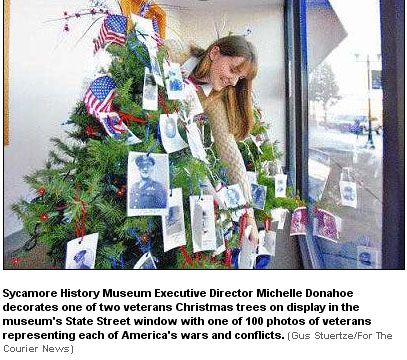
SYCAMORE -- Two little artificial Christmas trees stand in the window of the Sycamore History Museum, adorned not with silver or gold, but something much more valuable. Each tree has white lights, American flags and photos of veterans hanging from the branches.

These trees tell the stories of Sycamore-area veterans, Executive Director Michelle Donahoe said. The museum, 308 W. State St., is hosting its third annual veterans Christmas tree decoration.

"Viewers can learn more about their community," Donahoe said. "They can take a moment for all that these veterans did for them."

More than 100 photographs of men and women who served or are currently serving in the military were submitted to the museum, she said. The photographs state the veterans' names, the branch of military they served in and how many years they served. Veterans from the Civil War, World Wars I and II, Vietnam, the Korean conflict, Desert Storm and Operation Iraqi Freedom are all represented on the tree, Donahoe said.

She received photographs of couples who met while they were serving and who eventually got married. She added that their children brought in the photograph of their parents for remembrance. People walk by the trees and learn something new about the members of the community that they didn't already know, she said.

"People enjoy looking at and recognizing pictures of people they know," Donahoe said.

Click on 'Article Link' below tags for more...

In educational interest, article(s) quoted from extensively.

Andrea Noble for the Maryland Gazette:

Flowers, wreaths and even a miniature Christmas tree dot the 102 acres of Maryland Veterans Cemetery in Cheltenham on Crain Highway. But in the rear of the cemetery, in one of the oldest sections, almost all of the graves were bare of ornamentation, at least until Friday.

On Friday, a group of about 10 seniors from the Bowie Senior Center travelled by bus to the cemetery to lay 50 handmade wreaths, adorned with red bows and American flags, on the graves of the veterans buried there, including four of the seniors' family members.

Marion May, president of the Veterans of Foreign Wars Post 8065 Bowie Memorial Post, organized the excursion to honor veterans who may not have any family left to do so. She specifically picked an older section of the cemetery, which opened in 1978, on the premise that there may not be any surviving family members left to honor them. ...

"I don't think these guys get enough credit for what they do," said Bowie resident Mary Louise Estok, whose husband, Thomas, served during the Korean War and is still alive.

Bowie resident Cornelius Mabry, who served in the Vietnam War, had previously laid wreaths for unknown soldiers at Bowie Memorial Day services at Veterans Park in Bowie but had not been to Cheltenham before. Recalling the unpopularity of the Vietnam War, he said veterans' camaraderie and support for each other is important.

"The veterans have a soft place in my heart," said Bowie resident Pat Palarino, whose son and husband both serve in the Army.

Tim Karo for the San Francisco Examiner:

On a cold wet afternoon, the holiday spirit was brought to our veterans, thanks to the tireless effort of two brothers, Richie Lyon and Jimmy Scardino as well as their friends and family, along with staff and family members from Swords to Plowshares.

This year’s holiday dinner with all the fixings and a gift bag giveaway was for an estimated 270 homeless veterans, Tuesday December 16th 2008, at the Arc of Refuge Center on Howard Street here in San Francisco. The line was the longest ever seen according to one staff member from Swords to Plowshares, it seems that with all the social service cutbacks and the rising number of homeless veterans, this couldn’t of come at a better time, no one will be turned away.

And they weren’t, a festive occasion, complete with Christmas songs, turkey, lasagna, cole slaw, salad, and pumpkin pie. The participants were provided holiday cards to send to family and friends across California and The United States, to extend well wishes and to let others know all is well.

Christmas gifts (holiday backpacks) filled with all the essentials a person would need to survive in a shelter or on the streets during an abnormally cold December, were given out to each participant who came to the afternoon dinner. “The food was great” the spirit and sense of family was the best! which seemed to be the consensus of the participants, another veteran who served two tours in Iraq, who calls home golden gate park, characterized the experience as one of “belonging”, without being “hassled”.

Merry Christmas to our veterans we’ll never forget you and what you have done for us!

James Minton for the Louisiana Advocate:

Military veterans serving sentences at Dixon Correctional Institute donated 85 bikes Wednesday to organizations that will distribute them in time for Christmas to needy children in two parishes. The Veterans Incarcerated group raised the money to buy the bicycles and tricycles by operating a concession stand that serves the public during prison visiting hours.

“We’re still running that concession stand — every weekend,” said Robert Cox, the group’s inmate leader. The group has 28 members, and another six inmates who are not veterans also help out with the fundraising project, Cox said.

Nora N. Garza for the Texas Monitor:

Have you been enjoying the chilly weather? If you close your eyes, you can almost convince yourself that the icy drizzle splashing on your face is soggy snowflakes.

If the cold weather doesn't get you in the mood for Christmas, the goodwill and generosity being demonstrated all around us should. Many of the organizations associated with the Texas AgriLife Extension Service conduct special community service projects during this time of year.

On Tuesday, I had the joyful experience of singing with the Extension Education Association of Hidalgo County. Club members led patriotic songs and Christmas carols for residents at the Alfredo Gonzales Texas State Veterans Home in McAllen.

The songs about patriotism were made even more poignant when residents and staff lined the hallways earlier in the morning to honor a resident who had passed away. Taps was played as his body was wheeled away on a gurney.

The members of the Extension Education Association hosted the activity as a way to show appreciation for the sacrifices veterans and their spouses made for our country. Following the songfest, members hosted a merienda, serving bean tamales.

Jeff Muniz for WEEK-NBC [East Peoria, IL]:

A retired soldier is serving in a different way this December and that's earned him "Veteran of the Month" for the state. Ron Umdenstock from East Peoria earned the honor for his involvement in the "Gifts to Yanks Who Gave" Program.

For more than ten years, he's collected cash, wrapped presents and delivered Christmas gifts to veterans in hospitals and nursing homes. Nearly 8-thousand gifts go to Illinois veterans each year.

"If you go to the nursing homes and give these gifts out it's a real thrill. You'll have some real tears in your eyes when you go through that. A lot of veterans don't have anybody," Umdenstock says.

"I spent a little time in a hospital and the difference between getting a handmade quilt like what Ron gives out versus having to use a hospital sheet is a big difference," Illinois Department of Veterans' Affairs Director Tammy Duckworth says.

Besides the gifts, Umdenstock also helps veterans fill out paper work and even give them a ride to the doctor. Umdenstock makes it a goal to raise 150-thousand dollars each year and he has always reached that lofty figure or exceeded it.

Sharon Foster for American Forces Press Service:

A Christmas tree farm in Whitehouse, Ohio, is celebrating the holiday season by giving away 100 Christmas trees to military families.

“We've been giving trees to military families since the war started,” Duke Wheeler, owner of Whitehouse Christmas Tree Farm, said. “We feel it's important to let these families know that we appreciate their sacrifices. … We're grateful for all that they do.”

The tree farm is giving away 7-foot Christmas trees through Dec. 20 to military families who have a servicemember overseas or a servicemember who recently returned from duty. Family members can cut down their own tree at the farm or have it cut down while they wait. ...

For the program, trees are cut and collected from several Christmas tree farms around Veterans Day, and transported by the growers to the Ohio Department of Agriculture in Reynoldsburg to be inspected, packed into boxes and put on a FedEx truck for overseas shipment.

"This year alone, with 20 growers, we had 30 high school and middle school students come and help us pack 325 trees," Amy Galehouse, Operation Evergreen coordinator for OCTA, said.

Galehouse said the trees were shipped out Nov. 12 and arrived in Kuwait on Nov. 18. "It usually takes two weeks for the trees to get all the way to Afghanistan," she said. "Seventy-five went into Iraq, 100 into Kuwait and 150 into Afghanistan."

Wheeler says he is happy to...reach out to servicemembers and their families during the holidays. "This is just a small token, a simple 'thank you,'" Wheeler said.

And I do hope that freelancer J.P. Devine will oblige me the opportunity to share this large portion of his masterful article, which appeared in the Kennebec [Maine] Journal; I've left the last paragraphs off, so please do read it in full if you can:

You want to make a World War II veteran cry? Of course you don't. You have one in the family. So don't play "I'll Be Home For Christmas" this year. While you're at it, avoid "Have Yourself A Merry Little Christmas" and anything by Nat King Cole.

It's tough in any war to hear those songs when you're 17 or 18 and so far away from mashed potatoes and gravy; but remember, World War II was horribly different. In all the wars since that one, GIs got to come home once in a while. In Korea, it was basically a nine-month tour. In Iraq, I'm told, it was basically 18 months to two years. Now we have videos and the Internet and cell phones. Not to diminish any military pain, but In World War II, once you went overseas, unless you came home on a stretcher or in a box, you were there for the duration; and that was nearly four long years, in many cases.

The boys who landed on Omaha, if they got off the beach, went on through France, Belgium, and into Germany before they saw Mom and their girls again. They slept on the ground, in foxholes, in the snow, in bombed-out buildings; and they wore many of the same clothes for up to four years.

They already had done Africa and were pretty tired of missing Christmas in the snows of Maine all those years.

In the Pacific, my brothers tell me, Tokyo Rose was on the radio day and night, haunting and taunting the boys with sad songs from home, especially at Christmas. There was no one Rose. There were several Roses who tormented the boys by telling them their girls were fooling around on them at home, or that Mom was decorating the tree and crying. I don't think there is an Iraqi "Rose."

There they were, sleeping in the mud and waiting for mail that sometimes never came; and when it did, they had moved on to another village, another hole, another possible rendezvous with death.

But no matter where they were -- in a bombed-out church in France, a hole in the Ardennes or fighting malaria on Guadalcanal in the Pacific -- Christmas always came, and it was the most dreaded day of the year. If they were fighting hand to hand on Saipan, slogging through bloody mud in Burma or shivering at Bastogne, nobody knew if it was the Fourth of July or Valentine's Day or even a birthday. But they all knew when it was Christmas Eve and Christmas Day.

Even during the Korean War, the sad Christmas songs were torture. From patrols in the snow at Pyongyang to the Cherry Bar on a downtown side street in Tokyo, the sad dirges went on and on. We drank more, we cried more in the fabled "season of joy."

Keeping our veterans and military families in my heart throughout the season, especially those so far away from loved ones today.


Related Posts

Labels: , , , , , , , , , , , ,

In Their Boots: 'The War Within' Segment Covers Military Suicide

The ever-enlightening webcast series In Their Boots ran the heartbreaking story of Jeffrey Lucey -- a Marine who'd served during the initial invasion of Iraq and returned home safely only to commit suicide less than a year later, on June 22, 2004. He would be among the first wave of OEF/OIF suicides, leaving his parents, Kevin and Joyce Lucey, to be on the leading edge of the senseless pain now known to hundreds of military families.

While some suffer in silence -- a choice that is certainly to be fully respected and understood -- the Luceys were among the first to come forcefully forward to sound the alarm on the issue of suicide and our returning troops. Their story was again presented in a two-part In Their Boots segment, "The War Within," this month that I wasn't able to post on due to my finals.

[The Luceys were also generous enough to share their story in Moving a Nation to Care.] From In Their Boots:

Kevin, a therapist in Connecticut, and Joyce, a retired nurse, are the parents of three. Jeffrey was their only son. Ever since Jeff lost the battle with his PTSD, Kevin and Joyce have been advocating for the establishment of a realistic and efficient healthcare system, especially for veterans dealing with invisible wounds, like post-traumatic stress disorder. Part of that advocacy involves a lawsuit they've filed against the Veterans Administration for medical malpractice and wrongful death. [other lawsuits]

Dr. Judith Broder, Director of The Soldiers Project, joins the Luceys in the first episode (which ran on December 3), and Paul Sullivan, Executive Director of Veterans for Common Sense, adds his knowledge to the discussion to the second (which aired December 10). The videos are now up on YouTube.

For some reason, the YouTube audio is not working for the first segment; please view Chapter 1 at the In Their Boots site (you can also view Chapter 2 along with supplemental clips).

Click on 'Article Link' below tags for videos...

Chapter 2 - Part 1


Chapter 2 - Part 2


Chapter 2 - Part 3


Such suicides after a loved one has safely returned from combat are especially painful. My thoughts, evergreen as they have been, are with the Luceys and the hundreds of other military families whose lives have been pierced by this unique burden.

You are not forgotten.


Related Posts

Labels: , , , , ,

Wednesday, December 17, 2008

As Second Legal Attempt Fails to Force VA Hand on Claims Processing, Army Sued Over Discharged Veteran PTSD Disability Ratings

From CNN:

The U.S. Army intentionally denied benefits to soldiers suffering from a widespread stress disorder after they returned from service in Iraq and Afghanistan, a veterans advocacy group charges in a suit filed Wednesday.

The lawsuit [pdf], filed by the National Veterans Legal Services Program, accuses the Army of illegally cutting off benefits to thousands of veterans and their families by refusing to assign a proper disability rating to those veterans after they had been discharged with a diagnosis of post-traumatic stress disorder (PTSD). As a result, the veterans have been denied benefits, including, among other things, lifetime monthly disability payments and free medical care for themselves and their families. ...

All disabled veterans are assigned a disability rating from zero to 100 percent. According to the Legal Services Program, a rating of at least 30 percent is required to qualify for benefits such as monthly disability payments and free health care. Soldiers receiving less than a 30 percent rating are entitled only to a one-time lump sum severance payment after being discharged.

On October 14, the Defense Department ordered the Army to assign at least a 50 percent rating to all soldiers discharged with PTSD in the future. The lawsuit seeks to provide full benefits to all veterans discharged with PTSD in the past six years.


Click on 'Article Link' below tags for much more...

In educational interest, article(s) quoted from extensively.

OEF/OIF vets seeking help from Lawyers Serving Warriors should visit lawyersservingwarriors.org and submit information through the "Request Free Legal Help" button on the left side of the screen.

While one lawsuit is filed, another has been shot down.

Details on the second such challenge pointing to the VA system's inability to efficiently deliver health care services and process its disability claims in a timely fashion [details on the first lawsuit, now awaiting appeal, in extended] from Hope Yen of AP:

A federal judge on Wednesday rejected a bid by veterans groups to force the Veterans Affairs Department to speed up handling of its disability claims, saying it was not the court's role to impose quicker deadlines. Vietnam Veterans of America and Veterans of Modern Warfare, which represent roughly 60,000 military veterans, had filed the lawsuit asking the VA process initial disability claims within 90 days and resolve appeals within 180 days. If the VA failed to do so, the two groups were seeking interim payments of roughly $350 a month.

At a court hearing Wednesday, U.S. District Judge Reggie Walton said he was sympathetic to the plight of disabled veterans, many of whom he acknowledged might face unemployment and homelessness in a tightening economy. But Walton said that setting a blanket rule of 90 days for processing claims was a role for Congress and the VA secretary to decide.

Currently, thousands of veterans endure six-month waits for disability benefits and appeals that take years, despite promises by current VA Secretary James Peake and his predecessor, Jim Nicholson, to reduce delays. More recently, Congress passed legislation that sets up a VA pilot program aimed at speeding the processing of disability claims.

"It has to be appreciated that courts play a limited role," Walton told a courtroom filled with about two dozen veterans and their family members. "I am being asked here in a sense to run the VA and set in place a timeline that Congress has not."

"As much as I as an individual would like to see claims expeditiously concluded, ...I just don't see how I could provide the relief," he added. "If I did, I would be reversed in a heartbeat."

While this lawsuit has been struck down, another private suit has been filed against the VA by the family of a two-tour Iraq veteran who committed suicide in 2006.

Continuing from AP:

Noting that the backlogs have persisted for nearly a decade, [veterans' attorney Robert] Cattanach argued that the VA has no incentive or requirement to improve its practices without a clear deadline. ...But government attorney Ron Wiltsie countered that the VA is working to reduce delays and has made some improvement. In recent months, the VA has added dozens of claims processors and now says it has whittled delays from 178 days to about 163 days. The VA should be allowed to continue its work without micromanagement and blanket judgments from a federal judge who has not reviewed the individual cases, Wiltsie said.

The hearing comes as the VA is scrambling to upgrade government technology systems before new legislation providing for millions of dollars in new GI education benefits takes effect next August. On Saturday, the VA also said it was working to pay back millions of dollars in government benefits to surviving spouses of veterans who — due to computer glitches — were wrongfully denied disability checks during the month of their spouse's death.

On the claims backlog, Kelly Kennedy for Military Times:

Rita Reese, principal deputy assistant VA secretary for management, told Congress in January that the department would increase the number of fulltime case workers from 14,857 to 15,570, with a goal of reducing the disability claims backlog to 298,000 by the end of fiscal 2009, which would be a drop of 24 percent.

Following the news of the lawsuit's rejection, some good news: VMW executive director David Overton was able to meet privately with a Obama's transition team; by his account, the meeting buoyed him.

Now, some background on the earlier class action vs. the VA:

Back in June 2007, the first class action lawsuit to directly challenge the U.S. Department of Veterans Affairs' handling of disability claims processing (especially as it pertained to those coping with PTSD) was filed. The lawsuit, pointing to the VA's 600,000+ backlog of claims and long processing times that disabled veterans said prevented them from receiving life-saving mental health care services they earned, aimed to force the VA to do a better job.

At first, the government attempted to dismiss the suit in its entirety, arguing that vets have no legal right to expect specific types of medical care. The lawsuit, however, was allowed to move forward and, as the case proceeded through 2007, became the essential catalyst that moved media organizations to use their power to gather long-needed data from the government.

FOIA requests and investigations by CBS news revealed the first real numbers regarding OEF/OIF (and previous) veterans' suicides. In June 2008, controversial emails by VA officials caused an uproar, leading the judge -- who had heard closing arguments in April 2008 -- to re-open the case briefly in order to accept them into evidence.

In the end, the judged ruled [pdf] in favor of the VA.

June 2008, Pia Malbran of CBS News:

The non-profit groups Veterans for Common Sense and Veterans for Truth sued the VA claiming the agency, charged with taking care of US military veterans, is not properly processing health claims and not fully addressing the mental health needs of vets especially when it comes to suicide. The lawsuit, filed in San Francisco federal court as a pro bono case led by the law firm Morrison & Forester, did not ask for any money but rather that a judge step in and force the VA to better fulfill its federal responsibilities.

U.S. District Judge Samuel Conti allowed the case to go to trial and held almost three weeks of court hearings earlier this year. On Wednesday, Judge Conti announced his decision in the case.

The VA may not be meeting all of the needs of the nation's veterans,” Judge Conti said in an 82-page ruling. But, the ability to do anything about it is “beyond the power of this court.” Instead he noted that the authority rests in the hands of Congress and the VA’s Secretary. Judge Conti said he found “no systemic violations system-wide that would compel district court” to take action.

Gordon Erspamer, attorney on behalf of veterans suing the VA, held a press conference following Judge Conti's ruling:


Related Posts

Labels: , , , , , , , , , , , ,

Monday, December 15, 2008

National Resource Directory Offers Veterans One-Stop Info and Access to Myriad Health, Employment Services

Wonderful news:

The Department of Defense [last month] launched the National Resource Directory, a collaborative effort between the departments of Defense, Labor and Veterans Affairs.

The directory is a Web-based network of care coordinators, providers and support partners with resources for wounded, ill and injured service members, veterans, their families, families of the fallen and those who support them.

"The directory is the visible demonstration of our national will and commitment to As new links are added each day by providers and partners, coverage from coast to coast will grow even greater ensuring that no part of that journey will ever be made alone," said Lynda C. Davis, Ph.D., deputy under secretary of defense for military community and family policy.

Located at www.nationalresourcedirectory.org, the directory offers more than 10,000 medical and non-medical services and resources to help service members and veterans achieve personal and professional goals along their journey from recovery through rehabilitation to community reintegration.

"The VA is extremely proud to be a partner in this innovative resource. This combination of federal, state, and community-based resources will serve as a tremendous asset for all service members, veterans, their families and those who care for them. The community is essential to the successful reintegration of our veterans, and these groups greatly enhance the directory's scope," said Karen S. Guice, M.D., executive director, federal recovery care coordination program at the Department of Veterans Affairs.

-- Source: National Guard

I've been among those calling for something like this for some time now. Yet again this week I found myself carrying on about the need for such a database in an email exchange with the organizers of next month's Survivor Corps Community Reintegration Summit at the Carnegie Institution (I have been invited to attend).

It looks like we're getting closer to that goal.

Click on 'Article Link' below tags for more...

In educational interest, article(s) quoted from extensively.

Continuing:

"The National Resource Directory will prove to be a valuable tool for wounded, ill, and injured service members and their families as they wind their way through the maze of benefits and services available to them in their transition to civilian life. The Department of Labor is pleased to have the opportunity to work with our partners at DoD," said Charles S. Ciccolella, the assistant secretary of labor for the veterans' employment and training service.

The National Resource Directory is organized into six major categories: Benefits and Compensation; Education, Training and Employment; Family and Caregiver Support; Health; Housing and Transportation; and Services and Resources. It also provides helpful checklists, Frequently Asked Questions, and connections to peer support groups. All information on the Web site can be found through a general or state and local search tool.


Launching last month, (but, because I was completely inundated with finals prep, I missed its arrival), it looks to be a step in the right direction. Last year, so many frustrated community caregivers who came out on my book tour to share their resources and knowledge told me that they were at the ready, but having a difficult time connecting with the military members in their area who might have a need for their services or resources.

But the military wasn't willing to share their information. And so, veterans weren't coming in to make use of community-based help because they didn't know those services even existed.

But, how to get the word out? Online.

This younger generation of vets is highly Internet-savvy; they would have no problem using some sort of online searchable database to find what’s out there for them (one promise of the NRD). Veterans could easily seek these services out themselves – rather than having the community service providers tasked with doing it themselves.

I mentioned this to Congress last year when I testified (although by no means am I taking credit for the NRD):

Mr. SNYDER. So that is what I was getting at, the community-based resources. Even now, you are talking about our not really being called forward as a country, but think of where we will be 5 and 10 and 15 and 20 years from now when memories will have faded about our responsibilities, and we are still going to have families from these folks who are going to have these needs.

I think it is on the second page where the two of you recommend and you talk about complimentary counseling to all immediate family members. That is what triggered my thought because we need to have a system in this country of providing better mental health coverage because that need is going to be there for a lot of years for these families, and it may be generational. And I think that we are going to be grappling with it on this Committee, but we need to be grappling with it in our entire healthcare system.

Ms. MEAGHER. I do have one suggestion that could be easily done, and I would have done it myself if I only had the opportunity.

Mr. SNYDER. Yes.

Ms. MEAGHER. I think it could be easily done.

All of these resources that are out there—now, I am from Illinois, and the Bowmans are as well. We have National Guard troops. They come from the community.

Mr. SNYDER. Right.

Ms. MEAGHER. So they know the community. The community knows them. And there are resources available to them, but there is not a database. There is nothing where somebody who is sitting in Texas or in Illinois can simply just go to a database to see "what is available in my community." The military is not giving the information to the soldiers, and the soldiers do not know where to go often. They do not know that there are psychologists who are at the ready to donate their services. There are programs. There are all types of programs. So there could be a database. There could be something that is put together that has resources for people.

Not the most eloquent exchange on my part, I know. But it was the one recommendation I felt fully confident in making at the time.

The need was and is clearly there.

There are so many resources (many free), but their details are scattered far and wide. Some are listed online, others are not. Up until now, we've had Military OneSource -- lots of info in there; but, most of it strictly the "official" DoD/VA kind. It doesn't include all the free veterans reintegration retreats, or important conferences and other events that military families might be interested in attending.

I'm also pretty sure it doesn’t include all the writing or artistic expression workshops or free yoga or meditation classes that are right now being offered to our vets across the country.

I'm not sure that the new National Resource Directory will include all of these, either. If it doesn't, then I guess I'll still have something to agitate for. (If you head over to the NRD to kick its tires a bit, please consider leaving me your thoughts and feelings on the resource in comments. Would love to hear what you think of it.)

My feeling has been that we need to have an online searchable database created and funded properly that brings together *all* resources that are available to a veteran and his/her family. Not just military or VA resources in there; but all the big, medium and small organizations and groups and individuals in communities large and small who are doing things to help in their own corner of the world.

There are so many great things going on [events list] – free conferences, workshops, retreats, counseling, art programs (like the Vet Art Project orientation I attended on Saturday), etc.

While I understand the need to check each item placed in the database, I believe even the "lesser" offerings should go in alongside the more "official" stuff. If necessary, designate the lesser entries in some way to show that they are not fully sanctioned by the DoD/VA, but pass along the information nonetheless.

Military families can and should make some decisions for themselves about the style and direction of their reintegration and post-war care. Give them access to the myriad resources out there, and they'll feel they have more control over their health and well being.

They'll also see just how many civilians really do care.

Have a resource/service? Be sure to add it.

---

A few more details from the American Forces Press Service:

The National Resource Directory will include information on care coordinators, health care providers and support partners, Dr. Lynda Davis, deputy undersecretary of defense for military community and family policy, said during an “ASY Live” interview today on BlogTalkRadio.com.

"Working with wounded ill and injured servicemembers and their families, there [are] many resources and individuals available to help them," Davis said. "We needed one source that can tell us where everyone in the country is who wants to help our wounded warriors and their families."

The directory is part of a larger effort by the departments to improve wounded warrior care.


Related Posts

Labels: , , , , ,

Friday, December 12, 2008

This Weekend in Chicago: Veterans Art Project Event Explores the Warrior-Society Experience

Latest Vet Art Project event details for Feb '09 in my post Renaissance by Fire: Returning Veterans, Society & the Forging of a New Enlightenment. -- Ilona Meagher, 2/10/09

For years, I've been an unapologetic and unabashed fan of what I believe is the best guide to reintegration and transformation of both veteran and society: the book, "War and the Soul: Healing Our Nation's Veterans from Post-traumatic Stress Disorder." Written by Dr. Edward Tick, it was recommended to me by a Vietnam vet and friend as I began my research on my own slim volume.

Since then, I've had the chance to attend two of Tick's highly-recommended workshops over the years. And what I've observed is this: Tick is a soldier of service, providing warriors and civilians alike a chance to consider their impact on one another. His organization, Soldier's Heart, brings into being the ideas set down on paper in War and the Soul; the organization does a top job of bringing these two groups together to share each others' concerns and work toward solving each others' problems.

It's not a mistake to say that Dr. Tick and all of the people who work at Soldier's Heart have inspired me. And I'm not alone. Their work has also admittedly inspired Lisa Rosenthal, an author, playwright, writing coach and workshop leader who has transformed that inspiration into the ongoing Vet Art Project.

[See the VAP's full winter calendar of events].

On Saturday, she offers another community outreach program -- sponsored by the DuPage Writer's Group -- at the Carol Stream Public Library, beginning at 10 a.m. (please note the start time is 10 a.m.; I've spoken with Lisa today to confirm this, as the time is incorrect on the library's website). I'm excited to be able to attend the event now that my finals are behind me, and also because one or two of NIU's ace Veterans Club members may join me, too.

Details:

Vet Art Project Community Workshop and Meeting
Sat., Dec. 13th, 2008 - 10 a.m
Carol Stream Public Library
616 Hiawatha Dr
Carol Stream, IL 60188
630.653.0755

This event is an orientation for interested artists to explain how to get involved in the Vet Art Project that culminates in collaboratively created art about war for public performance or viewing. This workshop includes experiential exercises about war as well as information about the structure of the project, which will be in residence in February 2009 at the Chicago Cultural Center in the Studio Theater as part of their Incubator Series.

NOTE: Artists working in all media are welcome.

----

The Vet Art Project will be a part of the Incubator Series at the Chicago Cultural Center in February 2009. That means we'll have the whole month to build a supportive community, help veterans and their loved ones share their stories both orally and in writing in a small-group setting, and then area artists will work with the veterans to transform these stories into stagecraft, film, dance, music, and more.

The project will culminate with a performance at 7:30 p.m. on Feb. 23, 2009 when community members are invited to bare witness to these stories and this art. Visit Vet Art Project for important updates, including how to reserve tickets to this free performance, which requires advance reservations.

Official announcement.

An interview with Lisa Rosenthal, the program creator, goes into greater detail about this thoughtful community project. And in extended, you'll find news of last weekend's Global Spirit segment, "Forgiveness and Healing," featuring Dr. Tick.

[UPDATE Dec. 14, 2008]: I'll post a full report in the coming week on this event, but wanted to share a few photos [full set]:

VAP_0203 VAP_0200 VAP_0198 VAP_0193 VAP_02 VAP_04 VAP_0197

Click on 'Article Link' below tags for more...

In educational interest, article(s) quoted from extensively.

From the Soldier's Heart newsletter:

Dear friends,

The documentary, Forgiveness and Healing, which was filmed in part during the 2007 Soldier's Heart Journey to Viet Nam, led by Dr. Ed Tick, [aired] on LINK TV [last] week.

An 8-minute video excerpt of this episode is essential viewing:
www.linktv.org/programs/gs_forgiveness

Most world religions and wisdom traditions include teachings on the nature of forgiveness. From the notion of divine forgiveness to that of humans practicing forgiveness between one another, there are countless spiritual myths, lessons and teachings that explore the complex nature and process of forgiveness and reconciliation in their various forms.

Outside of the spiritual realm, psychologists, sociologists and doctors are among the scientific disciplines researching this perennial human need. The desire to forgive is widely recognized by the public, but they are often at a loss for ways to accomplish it. A 1988 Gallup poll found that 94% of people asked said it was important to forgive, but 85% said they needed some outside help to be able to do it.

The path to reconciliation can be just as challenging. According to The International Reconciliation Coalition reconciliation begins with individual acts of confession, but that “the greatest wounds in human history, the greatest injustices, have not happened through the acts of some individual perpetrator; rather through the institutions, systems, philosophies, cultures, religions and governments of humankind. Because of this, we, as individuals, are tempted to absolve ourselves of all individual responsibility.”

This episode of Global Spiritexplores forgiveness and healing on a personal and societal level, illuminating how spiritual practice and compassion can aid us on this most critical of journeys. Host Phil Cousineau brings together three guests who each approach the topic from a different angle. We see Ed Tick and his wife Kate Dahlstad take a group of traumatized Vietnam War vets back to Vietnam to help them learn the art of forgiveness – specifically, how to forgive themselves for what they did at war almost 40 years ago. Program guest Azim Khamisa is practicing the more typical “forgiveness of the other” as he traces how he learned to forgive the boy who murdered his own son. Now Khamisa works with the boy’s grandfather to foster forgiveness and healing with young audiences all over the world.

He who cannot forgive breaks the bridge over which he himself must pass. -George Herbert

----

LEARN MORE:

Soldier's Heart veterans return and healing project
Tariq Khamisa Foundation
Azim Khamisa's website
International Reconciliation Coalition

I'm checking to see if the full program will be re-run or is available for online viewing, and will post it as soon as that's available.


Related Posts

Labels: , , , , , , , ,

Wednesday, December 10, 2008

Study Finds PTSD Risk Rooted in Stress as Neuroscience Field Bids Farewell to "Patient H.M."

Last week, Henry Gustav Molaison -- a name most would not recognize even though he was the neuroscience field's most famous of patients -- passed away at the age of 80. Since 1953, when experimental brain surgery to alleviate severe epileptic seizures severely damaged his ability to lay down new memories, Molaison was known simply as "H.M."

From Wikipedia:

Henry Gustav Molaison (February 26, 1926 – December 2, 2008), better known as HM or H.M., was a memory-impaired patient who was widely studied from the late 1950s until his death. His case played a very important role in the development of theories that explain the link between brain function and memory, and in the development of cognitive neuropsychology, a branch of psychology that aims to understand how the structure and function of the brain relates to specific psychological processes.

Before his death, he resided in a care institute located in Windsor Locks, Connecticut, where he was the subject of ongoing investigation. Audio recordings from the 1990s of him talking to scientists were released in early 2007. Henry loved to do crossword puzzles, play bingo, watch TV, and socialize with the people who took care of him.

Not surprisingly, in February 2007, NPR's Weekend Edition [listen] introduced their audience to the man whose ill-fated surgery gave scientists a clearer window into the body's most complex and vital organ: the brain. The program also provides a short introductory primer on memory and the brain.

Due to PTSD and memory's unique relationship -- with past traumatic experiences feeling vivid, painfully immediate and even more "real" than recent events rather than the distant memories they should be for its sufferers -- H.M. (who was an "n of 1," or the only person who is known to have had the surgical procedure performed on him; therefore, the only one available in this specific research pool) increased our knowledge base in this area, too.


In extended, a journey into the world of Molaison's amnesia, along with a host of fresh research coming out on the subject.

Click on 'Article Link' below tags for more...

In educational interest, article(s) quoted from extensively.

Introduced in the NPR program mentioned above was Joanna Schaffhausen, the neuroscientist who wrote her PhD dissertation on her famous patient, and spent 40 years at his side. She writes of him in Brain Connection:

When twenty-seven year old Henry M. entered the hospital in 1953 for radical brain surgery that was supposed to cure his epilepsy, he was hopeful that the procedure would change his life for the better. Instead, it trapped him in a mental time warp where TV is always a new invention and Truman is forever president. The removal of large sections of his temporal lobes left Henry unable to form any new personal memories, but his tragic loss revolutionized the field of psychology and made "H.M." the most-studied individual in the history of brain research.

Henry grew up outside of Hartford, Connecticut, and was by all accounts an amiable young man with above average intelligence. He liked to go ice skating and to listen to mystery shows on the radio, which he enjoyed because he could often deduce the villain ahead of the program detective. Then on his sixteenth birthday, Henry had his first grand mal seizure during a celebratory trip to the city with his parents. After that point, the paralyzing seizures arrived with increasing frequency, until by the summer of 1953, he was experiencing as many as eleven episodes per week. He was unable to hold a steady job, and his prospects for independent living seemed dim. There were not many effective treatments available for epilepsy in 1953, so it was with a mixture of hope and trepidation that Henry's family turned to Dr. William Scoville and his experimental surgery.

The idea behind the surgery was simple. Seizures, as Scoville correctly reasoned, are caused by uncontrolled electrical impulses that start in a localized area and then spread throughout the rest of the brain. If one could remove the part of the brain where the seizures originated, it should be possible to cure the epilepsy. Henry had the most common form of the disease, called temporal lobe epilepsy, which meant that his seizures began in the tissue located on either side of his brain.

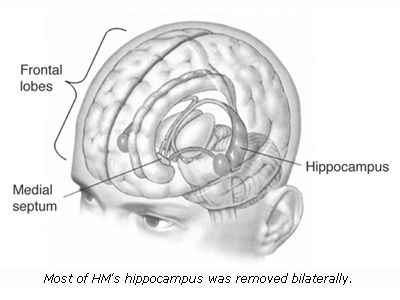
Dr. Scoville removed a large chunk of Henry's right and left temporal lobes, which was a crucial decision because the brain is symmetrical and thus most important structures are duplicated. Altogether, Henry lost about a fist-sized portion of his brain, which encompassed (on both sides) the hippocampus, the amygdala, and the entorhinal and perirhinal cortices. As it turns out, the hippocampus is crucial for memory storage. When he lost his hippocampi, Henry became frozen in 1953, remembering very well the events before his operation but unable to create any new memories. He describes the experience like this:

"Right now, I'm wondering, have I done or said anything amiss? You see, at this moment everything looks clear to me, but what happened just before? That's what worries me. It's like waking from a dream. I just don't remember."

While H.M.'s brain functions were altered as a result of physical effort during the surgical procedure, psychological damage has been shown to have an effect on the hippocampus region as well:

Psychological trauma has great effects on physical aspects of patients’ brains, to the point that it can have detrimental effects akin to actual physical brain damage. The hippocampus...is involved in the transference of short term memories to long term memories and it’s especially sensitive to stress. Stress causes glucocorticoids (GCs), adrenal hormones, to be secreted and sustained exposure to these hormones can cause neural degeneration. The hippocampus is a principal target site for GCs and therefore experiences a severity of neuronal damage that other areas of the brain do not[7].

In severe trauma patients, especially those with Post Traumatic Stress Disorder, the medial prefrontal cortex is volumetrically smaller in size than normal and is hyporesponsive when performing cognitive tasks, which could be a cause of involuntary recollection (intrusive thoughts)[8]. The medial prefrontal cortex controls emotional responsiveness and conditioned fear responses to fear-inducing stimuli by interacting with the amygdala. In those cases, the metabolism in some parts of the medial prefrontal cortex didn’t activate as they were supposed to when compared to those of a healthy subject.

J. Douglas Bremner, the director of Emory University's Center for Positron Emission Tomography and an associate professor of psychiatry and radiology at Emory's school of medicine, explains how patient H.M. moved neuroscience field's understanding of PTSD forward in his book, "Does Stress Damage the Brain?: Understanding Trauma-Related Disorders from a Neurological Perspective."

First, a bit of background:

Working as Medical Director at the VA's first specialized post-Vietnam hospital-based treatment program in West Haven, Conn., Bremner noticed that patients were consistently missing counseling appointments. When asked about this, they relayed that they simply forgot about them.

While the unit's psychiatrists chalked all of this up to their unconscious resistance to treatment, Bremner wasn't so sure. After having observed "damaging effects of glucocorticoids released during stress on the hippocampus" in firemen, he wondered if his vets were also suffering the same stress-induced brain damage.

From "Does Stress Damage the Brain?," p. 112-113:

Another thing I noticed about these patients is that they remembered things that happened in Vietnam very vividly. One of my patients would bring me scrapbooks with pictures of him and his friends in Vietnam. He would talk about his friends as if he had seen them the day before. However, he couldn't remember what he had for breakfast that morning, and could only vaguely describe what was going on in his current daily life. ...

These PTSD patients appeared to be suffering from an inability to learn new things. However, their memories of long-ago events were intact. These patients were very similar to patients suffering from what we call neurological amnesia, which is caused by strokes or tumors that specifically affect the hippocampus.

A well-known example of this is the patient H.M., who had strokes affecting the hippocampus on both sides of his brain. He could carry on normal conversations, and remember everything that happened in his life very clearly before the stroke occurred. However, since the time of the stroke he couldn't learn anything new (Scoville & Milner, 1957). [Ed. note: My understanding is that the surgery to prevent H.M.'s frequent strokes is what damaged the area of the brain related to memory, not the stroke itself.]

He spent his days reading one copy of the Reader's Digest. When he got to the end, since none of the articles stayed in his memory, he would just start all over again. [...] My patients with PTSD have similar experiences.

Based on the observations and the studies of the effects of stress on the hippocampus, my colleagues and I became interested in studying memory disturbances in our PTSD patients. We administered tests of memory, such as remembering a story or a list of words, that had been shown to be related to neuron (the basic cells of the brain) loss in the hippocampus. [...]

These studies led us to conclude that stress may have resulted in damage to the hippocampus in PTSD patients, and that this could explain the memory problems we had observed. PTSD patients have trouble remembering things like what to buy at the grocery store, or appointments they have made.

(Even more alarming: Those suffering with PTSD may also have difficulty remembering to take or recalling if they've already taken their medications, which may lead to under- or over-medication.)

Recent studies related to memory loss and PTSD:

  • In August 2006, a study revealed that "Iraq [veterans] are more likely than other U.S. soldiers to suffer mild memory and attention lapses back home, but they also tend to have better reaction time, at least in the short-term, a study found. ... The study involved 654 soldiers who took mental-function tests a few months before going to Iraq in mid-to-late 2003 and within three months after returning in 2005. The researchers noted subtle changes in their scores. If the changes persist, "that's where you have to worry about people developing stress-related emotional problems like post-traumatic stress disorder," Vasterling said."

  • In January 2007, a study involving New Yorkers in the vicinity of the September 11 attack found that "people who were within about two miles of Ground Zero on that day now retain especially vivid, detailed recollections of the scenes and events of that morning -- a kind of recall that experts call "flashbulb memories." Brain imaging suggests that these memories are especially strong because the amygdala -- a brain area focused on fear and memory -- kicked into high gear as these people watched that morning's catastrophic events unfold."

  • In February 2007, a study suggested "hyperactivity in a region of the prefrontal cortex might contribute to disorders of learned fear in humans, such as post-traumatic stress disorder. While building on previous findings, the study contradicts prior thinking that the amygdala, which plays a central role in emotional learning, is sufficient for processing and expressing fear. The findings, say the researchers, open the potential for new avenues of treatment."

  • In April 2007, a study "evaluated 15 pre-adolescent children with symptoms of PTSD, including nightmares and uncontrollable flashbacks, extreme agitation and emotional numbness. ...They found that kids with more severe PTSD symptoms had more cortisol in their blood and their hippocampi decreased in volume. "What that means is that the higher your symptoms of PTSD, or the higher your level of cortisol, the higher your chances of having a decrease in the size of this structure," Carrion notes, adding that this was the first time researchers have really seen that connection, indicating how cortisol might be related to the hippocampus."
Yesterday, the latest study arrived. Amanda Gardner for HealthDay:

A decade-long study into post-traumatic stress disorder among combat veterans and their identical twins has yielded critical information on the root causes of this devastating condition.

The researchers found that both genetic and environmental factors increase the risk of developing post-traumatic stress disorder (PTSD). The work, to be presented Tuesday at the American College of Neuropsychopharmacology annual meeting in Scottsdale, Ariz., was sponsored by both the U.S. National Institute of Mental Health and the Veterans Administration.

"In addition to building our understanding of how PTSD comes to exist, we may have useful signs for PTSD prevention and treatment," study author Dr. Roger Pitman, a professor of psychiatry at Harvard Medical School, said during a recent teleconference on the research. "For example, persons with recognized PTSD risk factors may be best advised to avoid occupations that would have them serve in highly stressful situations, such as serving in military forces. Things acquired as a result of stress are more likely to be reversed by treatment and could be taken as targets of PTSD treatment."

Scientific American also chimed in yesterday with an important piece called "The Amnesia Game" by Rajamannar Ramasubbu:

...[I]n some individuals, extremely stressful or traumatic events can induce amnesia, so that they lose the ability to remember what happened. In some instances this loss can lead to the erasure of a vast amount of memory, so that people even forget basic facts about their identity, such as where they live or what their name is.

Amnesia induced by negative emotions is considered a psychological defense mechanism that protects the organism from the consequences of extreme trauma and catastrophic fear. However, recent studies suggest that emotion induced memory loss can also prevent appropriate coping mechanisms, so that people never learn to deal with their painful emotions. (Even if these emotions can’t be recalled, they can still linger below the surface and have psychological consequences.) Hence, understanding how negative emotions induce amnesia, and why only some people who are exposed to traumatic events develop emotion induced amnesia, may have clinical and preventive implications. ...

[In a new study] authors conclude[d] that emotion induced memory is a complex phenomenon influenced by multiple genes. Although serotonin transporter genes may play a role in regulating emotion induced retrograde amnesia, they do not seem to underlie all forms of emotion-induced memory loss.

The amygdala is a brain region critical for the experience and expression of emotion as well as for the consolidation of emotional memory. At a modest level of activation, the amygdala seems to augment the function of the hippocampus, a brain region involved in the formation of long-term memory. When the amygdala is greatly excited, as during traumatic events, however, hippocampal function is inhibited and memory impairment is triggered. ...

One potential implication of this research involves preventative genetic testing. By screening high risk subjects for the 5-HTTLPR short variant genotype—including in military personnel or survivors of childhood trauma—doctors and therapists can better focus their energies. In theory it should also be possible to develop medications or cognitive strategies that regulate or suppress the expression of serotonin transporter short variant genes, which should be useful in preventing and treating PTSD or other stress induced psychiatric disorders.

Well, that's a lot of data for any tired, old brain to absorb. But, good news arrived last month on the benefits of being online:

A new UCLA study, part of the growing research into the effects of technology on the brain, shows that searching the Internet may keep older brains agile - it's like taking your brain for a walk. It's too early to conclude that technology will help vanquish Alzheimer's disease, but "our study shows that when your brain is on Google, your neural circuitry changes extensively," said psychiatrist Gary Small, director of UCLA's Memory & Aging Research Center.

The new study, which will be published next month in the Journal of Geriatric Psychiatry, comes at a time when medical experts are forecasting that Alzheimer's cases will quadruple by 2050. In response to such projections, "brain-gyms" and memory-building computer programs have proliferated.

The subjects in Small's nine-month study were 24 neurologically normal volunteers ages 55 to 76, with similar education levels. They were assigned two tasks: to read book-like text on computer screens and to perform Internet searches. ...

MRI results showed that both text reading and Internet searching stimulated the regions of the brain controlling language, reading, memory and vision. But the Internet search lit up more areas of the brain, additionally activating the regions controlling complex reasoning and decision making. The increased brain activity, which is probably due to the many rapid choices such searches involve, suggests that subjects had a richer sensory experience and heightened attention.

By focusing on older users, Small said, he aimed to fill a gap in brain research. Few studies have looked at the effects of technology on these "digital immigrants," who began using computers later in life than their younger counterparts, the "digital natives." Small's study was started as part of the research for his latest book, "iBrain: Surviving the Technological Alteration of the Modern Mind."

"Our findings point to an association between routine Internet searching and neural circuitry activation in middle-aged and older adults," the study said. "Further study will elucidate both the potential positive and negative influences of these technologies on the aging brain." The implications are provocative, particularly because it is well known that developments in technology affect human behavior.

"People who are more adept with the technology will be more successful in society, and their offspring will be more likely to excel," Small told The Chronicle.

Cheers to massaging that brain muscle!


Related Posts

Labels: , , , , , , , , , , , ,

Tuesday, December 09, 2008

Wednesday Deadline to Send Red Cross Holiday Mail for Heroes


Who says nothing's for free?

Tomorrow -- Wednesday, December 10 -- is the last day to participate in the Red Cross Holiday Mail for Heroes program. The program is a "partnership between the American Red Cross and Pitney Bowes to deliver one million holiday cards to American service members, veterans and their families in the United States and around the world."
Download free postcards [pdf] or mail your own to the address below, following all the rules below to ensure it gets delivered:

Holiday Mail for Heroes
PO Box 5456
Capitol Heights, MD 20791-5456

Please follow all rules below:

  • All cards must be postmarked no later than Wednesday, December 10, 2008. Cards postmarked after this date will be returned to sender.
  • If sending more than one card, please mail all cards together in one large shipping envelope. Cards sent in this manner do not need individual envelopes or postage.
  • Ensure that all cards are signed.
  • Use generic salutations such as “Dear Service Member.”
  • Do not include personal information, like email or home addresses.
  • Do not send letters.
  • Please do not include inserts of any kind, including photos, glitter, confetti, gift cards or calling cards. Any items inserted into cards will be removed during the reviewing process.
  • All cards received may be used in program publicity efforts, including appearing in broadcast, print or online mediums.
  • Phone cards or gift cards will not be accepted with the holiday cards. Those wishing to send calling cards or gift cards/certificates should go to www.aafes.com, scroll down to "AAFES Community Connection" and click on "Help Our Troops Call Home" or "Gift Cards/Certificates for Our Troops" in order to send such items.
  • No 'Care Packages' will be accepted at this address. Those wishing to send care packages should go to www.AmericaSupportsYou.com and click under "Homefront Groups" to find out how to send care packages.

Labels: , , ,

VA Begins Major Expansion of Outpatient Services

From the VA:

World-Class Health Care Brought Closer to More Veterans

WASHINGTON – Veterans will have easier access to world-class health care under a Department of Veterans Affairs (VA) plan to open 31 new outpatient clinics in 16 states. Secretary of Veterans Affairs Dr. James B. Peake announced [on December 4, 2008 the] VA will establish new clinics in Alabama, Arkansas, California, Florida, Georgia, Hawaii, Illinois, Iowa, Maryland, Michigan, Minnesota, Mississippi, Missouri, North Carolina, Pennsylvania and Vermont. ...

With 153 hospitals and about 745 community-based clinics, VA operates the largest integrated health care system in the country. VA’s medical care budget of more than $41 billion this year will provide health care to about 5.8 million people during nearly 600,000 hospitalizations and more than 62 million outpatient visits.

“Community-based medicine is better medicine,” said Dr. Michael Kussman, VA’s Under Secretary for Health. “It makes preventative care easier for patients, helps health care professionals have closer relationships with their patients and permits easier follow-ups for patients with chronic health problems.”

The community-based outpatient clinics, or CBOCs, will become operational by late 2010, with some opening in 2009. Local VA officials will keep communities and their veterans informed of milestones in the creation of the new CBOCs.

Full list of proposed VA outpatient clinics.

The VA and the State of Louisiana also recently "jointly announced the selection of adjacent downtown sites for construction of their replacement medical center projects. The two projects, called the Veterans Affairs Medical Center and the Louisiana State University Academic Medical Center, restore greatly needed health care capability lost in New Orleans during flooding after Hurricane Katrina in late August 2005."

Click on 'Article Link' below tags for more...

In educational interest, article(s) quoted from extensively.

On November 17, 2008, a new travel reimbursement rate went into effect aiming to ease the financial burden placed on veterans who currently have far distances to travel to access VA health care services:

The U.S. Department of Veterans Affairs (VA) announced today that eligible veterans will see an increase in the mileage reimbursement they receive for travel to VA facilities for medical care. Secretary of Veterans Affairs Dr. James B. Peake announced today that he will use his authority to raise the mileage reimbursement from the 28.5 cents per mile to 41.5 cents per mile for all eligible veterans.

“We owe it to our veterans to give them the best care possible,” said Peake. “The increase will once again provide assistance to our veterans, especially in these difficult economic times, to help offset gasoline costs and to assist veterans with access to the VA’s world-class health system.”

Congress, which mandates such increases, recently provided funding to VA to increase the reimbursement rate, which goes into effect on November 17, 2008. Service connected veterans, veterans receiving VA pensions, and veterans with low incomes are eligible for the reimbursement. ...

While increasing the payment, the current deductible amounts applied to certain mileage reimbursements will remain frozen at $7.77 for a one way trip, $15.54 for a round trip, and capped at a maximum of $46.62 per calendar month. On January 9, 2009, these deductibles will decrease to $3 for a one way trip, $6 for a round trip, with a maximum of $18 per calendar month. Deductibles can be waived if they cause a financial hardship to the veteran.

And for anyone not able to travel to the nearest VA, a new program kicked off at the end of October 2008, and continues to roll out -- possibly to a town near you:

The first of a fleet of 50 new mobile counseling centers for the Department of Veterans Affairs (VA) Vet Center program was put into service today with the remainder scheduled to be activated over the next three months.

Our widespread distribution of this fleet from coast to coast marks a new chapter in VA's innovation to reach rural and underserved veterans with high-quality readjustment counseling,” said Secretary of Veterans Affairs Dr. James B. Peake. Each vehicle will be assigned to one of VA's existing Vet Centers, enabling the center to improve access to counseling by bringing services closer to veterans.

The 38-foot motor coaches, which have spaces for confidential counseling, will carry Vet Center counselors and outreach workers to events and activities to reach veterans in broad geographic areas, supplementing VA's 232 current Vet Centers, which are scheduled to increase to 271 facilities by the end of 2009.

Vet Centers, operated by VA's Readjustment Counseling Service, provide non-medical readjustment counseling in easily accessible, consumer-oriented facilities, addressing the social and economic dimensions of post-war needs. This includes psychological counseling for traumatic military-related experiences and family counseling when needed for the veteran’s readjustment.

The team leader at each Vet Center will develop an outreach plan for use of the vehicle within that region, not being limited to the traditional catchment area of a particular Vet Center.

These vehicles will be used to provide outreach and direct readjustment counseling at active-duty, reserve and National Guard activities, including post-deployment health reassessments for returning combat service members.

The vehicles will also be used to visit events typically staffed by local Vet Center staff, including homeless "stand downs," veteran community events, county fairs, and unit reunions at sites ranging from Native American reservations to colleges.


Related Posts

Labels: , , , , , ,

Monday, December 08, 2008

Talking Post Trauma Blues: Will Obama Make PTSD a Household Name?

One of my favorite female OIF vets, Abbie Pickett, shared the following video on her facebook page. (If you're a frequent reader of PTSD Combat and wish to connect with me via my facebook account, you're invited to do so; I frequently post PTSD-related content via that channel when I'm pressed for time -- which is often when my semesters are in full-swing).

The video is for a song called "Talking Post Trauma Blues."


Meanwhile, Colleen Perry writes over at Huffington Post today:

PTSD or Post Traumatic Stress Disorder may not be a "household name" yet, but it soon will be. As our combat veterans return from Afghanistan and Iraq, we will be inundated, as a country, with cases of PTSD and TBI, traumatic brain injury. ...

I can tell you from personal experience that the symptoms of PTSD affect not only the soldier, but their entire family, their friends and often, their employers. Some of you may remember when the U.S. invaded Panama in the early 1990's. Most of you have probably forgotten that little skirmish, but select special forces troops like the Army Rangers were sent in. My brother, Jamie, was among them. He and others parachuted under the cover of darkness into the jungle.

After his return, my brother was never the same. He experiences bouts of uncontrollable anger which have contributed to the dissolution of most of his personal relationships, including ours. In addition, he suffered some profound changes to his personality, as though his moral compass went missing. After being lied to and stolen from by him on many occasions, I made the heartbreaking decision to eliminate contact with my brother. My father and the three mothers of his three children have made the same choice. My mother continues to believe in him and tries to help him whenever he is in trouble, which is often.

This in and of itself has caused a tremendous strain on my relationship with her. As you can see, there isn't a member of his family that hasn't been impacted by his untreated PTSD, including his children. I truly wish that love alone were enough to heal his pain.

Click on 'Article Link' below tags for more...

In educational interest, article(s) quoted from extensively.

Continuing:

In the private sector there are wonderful organizations bringing their skills and talents to helping our combat veterans. One of them here in California is called The Soldiers Project of which I am a part. We are therapists, psychologists and social workers specially trained in treating PTSD who volunteer our time to seeing combat veterans in our offices. I am very new to this organization, and there have been many giving freely of their time for years now. But this is not enough.

We need a national commitment with money behind it to develop comprehensive treatment programs and education aimed at erasing the stigma of seeking therapy and treatment upon their return home. In our current state of economic crisis I fear these types of programs will be put on the back burner, but the way I see it is the cost of turning our backs on the needs of our military men and women, we are setting ourselves up for the same fallout that occurred after Vietnam, affecting millions of families and our society as a whole for generations to come. President-elect Obama, are you listening?

Obama, in fact, is listening...and has been doing.

Looking back over the past few years, one of the more exasperating elements of our national leadership has been the fact that they have failed to take the reintegration problems of our returning veterans seriously. They failed to ask society to help military families with their work once their loves ones returned home, and they failed to rally organizations already providing mental health care to hard-to-reach rural areas or jam-packed cities to come on board to assist the overwhelmed VA system.

Back in February 2006, I wrote a piece called, "Unutterable: For Reagan it Was AIDS. For Bush, PTSD?" At the time, I'd searched the White House transcripts database to see how often administration leaders had referenced the term, and came up short.

Even today, I think I can count on one hand -- and perhaps have 4 digits left with nothing to do -- how often I've heard President Bush utter or discuss PTSD. Obama, refreshingly, doesn't seem to have a problem broaching the topic that directly concerns so many of our military families.

Why should it be sheltered and locked away, held inside four walls and the battered and bruised bodies and minds of countless veterans returning home from war?

No, at least at the outset, we are in good hands for a change.

In the Senate, Obama called for oversight when we learned that troops were being deployed, diagnosed w/PTSD and medicated for it, to the combat zone. Obama also called for an Army Mental Health Services investigation when it was reported troops at Fort Carson were being stigmatized and kept from seeking help for their PTSD and reintegration difficulties.

The Senator from my home state of Illinois also introduced the Lane Evans Act and the Dignity for Wounded Warriors Act, and supported other military-friendly legislation.

Obama also jumped in when he heard of the 22,000 OEF/OIF vets given personality disorder discharges perhaps in lieu of the PTSD they might instead have been suffering from (PD discharges strip their recipients of much of their VA healthcare benefits, leaving treatment of their possible PTSD symptoms to community service safety nets rather than the federal government).

When the press began digging deeply, reporting that OEF/OIF VA PTSD cases jumped by 20,000 in one year -- to over 50,000 officially diagnosed (a figure that exceeded the number of official wounded in action as reported by the Pentagon at the time), Obama was again there to demand the DoD release all of their data on the matter.

Judging by his comments on PTSD yesterday while presenting Shinseki as his choice for VA Head, we -- and our military families -- are in better hands now than we've been in years:

"For many of today's troops and their families, the war doesn't end when they come home," Obama said at a press conference in Chicago. But "far too few" are receiving the treatment they need to cope with post-traumatic stress disorder and traumatic brain injury, he said. Obama pledged to cut red tape, eliminate budget shortfalls and help ease the transition back to civilian life for troops returning to a troubled economy.

"No one will ever doubt that this former army chief of staff has the courage to stand up for our troops and our veterans," Obama said of Shinseki. "He has always stood on principal because he has always stood with our troops, and he will bring that same sense of duty and commitment to insuring that we treat our veterans with the care and dignity that they deserve."

For his part, Shinseki promised to open new doors of opportunity for returning troops through the VA, which is the second largest US government agency after the department of defense. "Even as we stand here today, there are veterans who have worried about keeping their health care or even their homes, paying their bills or finding a good job when they leave the service," Shinseki said.

"They deserve a smooth, error-free, no-fail benefits-assured transition into our ranks as veterans, and that is our responsibility. Not theirs."

There's a lot of work to do, no doubt about it.

But, for the first time in almost four years of following and reporting on this issue, I'm really hopeful. We have someone who cares about this issue at the very top. (It's also wonderful to know that the lady most intimate with the President, Mrs. Obama, says she will be aggressively taking up the cause of helping our military families.)


Related Posts

Labels: , , , , , , , , , ,

Sunday, December 07, 2008

Response to Rebuked Army Chief of Staff Eric Shinseki's Selection as Next VA Secretary

"You must love those you lead before you can be an effective leader. You can certainly command without that sense of commitment, but you cannot lead without it. And without leadership, command is a hollow experience, a vacuum often filled with mistrust and arrogance." -- Retired Gen. Eric K. Shinseki, June 2003 farewell speech

On Pearl Harbor Day, Obama makes a stellar choice.


From the BBC:

United States President-elect Barack Obama has chosen the former army chief of staff, Eric Shinseki, as his secretary of veterans' affairs.

Mr Obama told NBC television that General Shinseki was "exactly the right person" to honour returning soldiers. Gen Shinseki left his top army job after disagreeing with the defence secretary over troop levels needed in Iraq after the invasion. He was the first four-star general of Japanese-American ancestry.

Iraq disagreement
Mr Obama made his comments ahead of a press conference on Sunday in Chicago to announce the appointment. Gen Shinseki's time as chief of staff from 1999 to 2003 was marked by constant tensions with then-Defence Secretary Donald Rumsfeld, particularly over the issue of Iraq.

In 2003 he testified to Congress that it might take several hundred thousand US troops to control Iraq after the invasion. His estimate was dismissed by Mr Rumsfeld, and he was ousted from his job within months.

But Mr Obama said he was suitable for the post of veteran affairs because he "was right" in predicting that the US would need more troops in Iraq than Mr Rumsfeld believed at the time.

Click on 'Article Link' below tags for more reaction...

In educational interest, article(s) quoted from extensively.

James Fallows for The Atlantic:

One of the truly nauseating moments in the run-up to the Iraq war was the humiliating public rebuke that Paul Wolfowitz, then Donald Rumsfeld's #2 at the Pentagon, delivered to Eric Shinseki, then a four-star general serving as Army chief of staff.

Shinseki, a wounded combat veteran of Vietnam, was by career and reputation a cautious, methodical person. Those who criticized his performance as Army chief mainly complained that he was too traditional and non-innovative in his approach. Thus, he was constantly at odds with Rumsfeld's crew, who viewed him as a passive-aggressive, fuddy-duddy obstacle to doing things in their new lean-and-mean way.

The showdown came just before the war began. Shinseki, who had direct experience with land warfare (in Vietnam) and post-combat occupation (in the Balkans), was urging that the U.S. go in with a force large enough to ensure that it could maintain order and genuinely control Iraq's sizable territory and potentially fractious society after it ousted Saddam. Rumsfeld and Wolfowitz hated this whole idea.

After the jump, a passage from my Atlantic article and subsequent book, both called Blind into Baghdad, describing what happened next. I think this also explains why it is so satisfying and right that Barack Obama will (reportedly) name Shinseki to his Cabinet as the Secretary of Veterans Affairs.

Here's one other point that is not as widely known as Rumfeld's and Wolfowitz's bullying of Shinseki: Despite being unfairly treated, despite being 100% vindicated by subsequent events, Shinseki kept his grievances entirely to himself. Although my book contains accounts of Shinseki's inside arguents with Rumsfeld et al, and his discussions with his own staff, zero of that information came from Shinseki.

I made a complete nuisance of myself requesting an interview, or a phone conversation, or an email exchange, or even some "you're getting warmer" guidance from him. Nothing doing, in any way. (I did track him down at an ROTC commissioning ceremony where he was speaking; he greeted me politely, but that was it.) I am confident in the accounts I presented, which came from a variety of first-hand participants; but Shinseki, who could have had a lucrative career on the talk show/lecture circuit giving "I told you so" presentations, has not indulged that taste at all.

So congratulations to Eric Shinseki, who has stoically served his country for decades and was wounded in that cause, in several senses, on this new honor -- and on the responsibility to help others who have served. Congratulations, too, that a Japanese-American patriot from Hawaii should receive this news on December 7. And not just congratulations but wonderment at the Obama team's deftness in the symbolism and substance of this choice.

Details of Shinseki-Wolfowitz showdown...


From PolitickerCA:

Senator Leland Yee (D-San Francisco/San Mateo), chair of the Senate Select Committee on Asian Pacific Islander Affairs, issued the following statement in response to President-elect Barack Obama’s selection of Gen. Eric Shinseki as the next Veteran Affairs Secretary:

“As the son of a WWII veteran, I commend President-elect Obama on the selection of Gen. Shinseki for Veterans Affairs Secretary. Gen. Shinseki was prophetic when he testified to Congress in 2003 that it would take hundreds of thousands of US troops to stabilize Iraq after an ill-conceived invasion. As a recipient of two Purple Hearts, he understands the needs of our veterans and the dismal failure of the Bush Administration in caring for those returning from war. Under Gen. Shinseki veterans will finally receive the treatment and respect they deserve and more importantly, earned. Once again, President-elect Obama is ensuring that his administration reflects the great diversity of our nation and at last puts the needs of all Americans first.” ,

In 2003, Gen. Shinseki talked about how an administration could put America first. He said, "You must love those you lead before you can be an effective leader. You can certainly command without that sense of commitment, but you cannot lead without it. And without leadership, command is a hollow experience, a vacuum often filled with mistrust and arrogance."

From IAVA:

Today, Iraq and Afghanistan Veterans of America (IAVA), the nation's first and largest nonpartisan organization for veterans of the wars in Iraq and Afghanistan, issued the following statement in response to President-elect Obama's nomination of General Eric Shinseki to serve as the Secretary of the Department of Veterans Affairs:

"IAVA applauds President-elect Obama and the transition team for making this historic selection. General Shinseki has a record of courage and honesty, and is a bold choice to lead the VA into the future. The President-elect has demonstrated an understanding of the urgency of the issues facing America's veterans by making this announcement early. General Shinseki is widely-respected, honest and experienced. He is a man that has always put patriotism ahead of politics, and is held in high regard by veterans of Iraq and Afghanistan. IAVA looks forward to supporting him to implement the historic change that is needed at the VA. ...

General Shinseki has a monumental task before him. To address these issues will require real leadership that encourages active VA outreach and transparency. We encourage General Shinseki to move quickly to add Iraq and Afghanistan Veterans to key positions in his senior staff.

President-elect Obama made veterans' issues a priority in his campaign, and Michelle Obama has called military families one of the issues she cares most about. We look forward to working closely with General Shinseki and the new Administration to ensure every veteran in this country gets the care and support they have earned."

Katrina Vanden Heuvel for The Nation:

On December 7th, the 67th anniversary of the bombing of Pearl Harbor, President-Elect Obama will nominate the retired General-- the highest ranking Asian-American in US military history (he is Japanese-American)-- to head the Department of Veteran Affairs. The Department, second largest after Defense (with 240,000 employees) administers health and other benefits for active military and veterans. It is underfunded, antiquated and stretched to the breaking point by a war this country should never have waged.

As Joshua Kors has reported in his award-winning Nation series, we've seen a stunning pattern of benefit denials to veterans by the Department of Veteran Affairs. Misdiagnosing PTSD as preexisting "personality disorder"--in an effort to save funds on the backs of worthy vets-- is a travesty that the Department and new administration must address with sustained commitment and bring to a full stop.

Fortunately, Kors' reporting in The Nation has led to congressional hearings, an amendment to the 2008 Defense Authorization Act and, crucially, payment of back benefits for the men and women who've served their nation. Let's work with Shinseki to repair the damage done to veterans' lives, health and well-being-- and ensure that those who understand the brutality of war don't escalate another futile one in Afghanistan.

From the Honolulu Advertiser:

U.S. Sen. Daniel K. Akaka, D-Hawai'i, chairman of the Veterans' Affairs committee, said:

"President-elect Obama made an excellent choice. I've worked with Eric Shinseki when he was Army chief (of staff) and he worked real well. I will tell you that I respect his judgment and I know he made good judgments when he was chief, and he will make good judgments as secretary of Veterans Affairs."

Akaka knew Shinseki before he was Army chief of staff, and in fact "pinned" Shinseki with the rank of colonel at the Pentagon.

"I think everything's happening for the best interests of the country. Anybody from Hawai'i, and in this case, Gen. Shinseki, will really add to the diversity and reflect our country," Akaka said.

U.S. Sen. Daniel K. Inouye, D-Hawai'i, said:

"President-elect Obama has selected the perfect candidate for the position of Veterans secretary. He (Shinseki) was an extremely dedicated soldier who I had the honor of nominating to West Point so many years ago.

"He served with distinction and was seriously wounded. Shinseki, like many other veterans, will carry his scars to his grave. He understands the military and the needs of our veterans. I am honored to support one of Hawai'i's greatest heroes."

Veterans for Common Sense:

Veterans for Common Sense strongly supports President-Elect Barack Obama's nomination of retired Army General Eric Shinseki to become the next Secretary of Veterans Affairs.

As a decorated and wounded Vietnam War combat veteran, we believe he has the bold leadership experience needed to implement President-Elect Obama's agenda and reform VA for the 21st Century.

In February 2003, General Shinseki honestly and correctly assessed our Nation's military needs before the invasion of Iraq in March 2003. This same level of candor and honesty will serve President-Elect Obama well so he can quickly and accurately identify VA's many challenges and then implement responsible solutions that take into consideration our veterans' needs and concerns.

We look forward to working with President-Elect Obama and General Shinseki as they listen to our veterans’ needs, assess VA’s challenges, and move forward to provide prompt and high-quality healthcare and disability benefits to our fellow citizens who protected and defended our Constitution.

Vietnam Veterans of America [via IBT]:

"President-elect Obama's selection of General Eric Shinseki as the next Secretary of the Department of Veterans Affairs is a promising choice," said John Rowan, National Presidentof Vietnam Veterans of America (VVA). "We have no doubt that General Shinseki has the integrity and personal fortitude to usher in the real changes needed to make the VA a true steward of our nation's veterans and their families.
"His selection certainly lives up to Mr. Obama's promise to bring change and hope to Washington," Rowan said. "VA bureaucrats, for whom 'change' is a dirty word, will learn that there really is a new game in town. Veterans ofall political persuasions should take heart and applaud this choice."

General Shinseki, 66, is the first Asian American to be a four-star general and to head one of the military services. In June 1999, he assumed duties as the 34th Chief of Staff of the United States Army. He ran afoul of the rose-colored optimism of the Bush administration before the war in Iraq,when he testified that it would probably require "something in the order of several hundred thousand soldiers" to maintain the peace after the invasion of Iraq. Subsequent events have proved Shinseki correct.

The general served two combat tours in Vietnam, with the 9th and 25thInfantry Divisions as an artillery forward observer and as commander of Troop A, 3rd Squadron, 5th Cavalry. He was severely wounded in action, losing partof a leg. In his long career, among his awards have been the Defense Distinguished Service Medal, the Legion of Merit with Oak Leaf Clusters, the Bronze Star with "V" Device and two Oak Leaf Clusters, the Purple Heart, and the Air Medal.

"The most effective administrator of the VA was General Omar Bradley, who was brought in by President Harry Truman to clean up the old Veterans Administration," Rowan said. "We hope that General Shinseki will follow General Bradley's example and exert the strong leadership needed to overhaul today's VA, particularly with the seemingly intransigent backlog of more than 600,000 claims and appeals that seem to stagnate in the Veterans Benefits Administration," Rowan said.

[UPDATE Dec 07, 2008 - 8pm]: Additional reaction.

VA Secretary James B. Peake:

"I worked for General Shinseki when he was Army Chief of Staff and am proud to count him as a friend. He is a soldier who has dedicated his life to serving this nation. He knows service men and women, he knows large organizations, and he knows Washington.

"The more than 270,000 VA employees serve veterans of all generations with great dedication, and, with record funding over the past eight years, they deliver outstanding care. General Shinseki will be a great leader for them and a strong advocate for our veterans."

Bipartisan praise, via Bloomberg:

Shinseki’s appointment won bipartisan praise from lawmakers, with Republican Senator Richard Shelby of Alabama pledging his support and saying the former general was correct in his 2003 assessment.

“He’s a great soldier, he’s a great leader,” Shelby said today on the “Fox News Sunday” program. “We should have listened to him,” Shelby said. “We didn’t and look where we are today.”

Democratic Senator Carl Levin of Michigan said on the Fox program that “it was wrong for the Bush administration to mistreat him the way they did.” Levin added that Obama’s choice of Shinseki shows that the president-elect “will welcome people who disagree with him to express those views to him.”

NPR's All Things Considers looks backwards and forwards:

Andrea Seabrook looks back at the moment that thrust Gen. Eric Shinseki into the spotlight: his prewar call to send far more troops into Iraq. She also speaks to Pulitzer Prize-winning reporter Dana Priest, who broke the story of the deplorable conditions for veterans at Walter Reed Army Medical Center, about the challenges Shinseki faces at the VA.

Announcement comments of Obama and Shinseki via AFP:

"For many of today's troops and their families, the war doesn't end when they come home," Obama said at a press conference in Chicago. But "far too few" are receiving the treatment they need to cope with post-traumatic stress disorder and traumatic brain injury, he said. Obama pledged to cut red tape, eliminate budget shortfalls and help ease the transition back to civilian life for troops returning to a troubled economy.

"No one will ever doubt that this former army chief of staff has the courage to stand up for our troops and our veterans," Obama said of Shinseki. "He has always stood on principal because he has always stood with our troops, and he will bring that same sense of duty and commitment to insuring that we treat our veterans with the care and dignity that they deserve."

For his part, Shinseki promised to open new doors of opportunity for returning troops through the VA, which is the second largest US government agency after the department of defense. "Even as we stand here today, there are veterans who have worried about keeping their health care or even their homes, paying their bills or finding a good job when they leave the service," Shinseki said.

"They deserve a smooth, error-free, no-fail benefits-assured transition into our ranks as veterans, and that is our responsibility. Not theirs."

Press announcement via Associated Press:


Sen. Patrick Leahy, Senate National Guard Caucus Co-Chair:
In choosing retired General Eric Shinseki to be Secretary of Veterans Affairs, President-elect Obama has made another impressive choice for his Cabinet. He is a straight shooter and a truth talker.

General Shinseki has tremendous character and honesty, deep experience and a clear vision. Throughout a stellar career, especially in his time as the Army's Chief of Staff, his words and deeds reflected an overwhelming care about soldiers and all of our military servicemembers.

It was a sad moment when the Bush Administration forced General Shinseki into retirement because he had the temerity to point out that the invasion of Iraq would be more difficult than they said it would be. He was right, and we would be in a much better position today if they had listened.

I'm tremendously encouraged that after eight years of mistakes and afterthought treatment by an administration whose attention was elsewhere, veterans will have a powerful and knowledgeable advocate at the top with the skill and vision to improve and modernize the veterans health care system.

-----
A remarkable, recent Harvard Kennedy Center for Public Leadership speech given by Shinseki addresses leadership in the armed forces, its development and applications. Well worth a viewing:

Part 1


Part 2


Related Posts

Labels: , , , , , ,

Saturday, December 06, 2008

Defining PTSD: Update on Our Way to DSM-V

Interesting developments in the the current updating of the DSM-IV, or Diagnostic and Statistical Manual of Mental Health Disorders (generally considered the "Bible of Psychiatry"), and the ongoing push to make the process as transparent as possible.

Concerns have begun swirling about regarding a number of entries, post-traumatic stress disorder [PTSD] among them. It would be wise to keep our eye out on these developments, especially if you are in the field's research and/or medical professions, as the early draft of the new DSM-V is due out in the coming year. A period for comment will follow before the final version is published in 2012. (Follow the latest back-and-forth over at Psychiatric Times' DSM-V page.)

First, a look at the desk reference's history via Wikipedia:

The DSM [official site | select contents] is published by the American Psychiatric Association and provides diagnostic criteria for mental disorders. It is used in the United States and in varying degrees around the world, by clinicians, researchers, psychiatric drug regulation agencies, health insurance companies, pharmaceutical companies and policy makers.

The DSM has attracted controversy and criticism as well as praise. There have been five revisions since it was first published in 1952, gradually including more disorders. It initially evolved out of systems for collecting census and psychiatric hospital statistics, and from a manual developed by the US Army.

The last major revision was the DSM-IV published in 1994, although a "text revision" was produced in 2000. The DSM-V is currently in consultation, planning and preparation, due for publication in May 2012. An early draft will be released for comment in 2009.

Last month, Christopher Lane, a professor of English at Northwestern University and the author of "Shyness: How Normal Behavior Became a Sickness," penned a searing LA Times opinion piece on the wrangling going on around the update process:

Over the summer, a wrangle between eminent psychiatrists that had been brewing for months erupted in print. Startled readers of Psychiatric News saw the spectacle unfold in the journal's normally less-dramatic pages. The bone of contention: whether the next revision of America's psychiatric bible...should be done openly and transparently so mental health professionals and the public could follow along, or whether the debates should be held in secret.

One of the psychiatrists (former editor Robert Spitzer) wanted transparency; several others, including the president of the American Psychiatric Assn. and the man charged with overseeing the revisions (Darrel Regier), held out for secrecy. Hanging in the balance is whether, four years from now, a set of questionable behaviors with names such as "Apathy Disorder," "Parental Alienation Syndrome," "Premenstrual Dysphoric Disorder," "Compulsive Buying Disorder," "Internet Addiction" and "Relational Disorder" will be considered full-fledged psychiatric illnesses.

This may sound like an arcane, insignificant spat about nomenclature. But the manual is in fact terribly important, and the debates taking place have far-reaching consequences. ...

Click on 'Article Link' below tags for more...

In educational interest, article(s) quoted from extensively.

Continuing:

Not only do mental health professionals use it routinely when treating patients, but the DSM is also a bible of sorts for insurance companies deciding what disorders to cover, as well as for clinicians, courts, prisons, pharmaceutical companies and agencies that regulate drugs. Because large numbers of countries, including the United States, treat the DSM as gospel, it's no exaggeration to say that minor changes and additions have powerful ripple effects on mental health diagnoses around the world.

Behind the dispute about transparency is the question of whether the vague, open-ended terms being discussed even come close to describing real psychiatric disorders. To large numbers of experts, apathy, compulsive shopping and parental alienation are symptoms of psychological conflict rather than full-scale mental illnesses in their own right. Also, because so many participants in the process of defining new disorders have ties to pharmaceutical companies, some critics argue that the addition of new disorders to the manual is little more than a pretext for prescribing profitable drugs.

The more you know about how psychiatrists defined dozens of disorders in the recent past, the more you can appreciate Spitzer's concern that the process should not be done in private. Although a new disorder is supposed to meet a host of criteria before being accepted into the manual, one consultant to the manual's third edition -- they're now working on the fifth -- explained to the New Yorker magazine that editorial meetings over the changes were often chaotic. "There was very little systematic research," he said, "and much of the research that existed was really a hodgepodge -- scattered, inconsistent and ambiguous. I think the majority of us recognized that the amount of good, solid science upon which we were making our decisions was pretty modest."

Things are different today, the new consultants insist, because hard science now drives their debates. ...Spitzer is bothered by the prospect of "science by committee." Others, like forensics expert Karen Franklin, writing in American Chronicle, warn that advocacy groups are pressing for the inclusion of dubious terms that simply don't belong in a manual of mental illnesses.

Franklin's Am Chronicle piece offers more on the personalities and problems wound up in the process. She specifically mentions Lane, author of the above LA Times op-ed:

In writing his book, Lane was able to get unprecedented access to internal memos and letters of the American Psychiatric Association's DSM-III task force. Based on these primary sources, he credits the rise of the DSM from an obscure tract used mainly by state hospital hacks to an international bible to one man - Robert Spitzer - who chaired the task force and handpicked its members from people he considered "kindred spirits." (Spitzer is perhaps better known among the general public for his controversial stance that gay people could be turned heterosexual through reparative therapy.)

Over the years, the DSM has expanded from just 106 pages to its current 886. The severe mental disorders that once formed the book's core are still in there. There's just so much fluff that it's harder to find them.

And now, the American Psychiatric Association is at it again, working on the fifth edition that is set to launch in May 2012. But this time, perhaps in response to exposes such as Lane's, there will be no telltale memos and letters to document the process. Task force members are sworn to complete secrecy; they must sign a "confidentiality agreement" prohibiting them from disclosing anything to anyone.

Pasadena Therapist shared his latest entreaty, "Update on Making DSM-V Transparent," at the end of November. In it, Spitzer makes specific mention of his concern involving transparency around the PTSD definition discussions:

UPDATE ON MAKING DSM-V TRANSPARENT

Robert L. Spitzer, M.D.
Professor of Psychiatry, Columbia University
Former Chair of Work Group to Develop DSM-III and DSM-III-R

...Pressure on APA leadership to increase transparency culminated in the drafting of an Action Paper by some members of the APA Assembly. ...In addition, each of the 13 Workgroups have been asked to prepare a report every 4 months summarizing their progress. Reports of the 13 Workgroups were posted on the DSM-V web site in the week prior to the Assembly vote.

Although clearly a move in the right direction, I believe that these reports fall far short of providing the requisite transparency. The Workgroup reports are quite variable in terms of the amount of detail they provide regarding possible directions for change in the DSM-V. Some are quite detailed (e.g., Eating Disorders) and provide a good window into the process. Others, like the summary for Anxiety Disorders, is so general as to provide almost no information about problematic issues that the workgroup has identified.

For example, although there has been considerable criticism of the criteria for PTSD (including a special issue of the Journal of Anxiety Disorders devoted to that topic), there is no information provided about possible directions for change – simply that PTSD is one of the subjects of the literature review.

One possible new direction, something called evolution theory, is presented in Clinical Psychology: Science and Practice's "Anxiety and Posttraumatic Stress Disorder in the Context of Human Brain Evolution: A Role for Theory in DSM-V?" Intro and summary grafs from the February 2008 article:

The published research agenda (Kupfer, First, & Regier, 2002) for the [DSM-V] advocated the "development of a physiologically based classification system in the DSM-V" (Charney et al., 2002). Psychophysiological research on PTSD is expanding at all levels of inquiry; for example, neuron counting methods (adopted from Parkinsonism research) have shown damage to the locus ceruleus in chronic PTSD (Bracha, Garcia-Rill, Mrak, & Skinner, 2005). The DSM-III, DSM-IV, DSM-IV-TR (American Psychiatric Association, 1980, 1994, 2004), and ICD-10 (World Health Organization, 2004) have judiciously minimized discussion of etiologies to distance clinical psychology and psychiatry from Freudian psychoanalysis. This goal has been largely achieved, and several authors now argue that sufficient empirical evidence has accumulated to re-introduce etiological factors into DSM-V (Akiskal & Akiskal, 2005; Bracha, 2006; Bracha, Ralston, et al., 2005, 2007; Cosmides & Tooby, 1999; Nesse, Stearns, & Omenn, 2006; Tooby & Cosmides, 1990). A related problem in DSM-IV-TR and ICD-10 is that the classification of anxiety disorders is neither mode-of-acquisition-based nor brain-evolution-based (Bracha, 2006). ...

With regard to anxiety disorders and PTSD, there is ample evidence for neurobiological underpinnings (Charney, Barlow, et al., 2002; Bracha, Garcia-Rill, et al., 2005); however, linking anxiety disorders to their evolutionary origins has had limited success in attracting the mainstream interests of mental health clinicians, Marx et al. (2008) being a rare exception. For example, Seligman's preparedness theory attempted to do this for specific phobias (Mineka & Öhman, 2002a, 2002b; Öhman & Mineka, 2001; Seligman, 1971). Bracha and colleagues have focused on PTSD, other anxiety disorders, and acute stress-induced conversive disorders (Bracha, 2006; Bracha, Williams, Haynes, et al., 2004, 2006d; Bracha & Hayashi, 2006; Bracha, Vega, & Vega, 2006; Bracha, Yoshioka, et al., 2005). Marx et al. comprehensively explain a previously misunderstood motor behavior, reported by victims of sexual assault, as an evolved predator defense. In so doing they eloquently highlight the clinical insights that evolution theory brings to clinical traumatology.

Although DSM revisions have moved toward empirical findings, there is still no mention of linkage between psychopathology and evolution. DSM-III was a paradigm shift in psychiatry and clinical psychology (Klerman, 1990; Maser et al., in press), but it continues to lack an overarching and unifying theory within which its symptoms and etiologies can be understood. While evolution theory has brought considerable clarity and unification to other specialties in biology and even to internal medicine (Nesse et al., 2006), it has not done so for psychopathology. Nesse's editorial stressed the need for an evolutionary approach to psychopathology (Nesse et al., 2006), and Bracha has made similar arguments for a host of anxiety disorders.

There may now be enough data in certain areas that the inclusion of theory should be reconsidered for DSM-V. The theory does not have to be perfectly correct, if it serves to stimulate research. Anxiety and its disorders could easily be a testing ground for inclusion of evolution theory in DSM-V, since those forms of psychopathology have the most empirical data. Along with the many changes that are being suggested for DSM-V, we urge the planners to seek out empirical studies and/or theories that place psychopathology in an evolutionary context. The field will then have a connection to broader issues in biology, the data on psychopathology can be placed within a widely accepted concept, and clinicians will have the possibility of developing more effective behavioral treatments (e.g., Levine, 1997).

A November 2007 Clinical Psychiatry News article by Damian McNamara explores another possible change being considered for PTSD's clinical definition:

"Does presence of a PTSD syndrome automatically imply exposure to severe trauma? That is true only if PTSD can arise as a specific response to severe trauma," [Michael First, professor of clinical psychiatry at Columbia University, said at the annual meeting of the American Academy of Psychiatry and the Law]. "However, if there are cases where PTSD develops in absence of severe trauma, it is not a valid assumption," added Dr. First.

The science since the last major revision--the DSM-IV Text Revision in 1992--suggests exposure to traumatic stress might not be required in all cases of PTSD, he said.Initially, case reports suggested PTSD could arise following sub-threshold events such as divorce, bereavement, or the end of a romantic relationship. More recent scientific studies have supported the findings. For example, PTSD was equally present in traumatized, equivocally traumatized, and nontraumatized participants in a study by researchers at McLean Hospital, Belmont, Mass. (J. Anxiety Disord. 2007;21:176-82). They assessed 103 adults enrolled in a depression study instead of using a traditional design that would assess only people who had experienced a trauma for subsequent PTSD.

"Investigators on this study decided to look at PTSD whether there was trauma or not," said Dr. First, who is also a research psychiatrist at the New York State Psychiatric Institute.

There were 198 traumatic events of any severity. A total of 54 participants rated the trauma as an A1 event (meeting DSM-IV-TR Al criteria), 13 reported equivocal trauma, and 36 reported never having experienced trauma. Without regard to trauma history, 81 participants met criteria for PTSD, which was equally prevalent (around 80%) in each of the three groups, he said. "This study raises major questions about major trauma being required to cause PTSD," Dr. First said.

In another study, researchers surveyed a large cohort in the Netherlands that had experienced a traumatic or life-altering event (Br. J. Psych. 2005;186:494-9). A total of 299 individuals reported a lifetime traumatic event, such as an accident or abuse, compared with 533 who reported life events such as relationship problems or the sudden death of loved one.

"The scores for traumatic and nontraumatic life events were about the same for PTSD, the exception being those individuals whose trauma was physical or sexual abuse," Dr. First said. "So this is another study supporting [the idea] that it does not have to be a severe, A1-level trauma to qualify for PTSD." ...

Before publication of the DSM-IV, "there was a huge debate over how broad versus how narrow criterion A should be." One of the problems is that the some of the criteria, such as irritability, insomnia, and a marked disinterest in activities, also occur in depression.

Even items that do not overlap with other disorders might not be pathologic for PTSD. A possible solution is to evaluate criteria B, C, and D for diagnostic specificity to differentiate PTSD from other mood and anxiety disorders. Then only symptoms related to exposure to extreme stress would be retained, Dr. First added.

A different entry for PTSD in the DSM-V is all but certain if history is any indication. Since the first publication of the DSM, the entry has changed with each update. In the DSM-I, the precursor to PTSD was called "traumatic neurosis." In DSM-II, it became "transient situational disturbances." This vague definition became more specific in the DSM-III, which introduced PTSD-qualifying stressors--a recognizable stressor that would evoke significant symptoms of distress in almost everyone, distress that is generally outside the usual human experience. The DSM-III-R updated this to refer to an event outside of normal human experience. "The manual gave examples for the first time, suggesting only severe stressors lead to PTSD," Dr. First said. The sudden destruction of one's home or community was an example.

PTSD stands out as one of those few disorders in the DSM with an etiology that is included in the definition with a specificity regarding trigger events. "This idea of specificity hung around with the DSM, even though the definition changed," he said. Prior to publication of DSM-IV, a field trial of the PTSD criteria was conducted, part of which determined the prevalence and magnitude of stressful events.

Among 400 treatment-seeking outpatients and 128 community participants, for example, investigators found a huge prevalence of high-magnitude events: 84% of treatment seekers and 93% of community participants had at least one lifetime, high-magnitude event. "It's part of human experience at some point to be exposed to traumatic stress, so the requirement that it be outside the range of normal human experience was eliminated from the DSMIV," Dr. First said.

Only 66 people, 13% of cases, reported that they had experienced a past-year low-magnitude event, "so the conclusion was that PTSD occurs very rarely in absence of high-magnitude events," he said.

Now the matter is up for debate prior to release of DSM-V.

Years earlier, in July 2004, McNamara shared changes being considered at the time to PTSD's definition:

Major changes that are expected in DSM-V include:

* Posttraumatic stress disorder (PTSD) and obsessive-compulsive disorder (OCD) may be removed from the anxiety disorders grouping. ...

The proposal to remove PTSD from the anxiety grouping raises the question of where to put it, Dr. First said. DSM editors will reconsider a DSM-IV proposal to create a category called Stress-Induced and Fear Circuitry Disorders. Such a grouping might also include acute stress disorder, adjustment disorders, and "disorder of extreme stress not otherwise specified." This last group could include some patients exposed to extreme stress who do not meet current criteria for any DSM-IV categories.

The diagnostic criterion for PTSD may change, Dr. First said. The question is whether the condition should be defined by the nature of the stressor or by the phenomenology of reexperiencing the trauma. Another goal will be to simplify the 19 criteria for the disorder--for both practical and legal reasons. "We are trying to stop the floodgates of new lawsuits, with everyone claiming they suffer from PTSD."

No matter how things eventually shake out, it looks like we can expect to see some changes to the current DSM definition for PTSD.


Related Posts

Labels: , , , ,

Archives
2009: Jan Feb Mar Apr May Jun Jul Oct Nov
2008: Jan Feb Mar Apr May Jun Jul Aug Sept Oct Nov Dec
2007: Jan Feb Mar Apr May Jun Jul Aug Sept Oct Nov Dec
2006: Jan Feb Mar Apr May Jun Jul Aug Sept Oct Nov Dec
2005: Sept Oct Nov Dec


Home | About | Contact | Sitemap


I Want You to Care About PTSD

Subscribe to PTSD Combat...
Your email address:
 
Delivered once daily by FeedBurner

Get Our News Feed (what?)

In a hurry?
Use the top left Blogger Search Bar.

Author Bio
Tour/Events
News
Reviews
Excerpt
Order
Info Sheet
Media Kit
Presentations

Ilona Meagher's Facebook profile

"Action is good for the soul
and the goal."

Ilona Meagher is an independent Illinois-based online writer, new media developer and author of Moving a Nation to Care: Post-Traumatic Stress Disorder and America's Returning Troops.

After reading of a soldier's lost battle with combat stress/PTSD in 2005, she decided to pursue the then under-reported topic.

It would change her life.


 Public Profile


Find Elected Officials
Enter ZIP Code:

or Search by State

See Issues & Action
Select An Issue Area:


Contact The Media
Enter ZIP Code:

or Search by State


Creative Therapy

Legislation News

Veterans Affairs

Department of Defense

Politics of PTSD

Legal Action

Science Advances

Body, Mind, Spirit

Poetic Wisdom

Supporting Family

Caregiver Issues

Fighting Stigma

Engaging Society

The Best Medicine

Women Warriors

Latest PTSD Google News

(No headlines? Enable javascript.)

McClatchy Veterans News

Wounded Times

Healing Combat Trauma

VA Watchdog


The information presented on this web site is based on news reports, medical and government documents, and personal analysis. It does NOT represent therapeutic prescription or recommendation. For specific information and advice, consult your health care provider.

Comments at PTSD Combat do not necessarily represent the editor's views. Illegal or inappropriate material will be removed when brought to our attention. The existence of such does not reflect an endorsement by PTSD Combat.

This site contains at times large portions of copyrighted material not specifically authorized by the copyright owner. This material is used for educational purposes, to forward understanding of issues that concern veterans and military families. In accordance with U.S. Copyright Law Title 17 U.S.C. Section 107, the material on this site is distributed without profit. More information.

Locations of visitors to this page

Add to Technorati Favorites