Found Links: Traumatic Stress, Brain Injury Research, Related Military News
 Shared on facebook recently:


Shared on facebook recently:
 Recent press reports on science, technology and health re: combat veterans and military. Edric Thompson, CERDEC Public Affairs via Army.mil:
Maj. Gen. Nick Justice, Research, Development and Engineering Command commanding general and key members of his staff traveled to Apple headquarters March 5. Apple officials gave the Army group tours of its laboratories and other facilities and talked about some examples of where the military is already using Apple technology. The Army's research and development command is evaluating commercial hand-held solutions such as iPad, iPhone, iPod, iMac, and MacBook platforms. ...
"We're continuing to leverage commercial technology for battlefield uses; we can't ignore that kind of existing knowledge," [Justice] said. "Our job, as stewards of the taxpayer's dollar, is to adopt and adapt appropriate commercial technology and offer the best possible solution to the warfighter."
The meeting was part of the Army's efforts to support "Connecting Soldiers to Digital Applications," an initiative to demonstrate the technical capabilities of hand-held devices and applications to the Army and gathering warfighter. The working group is tasked with looking at how commercial cellular technology - including devices, applications and networks - could be utilized in a tactical environment.
News clips examining recent PTSD, TBI and other combat trauma or deployment-related study insights. First, Jennifer Thomas for HealthDay via BusinessWeek:
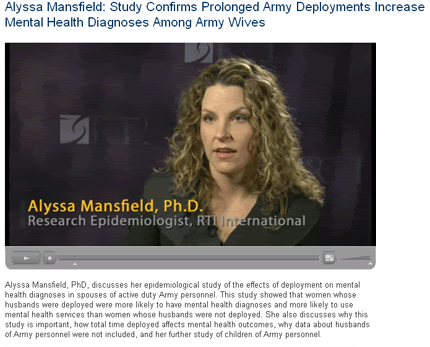
War isn't just tough on soldiers. Army wives whose husbands were deployed have higher rates of depression, anxiety, sleep disorders and other mental health issues than the wives of soldiers who stayed home, a new study shows.
Researchers looked at the medical records of more than 250,000 wives, accounting for most women married to active-duty U.S. Army personnel. Between 2003 and 2006, about 34 percent of the women's husbands deployed for one to 11 months, 35 percent deployed for longer than 11 months, while 31 percent of soldiers were not sent overseas.
Among wives of soldiers deployed for up to 11 months, researchers found almost 3,500 more diagnoses of depression, anxiety, sleep disorders and other mental health issues than among wives who[se] husbands stayed home.
 William Hageman of the Chicago Tribune reports today on an area doctor using a novel approach to treating the anxiety that surfaces in many PTSD sufferers.
Estimates of how many veterans suffer from PTSD range as high as 50 percent. What's not disputed is that most of them are undiagnosed. Dr. Eugene Lipov refers to the growing problem as "the reverse surge."
Lipov is the president and medical director of Advanced Pain Centers, with offices in Hoffman Estates and Westmont. He believes he has found a way to combat the feelings that come with PTSD through a seemingly simple injection that calms the section of the brain that becomes overactive in PTSD patients.
The treatment is called a stellate ganglion block [more info: general | clinical], an injection of the local anesthetic bupivacaine around a group of nerves in the neck.
"The medication we're using is the same numbing medication that has been used for decades for pregnant women during labor and delivery," explains Dr. Jay Joshi, director of research at Advanced Pain Centers. But using it against PTSD is a new idea. Lipov made another connection between the medication and the body's reaction.
"I found that one part of the brain that works on hot flashes and PTSD is the same ... the insular cortex," he explains. The injection, he says, "reboots" the insular cortex. "It resets the nerve system the way God built it," he says.
Recently received the following request:
We are currently recruiting research subjects to participate in either of three federally funded research protocols conducted in Manchester, NH and Boston, MA. Is there a way that we might solicit participation from your readership?
Important story on the cluster of OEF/OIF veterans who have recently been found to have died in their sleep, or thought to have committed suicide, while heavily medicated and being treated for PTSD. First, a May 23 introduction by Julie Robinson of the Charleston Gazette:
A Putnam County veteran who was taking medication prescribed for post-traumatic stress disorder died in his sleep earlier this month, in circumstances similar to the deaths of three other area veterans earlier this year.
Derek Johnson, 22, of Hurricane, served in the infantry in the Middle East in 2005, where he was wounded in combat and diagnosed with post-traumatic stress disorder while hospitalized.
Military doctors prescribed Paxil, Klonopin and Seroquel for Johnson, the same combination taken by veterans Andrew White, 23, of Cross Lanes; Eric Layne, 29, of Kanawha City; and Nicholas Endicott of Logan County. All were in apparently good physical health when they died in their sleep.
Johnson was taking Klonopin and Seroquel, as prescribed, at the time of his death, said his grandmother, Georgeann Underwood of Hurricane. Both drugs are frequently used in combination to treat post-traumatic stress disorder. Klonopin causes excessive drowsiness in some patients.
He also was taking a painkiller for a back injury he sustained in a car accident about a week before his death, but was no longer taking Paxil.
From Kelly Kennedy, Army Times:
A pilot project intended to speed the process of evaluating and rating service members’ disabilities will do little more than turn a bad process into “a fast bad process,” the Army’s top medical official said Friday.
Army Surgeon General Lt. Gen. Eric Schoomaker’s comments came at a hearing at which the services’ surgeons general had their chance to brag about what they have done in the year since the outpatient scandal at Walter Reed broke — standing up units specially designed to take care of wounded troops, asking for and receiving money to house those service members, ombudsmen, internal checks and toll-free numbers for reporting problems – before the House Armed Services Subcommittee.
Schoomaker also spent some time talking about continued problems, including his view that the pilot project designed to streamline the disability system will not prove to be the answer. Under the test, taking place at three military medical facilities and one VA medical center in the Washington, D.C., area, service members will receive a single medical examination and a single disability rating issued by VA, an effort to eliminate duplication in the separate military and VA systems and speed up the process.
But Schoomaker said both the military and VA systems for dealing with service members’ disabilities is based on an “outdated” model from the 1940s, when most of the force consisted of single soldiers with no health care. “When you speed up a bad process, all you have is a fast bad process,” Schoomaker said of the ongoing pilot project.
On other issues, Schoomaker said mental health descriptors used by military medical professionals need to be updated to fit today’s ideas about post-traumatic brain injury and depression.
He also said the Army found a new “trend” as it grouped all of its wounded soldiers into one system where they could be carefully monitored: 11 deaths in that population due to suicide, accidental overdose by prescription medications, and in motor vehicle accidents. Schoomaker said the combination of multiple prescription drugs — usually pain medication — mental health issues, alcohol and no supervision on the weekends are contributing to the problem.
This is another issue that's been floating around for a bit, but I'm only now getting to posting on it: PTSD researchers are now testing the efficacy of the hallucinogenic drug MDMA, or ecstacy, to treat post-traumatic stress. The Washington Post Magazine ran an article ("The Peace Drug") on the issue this past weekend:
PTSD is usually triggered by combat, rape, childhood abuse, a serious accident or natural disaster -- any situation in which someone believes death is imminent, or in which a significant threat of serious injury is accompanied by an intense sense of helplessness or horror. Not all or even most trauma victims develop PTSD, but enough do so that nearly 24 million Americans, or 8 percent of the population, have suffered from it at some point in their lifetime. It is estimated that in any given year, more than 5 million Americans have active PTSD -- a costly problem in humanitarian and economic terms. Drug and alcohol abuse are all-too-frequent consequences of PTSD, as is loss of productivity and the need for expensive, long-lasting medical treatment.
The ever-lengthening Iraq war will count among its other costs a legacy of thousands of veterans in need of psychiatric treatment. The government estimates that already more than 50,000 soldiers -- about 4 percent of those who have been deployed to Iraq and Afghanistan -- have been treated for symptoms of PTSD. Many more might actually have it: Military studies put the number at 12 to 20 percent of those returning from Iraq and 6 to 11 percent of those returning from Afghanistan. And the news gets worse.
"Vets with PTSD are particularly costly to the [Veterans Affairs] system," says Linda Bilmes, a lecturer in public policy at Harvard's Kennedy School of Government. "They constitute 8 percent of the claims, but 20 percent of the payments." Bilmes, who has studied the ongoing costs of the wars, estimates that treating Iraq vets with PTSD over the next 50 years will cost taxpayers $100 billion. This is based on findings that one-third of vets with PTSD will remain unemployable, and all suffering with PTSD will have a much higher than normal likelihood of needing treatment for physical ailments. And that's just the direct costs to the budget. "Assuming that the war continues, though with lower deployments, through 2017," she says, and assuming the rate of PTSD isn't being underreported, the cost of lost economic productivity to the U.S. economy will be in excess of $65 billion.
From the Bryan-College Station [TX] Eagle:
Over the next year and a half, a team of Texas A&M professors and other researchers are expected to follow troops who recently returned from Iraq and Afghanistan - trying to gain insight into why some people seem to be more susceptible to post-traumatic stress disorder than others.
The team, led by associate professor Keith Young, received $3 million from Congress earlier this year to start the study. And if the current incarnation of the 2008 fiscal year budget is approved by the Senate, the group will receive an additional $3.4 million.
The idea for the project - which will include ongoing interviews with 1,400 troops from Fort Hood set to begin this winter - was sparked by research Young completed in 2004. During that study, researchers were surprised to find that the brain's thalamus was abnormally large in people who had experienced major depression, he said.
They then detected a gene variant that caused the enlargement in some people.
The thalamus is used by the body to interpret threatening visual stimuli, facial expressions and fearful emotions, Young said. So those with the heightened "automatic threat detection system" could be more vulnerable when dealing with stressors that lead to PTSD, the team has theorized.
In 2004, Drs. Young and Hicks, along with collaborators at The University of Texas Southwestern Medical Center at Dallas, published a paper that described substantial changes in the anatomy of the brain in people suffering from major depression.
“It was the first time that findings like this were shown,” Dr. Young said. “In the brains of people that experienced major depression, the thalamus was larger. At the time, most scientists were focusing on neurochemical reasons for depression, not anatomical factors, and almost all of those studying anatomy were looking for brain defects, not enlargements.”
Based on their findings, Drs. Young and Hicks followed up with a study that sought to discover if a genetic alteration was responsible for the change. What they found was remarkable.
The inheritance of a common serotonin transporter (SERT) gene variant was found to be involved in enlargement of the pulvinar nucleus of the thalamus, which is involved in interpreting threatening visual stimuli, facial expressions and fearful emotions. The enlarged pulvinar may enhance the brain’s “automatic threat detection system,” making some people more vulnerable when exposed to stress and trauma.
The study is critical, Young said, "because we really don't understand what brain changes predispose people" to PTSD. "Once we understand, I think we're going to do a much better job at treating and determining which people are at risk for PTSD," he said.
In addition to the in-depth interviews, the study will include brain scans to look for possible post-combat changes in the brain structure and examination of cadaver brains from donors who had PTSD. Young said the group also plans to develop an animal model to test new ways of treatment. Rats can be subjected to extreme stressors using a "forced swim test." Trauma from the procedure tends to cause changes in the rats' neurochemistry that make the animals look like they're depressed, Young said, explaining they can become more easily startled and have an exaggerated response to loud noises.
Troops returning from combat zones often report similar responses.
The group also hopes to conduct a large clinical trial for fluoxetine, a drug commonly known as Prozac that has been widely used for depression. It's also used somewhat for PTSD, but it has never been tested on active-duty troops, Young said. "Particularly, we're looking to see if we can intervene very early after PTSD symptoms appear," he said, explaining that researchers hope early use of the drug could help prevent onset of the disorder.
The study isn't expected to result in people being screened or barred from combat, Young said. "Perhaps what we can do is identify a profile of someone, [and] if they become initially ill we can know how to treat them," he said. "Maybe we can know someone needs to be watched more carefully."

From Veterans Affairs Research:
A generic drug already used by millions of Americans for high blood pressure and prostate problems has been found to improve sleep and lessen trauma nightmares in veterans with posttraumatic stress disorder (PTSD).
"This is the first drug that has been demonstrated effective for PTSD nightmares and sleep disruption," said Murray A. Raskind, MD, executive director of the mental health service at the Veterans Affairs Puget Sound Health Care System and lead author of a study appearing April 15 in Biological Psychiatry.
The randomized trial of 40 veterans compared a nightly dose of prazosin (PRAISE-oh-sin) with placebo over eight weeks. Participants continued to take other prescribed medications over the course of the trial.
At the end of the study, veterans randomized to prazosin reported significantly improved sleep quality, reduced trauma nightmares, a better overall sense of well being, and an improved ability to function.
"These nighttime symptoms are heavily troublesome to veterans," said Raskind, who also is director of VA’s VISN 20 (Veterans Integrated Service Network #20) Mental Illness Research, Education and Clinical Centers program (MIRECC). "If you get the nighttime symptoms under control, veterans feel better all around."
Raskind, also a professor of psychiatry and behavioral sciences at the University of Washington, estimates that of the 10 million U.S. veterans and civilians with PTSD, about half have trauma-related nightmares that could be helped with the drug.
Participants were given 1 mg of prazosin per day for the first three days. The dose was gradually increased over the first four weeks to a maximum of 15 mg at bedtime. The average dose of prazosin in the trial was 13.3 mg. By comparison, typical prazosin doses for controlling blood pressure or treating prostate problems range from 3 mg to 30 mg per day in divided doses.
The drug did not affect blood pressure compared to placebo, though some participants reported transient dizziness when standing from a sitting position during the first weeks of prazosin titration. Other occasional side effects included nasal congestion, headache, and dry mouth, but these were all minor, according to the authors. "This drug has been taken by many people for decades," said Raskind. "If there were serious long-term adverse side effects, it is likely we would know about them by now."
The relatively small size of the study was due to the easy availability of this generic drug, Raskind said. "If you are doing a study with a new drug, the only way people can get it is to be in the study. With prazosin, we have approximately 5,000 veterans with a PTSD diagnosis taking it already in the Northwest alone. So we had to find veterans with PTSD who were not [taking it]."
For treating PTSD, prazosin costs 10 to 30 cents a day at VA contract prices. It is not a sedating sleeping pill, emphasized Raskind. "It does not induce sleep. But once you are asleep, you sleep longer and better." And better sleep can make a big difference. "This drug changes lives," Raskind said. "Nothing else works like prazosin."
Trauma nightmares appear to arise during light sleep or disruption in REM sleep, whereas normal dreams — both pleasant and unpleasant — occur during normal REM sleep. Prazosin works by blocking the brain’s response to the adrenaline-like neurotransmitter norepinephrine. Blocking norepinephrine normalizes and increases REM sleep. In this study, veterans taking prazosin reported that they resumed normal dreaming.
One dose of prazosin works for 6 to 8 hours. Unlike similar drugs, prazosin does not induce tolerance; people can take it for years without increasing the dose. But when veterans stop taking it, Raskind said, the trauma nightmares usually return.
Aside from the VA-funded study he just published, Raskind is working on three larger studies of prazosin. One, a VA cooperative study slated to start this month, will enroll about 300 veterans at 12 VA facilities. The second, a collaborative study with Walter Reed Army Medical Center and Madigan Army Medical Center, will enroll active-duty soldiers who have trauma nightmares. The third study, funded by the National Institute of Mental Health, will look at prazosin in the treatment of civilian trauma PTSD.
In a study funded by support from the Department of Veterans Affairs and appearing in the December 1, 2006 issue of the American Journal of Psychiatry, researchers found:
Guanfacine, a medication commonly prescribed to alleviate symptoms of post-traumatic stress disorder, is no more effective than a placebo, according to a study led by researchers at the San Francisco VA Medical Center.
“There was no benefit at all, and there were several adverse side effects,” says lead author Thomas Neylan, MD, medical director of the PTSD treatment program at SFVAMC. “People with symptoms of PTSD should probably stay away from this drug and others of its type.”
The double-blind study compared the effects of guanfacine and an identical looking placebo pill on 63 male and female veterans at four VA medical centers in California and Hawaii. Twenty-nine participants were randomly assigned to take weekly doses of the drug, and 34 were assigned the placebo, for eight weeks.
At the end of the study, the effect of guanfacine on PTSD symptoms was “zero,” and there were no differences between men and women or older versus younger veterans. In addition, the subjects who took guanfacine had significantly more somnolence, lightheadedness, and dry mouth than those who took placebo. The study authors conclude, “These results do not support the use of alpha 2 agonists in veterans with chronic PTSD.”
 From the Milwaukee Journal-Sentinel:
Families are alarmed by military statistics showing that 80% of soldiers who have been flagged with 'mild' symptoms of post-traumatic stress disorder have been sent back to Iraq and Afghanistan, many with anti-depressant pills aimed at ensuring they can still fight. ...
Maj. Gen. Paul Mock, commander of the 63rd Regional Readiness Command for the Army Reserves, told an Army convention last month that he doesn't think the infrastructure is in place to treat all returning troops who need mental health care, especially in rural areas. "When they don't get the kind of mental health screening - or physical - history tells us they will turn to coping mechanisms," said Steve Robinson, director of government relations for Veterans for America, a 35,000-member organization. He says many of the hundreds of soldiers he has interviewed are addicted to medications given to them in the field, such as painkillers and sleeping pills. But the soldiers are not getting the therapy that normally goes with such medications, Robinson said.
Adam Reuter, a 23-year-old former Army specialist from Atlanta who was stationed near the Syrian border, said a medic simply handed him a plastic bag filled with pills with no instructions after he was tossed out of a Humvee in an accident. The bag contained Percocet, Vicodin, Tylenol with codeine, a muscle relaxant, Motrin and Naproxen. He said he went back for more and developed a dependency that he is still trying to shake. More >>
Back in March, I wrote about a San Diego Union-Tribune report on troops being sent back into the combat zone suffering with and medicated for PTSD. In May, the story once more came into play when the Hartford Courant reported on the issue. It's back in the news again with CBS News and Raw Story chiming in.
Click on 'Article Link' below tags for more...
Unfit For Duty? - View the CBS News video
A number of U.S. troops who come home from Iraq suffer post-traumatic stress disorder. But as Sharyn Alfonsi reports, some of them are being sent back into battle.
From the companion report at CBS Evening News:Army Staff Sgt. Bryce Syverson spent 15 months in Iraq before he was diagnosed by military doctors with post-traumatic stress disorder (PTSD) and sent to the psychiatric unit at Walter Reed Medical Center, CBS News correspondent Sharyn Alfonsi reports. "It ended up they just took his weapon away from him and said he was non-deployable and couldn’t have a weapon," says his father, Larry Syverson. "He was on suicide watch in a lockdown."
That was last August. This August, he was deployed to Ramadi, in the heart of the Sunni triangle — and he had a weapon.
He's still there. Under pressure to maintain troop levels, military doctors tell CBS News it's become a "common practice" to recycle soldiers with mental disorders back into combat. The military's actions were first reported by the Hartford Courant newspaper.
I love the Hartford Courant -- they've been doing some of the finest reporting on the issue of combat troop mental health -- but they weren't the first to report on it.
The San Diego Union-Tribune beat them to it.
The Raw Story has also begun a series on this issue today, with the second installment coming on Thursday. From Mind games, part 1: The things they carry:The same administration that many claim sent US troops overseas without sufficient intelligence, planning, numbers, or armor is equally unprepared to deal with the wars' psychic toll on service members, RAW STORY has learned. ...
In Iraq, where US troops are, by the administration's own admission, struggling unsuccessfully with an increasingly bloody insurgency, US and civilian casualties are rising by the day. This past Sunday, the Associate Press reported that this month is on track to be the deadliest one of the war yet. It is already the deadliest since November 2004, when 92 American Marines were killed and another 500 wounded over the course of Operation Phantom Fury in Fallujah.
Even before this latest surge in violence, the men and women returning from Operation Iraqi Freedom (OIF) and Afghanistan's Operation Enduring Freedom (OEF) were seeking treatment in droves.
In August, the Veterans Administration (VA) released a report showing that almost one-third of the nearly half-million vets from these two conflicts are seeking treatment from VA facilities. Of these, a full 35% received a diagnosis of a possible mental disorder--a tenfold increase in 18 months. (View full VA PowerPoint presentation.)
Important issue. Good to see it back in the news.
Related Posts
A general run-down of trauma therapy techniques can be found in an article written by Dr. Bharati Vendgadasalam running in Sunday's Malaysia Star. Topics covered include:
[N]ot everybody who experiences trauma will suffer from PTSD. In fact, when given adequate support, most people recover without needing specific psychotherapy. It is when the person’s natural recovery is disrupted that specialised trauma therapies are needed.
Professional help is indicated when the intensity of trauma symptoms do not subside over weeks or months, when symptoms cause severe distress or when a person’s socio- occupational functioning or daily functioning is compromised. Therapies ought to be tailored to suit the needs of the particular individual in that particular circumstance of trauma. In fact the therapy ought to be adapted to the individual, not vice versa.
Creative therapy: sand-play therapy, art therapy
Children are a unique population who are often unable to express their feelings or describe the traumatic event(s). Thus they require more creative therapies using toys, art, games, and sand-play. This form becomes a means of non-threatening symbolic communication to express difficult or unspeakable truths and inner conflicts. These therapies have also been used as adjunctive therapies in adults.
Medications
When appropriate, medications are prescribed. Judicious use of specific serotonin reuptake inhibitor (SSRI) antidepressant medication has been found to alleviate symptoms of post-traumatic stress disorders.
SSRIs are often needed when symptoms are severe and persistent, there is coexisting depression, or when psychotherapy alone has not relieved the symptoms.
The duration of treatment varies between six months to two years before the medication is tapered off. Recurring symptoms will need more long-term treatment.
Anti-anxiety medications including benzodiazepines on the other hand should be used only briefly, if used at all, to suppress severe anxiety reactions. These tend to be sedative, impair coordination and induce physical dependence in those who use them for prolonged periods.
Holistic health
Alongside main therapies, there are simple therapeutic interventions such as exercise or physical activity, spirituality, reading inspirational literature and ensuring proper nutrition. Adopting a healthy exercise regimen reduces the stress arousal and aids in general wellbeing.
Social support
Family support greatly aids healing and facilitates social reintegration of the individual. By being empathetic listeners, the family can help reduce feelings of loneliness, guilt and self-blame.
Family members also ought not to expect too much or too little from the patient but on instead be realistic during the period of recovery. Working with the family may not always be feasible or beneficial, such as in the case of incestuous sexual abuse wherein family members do not accept the disclosure.
Support can be provided or supplemented by good self-help groups led by sensitive and trained facilitators. Often, this helps remove a sense of isolation through sharing of experiences.
 Another collection of news and commentary on issues important to veterans and their families -- especially those coping with PTSD.
 A recent press release from Emory University broadcasts the news that researchers are studying a new form of treatment program hoping to help returning combat veterans coping with PTSD get better quicker. The treatment program combines the drug d-cycloserine (DCS) and virtual reality therapy to temper the fear associated with and power of traumatic memories.
[UPDATE - Aug 13, 2008]: New study details.
Click on 'Article Link' below tags for more...
From WebWire:Emory University researchers will embark on a study they hope will enhance the treatment of post-traumatic stress disorder (PTSD) and help soldiers who are affected get better faster. The risk for PTSD among Iraq War veterans is estimated to be 18 percent, according to a 2004 study that examined the mental health impact of the war. According to the U.S. Department of Veterans Affairs, the estimated lifetime prevalence of PTSD among American Vietnam war veterans is 30.9 percent for men and 26.9 percent for women. PTSD is a serious condition that can become a chronic problem, with devastating life-altering effects on soldiers and their families.
Barbara Rothbaum, PhD, ABPP, and Kerry Ressler, MD, PhD, from the Department of Psychiatry and Behavioral Sciences at Emory University School of Medicine, will lead a study funded by the National Institute of Mental Health (NIMH) using the drug d-cycloserine (DCS) combined with virtual reality therapy.
DCS binds to neurotransmitter receptors in the amygdala called NMDA (N-methyl-D-aspartate) receptors. The mechanisms governing the fear response are located in that region of the brain. Previous rodent studies of DCS by Dr. Ressler and Michael Davis, PhD, of Emory School of Medicine, the Yerkes National Primate Research Center, and the Center for Behavioral Neuroscience have shown that it has a positive effect on the extinction of fear. The first trial using DCS with Virtual Reality Exposure Therapy for acrophobia, or fear of heights, was completed in 2004, and was very successful.
"We were very excited about the results of the acrophobia study and we are delighted to have the opportunity to move forward with the PTSD study," says Dr. Rothbaum, a professor of psychiatry and director of Emory’s Trauma and Anxiety Recovery Program. "A large part of the problem PTSD patients have is the fear of the memory itself. Although the memories will never really go away, we believe that the DCS will make it easier for patients to learn how not to fear their memories."
Co-investigators in the study will include Michael Davis, PhD, Erica Duncan, MD and Maryrose Gerardi, PhD, all faculty members of the Department of Psychiatry and Behavioral Sciences at Emory University School of Medicine.
"Persons with PTSD experience both psychological and physical effects, and just like any other illness, PTSD can worsen and become harder to treat the longer someone waits to be treated," says Dr. Ressler. "We hope this study will open up some new doors that will help us get people back to their normal lives as soon as possible."
Related Posts
 This one's a must-listen-to program. NPR's On Point had an important hour-long discussion of an issue gaining a lot of attention for those concerned with the mental health of our troops.
Matthew Kauffman, staff writer for the Hartford Courant and co-writer of an investigative series called Mentally Unfit, Forced To Fight opened the program. Steven Robinson, Gulf War veteran and Director of Government Relations at Veterans for America in Washington D.C. followed, along with Ret. Command Sergeant Major Mike Lopez and Scott Peterson, Reporter for the Christian Science Monitor. Troops and military family members also called into the show to share their stories.
Click on 'Article Link' below tags for related posts...
Related Posts
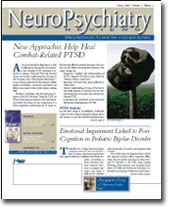 NeuroPsychiatry Reviews, a magazine which reports on "new research and emerging trends in neuropsychiatry and neuroscience, with an emphasis on practical approaches to diagnosis and treatment" ran a cover story in January on new approaches to healing combat-related PTSD. Well worth a look...
Click on 'Article Link' below tags for more...
From NeuroPsychiatry Reviews:As troops return from deployments to Iraq or Afghanistan, the need for posttraumatic stress disorder (PTSD) treatment is expected to increase. National Guard and Reserve troops account for a high proportion of troops in the war zones, and as they return to their homes—some of them relatively far from Veterans Affairs health care facilities—community psychiatrists are likely to encounter more combat veterans seeking help.
Matthew J. Friedman, MD, PhD, Executive Director of the VA’s National Center for PTSD in White River Junction, Vermont, told NeuroPsychiatry Reviews that these vets are coming home to a more supportive environment and to more informed and effective medical treatment than was the case for soldiers returning from Vietnam. The major changes are:
"We now have tested, validated treatment options for PTSD that have been shown to be effective by high standards of evidence-based medicine," Dr. Friedman said. "Two SSRIs are approved for treatment of PTSD. There is also definitive evidence for the effectiveness of cognitive behavioral therapy [CBT], including prolonged exposure therapy and cognitive processing therapy. Eye movement desensitization and reprocessing is somewhat controversial but also supported by clinical trial data.
"One major problem is that CBT is the most effective treatment for PTSD but is also the modality having the fewest trained personnel nationwide," Dr. Friedman added. "Consequently, clinicians not trained in CBT should turn to SSRIs as firstline treatment."
Sertraline and paroxetine are approved by the FDA for treatment of PTSD, he continued. Patients showing a partial response are sometimes treated with other medications that may be tailored to the specific residual symptoms. These might include antiadrenergic medications for arousal, insomnia, and reexperiencing symptoms; venlafaxine for broad-spectrum symptomatic relief; anticonvulsants and mood-stabilizing drugs for mood swings, impulsivity, or violent behavior; trazodone for sleep problems; and atypical antipsychotics for patients whose symptoms are refractory to other agents. Benzodiazepines are not recommended because they have proven ineffective in randomized trials and due to the risk of drug dependence.
Dr. Friedman cautioned that even patients successfully treated with SSRIs are at risk of recurrence if treatment is discontinued. He recommended maintaining SSRIs for six to 12 months before attempting to discontinue them.
Another problem is that SSRIs and other antidepressants may—in rare instances—"produce activation side effects which may exacerbate PTSD-related arousal symptoms." Dr. Friedman recommended "starting low and going slow" with these drugs due to concern that they may increase physical restlessness and insomnia.
Most patients with PTSD who are likely to recover will do so within the first two years, by which time more than half will have recovered. Another 20% will recover over the next five years. About 50% of patients with PTSD will achieve complete remission with CBT alone and about 30% with SSRIs alone. "Obviously, we hope to do better with the new drugs under development, Dr. Friedman said. "The big unanswered questions are whether to combine treatments, which to combine, and how to identify the patient likely to need combination treatment."
As much as we'd like to have the 'magic pill' that takes care of all of our worries and does the hard work of recovery for us, it's just not going to be that easy. Although these medications are a useful tool, they are not the end all and be all for combat PTSD treatement.
Factors of nature (genetics) and nurture (environment) are briefly reviewed, with the article closing on the following important note:Finally, "the most important factor in whether an acute stress reaction will become chronic PTSD is social support, including support from the soldier’s combat unit, family, community, and wider society," Dr. Friedman said. "Because of the political polarization of the nation during Vietnam, some people took their displeasure out on the troops, young men and women who had risked their lives, when their real anger was directed at decisions made by the country’s leaders. Our nation has grown up, and I think we are now sophisticated enough not to confuse our feelings about the war with our feelings about the warrior."
Offering every single one of our returning veterans a broad and strong social support network is key to their recovery from the effects of combat. Not every soldier or Marine who returns home has such a network of support to fall back on. That's where we, average citizens, come in to play.
Our troops need us more than ever to support them in real and tangible ways. Some need our help more than others. Look around. How are your troops doing in your community? Don't know? Reach out then and ask if they need your help; find creative ways to lend a hand -- even if it's only a day or two a month; and consider supporting them both with your time and your money, if you have it within your means.
If you'd like to offer feedback on this article, email NeuroPsychiatry Reviews and thank them for their look at combat PTSD.
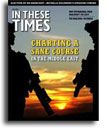 The June issue of Chicago-based In These Times magazine provides additional details on an issue with a whole host of consequences: sending troops diagnosed with PTSD back into combat -- medicated. Although the story's been reported in a number of areas the past couple of months (here, here, and here), more attention is needed on this important troop health issue.
Click on 'Article Link' below tags for more...
From In These Times:In Iraq and Afghanistan, when “suck it up” fails to snap a soldier out of depression or panic, the Army turns to drugs. “Soldiers I talked to were receiving bags of antidepressants and sleeping meds in Iraq, but not the trauma care they needed,” says Steve Robinson, a Defense Department intelligence analyst during the Clinton administration.
Sometimes sleeping pills, antidepressants and tranquilizers are prescribed by qualified personnel. Sometimes not. Sgt. Georg Anderas Pogany told Salon that after he broke down in Iraq, his team sergeant told him “to pull himself together, gave him two Ambien, a prescription sleep aid, and ordered him to sleep.”
Other soldiers self-medicate. “We were so junked out on Valium, we had no emotions anymore,” Iraq vet John Crawford told “Fresh Air” host Terry Gross. He and others in his unit in Iraq became addicted to Valium.
The issues around mental health and medication are exacerbated for the more than 378,000 troops who have served multiple tours to Iraq and Afghanistan. Post traumatic stress disorders (PTSD) caused by a previous tour are cropping up in later ones. “It concerns us when we hear military doctors say, ‘It’s wonderful that we have these drugs available to cope with second or third deployments,’” Joyce Raezer of the National Military Family Association told In These Times. “But that statement makes military spouses cringe,” she continues, “Soldiers are saying ‘we don’t have time to recover.’”
Marine psychiatrist Cmdr. Paul S. Hammer confirmed to San Diego Union-Tribune reporter Rick Rogers that Marines with PTSD are returning to Iraq. In many cases, their problem is labeled stress. “Army docs have told me that commanders pressured them not to diagnose PTSD because it would cut into combat power—the ability to project men and women into war,” says Robinson. “The docs admit that the decision [to misdiagnose] is unethical, but are unwilling to take the huge career risk of becoming a whistle blower.”
Related to this multiple deployment issue may be the 'ethics on the battlefield' training sessions the DOD has ordered up for all combat troops. It may be too early to tell what caused Marines in Haditha, Iraq to apparently lash out at civilians following the loss of one of their troops last year; but, reports indicate that the unit in question was in Iraq on its third combat deployment.
From AP:[Howard] Prince, [director of the Center for Ethical Leadership at the University of Texas at Austin and a retired Army general] also blamed a "revolving door" deployment policy that has worn on U.S. troops on their second and third tours in Iraq. The accused Marine battalion was on its third tour in less than 2 1/2 years. In comparison to the 10-year Vietnam conflict, most troops then only did two tours, Prince said.
"Repeated deployments have a cumulative effect on people's ability to maintain moral judgment, tactic standards," said Prince. "Leaders have to be aware of the cumulative, longterm effects of repeated deployments into this highly stressful and danger situation out there. We're wearing out our vounteer Army and Marines is what we're doing. And that's because the services are too small."
Back to the In These Times piece:[T]he use of brain-altering medications must be monitored for effectiveness and safety, which is beyond the Army’s capability in Iraq. The medications can take weeks to kick in, dangerously interact with other medications or fail to work at all. Side effects can include organ damage and thoughts of suicide.
But if the problem is bad for the occupying army, it is far worse for the Iraqi civilians, who have few medical resources and no end in sight to the constant fear and deprivation that occupation has brought. “The [Iraqi] Ministry of Health says since the U.S. invasion there’s been a 35 percent jump in cases of post-traumatic stress disorder [in Iraqis],” reported NPR Baghdad correspondent Jamie Tarabay.
Keith Humphreys of U.S. Veterans Affairs documented a substantial rise in drug use in Iraq resulting from the terrible stress of daily life. Drugs that would require a prescription in the United States are available in drug stores and many Iraqis are turning to them for relief.
Former biology undergraduate Rorla Monere began taking sleeping pills to dull the pain and fear after witnessing the kidnapping of a close friend who was thrown into a car and later raped; a suicide car bomb left another of Monere’s close friends in a wheelchair. Afraid to go out, Monere stays at home, terrified that someone will storm the house. “The pills don’t have any effect anymore,” she told NPR’s “Morning Edition,” “because I take so many of them. I just want my day to finish. I spend it alone. … My wish is to die, to be free and rest. Better than this slaughter.”
Please consider thanking In These Times for their coverage of this important issue; and contact your elected representatives to share your concern for the healthcare our deployed troops are receiving.
Related Posts


Archives
2011: Jan Feb