Showing posts with label homecoming. Show all posts

Friday, December 19, 2008

Fort Campbell Braces For 101st Airborne Return, Prepares to Study Multiple Deployment Effecfs on Soldiers and Caregiver Staff

Fort Campbell is considered one of the main "crossroads" of our military campaigns in Afghanistan and Iraq, with troops ever revolving through its doors to and from service in the Middle East. The rapid tempo of its operations has applied special stress and strain on its community. By October 2007, the base had reported nine suicides in its ranks that year.

The home of the 101st Airborne Division, its commanding general squarely turned his attention on the crisis when three of those suicides took place in the span of just two weeks. At the time, Maj. Gen. Jeffrey J. Schloesser wrote in a letter to the post community: "This is unacceptable and it must stop. I want everyone associated with Fort Campbell to take pause, and to focus on what we can do as a community to reverse this trend."

Schloesser, now being deployed to Afghanistan, find his work must be picked up by acting senior commander for the 101st Airborne Division, Brig. Gen. Stephen Townsend.

On his promotion this past weekend, Townsend applauded the reintegration program, calling it "superb." That program will be tested as some 15,000 of Ft. Campbell's soldiers once more return home after serving for more than a year in Iraq and Afghanistan. Leaders are aggressively attempting to meet the challenge of caring for them.


Tuesday, April 01, 2008

Military OneSource Offers Complimentary Combat PTSD Comic Book

Jackie Eckhart of the Virginian-Pilot is one of the lucky few to have had the opportunity to review a copy of a free comic book, "Coming Home: What to Expect, How to Deal When You Return from Combat," now being offered to service members at Military OneSource. Well, the way she tells it, the men in her life understood the value of the magazine better than she did at first:

"Coming Home: What to expect, how to deal when you return from combat" is a new project by Military OneSource. Created by comic book masters Sid Jacobson and Ernie Colon, who formerly worked at Harvey and Marvel comics, it is aimed at service members who have worn combat gear every day for a year. It's aimed at people who see potential IEDs at every intersection. It is aimed at guys who come back to the States to feel fury at traffic, and women who find that half the world thinks they're bad mothers because they had to serve overseas, and family members who can't understand why their returning soldier or Marine is drinking so darned much.

This comic is aimed to help folks who need to learn about post-traumatic stress disorder. Because I wasn't one of those people, and I wasn't sure how I felt about treating a subject as serious as combat and operational stress response in a comic book, I threw "Coming Home" into a stack of reading material to look at later.

Not a minute later my 14-year-old picked it up. Then the kindergartner. Then our houseguest, a 48-year-old former Navy helicopter pilot. "What kind of aircraft is that?" he asked, holding the cover up to the light from the sliding glass doors. Then he read the whole thing.


Saturday, March 29, 2008

After Afghanistan, House Webcasts, Vietnam Homecoming, Military Handbooks

A few items to share:

  • Stars and Stripes today offers an in-depth look at the return home of one Fort Drum, N.Y., soldier following a 17-month deployment to Afghanistan.

  • The House Veterans Affairs Committee goes high tech this Tuesday when the April 1, 2008 Subcommittee on Health “PTSD Treatment and Research: Moving Ahead Toward Recovery” hearing is webcast at 10 a.m. EST.

  • Cumberland County, Tenn., officially welcomes home its Vietnam veterans this weekend proving that it's never too late to thank those who serve in uniform.

  • Military Handbooks' 2008 crop of pdf offerings have arrived -- and they're free for the asking.


Monday, March 10, 2008

Philadelphia Inquirer Alpha Company Series: Nearly 50% of Returning Troops Treated for PTSD

The Philadelphia Inquirer spent nearly a year reaching out to the Pennsylvania National Guard's Alpha Company following their return from Iraq. They lost six troops while overseas; the Inquirer spoke with almost all of the 131 who made it home alive. The paper's coverage, packaged in a four-part series, began yesterday.

First, Alpha Company's stunning PTSD figure:

Of all the things that Alpha Company has had to struggle with since it came home from Iraq, the most pervasive may be post-traumatic stress disorder, or PTSD. Of the 126 veterans interviewed or surveyed by The Inquirer, almost half - 46 percent - said they had been treated for PTSD, most at VA hospitals and clinics in the region.

Alpha's rate of PTSD is higher than that of most U.S. troops who served in Iraq or Afghanistan - partly, no doubt, as a result of its being a frontline combat unit that lost six men. Shelley M. MacDermid, a Purdue University professor who served on a Defense Department mental-health task force last year, said typical PTSD rates among returning veterans were about 14 percent.

"Those are big numbers," she said of The Inquirer's Alpha findings.

National Guard and Reserve units, in general, have shown slightly higher PTSD rates than have regular Army units, she said. The Defense Department task force said this might be in part because civilian-soldiers were separated after they returned home, rather than staying together as units in which the members could support one another.

Ira Katz, director of mental-health services for the Department of Veterans Affairs, said that among the 300,000 or so veterans who have been seen by the VA, about 20 percent have been diagnosed with PTSD. But he said that twice that number - about 40 percent - have had some "mental condition."

"That's not all that different from your [46] percent," he said.

Both MacDermid and Katz said that PTSD had become a popular shorthand for all sorts of emotional symptoms that veterans experience. These may include depression and anxiety disorders, but not rise to the level of PTSD.


Wednesday, December 19, 2007

WWII, Korean, Vietnam, Desert Storm and OEF/OIF Vets Chime in on Combat

An interesting look at the experiences of war veterans over the decades ran earlier this month and is still well worth a reading.

From the Kansas City Star:

Q. Did you have any problems readjusting after you returned from war?

Joseph L. Dickerson (Korean War): I was in several pretty strong firefights, and I was wounded — shrapnel from mortar fire at night in left chest. It’s still there, close, by my heart. They see it every time they take an X-ray. I had a hard time adjusting because I saw a whole lot of dead bodies in the short time I was there. And blood. Head blown off, arm blown off.

When I got discharged I never did talk too much to anyone about it. I kept it to myself. But I knew something was wrong, because I had problems holding jobs. I think I was 21 when I got out. Battle fatigue, that’s what they called it then. I had dreams, and you become touchy sometimes.

I went in at 17, and I used to be a happy-go-lucky guy. When I got out I was a little different. I wouldn’t go to work as I was supposed to. I couldn’t take orders till after about three or four years. And dreams. I still have the dreams. I sleep with a weapon. I always have slept with a weapon after I came out of the service. You just feel safer.

Maj. Jason “Tank” Sherman (Iraq and Afghanistan): I came back, still in the reserves, and didn’t really go through anything. I didn’t see what some other people have seen.

Gary Shepard (Vietnam War): I’m still not adjusted. I mostly stay with my friends. I’m still not comfortable in restaurants, and my kids still know they don’t let me get my back to the wall, and they watch out for me. I try not to let that bother me so much anymore, but sometimes it does. I still go to sleep with a loaded pistol most of the time.


Monday, November 05, 2007

Idaho State University's Free TBI Education Programs

Idaho State University last week kicked off a series of TBI programs aimed at reaching those who typically have a harder time getting information and services: military families in rural areas of the country. The first telecast took place last Thursday, but there's still five more presentations on tap to choose from. [Visit their Fall 2007 Virtual Grand Round Series page to access program resources.]


Saturday, November 03, 2007

Fort Carson Prepares for Return of 4,000

An update on things happening at Fort Carson, the Army base which came under scrutiny last year for reportedly stigmatizing troops from seeking help for their post-deployment stress, and this year for reportedly discharging so many soldiers with personality disorder rather than PTSD.

In January, the 2nd Brigade Combat Team's 4,000 infantrymen return following a second intense deployment to Iraq, and Fort Carson is joining forces with local community resources to provide better transition help this time. This is a great, great development.

From the Colorado Springs Gazette:

Leaders at Fort Carson said Friday they’re expanding community outreach initiatives in a bid to more quickly identify war-related mental illness and family problems in the ranks. The expansion of the post’s Warrior Family Community Partnerships precedes the homecoming of nearly 4,000 soldiers who have spent the past year battling in Ramadi and Baghdad.

Fort Carson’s commander, Maj. Gen. Mark Graham, said he wants to work with police departments and schools to ensure that troops exhibiting signs of post-traumatic stress disorder or brain injury get help from the Army.

Graham said his officers are contacting experts nationwide in a bid to find better treatments for PTSD, which has been diagnosed in hundreds of Fort Carson soldiers since the Iraq war began in 2003.

“There’s not one medical solution to help our soldiers and our families get through this,” he said.

Driving the efforts is the upcoming return of the 2nd Brigade Combat Team of the 2nd Infantry Division, which is due home in January. Because the unit is on its second deployment and has seen intense combat, costing the lives of 42 of its soldiers, commanders expect a high rate of war-related mental illness that will tax the post’s staff of 37 mental health workers.

The demand when 2nd (brigade) comes back will be really dramatic,” predicted Col. Jim Terrio, the post’s top doctor.


Friday, October 05, 2007

A Look at the Unease of Transitioning to Homefront Living Following Combat

Last week, the New York Times examined concerns some of the 3,300 soldiers of the 10th Mountain Division’s Second Brigade have after winding up their 15-month combat tour. It's a good window into the anxious feelings many troops have at homecoming.

On bases big and small south of Baghdad, the scrambled reality of war has become routine: an unending loop of anxious driving in armored Humvees, gallons of Gatorade, laughter at the absurd and 4 a.m. raids into intimate Iraqi bedrooms.

This is Iraq for the 3,300 soldiers of the 10th Mountain Division’s Second Brigade, and many have come to the unfortunate realization that it now feels more like home than home.

No brigade in the Army has spent more days deployed since Sept. 11, 2001, and with only a few weeks to go before ending their 15-month tour, the soldiers here are eager to go. But they are also nervous about what their minds will carry back, given the psychic toll of war day after day and the prospect of additional tours.


Monday, August 06, 2007

Proactive Reintegration Suggestions for Military Family Members


Recently I was interviewed by Tranette Ledford for Operation Homefront's CinC House "Of Special Concern" series on PTSD. The result is now online. Here's a snippet:

Casie’s husband has not been medically diagnosed with post traumatic stress disorder. But his behavior mirrors the symptoms. “He still goes to work, but I don’t think anyone knows how he’s really doing,” she said. “He comes home, he drinks, he gets mad and then he loses it.”

Casie, like many military spouses, has a tremendous challenge. Without a formal diagnosis, her husband is not getting help. She feels paralyzed, afraid to contact his commander because it might hurt his career and afraid to contact his family — or hers — because it might make things worse. “My family said I jumped into marriage too quickly,” Casie said. “But this isn’t about how long I knew him. And his family, well, if he knew I talked to them, he’d kill me.”

Casie’s situation — and that of her husband — are at the heart of Ilona Meagher’s new book, “Moving a Nation to Care.” It is a comprehensive look at the prevalence and stigma of PTSD among returning veterans and a call for society to get upfront and personal about it. The book includes interviews with veterans and experts and a host of resources for help. It’s also a reminder that more help needs to be available. “There were once cultural rituals in place to help warriors when they returned,” Meagher said. “Our society has lost this.”

To get it back, Meagher believes the nation has to understand what veterans and their families are facing — then work together to find solutions. It is slowly beginning to happen. Meagher cites organizations and ongoing programs. She also offers ideas for military spouses heading down the long road paved by the consequences of combat.

Click on 'Article Link' below tags for more...

The article lists a few ways to find help and take action, and I would highly recommend having a look at those areas. A few more ideas:

Proactive reintegration ‘action ideas’ for military family/service members

Shore up your own reserves
Begin by getting professional support for yourself so that you are able to do a lot more – and do it with more success and satisfaction – for your family and for your community. Don’t be shy about this. You don’t have to have a ‘problem’ to seek out support/suggestions from a neutral and knowledgeable professional.

  • Check out free counseling sources, of which there are many. Operation Comfort, for example, has a database of over 450 professionals from across the country who are offering pro-bono services.
  • If there aren’t any pro-bono services in your area, add this to the list below.
  • Gather with as many in your area who have similar concerns. Some organizations may already exist (like Soldier’s Heart groups), making it easy to band together to work on making your own community as prepared as possible for the needs of returning troops and their families.
Get help from community leaders
Contact Mayors’ and city council offices and ask them for help with organizing community action. If they aren’t motivated, contact the following groups on your own, asking each what responses they have put in place to deal with the specific needs of military families:

  • Law enforcement/emergency responders/fire stations: How will they deal with a domestic dispute if the soldier/loved one is having a PTSD episode? How will they deal with a police stand-off (some localities use more lethal force than others). Have they trained their personnel in dealing with the special situations that may arise after troops return to the community? Have they considered reaching out to military families (since they have some commonalities, they are in an especially good position to connect w/veterans) by organizing a monthly BBQ or bowling or other sporting event – or whatever else they might come up with? Veterans may want to enter these fields, and so are more inclined to accept an invite from them; this will also give law enforcement, etc. and opportunity to get to know who the vets are in their community, which may help in stemming a future PTSD episode.
  • Emergency rooms/hospitals: Do they have any special care practices/emergency responses that deal solely with issues of PTSD outbursts/episodes? Have they trained personnel to know what the symptoms of PTSD or TBI are?
  • Religious institutions: Have they trained their chaplains/priests, etc. to assist with the special needs of military families?
  • Employers: Are they aware – and have they made their employees aware – of the need for understanding and supporting the special needs of returning troops have? Are they reaching out enough to help veterans get back on their feet?
  • Art museums/galleries/music venues: Are they willing to host poetry readings, plays, concerts, shows that might appeal specifically to the military community? Art is a great tool in helping vets and their families process their experiences – it also allows them to receive some much-needed attention (and even adoration in some cases) from civilians who are naturally curious about and drawn to war stories. Perhaps tie some of these events to fund-raising to send care packages to troops who are deployed – a hesitant vet may be more willing to go out and mingle with a crowd if he/she knows that by their doing that they can help their battle buddies who are still in harm’s way.
  • Community colleges: Would they be willing to create and deliver a class/section specifically teaching reintegration/coping skills to military families for free or at a reduced rate? Even an online section would be beneficial and give a worried family member access to someone knowledgeable to ask questions of, and online classmates to interact with.
  • Counselors: If not pro-bono services are offered in your area, approach professionals in your area and ask them if they might consider providing such services.
These are just a few ideas to springboard from. Sservice members and military families themselves are even better equipped to come up with many more. Please add any of your own in comments.


Related Posts


Tuesday, April 10, 2007

Reintegration Tips for Returning Vets

From the Utica Observer-Dispatch:

Fred Bush, a clinical social worker with the Veterans' Administration hospital in Syracuse, said he has seen many returning soldiers who exhibit a wide range of feelings and reactions as they try to readjust to their old home lives. "Everybody will have some sort of readjustment issues," he said. "Whatever a person has experienced will never go away, and we should never forget what we've done," he said, "But if you can learn to live with them, and symptoms are not stopping you from having a productive life, (it's alright)."

It's when the symptoms don't go away or start to interfere with relationships or the soldier's ability to function professionally or in other ways that the returning soldier should seek help. ... It's estimated many as 30 percent of those may need clinical intervention at some time, he said. Each returning veteran must readjust to life in the United States after experiencing things most American civilians can't fully comprehend.

Click on 'Article Link' below tags for his reintegration tips...

Readjustment issues are normal, but if they persist, the returning soldier should seek help from a mental health professional.

Watch for acute changes to behavior, like excessive drinking, social isolation or high levels of anxiety.

It's normal for a person returning from a combat situation to sleep lightly for a while, but continued problems sleeping, or repeated bad dreams could be a sign help is needed.

A readjustment period in a marriage after being in a war zone is common. Home-life patterns may have shifted in the soldier's absence. It helps to let the returning spouse feel needed and have them take on responsibilities they used to perform, even if the spouse who stayed home had been doing them.

It's helpful if a returning soldier can find at least one person to talk to about their experiences. Family and friends should let soldiers know, without badgering or pressuring, that they're willing to listen.

Returning soldiers shouldn't be afraid to share their experiences with people close to them. It can help to talk. Also, some soldiers think they shouldn't tell their loved ones about dangerous or disturbing situations they faced, because they don't want to hurt or upset them. It can still be important to share those stories with the right person and to reach out for support.

Returning soldiers may have been near explosions, and could have undiagnosed brain injuries. Behaving out of character can be a sign of such an injury.

No matter what your view of the politics surrounding the war, be sensitive when talking about them to a returning veteran. A "thank you" or a pat on the back can go a long way.

•For information about readjustment issues faced by returning soldiers, or to find out how to get help, call the Veterans' Administration's TelCare information line at 1-888-838-7890. To ask Veterans Administration Clinical Social Worker Fred Bush to speak at your organization, call 425-4400 ext 52719.

Source: Veterans Administration Clinical Social Worker Fred Bush


 Related Posts


Monday, February 19, 2007

Money Dries Up for Military Homecoming Celebrations

While our political leaders are determined to keep deep tax cuts in place for civilians during a time a war -- a move unprecedented in our nation's history -- our military begins slashing homecoming celebrations for troops returning to base following tours in Iraq due to budgetary shortfalls:

In response to continuing financial strains, U.S. Army Europe has canceled all welcome home celebrations for units returning from deployment through this fiscal year, halting the tradition of free food, rides and other community festivities for returning soldiers and their families. ... USAREUR will continue to host the formal welcome-home ceremonies for returning units, where the soldiers march in formation and the colors are unfurled, according to Lt. Col. Liz Hibner, a USAREUR spokeswoman. But the celebrations — full of free food, beer and, typically, some form of big-name entertainment — will be no more. ...

Local leadership is considering some sort of potluck supper for the returning company in place of a command-sponsored event, said Ignacio Rubalcava, a spokesman for the Baumholder garrison. “There is no money for welcome homes,” Rubalcava said Thursday, adding that even a potluck at the Rhinelander Club on Smith Barracks might have monetary issues attached. “[Garrison leaders] want to do something for the unit.”

But any kind of potluck for the company and its family members would have to be funded and supported by people in the community, he said.

Welcome home, indeed.


Thursday, February 08, 2007

Vet Orgs Take to Washington, Need Our Help

A number of veterans organizations are turning up the heat lately in Washington, D.C., on issues having to do with homecoming reintegration and healthcare, accountability, the escalation (or troop 'surge') in Iraq, and even a stand against entering war with Iran. Thought I'd pass along a few of their calls for action.

Click on 'Article Link' below tags for more...

Iraq and Afghanistan Veterans of America (IAVA)
2007 Legislative Agenda

IAVA is going to Washington. IAVA is launching one of our most important projects to date - the 2007 IAVA Legislative Agenda. Our Legislative Agenda contains 31 action items for the new Congress: concrete steps lawmakers can take to get troops and veterans the support they need and deserve.

Our agenda covers all aspects of the issues facing new vets, including:

• Mandatory and confidential mental health screening for troops coming home from combat. [more on mental health and healthcare agenda]
• A better transition system to help new veterans go to college, get a job, or start their own business. [more on homecoming agenda]
• Criminal investigation of fraud and waste by contractors. [more on accountability agenda]

Read it in full online, download the PDF, or check out the MS Word version.

In the next few weeks, we'll be reaching out to legislators on both sides of the aisle to present our agenda and ask for their support, and we'll need you to get involved.

Thank you for your continued support.

Sincerely,

Paul Rieckhoff
Iraq Veteran
Executive Director/Founder
Iraq and Afghanistan Veterans of America

VoteVets.org
Meets with Democratic Leaders on Hill

Today, VoteVets.org is profiled in the Washington Post, regarding our trips to Capitol Hill and ads we've been running.

Because of our campaign against the escalation of the war in Iraq, we're seeing some serious movement. This article details that many Senators who had blocked a debate on the bipartisan resolution against escalation are now doing a quick about-face. Because of you, the proponents of escalation of the war are starting to crumble.
We're not done yet!

This week, we had meetings with a dozen Senate offices from both sides of the aisle, and a very productive meeting with House Speaker Nancy Pelosi and Majority Leader Steny Hoyer. We have their firm commitment that nothing will get in the way of the House speaking out forcefully against an escalation in Iraq. We will do everything we can to ensure quick passage of a resolution against escalation. Once a resolution passes in the House, and more Republicans in the Senate come to the conclusion that their political lives depend on them doing the right thing, we will see the Senate follow suit.

Please help us keep the heat on. Call your Representatives and Senators, and tell them that you stand with VoteVets.org's troops and veterans of the war in Iraq by opposing the escalation. The Capitol Hill switchboard number is 202-224-3121.
Thank you for supporting the Voice of the 21st Century American Patriot.

Best,

Jon Soltz
Iraq War veteran
Co-Founder and Chairman,
VoteVets.org

Veterans for America
Demand Congressional Action

We rushed into our war with Iraq without sufficient congressional involvement, and the consequences have been dire, far-reaching, and irrevocable.

Political action is the ONLY way to prevent this from happening again.

The 110th Congress campaigned with the promise to reengage in war making decisions and we empowered them accordingly. We must hold them to this promise.

Recently, Senator Robert C. Byrd (D-West Virginia) introduced a much-needed resolution [pdf] that states that Congress must approve any offensive military action taken by the United States against another country.

Veterans for America strongly supports Senator Byrd’s resolution, and we are working to rally support for it. To join our effort, please contact your Senators and urge them to co-sponsor Senate Resolution 39.

Send a message to your Senators by visiting the Veterans for America Congressional Action webpage. Together, we can make it clear that the American people will not allow our war to be expanded to include other countries without congressional authorization.

Thank you for your continued support,

Bobby Muller
President, Veterans for America


 Related Posts


Saturday, December 02, 2006

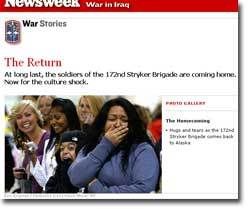
After Sixteen Months, Vets Come Home

From Newsweek:

For Staff Sgt. Duane Leventry, the culture shock hit him full force in an Anchorage, Alaska, supermarket.

Shortly after returning home from 16 months in Iraq, he found himself staring at an aisle full of steak sauce and marinade, paralyzed by the sheer volume of choices. “I must have stood there for 10 minutes trying to figure out what to get,” says Leventry, who arrived home in Anchorage last Saturday, Nov. 25, to his wife Kelly and 3-year-old daughter Alexia. “Do I want this? Do I want that? It took us about two hours to get out of the store.”


Click on 'Article Link' below tags for more...

For Spc. Shawn Mott, it happened on his first night home at a restaurant in Fairbanks, where the 172nd Stryker Brigade’s home base of Fort Wainwright is located. “The waitress walked up to me and I didn’t know what to do. I sat there for like 15 minutes going ‘What do I want?’” says Mott. “Having choices is overwhelming to me. All I ate in Iraq was chicken tenders and fries.”

After nearly a year and a half of combat duty, the returned soldiers of the 172nd are trying to adjust to life at home in Alaska. The Army has prepared the soldiers for the big things—how to watch for symptoms of posttraumatic stress disorder, how to reintegrate themselves into family life after what has been for some an unbearably long absence. But for the soldiers of the 172nd, who started arriving home last weekend, it’s the little things that have caught them by surprise.

This, by the way, is the same Stryker Brigade force that went through July's helter-skelter deployment extensions.

From the Stryker Brigade News:

First Arctic Wolves Return to Alaska After 16 Months in Iraq

By Brian Lepley and Spc. L.B. Edgar, AFPS

FORT RICHARDSON, Alaska, Nov. 27, 2006 – Two days after Thanksgiving, the families of the 172nd Stryker Brigade Combat Team had a lot to be thankful for as three planeloads of the “Arctic Wolves” returned from a 16-month deployment to Iraq.

Fort Wainwright welcomed more than 620 soldiers and Fort Richardson welcomed another 215 troops Nov. 25. More flights through this week and next were expected to get more than 3,720 Stryker soldiers back home by Dec. 5. For many of the returning soldiers, the homecoming was a bit of a déjà vu. Some 380 of the 172nd soldiers came home to Fort Wainwright in July before their unit’s deployment was extended four additional months.

More than 300 of the soldiers rejoined their units in Iraq, this time to conduct combat operations in Baghdad. They had previously been operating in the northern provinces of Iraq, mainly in Anbar, Rawaha and Mosul.


Back to Newsweek:

Next month, Leventry, 27, will leave the Army and intends to apply for the Anchorage police force. He never planned on a military career, but says the long, stressful deployments “definitely contributed” to his decision to leave the service. He was supposed to have gotten out in October but couldn’t because of the extension.

Shawn Mott, 26, still hasn’t decided whether to re-enlist. He is drained by his 16-month tour and says some of the worst stress of his time in Iraq came after the 172nd was suddenly transferred to Baghdad and had to deal with the resentment of other Army units already in the capital. Rivalries quickly developed between the members of the elite 172nd and the Fourth Infantry Division and the 101st Airborne. The Stryker soldiers were furious at their last-minute extension and felt they’d been diverted to Baghdad because the other units hadn’t done their jobs. The other units seemed to resent the swaggering, informal style of the Stryker soldiers. “It was a real culture clash,” Mott says. “Me and the Army don’t get along too well right now.”

For now, Mott is both reveling in his reunion with his fiancée, Nina Herrera, as well as dealing with feelings of “weirdness” at being out of Iraq. When Mott arrived in Fairbanks on Saturday after a 13-hour flight from Kuwait, there was no one to greet him: “There was no one to hug,” says Mott. “It was lonely.” More>>

Welcome Home, 172nd. To a happy and successful transition back into civilian life, surrounded by your loved ones.


Wednesday, November 29, 2006

Frederick News-Post Covers Combat PTSD

Alison Walker-Baird of Maryland's Frederick News-Post offers two well-written articles on combat PTSD today. The paper's Karen Gardner files another, too. Well done, News-Post!

From Walker-Baird's Stress Wounds:

The face of Post Traumatic Stress Disorder is changing. Far from the misguided stereotype of a wheelchair-bound, unemployed, middle-aged man, today's veteran with PTSD looks more like Spc. Christopher Clayton of Hagerstown, like your next-door neighbor. The 29-year-old Maryland Army National Guardsman returned from Iraq in May after 18 months in combat, greeted with hugs and beaming smiles from wife, Erika, and two young daughters.

He works full time and is pursuing a career in nursing. But a year and a half of constantly being on edge left this loving husband and father with depression and mood swings, and a diagnosis of PTSD. He's getting help. More than 400,000 veterans from the wars in Iraq and Afghanistan are expected to do the same.

Solid information, including stats and personal accounts, in all three pieces. Click on 'Article Link' below tags for more...

Continuing from Stress Wounds:

People with PTSD often don't experience symptoms until months or years after the traumatic experience. Despite the predicted flood of veterans needing mental health services, significantly fewer troops have served in Iraq and Afghanistan than in past conflicts such as the Vietnam war.

The U.S. Census Bureau estimates 8.2 million veterans served in Vietnam, making up more than 30 percent of all U.S. veterans, and about 3 million served in the Persian Gulf War. Studies have estimated from 19 percent to 31 percent of Vietnam veterans developed PTSD at some point, with between 9 percent and 15 percent still having the disorder by the end of the 1980s.

Among Gulf War veterans, 1997 and 2003 studies found 2 percent to 10 percent were still suffering from PTSD a decade after returning from deployment.

Plenty of stats on the relationship between injuries and the heightening of PTSD risk:

For every service member who dies in Iraq, nine have been wounded but survived. While more troops in Iraq and Afghanistan are surviving injuries that would have killed them in past wars, they are at risk of developing PTSD. Being wounded in a traumatic experience puts one at a significantly greater risk of developing PTSD than someone who was not injured, several recent studies found.

In the Vietnam and Persian Gulf wars, 24 percent of the wounded died. About 1 in 10 troops injured in Iraq has died, the lowest rate of any U.S. war.

They have survived with the help of better equipment and medical care than in past wars, but the weapons used in Iraq today leave many with lifetime disabilities or disfigurement. Pentagon data show more than half of troops injured are hurt so badly they can't return to war.

Military surgeons reported a high incidence of blindness, multiple amputations, burns and significant brain damage, according to Dr. Atul Gawande's study on modern war casualties published in the New England Journal of Medicine in December 2004.

Roadside bombs have caused about half of U.S. troops' injuries and deaths in Iraq, the Department of Defense's Defense Manpower Data Center reported.

Walker-Baird's second piece, Soldier faces new battle with PTSD, is an inside look into one solider's journey home from combat:

He spent 18 months in Iraq, constantly wound up and never letting his guard down. When the veteran returned home to his family, the stress didn't disappear as easily as changing into civilian clothes.

For this Hagerstown man, the wake-up call was his 3-year-old daughter telling her dad he was too angry. Spc. Christopher Clayton was living with Post Traumatic Stress Disorder.

Spc. Clayton, a member of the Frederick-based Alpha Company in the 1-115th Infantry Regiment of the Maryland Army National Guard, didn't experience symptoms of the disorder until several months after he came home.

Gardner contributes another personal account in The strength to find help: A Vietnam veteran takes steps toward healing:

Curtis Callender served in Vietnam. He went on to serve in the Army for an additional 25 years, retiring 15 years ago. It wasn't until less than a year ago, however, that he was diagnosed with Post Traumatic Stress Disorder.

Mr. Callender, 62, a native of Texas, works for the Military Amputee Research Program at Fort Detrick. After Vietnam, he became a medic in the Army and retired as a sergeant major. But something wasn't right. "I cried if I saw anything war related," he said. "I thought it was a weakness in my personality."

War movies, war stories, just about any reminder of war set him off. And as he got older, the tears came more often. He had been to see George Kauffman, the Veterans Service Officer for the Maryland Department of Veterans Affairs, at his Frederick office. "George is the one who thought I should get checked," he said.

Please read the rest, and then consider thanking the Frederick News-Post for this important coverage. Way to go!


Thursday, June 15, 2006

Vietnam Vets' PTSD Experience Helping Today's Troops

An informative and in depth piece on combat-related posttraumatic stress disorder appeared this weekend in The Spectrum out of St. George, (Southern) Utah.

In addition to a brief history of PTSD, and a look at how the book Down Range: To Iraq and Back is being used to help troops in the combat zone deal with the stress of war, you'll read how one Vietnam veteran recently came to terms with the PTSD that had been tailing him (yet that he refused to believe existed) since his return home decades ago. A solid piece of reporting that challenges those who believe PTSD is hogwash to take another look at their own reasons for denying its existence.

Click on 'Article Link' below tags for more...

From The Spectrum:

Despite the signs, 57-year-old Steve Cantonwine spent the last 34 years believing his symptoms were simply part of his personality - one that had been steeled by the rigors and scenes of the Vietnam War. "To me, there wasn't anything wrong with me. I was a Marine. I didn't believe in post-traumatic stress disorder. 'They' were just a bunch of people that were whining and crying for sympathy," said Cantonwine.

But his wife, KayAnne, always knew something had a grip on him, though she didn't have words to explain their experiences. So the two blindly worked their way through, daily facing and unknowingly dealing with the symptoms of PTSD. "I don't think you can see and do the kinds of things you have to do in war to survive and not be affected in some way. They can't ever go back to the way things were, too many things have happened. But there's healing that takes place," said KayAnne.

As soldiers now serving in today's foreign wars prepare to return home, families like the Cantonwines, along with the medical community and military officials, are sharing their knowledge and experiences with PTSD and offering resources and education to soldiers, their families and the community.

PTSD, the piece continues, is not only for those who've served in combat.

Events leading to PTSD include plane or train crashes, vehicle accidents, cave collapses, sexual abuse, rape, domestic violence and other trauma. But the differences in healing and symptom management may vary for individuals depending on the severity, length and intensity of the event.

Cantowine, a Marine who'd returned from two tours in Vietnam in 1973, had shown signs of PTSD for decades, but it wasn't until 2004 that he realized he was having problems coping.

After he left the Iron County Sheriffs Office, Cantonwine began work as an over-the-road truck driver. During the long hauls, depression set in and in April of 2004, the second trigger hit. Cantonwine, along with his best friend - a fellow Vietnam veteran - was involved in a rollover outside Coeur d'Alene, Idaho.

The two events, a major life change coupled with a traumatic event - both triggers for PTSD - sent Cantonwine reeling. He struggled through nightmares that echoed the dreams that once plagued him when he first returned home from the war and he battled suicidal thoughts and tendencies. "I didn't feel like there was anything left for me. One was to be a Marine. One was to be a cop, and being a cop was taken from me," he said.

Those events landed Cantonwine in the doctor's office for medical assessments where his primary care provider quickly cued into his condition and recommended treatment for PTSD.

At first, he refused to believe that he had PTSD, denial being a common defense mechanism. His wife, however, could see that the doctors were on to something.

"I had a lot of signs as I look back on it," Cantonwine said, recalling symptoms of the last 30 years. Signs from uncontrolled bouts of anger that included scenes of road rage to an obsession with adrenaline that he sought out through employment as a deputy, EMT and as a hospital volunteer. "Some vets had drug and alcohol problems. Steve's was adrenaline. That's what fed him. It was like a combat rush," said KayAnne.

And his authoritative qualities as a Marine and deputy, at times, carried over to loved ones. "He expected perfection from co-workers and family. I think it goes back to 'If you don't do things right, people might get killed.' There wasn't a lot of room for excuses," said KayAnne.

Of all the symptoms, it was the anger that worried his family most. "We never would know what would make him angry," said KayAnne, noting that at times her husband's ire would last for several weeks. Cantonwine's anger never led to physical violence or abuse, but his tension was hard to live with and often left the family on edge.

When Cantowine finally reached out for help, he also found acceptance and a feeling of 'fitting in' that had been elusive in the civilian world.

Cantonwine traveled to the VA hospital in Denver to receive treatment and still attends group therapy sessions. "He always felt like a fish out of water in the civilian world and all of a sudden he was surrounded by people who felt the way he felt," said KayAnne.

And Cantonwine appreciates the opportunity to learn skills to manage his symptoms. In the past year, he has missed only one group session, which was for surgery on May 3 when doctors removed a 2-pound cancerous tumor from his abdomen, possibly linked to Agent Orange exposure. "We don't sit and talk about specific memories. I don't have to tell them what my flashbacks are, what nightmares I'm having. But we're able to sit there and offer support to one another," he said.

Despite frustrations with the VA's bureaucratic process, the treatment and ongoing healing Steve has received have become welcome blessings for the Cantonwines. "Now things are so good. Steve's learned how to manage it and he's healing," said KayAnne.


The Silver Lining

The silver lining to this journey is, of course, how the struggles of our Vietnam vets can be lessons for learning how to do better with the next generation of warriors returning home from combat. Cantowine wants to ensure that we learn the lessons, and not repeat the same mistakes.

"People have woken up and Vietnam vets primarily brought it out into the forefront," said Cantonwine. "I don't want to see anybody go through what I went through or see anyone put their family through what I did unknowingly."

"I think we've come to a place where you can support the soldier without supporting the war and it's too bad we didn't know that in Vietnam," said KayAnne.

This isn't to discount the fact that there are very real problems that still face our returning veterans as they move towards reintegrating into civilian life.

Despite the gains made in recent years, the strain of transitioning home today is as great as ever on soldiers and their families. "It wasn't easy and it's not going to be for this new set of war veterans," said KayAnne. "I think the biggest thing for the vets is the stigma that they perceive in asking for help. They all want to think they're just fine and haven't been affected by anything."

As a wife of a Marine, KayAnne had to learn the delicate balance of simply being there for her husband and listening without prying when he returned home. And for healing to occur, Andrews and Cantonwine say vets need to be heard. "Hearing it sometimes isn't pleasant. Vietnam vets, nobody wanted to hear their stories, what happened to them. It was such an unpopular war that they soon learned not to talk about it," said KayAnne.

Today, Barbara Stringham is anxiously counting the days until her son returns home with the Utah National Guard's 2nd Battalion, 222nd Field Artillery, which has served a year in Iraq.

While her son was home on leave, Stringham found herself struggling with the balance between her own instinct as a mother to nurture and her son's need for space and need to handle things on his own. "They've just served in open-hand combat. They've seen death and destruction. They don't know to receive that nurture from a mother. They're soldiers. They're supposed to be tough. Some of these guys are going to just need to break down and the public needs to know that's OK. Heck, we as family members sometimes need to break down," Stringham said.

And while family members like Stringham say they may not fully comprehend all that their soldiers have been through, they know lasting changes have taken place. "I just hope that he doesn't go through the mental anguish that you hear so prevalent from soldiers. It's scary as a parent because you're at a disadvantage. You don't know where to turn for the help they need," said Stringham, a member of the Triple Deuce family support committee that assists families during their soldier's absence.

Though Stringham wants her son to feel open to talking with her, she's prepared for him to set the pace. "You don't want to pull it out of them. In time they'll share, but they have a lot to cope with. And also I think it's something of them not having to relive it. When he's home and he's home for good, he wants it to be behind him and not have to relive it, he doesn't want to have to relive it over and over and over again," she said.

Stringham and other family members say their focus will center on one thing as soldiers return home, integrating them back into the society that they served and getting them back into their daily routine. Families are also hopeful the military and VA will continue to support soldiers who served in military action.

Though communities like St. George are preparing for top-notch celebrations upon their return, Stringham's looking ahead to the coming weeks and helping the soldiers adjust. "That initial homecoming day will be full of hoopla and pageantry - and that may carry through for the next few weeks. But afterwards, that's when the help really, truly needs to be there in the next months and years ahead," Stringham said.

Be sure to read the rest of the piece for an IM interview with 1st Lt. Bryan Hofheins, physician assistant of the Utah National Guard, 2nd Battalion, 222nd Field Artillery, and an interview with Gaylan Springer, chaplain for the 222.

And consider sending your thanks to The Spectrum for providing us with such rich coverage of this topic.


Related Posts


Sunday, April 23, 2006

Sebring, OH: Community Returning Veteran PTSD Program

Little Sebring, OH is gearing up to offer its returning veterans a program of great importance. Robert Roerich, MD and Darla Hough have received approval from the local American Legion to use their space and resources for the first veteran and veteran family support group, tentatively called Veteran Freedom Fighters of America. Kick-off meeting is on Wednesday, May 10, 2006 from 7-9 p.m. All veterans and military family members are encouraged to participate in this program which will meet the 2nd Monday of every month (with an option to have additional meeting and support groups to be determined by its members). Contact 'Doc' Roerich if you have any questions.

Click on 'Article Link' below tags for map and directions, agenda, etc...

Sebring is a village of approximately 5,000 people in Mahoning County of northeastern Ohio. It is 5 miles east of Alliance, Ohio and 10 miles west of Salem, Ohio. I'm pleased to share preliminary details of their inspiring Veteran Freedom Fighters of America program (please check back for any additional updates as I receive them):

WHEN?

Kick-off meeting is on Wednesday, May 10, 2006 from 7-9 p.m. All veterans and military family members are encouraged to participate in this program which will meet the 2nd Monday of every month (with an option to have additional meeting and support groups to be determined by its members).

WHERE?

American Legion Post #76
395 W California Ave
Sebring, OH 44672


Click on above image for GoogleMaps directions. Or phone the American Legion at (330) 938-9082.

MISSION STATEMENT?

The Veteran Freedom Fighters of America (VFFA) support network was founded by a veteran’s wife and a psychiatrist who saw a growing need to provide a community based support network for our returning military back from Iraq and their families. With many veterans experiencing increased stress in the aftermath of war, a critical need was identified to help heal the unseen wounds of war by providing timely support. It takes a village to help our warriors transition from military to civilian life free of the social stigma of suffering from mental health problems such as anxiety, depression, Post Traumatic Stress Disorder (PTSD) and suicidal or homicidal acts.

A key component of fighting for mental peace of mind is knowing when there is a problem in relationships with friends and family. VFFA will help veterans and families fight for themselves, armed with knowledge of what problems can occur. The support group will not judge or stigmatize anyone but provide a nurturing, healing environment in order to truly return home.

AGENDA?

I. Welcome by Darla Hough and Robert Roerich. Introductions among attendees of the meeting.

II. Informal discussion and timeline of what problems can occur with returning military and their families. Feedback of what members have experienced if they wish to share with the group.

III. Survey of what resources group members would want in the group, which may include:

  • Printed and digital information handouts on depression, PTSD, and suicide for personal use.
  • Distribution of a support group work book for member’s use.
  • Information on problems with spouse or significant other and children affected by a veteran with PTSD.
  • Stress management
  • Anger management
  • Resource manual for families on financial assistance, filing disability claims from the VA, health care and referrals to outpatient, hospital and crisis hotlines.
  • Setting up peer and family support groups with group facilitator.
  • Social activities and group functions, fund raisers, grant applications.
  • Outreach and networking with others at the local, regional, state and national level to set up veteran and veteran family support networks.
CONTACT?

American Legion Post #76 will send out an invitation to their members in their newsletter informing them of their support in setting this veteran and veteran family community support network. A Salem, Ohio newspaper and others may also run a news story about this.

It is not necessary to contact anyone before coming, but if there are questions about the support network, 'Doc' Roerich will post about it on www.roadmind.com which has an announcement about this meeting. Additionally, you may contact the American Legion at (330) 938-9082 for directions or email 'Doc' at Roadmind University if you have any questions.


As the VA struggles to meet the increasing needs of our returning troops (alongside taking care of the those who've served in prior eras) more and more local and state efforts are being made to reach out and offer assistance. Programs like the one started up in Sebring, OH are vital to augment programs offered by the VA, providing yet another option and safety net for our returning troops and their families.

As Dr. Roerich says, "With the VA overwhelmed, understaffed and underfunded, getting the word out on the grass roots effort of concerned citizens and families to set up community based support networks in every hometown in America."


Other local communities are pitching in to help their returning troops in targeted and unique ways including those found in Minnesota, Oregon, and New Jersey and Philadelphia to name a few.

Kudos to them all. And here's to seeing more of this kind of thing pick up steam!


Tuesday, April 18, 2006

Reconnecting with Your Kids After Deployment

The DOD has once more christened April the Month of the Military Child. Since 1986, this month is set aside to focus on honoring the littlest member of the military family. I'll share resources and family transition tips for those returning home from a long deployment overseas.

Click on 'Article Link' below tags for more...

First, some military resources you might want to make use of:

Explore Grand Forks [ND] Air Force Base's Escape Zone, a new interactive learning center opened just yesterday at 410 Seventh Ave., Building 320, on base. Open for all active-duty military families (Reserve and Guard included), the Escape Zone offers a place for parents to join their kids in a number of hands-on activities and programs aimed at helping with their pre- and post-deployment bonding. Phone (701) 747-5608 for more details.


Don't miss these two great clearinghouses of family info: DeploymentLINK and the valuable Blue Box of resources.

Highly recommended -- lots of Blue Box family reintegration guides, including the following must-haves workbooks:


Access the DOD's Military Child in Transition website, brimming with great information for both parent and 'military brat' (said lovingly, of course :o). Some of the gems you'll find here are the 85-page Military Students on the Move Toolkit for Parents [pdf]; the 29-page Parent's Guide to the Military Child During Deployment and Reunion [pdf]; and the 12-page How Communities Can Support the Children and Families of Those Serving in the National Guard or Reserves [pdf].


Check out the DOD's Military Homefront website. Take a special look at the resources collected on their Children & Teens page.


Have your kids explore Kids Information on Deployment Stuff (KIDS), a website made especially for them. Click on their grade level (grouped into three categories), and away they go!


View the Army Reserve Family Programs Readiness Video, Dealing with the Emotional Side of Deployment, that explores what to expect during your soldier's deployment. You'll also learn to handle the stress and emotions that you'll be feeling during this anxious time. Although the video is geared toward the couple's relationship, kids will benefit, too.


Take a look at the Deployment Health Clinical Center Family & Friends page. It has a lot of resources waiting for you including links to the following videos: Making Your Reunion Work, Family Readiness Groups, and Family Assistance Center.

A few other resources:

Give Zero to Three a quick look; they're a nonprofit whose mission is to "support the healthy development and well-being of infants, toddlers and their families." They have some veteran-specific resources including the 8-page booklet Little Listeners in an Uncertain World: Coping strategies for you and your child during deployment or when a crisis occurs [pdf].


Read WNBC's great article
which provides a list of things parents and teachers can do to support military children. A few tips include:

  • Keep in touch. Help kids find ways to keep in touch with their parents overseas. E-mail and/or phone calls can be helpful, when available. Kids can also send letters and/or packages.

  • Build a scrapbook. If a parent will or may be out of contact for an extended period of time, help kids keep a journal, scrapbook or photo album of daily events to share with their mom or dad when they return. Pay particular attention to holidays and special occasions like birthdays, school plays or graduations. Kids will want to help parents "catch up" on these events when they return.

  • Leave comforting reminders. Some parents record themselves reading a familiar and soothing story before they leave. Others write notes or leave photographs to be opened each day or week.

  • Kids need predictability. Be careful about promises to call at a certain time or come home on a specific date.

  • Schoolwork issues. Children may experience a slight decline in classroom performance while a parent is on active military duty. Children may have difficulty studying with so many other things on their mind. Other children may actually focus on schoolwork as a way to deal with their anxieties. In general, teachers should be told that a parent is on active military duty. It may help them understand any academic or behavioral changes they may see in the classroom.

  • Get in touch with other military families. Help kids make contact with other kids whose parents are on active military duty. In some areas, school guidance counselors or local therapists are organizing informal groups to give kids a chance to talk about their thoughts and fears.

  • Limit TV. Many children in military families are riveted to the details of daily media coverage. In part, this may be an effort to master the situation by gathering as much information as possible. This can be an important and healthy reaction. Young children (preschool and school age) should not watch war-related coverage unattended. It's best done with a parent or other adult who can provide reassurance and/or help answer questions. Even adolescents should be encouraged to limit TV viewing. Research clearly indicates that constant exposure to war related coverage may heighten anxiety. Read more on kids' viewing of TV war coverage.
These are only a few of the suggestions, so I'd highly recommend taking a look at the entire article.


Military.com's Your Children and Separation page offers solid advice and links to more solid resources for military parents. A few suggestions:

  • Be Truthful. Children are very perceptive! As soon as the servicemember starts planning and preparing for a drill or deployment, the child will catch on that something is up. Do not lie to your child in an attempt to shield him or her from the truth or they may assume something worse. Talk to your child openly and honestly.

  • Share Feelings. Children often lack the vocabulary to share their feelings. It will help if parents talk about their own feelings which will help children communicate their feelings. Let your child know that even negative thoughts and feelings are OK and normal.

  • Explore Destination. Using a map or globe, show your child where you are going and chart your route. Using books or encyclopedias, explore weather conditions, cultural norms, or products produced in that region.

  • Communicate with Teachers. If your child is school-age, let the teacher know what is going on at home. The teacher may use maps and chart your travels with the class!

  • Design an Activity to Pass Time. With your child, design or create an activity to help mark time. For younger children, make a paper chain with a link for each day you will be gone that the child can use to measure time (the child will break a link each day). For an older child, choose a book that you both would enjoy and each read a pre-assigned passage everyday.

  • Show Your Workspace. If possible, set aside time to show your child the ship and where you will be eating, sleeping, and working. Or, take your child to the armory prior to departure and show him or her the artillery guns or weapons that you might be working with while away.

  • Let Your Child Help You Pack. Letting your child help you pack will allow him or her to be more involved in the process and also allow them to "care" for you. If possible, let them decorate the inside of your footlocker. Not only will they have great fun but you will enjoy their artwork for days and months to come.
Read to learn to identify signs of possible distress in your child.


Finally, the following helpful tips come from the Blue Box's A Soldier and Family Guide to Redeploying:

Deployment Reunions and Children

Deployment reunions and reintegration are a process, not an event. The process requires time and effort. Stress levels may remain high up to seven months post deployment. School is a setting that remains the same for the child of a deployed parent[; t]herefore, it's an important part of their life. Families and schools working together help children adjust to the changes inherent in deployment reunions and reintegration.

Tips for Parents:

  • Talk with you children before the service member comes home much as you did when the parent was preparing to leave.
  • Tell your child's teacher about the return of the military parent from deployment.
  • Use the services of the Family Support Center and Army Community Service to help address the special challenges of wartime deployment reunions and reintegration.
  • Know that children's behavior will greatly depend on how their parents renegotiate, compromise, and communicate.
  • Take care to avoid abruptly shifting love and attention from the children to the returning spouse.
  • Help children understand that they have changed while the parent was away, AND that the parent has changed, too. Assure them that even though the parent may look or act differently than the child remembers, the returning parent is their same father or mother that left and that loves them.
Understand that children may experience a variety of feelings:

  • Happy that they will see the parent again.
  • Afraid that the parent will not like the way they have changed, or that the parent will leave again.
  • Excited about being able to share some of their favorite activities again.
  • Proud that their parent is doing an important job for our country.
  • Jealous of the time and attention taken from them and now given to the returning parent.
  • Worried that all these feelings are not normal.
Know that the children may not respond to discipline from the returning parent because of the loyalty to the parent that remained behind. Children may test the limits of the family rules to find out how things may have changed with the return of the deployed parent.

Go slowly and let the children set the pace in accepting the parent back. Plan some special time for just the child and the returning parent to get reacquainted.

And finally, just go easy on yourself. Take things one step at a time. And seek out outside help in all of its forms to help support your transition back into the family you so missed -- and so missed you -- while you were away.

Related Posts


Saturday, March 25, 2006

Lifelines Online PTSD Video Series for Military Families

As our troops continue to stream home to us, families are having to deal with a variety of adjustment issues. Soldiers, sailors, airmen, and Marines are likely coping with combat stress or post-traumatic stress disorder; and so, Navy hospitals have been reaching out to help their service members and families via traditional counseling and online videos to assist families in understanding some of the reintegration issues they'll be facing.

Click on 'Article Link' below tags for more...

[UPDATE Apr 09 2007]: View videos below.

From AP:

Sgt. Milton Caples made it home to his wife and daughter after a year as a security convoy driver in Iraq, but thoughts of suicide bombers and mortar attacks haunted him, nearly costing him his former life. Driving on the rural roads near his home, he would flashback to the streets of Balad and Tikrit, speed up and try to out run other drivers. "I would know I was doing crazy stuff. It would seem like I was driving but I wasn't there. I was looking at myself doing stuff in a video game or something," he said. "In some cases, I'm glad the police didn't see me because they would have taken my license away."

He spent his nights doing security patrols of the family home - repeatedly checking to see if doors and windows were locked, if anyone was prowling around outside. His anger ate away his relationship with his wife and daughter, who struggled to reach the fun-loving man they once knew.

Three years into the Iraq war and almost five years after the invasion of Afghanistan, American families like the Capleses are increasingly becoming part of its collateral damage. Learning from the mistakes of Vietnam, the military has long encouraged returning soldiers to seek counseling. Now its leaders are trying something different - reaching out to the soldiers' families.

Although treatment and medication have evolved since Vietnam, the warrior mentality still prevents most returning soldiers from getting the help they need, said Rick Weidman of Vietnam Veterans of America. "Real men don't eat quiche and they don't have problems like this - hooah," he said, giving the shout soldiers make.

To counteract this attitude, Navy hospitals have begun advertising their counseling programs as well as pointing families to their online PTSD video series.

The videos were designed not for service members, but their families. "The goal was to bring in the family in hopes that if the individual wouldn't come in on their own, we would reach them through the family. We made thousands of copies and distributed them to all kinds of places," said retired Navy Capt. Jennifer Morse, the San Diego Naval Hospital psychiatrist featured on the videos. The Navy began producing the videos in 2004 and is releasing a re-edited version of the project in the coming months.

"The intent is to get people help, not to fix them over the Internet. (To tell them that) they shouldn't be ashamed of their feelings after they have served in these situations," said Bill Hendrix the Navy's Pentagon-based coordinator of the Lifelines video project. The videos have been so successful that the Air Force and the Army are also using them to encourage families to seek counseling for veterans of both Iraq and Afghanistan, Hendrix said.

Weidman, of the Washington-based Vietnam veterans group, applauded the efforts to reach troops by reaching out to families. "The military, under significant pressure, has made some significant efforts," he said. Vietnam Veterans of America has long pushed the Department of Defense to develop such programs, he said.

But Capt. Jeffrey Weyeneth, a psychiatrist at Pensacola Naval Hospital, estimates continued counseling programs still reach only 10 percent of troops returning from Iraq and Afghanistan. "A lot of guys, they see it as a nick in their armor, 'If I want to do 20 (years) or more, I don't want to be seen as a nut case'. And confidentiality is difficult with the military because mental health can affect your ability to function in the military so confidentiality is not as absolute as it is in the civilian world," he said.

Returning soldiers who go without treatment often hide their stress from co-workers to avoid ruining their careers and instead take their problems out on their families, Weyeneth said. "A lot of these guys come back from war but never get out of the combat, the enemy just changes. They direct their anger at other people," he said.

You may access the full Lifelines video series online.

[One technical note: For some reason, this link wouldn't open the video page in my Firefox browser; Internet Explorer, however, downloaded it just fine, making the programs available for viewing.]


The videos have been made available on YouTube:

#1


#2


#3


#4


 Related Posts


Sunday, March 12, 2006

Rep. Martin Meehan Works to Help Returning Veterans

Rep. Martin Meehan [D-Mass.] deserves the spotlight for his tireless efforts on the behalf of veterans -- and especially for those coping with PTSD. He joins a list of other hard-working elected officials trying their best to get the VA adequate funding, deliver top-quality health care to our veterans and their families, and protect other benefits our troops have earned for their service to our country.

Click on 'Article Link' below tags for more...

From Rep. Meehan's website:

Working to address Post Traumatic Stress Disorder (PTSD) continues to be one of Congressman Meehan's top priorities in Congress. Congressman Meehan has called on his colleagues to redouble the commitment to soldiers now returning home and those who defended our freedom in past conflicts, ensuring that we provide care not only for the physical wounds, but the emotional scars as well.

As it stands now, the government maintains an unacceptably flawed system that neither pays adequate attention to veterans suffering from mental health disorders, nor dedicates sufficient resources to diagnosing and assisting them. This allows too many veterans suffering from mental health disorders to fall through the cracks. ...

Congressman Meehan wrote legislation -- included in the House version of this year's National Defense Bill -- that would create a Defense Department mass media campaign to raise awareness about mental health and substance disorders among service members and their families. It would also create peer support programs to support and educate soldiers about PTSD. This legislation, which was endorsed by Dr. William Winkenwerder, Jr., Assistant Secretary of Defense for Health Affairs at the Department of Defense, will help remove the stigma and encourage people to seek treatment.

The legislation in question above appears to be HR2411:

To provide improved benefits and procedures for the transition of members of the Armed Forces from combat zones to noncombat zones and for the transition of veterans from service in the Armed Forces to civilian life.

Sponsor: Rep Meehan, Martin T. [MA-5] (introduced 5/17/2005)
Cosponsors: None
Committees: House Armed Services; House Veterans' Affairs; House Financial Services
Latest Major Action: 6/21/2005 Referred to House subcommittee.
Status: Referred to the Subcommittee on Military Personnel

As the bill appears to have no co-sponsors presently, perhaps those interested in supporting this work could take a moment to contact their district representative, asking them to consider co-sponsoring this important legislation.

More details:

U.S. Rep. Martin Meehan, D-Mass., has filed legislation that would require every returning veteran to undergo a thorough psychological and physical examination. Meehan also seeks to increase funding for treatment of veterans with post-traumatic stress disorder. "If you look at how much money we're spending in Iraq and the increase in the defense budget, surely a small portion of that could be used to take care of these kids coming back from Iraq," Meehan said.

Part of the reason for the mental stress when soldiers return could be the nature of this war, in which U.S. troops aren't fighting an army. Soldiers never know whether a civilian is the enemy. Troops rotate in and out of Iraq and return home to a country less accepting of the war. "It's one thing to hunker down in one area, but it's another to move around to a new unsecured area all the time," said staff Sgt. Robert Davis, a mental health technician with the Army's 883rd Combat Stress Control Company, a unit that offers psychological counseling to troops on the front lines in Iraq. "There's anxiety, battle fatigue, lack of sleep and they're miles from home. Any of those is difficult, but all of them together is bad," Davis said.

David Spiegel, a psychiatrist at Stanford University and expert in PTSD, said soldiers are immersed in a brutal environment, then just dumped back home among people who don't understand. "You have a society not prepared to deal with what these people have been through and done. It isolates them when they come back."

Many are reluctant to seek help. Veterans worry that getting counseling could hurt their careers or alter relationships, said a study last year in the New England Journal of Medicine by the Walter Reed Army Institute of Research. "A lot of the younger guys won't do that," said National Guard Staff Sgt. Joseph Nelson of Bloomingdale, N.Y. "They think it makes them into wimps."

Please take a moment to send a note of thanks to Rep. Meehan. He's got every veteran's back. Shouldn't we have his?


Previous/Older Posts Return Home

Archives
2011: Jan Feb
2010: Jan Feb Mar Apr May Jun Jul Aug Sept Oct Nov Dec
2009: Jan Feb Mar Apr May Jun Jul Aug Sept Oct Nov Dec
2008: Jan Feb Mar Apr May Jun Jul Aug Sept Oct Nov Dec
2007: Jan Feb Mar Apr May Jun Jul Aug Sept Oct Nov Dec
2006: Jan Feb Mar Apr May Jun Jul Aug Sept Oct Nov Dec
2005: Sept Oct Nov Dec

Legal Notice

The information presented on this web site is based on news reports, medical and government documents, and personal analysis. It does NOT represent therapeutic prescription or recommendation. For specific advice and information, consult your health care provider.

Comments at PTSD Combat do not necessarily represent the editor's views. Illegal or inappropriate material will be removed when brought to our attention. The existence of such does not reflect an endorsement.


This site contains at times large portions of copyrighted material not specifically authorized by the copyright owner. This material is used for educational purposes, to forward understanding of issues that concern veterans and military families. In accordance with U.S. Copyright Law Title 17 U.S.C. Section 107, the material on this site is distributed without profit. More information.