Showing posts with label politics. Show all posts

Monday, May 03, 2010

AP: Raising Traumatic Stress Malingering, VA Disability Claim Fraud Fears

Here we go again. Fears of PTSD malingering and VA claim fraud bobbed to the surface this weekend in a piece by Allen G. Breed, AP:

Moved by a huge tide of troops returning from Iraq and Afghanistan with post-traumatic stress, Congress has pressured the Department of Veterans Affairs to settle their disability claims — quickly, humanely, and mostly in the vets' favor.

The problem: The system is dysfunctional, an open invitation to fraud. And the VA has proposed changes that could make deception even easier.

PTSD's real but invisible scars can mark clerks and cooks just as easily as they can infantrymen fighting a faceless enemy in these wars without front lines. The VA is seeking to ease the burden of proof to ensure that their claims are processed swiftly.

But at the same time, some undeserving vets have learned how to game the system, profitably working the levers of sympathy for the wounded and obligation to the troops, and exploiting the sheer difficulty of nailing a surefire diagnosis of a condition that is notoriously hard to define.

"The threshold has been lowered. The question is how many people will take advantage of that," said Dr. Dan G. Blazer, a Duke University psychiatrist who has worked with the military on PTSD issues. PTSD, he adds, is "among the easiest (psychiatric) conditions to feign."

Mark Rogers, a longtime claims specialist with the Veterans Benefits Administration, agrees. "I could get 100 percent disability compensation for PTSD for any (honorably discharged) veteran who's willing to lie," said Rogers, a Vietnam-era vet who is now retired. "I just tell him what to say and where to go."

The only problem with this, of course, are the reams of past years' studies showing quite the opposite. Two that come immediately to mind:

  • In 2007, Navy Times reported: "In 2001, 10 percent of soldiers going through the medical retirement process received permanent disability benefits. In 2005, with two wars raging, that percentage dropped to 3 percent, according to the Government Accountability Office. Reservists dropped from 16 percent to 5 percent."

  • Also in 2007, US News & World Report found the military to be downgrading disability ratings, reporting: "Since 2000, 92.7 percent of the disability ratings handed out by PEBs have been 20 percent or lower... Moreover, fewer veterans have received ratings of 30 percent or more since America went to war in Afghanistan and Iraq... As of 2006, for example, 87,000 disabled retirees were on the list of those exceeding the 30 percent threshold; in 2000, there were 102,000 recipients."
Then again, maybe PTSD diagnoses shouldn't be taken seriously.

Breed, in a companion AP piece getting a bit less buzz but championing the same cause, reports "the fact that, as a constellation of self-reported symptoms, PTSD is very subjective."

Apparently, biological changes in the brain aren't objective, either.

Everyone agrees that each case of malingering or fraud should be penalized and stopped, no matter if that claim is being filed with the VA or a civilian's private insurance company. Unfortunately, this AP piece appears to do more to spread distrust and blame the veteran than anything else. Not surprisingly, the push-back has begun.



Sunday, April 11, 2010

Chicago Tribune Reports on VA Claims Process Quandary

Headline splashed across the front page of today's Chicago Tribune: The Cost of War.
Analyzing more than 3 million VA disability claims (this figure equals the number of vets receiving such compensation in 2009 -- a jump of 24 percent over the 2003 total), it is the latest in a long line of government and private studies on problems at the VA. The Trib found:

The bulk of the increases didn't come from veterans of the current wars in Iraq and Afghanistan but from those who served years or even decades before. Veterans from the Vietnam and Persian Gulf eras accounted for roughly 84 percent of the rise in spending, which hit $34.3 billion last year.

The surge from past eras comes even as more soldiers than expected are returning home from Iraq and Afghanistan in need of care. With hundreds of thousands of troops still deployed, the VA already provides disability payments to nearly 200,000 veterans from the current conflicts, a number that is expected to balloon during the next 30 years.

The unanticipated crush of claims is exacerbated by the VA's antiquated compensation system, which hasn't been overhauled since 1945. Cumbersome and heavily bureaucratic, the system requires a mountain of paperwork, is based on diagnoses that lag far behind medical advances and runs on a computer system that is so outdated it can't accurately verify whether veterans were deployed.


Wednesday, November 04, 2009

Afghanistan, Iraq Veteran Army Suicide Rate Continues to Climb

The problem is clearly complex.

The reasons are many-fold, as varied and numerous and hard to pin down as are people themselves. But this much we know: Our veterans are turning to suicide at an alarming rate; and, at least for now, all of the programs and outreach and educational campaigns the military and the VA have been throwing at the problem have failed to staunch the tide.

The latest numbers do not provide relief.

Yochi Dreazen, Wall Street Journal:

Sixteen American soldiers killed themselves in October in the U.S. and on duty overseas, an unusually high monthly toll that is fueling concerns about the mental health of the nation's military personnel after more than eight years of continuous warfare. ...

The October suicide figures mean that at least 134 active-duty soldiers have taken their own lives so far this year, putting the Army on pace to break last year's record of 140 active-duty suicides. The number of Army suicides has risen 37% since 2006, and last year, the suicide rate surpassed that of the U.S. population for the first time.

It's important to note that the above figure reflects only Army suicides; it does not include data from any of the remaining military branches or from the VA. And so, if this year's active-duty Marine suicide rate is the same as it has been in previous years (41/2008; 33/2007; 25/2006), expect to add another 30-40 incidents to the above total.

And yet, that figure isn't the full measure, either.


Sunday, March 22, 2009

Female Faces of War - Part 1: Jessica Lynch and Lori Piestewa

This past week has marked the sixth anniversary of the start of the Iraq War. As I prepare for my presentation at next weekend's Female Faces of War conference, I'm going through some of my previous writing related to the women warriors of this era. I'm also in the midst of writing my Honors Capstone paper, Combat Veterans, Mass Media and the Advancement of Social Consciousness, that I've been researching since January.

Something I'm still shaping, but wish to share with you...

Women have been smack-dab in the middle of three significant historical markers and media stories to have come out of the Iraq War era so far (as nearly 20 percent of deployed forces in the Middle East, they are a part of many more, of course). Three female service members in particular have also -- each in their own way -- played a role in coming forward to set the record straight on an important issue, provide important evidence and testimony, and share something they felt was hidden or not understood correctly by society.

Three notable female figures of the Iraq War's first year:

  • Jessica Lynch, an Army private held hostage and made into a hero after her support convoy came under attack during the initial invasion of Iraq in March 2003, set the record permanently straight about what really happened.

  • Sabrina Harman, former Army Reserve specialist with the 372nd Military Police Company who would later be convicted of participating in Abu Ghraib's horrors, photographed both prisoners and the guards meting out the abuse during the fall of 2003 "trying to expose" what was happening -- even while taking part herself.

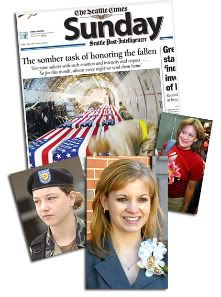
  • Tami Silicio, a Kuwait-based military contractor whose photos of fallen U.S. service members' flag-draped coffins created an uproar after the Seattle Times published them in April 2004, acted to show military families the dignified way in which the bodies of their loved ones were were being transported home.
As you can see, I'm not going the easy route, listing merely "heroes" -- although Lynch certainly qualifies as one in my book. The reason Harmon is included yet others are not? There is no doubt that her digital images and emails home describing what was happening at Abu Ghraib prison shaped the course of Iraq War history.

Though their contributions widely differ, it is clear that each made a significant mark. I'll be expanding on their influence as I piece together my remarks for the FFW conference; when I have those ready, I'll be sure to share them with you here as well.

Although a departure from the PTSD-focus on this blog, in extended a few excerpts from a piece I wrote in 2007 about Jessica Lynch and the saga she was swept up in. This post also pays tribute to Lori Piestewa, Lynch's best friend and the first female service member to die in Iraq.


Wednesday, March 18, 2009

Gulf War Vet Dies on Road to Honor the Fallen, Are Doctors Over-Diagnosing PTSD?, Colbert Nation to Invade the Middle East, VFA News, MTV's Real World

  • USA Today | Veteran on cross-country trek dies - "A disabled Gulf War veteran who left Norman earlier this month on a hand-propelled bicycle headed for Washington D.C. to honor fallen soldiers has died. Kevin Baker suffered a seizure Friday morning in his sleep at the home of some friends in Lake Charles, La., said Norman resident Diane Zellner. He died in an ambulance en route to a local hospital, Zellner said she was told. Baker, a 39-year-old Navy veteran, had a history of seizures, stemming from a traumatic brain injury, she said. He also had been diagnosed with lymphoma."

  • Scientific American | Soldiers' Stress: What Doctors Get Wrong about PTSD - A provoking article (of thought, certainly, and anger in some as well) says that PTSD "is under fire because its defining criteria are too broad, leading to rampant overdiagnosis;" that the "flawed PTSD concept may mistake soldiers' natural process of adjustment to civilian life for dysfunction;" and that "misdiagnosed soldiers receive the wrong treatments and risk becoming mired in a Veterans Administration system that encourages chronic disability." Mind Hanks has more commentary (its comments are reflective of the opinion tug of war).

  • On a lighter note, comedian and Comedy Central talk show host Stephen Colbert plans to take The Colbert Report to the Middle East. "I’m not supposed to tell anyone where I’m going, but just say it’s sandy and they’d like us to leave," Colbert told Stars and Stripes on Tuesday.

  • Veterans For America | News Analysis: March 18, 2009 - Always recommended, John Steinman collects another day's worth of valuable info- and link-laden tidbits.

  • MTV's “The Real World” highlights cast member and Iraq vet Ryan's recent visit to the New York office of Iraq and Afghanistan Veterans of America (IAVA). The episode, premiering tonight and rerun throughout the week, has Ryan marching in the Veterans' Day Parade and attending IAVA's Second Annual Heroes Gala.
More PTSD Combat Diigo links.


Sunday, January 11, 2009

Reaction to DoD Decision Against Awarding Purple Heart to Veterans with Combat PTSD

This week's news that the Purple Heart will not be considered for those coping with the psychological wounds of war has gotten a reaction from many quarters. The military decoration is awarded for "being wounded or killed in any action against an enemy of the United States or as a result of an act of any such enemy or opposing armed forces."

Through August 2008, 2,743 OEF and 33,923 OIF veterans have received the distinguished medal (of ~1.7 million given out since its modern inception in 1932; more Purple Heart history), which brings with it "enhanced benefits, including exemptions from co-payments for veterans hospital and outpatient care and gives them higher priority in scheduling appointments."

In extended, a selection of some of the debate on the matter. These are lengthy and multiple pieces, but are quite enlightening to read through if you have the time. The issue touches upon a slew of concerns dealing with our positions on tradition, progress, science, psychology, honor, equity -- all well worth examining.


Monday, December 08, 2008

Talking Post Trauma Blues: Will Obama Make PTSD a Household Name?

One of my favorite female OIF vets, Abbie Pickett, shared the following video on her facebook page. (If you're a frequent reader of PTSD Combat and wish to connect with me via my facebook account, you're invited to do so; I frequently post PTSD-related content via that channel when I'm pressed for time -- which is often when my semesters are in full-swing).

The video is for a song called "Talking Post Trauma Blues."


Saturday, December 06, 2008

Defining PTSD: Update on Our Way to DSM-V

Interesting developments in the the current updating of the DSM-IV, or Diagnostic and Statistical Manual of Mental Health Disorders (generally considered the "Bible of Psychiatry"), and the ongoing push to make the process as transparent as possible.

Concerns have begun swirling about regarding a number of entries, post-traumatic stress disorder [PTSD] among them. It would be wise to keep our eye out on these developments, especially if you are in the field's research and/or medical professions, as the early draft of the new DSM-V is due out in the coming year. A period for comment will follow before the final version is published in 2012. (Follow the latest back-and-forth over at Psychiatric Times' DSM-V page.)

First, a look at the desk reference's history via Wikipedia:

The DSM [official site | select contents] is published by the American Psychiatric Association and provides diagnostic criteria for mental disorders. It is used in the United States and in varying degrees around the world, by clinicians, researchers, psychiatric drug regulation agencies, health insurance companies, pharmaceutical companies and policy makers.

The DSM has attracted controversy and criticism as well as praise. There have been five revisions since it was first published in 1952, gradually including more disorders. It initially evolved out of systems for collecting census and psychiatric hospital statistics, and from a manual developed by the US Army.

The last major revision was the DSM-IV published in 1994, although a "text revision" was produced in 2000. The DSM-V is currently in consultation, planning and preparation, due for publication in May 2012. An early draft will be released for comment in 2009.


Monday, August 04, 2008

DoD's $300M PTSD/TBI Research Push, Ft. Hood Presidential Candidate Debate?, Online Sleeplessness Chat

  • Congress and the Pentagon are in the midst of funding a record $300 million military PTSD/TBI research push this summer. With approximately 1.4 million Americans diagnosed with TBI annually, civilians will benefit from the groundbreaking drive, too. "The Pentagon also will target new ways of delivering therapy to PTSD victims living in remote areas of the USA and reducing the stigma that can keep victims from seeking help."

  • Since last November, Military Spouses for Change has been on a mission to bring our presidential candidates together for a Fort Hood, Texas, debate and discussion of issues important to military families. Founder Carissa Picard has so far succeeded in securing a date (August 11); getting CBS to agree to broadcast the event live; and received candidate John McCain's OK. As for Barack Obama? He says that due to scheduling difficulties he can't be there. Maybe something will change by then and the conversation will get underway. If not, a tip of the hat to MSC for their effort.

  • Don't forget Tuesday's LA Times online chat on the sleeping difficulties of combat veterans diagnosed with PTSD. The chat begins at 9:00 am Eastern/noon Pacific, but the accompanying article is already online. Some stats: "About 36% of Army troops who have been back from Iraq for a year said they struggled nearly every day with feeling tired. About 34% said they had difficulty falling asleep, staying asleep or sleeping too much nearly every day... About 70% of veterans being treated for [PTSD] have sleep problems."

  • And if you're looking for more stats on the mental health and well being of our OEF/OIF troops and veterans, "The military's invisible wounds" by David Isenberg would be well worth a read.


Thursday, May 22, 2008

Back to the Future: Senate Joins House in Restoring WWII-Era Veterans' GI Bill Benefits

As Memorial Day approaches, both aisles of Congress have done something quite extraordinary: joined forces to deliver on another important reintegration resource -- education benefits -- for returning troops. Robert Pear for the New York Times:

Twenty-five Republican senators broke with President Bush and voted Thursday for a major expansion of veterans’ benefits as part of a bill to finance another year of the wars in Iraq and Afghanistan. The proposal, adopted by a vote of 75 to 22, also provides money for extended unemployment insurance benefits and other domestic programs to which Mr. Bush has objected. ...

While 25 Republicans supported the proposal, 22 opposed it. Forty-eight Democrats and two independents voted for the bipartisan measure, drafted by two Vietnam veterans, Senators Jim Webb, Democrat of Virginia, and Chuck Hagel, Republican of Nebraska. The proposal on veterans’ benefits was approved by a veto-proof majority, with support from conservative Republican senators including Saxby Chambliss of Georgia, James M. Inhofe of Oklahoma and John Thune of South Dakota.

The bill now goes back to the House, where its future course is somewhat uncertain. The House had endorsed a similar expansion of education benefits for veterans, but has also adopted policy measures to speed the withdrawal of American troops from Iraq. The Senate rejected efforts to limit the president’s hand in Iraq.

Senators John W. Warner, Republican of Virginia, and Frank R. Lautenberg, Democrat of New Jersey, said they were in the Senate today because of the help they had received under an earlier G.I. Bill. Mr. Hagel said the new legislation “fulfills the commitment that America made in 1944, and has continued, to honor every generation of veterans since World War II.”


Sunday, March 23, 2008

4,000 and 488

Together with the news that 25 fuel trucks transporting fuel to our forces in Afghanistan were bombed today, it is a sad Easter as we reach our 4,000th fatal casualty in the Iraq War (not confirmed yet in the media, but I have received word of it via email by a knowledgeable source; ICasualties.org is showing the same) alongside our 488th fatal loss in Afghanistan, Pakistan and Uzbekistan under the Operation Enduring Freedom umbrella.

My thoughts and prayers to our military families.

[UPDATE] From AP:

A roadside bomb killed four U.S. soldiers in Baghdad on Sunday, the military said, pushing the overall American death toll in the five-year war to at least 4,000. The grim milestone came on the same day that rockets and mortars pounded the U.S.-protected Green Zone, underscoring the fragile security situation and the resilience of both Sunni and Shiite extremist groups despite an overall lull in violence.


Thursday, March 13, 2008

Winter Soldier Gathering to Hold Crisis in Veterans' Healthcare Panel on Friday

The Winter Soldier: Iraq and Afghanistan testimonies begin at the National Labor College near Washington, D.C., today and continue through Sunday. The event title hearkens back to the 1776 writings of Thomas Paine: "These are the times that try men's souls. The summer soldier and sunshine patriot will, in this crisis, shrink from the service of his country; but he that stands by it now, deserves the love and thanks of man and woman."

Tomorrow, Friday March 14, 2008, The Crisis in Veterans' Heathcare panel will be convened from 11:00AM – 12:30PM EST. From the event schedule:

This panel will look at neglect and abuse of veterans and service members with regards to their mental and physical health. Testimonies will include accounts about the impact of an under-funded Veterans Administration, injured soldiers being forced back into combat without fully recovering from their wounds, cases of the military’s denial of mental healthcare for those suffering from post traumatic stress syndrome and exposure of service members to depleted uranium munitions and other hazardous materials.

(Speakers: Martin Smith; Adrienne Kinne, IVAW member and worker in Veterans Administration; Eugene Martin, national organizer with American Federation of Government Employees, AFL-CIO; Joyce & Kevin Lucey, parents of a son who committed suicide after being denied treatment for post traumatic stress syndrome; Zollie Goodman; Tod Ensign)

Listen in via online stream or check other viewing options.


Thursday, December 13, 2007

A Thank You to the House Veterans Affairs Committee From a Concerned Citizen

houseva_kr3 houseva_cspan17 houseva_cspan2 houseva_cspan13

Mike and Kim Bowman, parents of local Illinois National Guardsman who committed suicide two years ago on Thanksgiving Day after having returned home from Iraq only eight months earlier, my husband, and I flew home late last night following an incredible two days in Washington, D.C. testifying before the House Veterans Affairs Committee on the issue of veterans suicide.

[Written testimony transcripts; my full testimony below.]

I have a lot going on today as a result, but wanted to share a few things quickly now and promise to return to share some of my thoughts in full as soon as I can. But I want to say how honored and moved I was to have been in that room during the two breathtaking hours of testimony the Bowmans gave.

There really was very little left to have to say after their masterful and information-rich time in front of the committee. It just makes one all the more realize the inanity of having to do study after study and call in professional after professional to analyze data and point to what needs to be done.

If the VA and the DoD really want to know what we should be doing to assist military family members through the reintegration process, here's all they need to do: ask our military families. Fortunately, these types of hearings at least offer the rest of us -- and the VA and the DoD -- the opportunity to learn straight from the source what is needed.

We must listen, and then we absolutely must act.


Thursday, December 06, 2007

Confirmation Hearings Begin for Veterans Affairs Nominee James Peake

From AP:

Pledging to "do the right thing," Veterans Affairs nominee James Peake said Wednesday he will be an independent advocate for thousands of injured veterans and will fight for the needed funding for their care.

In a 2 1/2-hour confirmation hearing, the retired Army lieutenant general also vowed to work on making significant headway in fixing gaps in care and reducing delays in disability pay.

But Peake hedged on offering specific solutions, deferring to detailed briefings he will receive later if confirmed. He indicated his greatest mark on the agency in the waning months of the Bush administration might be improved communications with the Defense Department.

"I'm not much of a legacy guy," Peake said.


Saturday, December 01, 2007

Mark Fiore: The Surge at Home

This week, the politically biting and brilliant editorial cartoonist/animator Mark Fiore tackles the myriad holes that have been reported of late in society's veteran safety net. To absolutely get the full effect of this admittedly dark piece of comic humor, please view his latest animation, The Surge at Home, aptly narrated by "your Pentagon pal 'Ouchy.'"


Saturday, November 24, 2007

Military Spouses Challenge Presidential Candidates to Attend February Veterans Issues Forum


Military Spouses for Change is a "non-profit, non-partisan organization created to promote the rights, interests, and needs of service members, veterans, wounded warriors, and military families by educating the public and empowering military spouses."

They are laying down a compelling challenge:

As much as individual presidential candidates talk about health care plans or personal values, the fact remains that we are electing a war president. We are electing a president who will probably spend the bulk of his or her first term managing military conflicts and performing extensive foreign policy damage control. In 2008, the next President will inherit at least two wars and the costs of those wars, internally as well as internationally, will continue to grow long after the last service member comes home.

Consequently, Military Spouses for Change is inviting the presidential candidates from both parties to Fort Hood, Texas (Killeen), on February 1st, to talk about foreign policy, our military, our veterans, our wounded warriors, and our military families. ...

This kind of event has never been done before and it needs to be done now. Not only because Americans on both side of the aisle need to be reminded (before Super Tuesday) that we are electing the next Commander-in-Chief, but also because our service members and their families deserve to be addressed and heard by the people who wish to be elected in that position.


Friday, November 23, 2007

Veterans Service Organizations Praise Democratic Congressional Leadership

From Stars and Stripes:

Veterans service organizations are thrilled with a $43.1 billion appropriations bill that Congress is set to pass next month for the Department of Veterans Affairs.

The funding level for veterans programs and facilities is almost 20 percent higher than demoralized Republican leaders left behind a year ago. The $6.9 billion increase will allow VA to hire 1,800 more claim processors, beef up medical staffs and modernize long-neglected hospitals and clinics.

“I can’t praise the Democratic leadership enough for what they’ve done with addressing the budget that was handed to them the day they took office,” said Steve Robertson, legislative director for the American Legion.

The 109th Congress adjourned last December without passing a VA appropriations bill. It left the department operating under a “continuing resolution” with VA spending frozen at its fiscal ’06 level. In taking control of the 110th Congress, Democrats immediately raised VA funding for fiscal 2007 by $3.5 billion. They then turned to veterans groups for guidance on setting the VA budget for ’08.


Sunday, November 18, 2007

Combat PTSD Positions: Edwards, Obama, and Clinton

Last week, Sen. John Edwards unveiled a $400 million five-point plan to help returning troops and their families cope with post traumatic stress. While not the only presidential candidate to set his sights on this issue, the Edwards plan is the first to be prominently unveiled as the presidential race heats up. From AP:

Under Edwards' plan, veterans could seek counseling for post-traumatic stress disorder outside the Veterans Health Administration system; the number of counselors would increase; and family members would be employed to identify cases of PTSD. ...

"I strongly believe we must restore the sacred contract we have with our veterans and their families, and that we must begin by reforming our system for treating PTSD. We also must act to remove the stigma from this disorder," Edwards said in prepared remarks his campaign provided to The Associated Press. "Warriors should never be ashamed to deal with the personal consequences of war."

Let's take a deeper look at these points, as well as what fellow presidential candidates Barack Obama and Hillary Clinton are doing -- or planning to do -- on this issue.


Tuesday, October 30, 2007

President Nominates New VA Chief: Former Army Surg Gen James Peake

President Bush nominated retired Army General James Peake to the position of Veterans Administration Secretary today. Early reaction...


Sunday, October 14, 2007

As Combat PTSD Stigma Ebbs, Funding Fight and Political Disillusionment Flow

Today's New York Daily News quotes two highly-decorated veterans appointed to the House Veterans Disability Benefits Commission.

They've spent over two years studying the problems of the Veterans Administration health care system. In discussing their 113 recommendations (released earlier in the month), comments by one of its distinguished members, retired Marine Maj. Gen. James Livingston, brought to focus how far we've come in our work to destigmatize combat PTSD:

They were an unlikely bunch of soldiers to be making the case for the "talking cure" before Congress last week. They once dismissed it as a copout for shirkers and wimps.

"Absolutely, we've gone through a transition" over the years, said retired Marine Maj. Gen. James Livingston, who wears the Medal of Honor from Vietnam. "Now I'm a believer in early intervention" by therapists in the treatment of post-traumatic stress disorder, the diagnosis for what was called battle fatigue or shell shock in wars gone by, Livingston said.

While we've made great inroads (especially considering that a rough, tough guy like Livingston has come full-circle in his attitude towards the psychological wounds of war), the truth is that our changed attitudes are worthless if we don't follow up with the proper response.


Previous/Older Posts Return Home

Archives
2011: Jan Feb
2010: Jan Feb Mar Apr May Jun Jul Aug Sept Oct Nov Dec
2009: Jan Feb Mar Apr May Jun Jul Aug Sept Oct Nov Dec
2008: Jan Feb Mar Apr May Jun Jul Aug Sept Oct Nov Dec
2007: Jan Feb Mar Apr May Jun Jul Aug Sept Oct Nov Dec
2006: Jan Feb Mar Apr May Jun Jul Aug Sept Oct Nov Dec
2005: Sept Oct Nov Dec

Legal Notice

The information presented on this web site is based on news reports, medical and government documents, and personal analysis. It does NOT represent therapeutic prescription or recommendation. For specific advice and information, consult your health care provider.

Comments at PTSD Combat do not necessarily represent the editor's views. Illegal or inappropriate material will be removed when brought to our attention. The existence of such does not reflect an endorsement.


This site contains at times large portions of copyrighted material not specifically authorized by the copyright owner. This material is used for educational purposes, to forward understanding of issues that concern veterans and military families. In accordance with U.S. Copyright Law Title 17 U.S.C. Section 107, the material on this site is distributed without profit. More information.