Monday, February 14, 2011

Closing One Chapter, Opening Another

Dear friends,

Since it's been mostly quiet here the past year, it's time for me to write a note. First come the thank yous.

To those of you who have read, shared and/or supported my Moving a Nation to Care project, you are appreciated. The slim volume made bigger waves than this little fish ever expected.

To all of you who, at one time or another over the past five years, visited PTSD Combat -- and most especially to its nearly 1,300 subscribers, who supported my writing with your vote of confidence -- thank you for sharing the journey.

For all the veterans and military family members and veterans advocates I have interacted with, or humbly was able to help in some small way, or even sadly could not help due to my own time and resource limitations, my deepest gratitude for all you do for our nation.

Thank you for letting me be a part of your life.

It's been five remarkable, unimaginably productive and ever-to-be-cherished years of veterans advocacy work. What eventually became Moving a Nation to Care, was first an issue that I simply stumbled into unwittingly back in 2005.

First, as a citizen journalist, and later as a recognized expert, my attempt to understand why some of our veterans were returning home from war only to commit suicide landed me on avenues I'd never plotted for myself. Life has a funny way of pointing you in the direction you're most needed to go, it seems.

I tried to do my best and rise to the occasion.

When an opportunity to push the issue of combat PTSD presented itself, with the blessing and backing of my husband and family, I did what I could to raise Americans' awareness.

I wasn't alone.

Many of the same seasoned advocates who welcomed and helped this unknown novice writer continue the work still today. I could list all of you; but, there are too many to count. You know who you are. Thank you for doing what you do.

The work is unrelenting, exigent, and often thankless.

I know. And I say, "Thank you."

I have been honored to have been a small grain of sand in this movement to raise awareness and exact change concerning issues of so much importance to our troops, veterans, military families and even citizens. But everyone needs to regenerate and refresh themselves every-so-often, and that is certainly the case here.

Sadly, PTSD Combat is officially being retired today.

I've been grappling with this for quite some time and took a long-needed break from blogging in 2010.

Thank you so much for allowing me to have a voice on an issue that I continue to care so much about. I also look to the stars and send a thank you to my late sister, Zsuzsanna, whom we lost to suicide 10 years ago. Through that pain, I gained a deep empathy for other families going through the same tragedy.

We have much to offer one another in the world.

Above all, I hope that we continue to work to remove the stigma of imperfection that defines the human experience. We are all just trying to make our way, doing the best that we can in an imperfect world.

Tragedy and challenge define our reality.

But we need not be defined by it. Marcel Proust said, "We are healed of a suffering only by experiencing it in full." My work here helped me, too. Let's continue to strive and work together so that we may all attain strength in body, peace of mind, and nourishment of spirit.

The load is much lighter, the road much brighter, together.

And there is so much healing in the doing,


Wednesday, November 10, 2010

Pausing to Remember This Veterans Day


Known as Armistice Day or Remembrance Day in other parts of the world, in America -- in towns and cities small and large -- we take a few moments this Thursday, on Veterans Day, to remember those who have served this land.

Events and gatherings, in fact, have already been in full swing since at least this past weekend, when I snapped the above series of photos in little Utica, Ill., population: 1000. Preparing for what is hailed as the largest such parade in the state, store windows held the usual wares alongside images of local heroes whose service and sacrifice will never be forgotten.

It was a very moving display.

A couple of weeks ago, I was able to visit -- for the first time -- the magnificent World War II Memorial in Washington, D.C., as well as return to the Vietnam Veterans Memorial once more. No matter how many times I stand in the Wall's wake, I'm revisted by quiet tears.


My husband and I were joined by our nephew (on his first visit to the Capitol) and we spent some time reflecting on the service and sacrifice of our service members, and the difficult times and trials of our military families over the years.


Sometimes it can seem almost dispiriting to think about all of the losses people have endured in the cause of war. We all yearn for peace; yet, no matter how many souls each generation offers in that vein, we never seem to be able to staunch the blood loss.

While I don't have any idea how or if we'll ever resolve such an evergreen condition of human nature and experience, I do know that it makes me feel better to stand with others to remember those who gave their very lives in a valiant attempt to forge a better world for those left behind -- even if what they yearned for is not yet fully realized.

This year, I'm looking forward to once more attending NIU's annual Veterans Day ceremony. [I'd also like to extend my oh-so-thrilled-for-you congratulations to everyone at Northern, which recently received the the Governor’s Award for Excellence in Veterans Education. The recognition is well-deserved.]

Wherever your day takes you, please pause and remember those who have devoted a portion -- or even all -- of their lives to answer the nation's call. And moving beyond this day, it is my wish that we might also strive to be better to one another in honor of those sacrifices.

In extended, news clips in keeping with the day.


Sunday, June 27, 2010

30 Years in the Making, National PTSD Awareness Day Arrives

This past week, the U.S. Senate passed a resolution submitted by Sen. Kent Conrad [D-ND] marking today, June 27, as National PTSD Awareness Day. Boy, have we come a long way.

It's been three decades since post-traumatic stress disorder was first listed in the Diagnostic and Statistical Manual of Mental Disorders (DSM-III). Since then, the study of trauma has taken off, reflected in academic publications such as the Journal of Traumatic Stress.

In February, in fact, JTS devoted an entire issue specifically to combat PTSD as it has affected veterans and military families embroiled in our current wars in the Middle East.

A few stats from the issue's editorial [pdf]:

High-profile events such as the terrorist attacks on 9/11 have contributed to an increased public recognition of trauma as well as greater professional interest. The number of articles on disaster increased substantially from the period in the 5 years before 9/11 to the period 5 years after by 145% in specialty disaster journals and 320% in general medical journals, with the largest increase being 2,340% in the New England Journal of Medicine (Kelen & Sauer, 2008). Other high-profile events -- the wars in Iraq and Afghanistan, the bombings in London and Madrid, Hurricane Katrina, and the tsunami in Southeast Asia -- have undoubtedly had a similar impact.

KFYR-NBC out of Bismarck, N.D., broadcast news of National PTSD Awareness Day in a segment now online. In extended, a few informative videos including a recent PBS interview with Dr. Jonathan Shay, noted VA psychologist, author and 2007 MacArthur Fellow.

I hope today will help to further chip away at the stigmas associated with seeking help for those battling traumatic injuries of all kinds.


Monday, May 03, 2010

Report: The Community Service Desires, Civic Lives of Returning OEF/OIF Veterans

Flush with important skill sets and valuable experiences, military veterans can be counted among a community's greatest assets. Unfortunately, one barrier they face when out of uniform and in a civilian capacity is a feeling of disconnection from the very people they wish to serve.

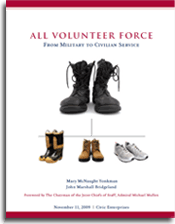
So says a a 44-page report, All Volunteer Force: From Military to Civilian Service [pdf]. Published last November on Veterans Day by public policy firm Civic Enterprises, it presents the findings of a first ever nationally representative survey focusing on veterans' homecoming transition and civic lives.

The survey found that "only 13 percent of veterans strongly agree their transitions are going well. Yet those veterans who said they had volunteered since returning home had better transitions than those who had not." More:

  • Nearly 9 out of 10 veterans said Americans could learn something from their example of service, yet only half considered themselves leaders in their communities as a result of their military service.

  • Nearly 7 in 10 veterans had not been contacted by a community institution, local non-­‐profit, or place of worship after their return home.

  • 92 percent of OIF/OEF veterans agreed that serving their community is important to them.

  • Veterans said a diverse range of issues was important or very important to them: helping military families (90 percent), being involved with disaster relief (88 percent), working with at-risk youth (86 percent), and being involved with the environment/conservation (69 percent).

  • 7 in 10 non-volunteering veterans said they do not have enough information of meaningful service opportunities.

In extended, a portion of the report's statistic-heavy intro.


AP: Raising Traumatic Stress Malingering, VA Disability Claim Fraud Fears

Here we go again. Fears of PTSD malingering and VA claim fraud bobbed to the surface this weekend in a piece by Allen G. Breed, AP:

Moved by a huge tide of troops returning from Iraq and Afghanistan with post-traumatic stress, Congress has pressured the Department of Veterans Affairs to settle their disability claims — quickly, humanely, and mostly in the vets' favor.

The problem: The system is dysfunctional, an open invitation to fraud. And the VA has proposed changes that could make deception even easier.

PTSD's real but invisible scars can mark clerks and cooks just as easily as they can infantrymen fighting a faceless enemy in these wars without front lines. The VA is seeking to ease the burden of proof to ensure that their claims are processed swiftly.

But at the same time, some undeserving vets have learned how to game the system, profitably working the levers of sympathy for the wounded and obligation to the troops, and exploiting the sheer difficulty of nailing a surefire diagnosis of a condition that is notoriously hard to define.

"The threshold has been lowered. The question is how many people will take advantage of that," said Dr. Dan G. Blazer, a Duke University psychiatrist who has worked with the military on PTSD issues. PTSD, he adds, is "among the easiest (psychiatric) conditions to feign."

Mark Rogers, a longtime claims specialist with the Veterans Benefits Administration, agrees. "I could get 100 percent disability compensation for PTSD for any (honorably discharged) veteran who's willing to lie," said Rogers, a Vietnam-era vet who is now retired. "I just tell him what to say and where to go."

The only problem with this, of course, are the reams of past years' studies showing quite the opposite. Two that come immediately to mind:

  • In 2007, Navy Times reported: "In 2001, 10 percent of soldiers going through the medical retirement process received permanent disability benefits. In 2005, with two wars raging, that percentage dropped to 3 percent, according to the Government Accountability Office. Reservists dropped from 16 percent to 5 percent."

  • Also in 2007, US News & World Report found the military to be downgrading disability ratings, reporting: "Since 2000, 92.7 percent of the disability ratings handed out by PEBs have been 20 percent or lower... Moreover, fewer veterans have received ratings of 30 percent or more since America went to war in Afghanistan and Iraq... As of 2006, for example, 87,000 disabled retirees were on the list of those exceeding the 30 percent threshold; in 2000, there were 102,000 recipients."
Then again, maybe PTSD diagnoses shouldn't be taken seriously.

Breed, in a companion AP piece getting a bit less buzz but championing the same cause, reports "the fact that, as a constellation of self-reported symptoms, PTSD is very subjective."

Apparently, biological changes in the brain aren't objective, either.

Everyone agrees that each case of malingering or fraud should be penalized and stopped, no matter if that claim is being filed with the VA or a civilian's private insurance company. Unfortunately, this AP piece appears to do more to spread distrust and blame the veteran than anything else. Not surprisingly, the push-back has begun.


Saturday, May 01, 2010

Found Links: Traumatic Stress, Brain Injury Research, Related Military News

Shared on facebook recently:

  • Blood protein triggers scars in the brain after injury | EurekaAlert release -- Clip: "A protein called fibrinogen that is known to help form blood clots also triggers scar formation in the brain and spinal cord, according to new research in the April 28 issue of the Journal of Neuroscience. Researchers found that fibrinogen carries a dormant factor that activates when it enters the brain after an injury, prompting brain cells to form a scar. Scars in the brain or spinal cord can block connections between nerve cells and often keep injury patients from reaching full recovery."

  • It pays to remember what made you sad | New Scientist

  • Pentagon: Boost Training With Computer-Troop Mind Meld | Wired -- Clip: "The Pentagon is looking to better train its troops — by scanning their minds as they play video games. Adaptive, mind-reading computer systems have been a work-in-progress among military agencies for at least a decade. In 2000, far-out research agency Darpa launched “Augmented Cognition,” a program that sought to develop computers that used EEG scans to adjust how they displayed information — visually, orally, or otherwise — to avoid overtaxing one realm of a troop’s cognition."

  • A brain-recording device that melts into place | PhysOrg.com -- Clip: "...the ultrathin flexible implants, made partly from silk, can record brain activity more faithfully than thicker implants embedded with similar electronics. ...In people with epilepsy, the arrays could be used to detect when seizures first begin, and deliver pulses to shut the seizures down. In people with spinal cord injuries, the technology has promise for reading complex signals in the brain that direct movement, and routing those signals to healthy muscles or prosthetic devices."

  • Placebo effect beats God, Prozac | SF Chronicle -- An intense opinion piece with lots of interesting data and ideas to consider.

  • Aging: The Secret Life of the Middle-Aged Brain | Huffington Post -- A few tips and clearing up of myths.

  • The Conversation: Brain research brings wonders and worries | Sacramento Bee -- Important read. Intro clip: "What ethical concerns will arise from new technology and medicine that can reveal our thoughts and enhance our brains?"


Friday, April 30, 2010

The Singular Trails and Trials of Female Combat Veterans

Sharing a handful of recent news reports focusing on the unique military service and civilian reintegration experiences of our women veterans. A good intro for our purposes from Jayme Fraser, Montana Kaimin:

Military policies banning women from the frontline are disappearing as the number of female veterans in the United States nears 1.9 million.

“I think we’re growing up,” Army National Guard Capt. Dawn Gray said. “If you look at other countries, especially Israel, women are not excluded from any combat role if they can physically handle it.”

The role of women in war has expanded significantly since World War II, when women moved into the workplace void left by men going off to war.

“There are only a few places that women aren’t actively assigned and I expect that will change, too,” Gray said.

Female pilots fly combat missions for the Air Force and Navy. Though Army policy prohibits women from the frontline, temporary assignments and test programs, as well as changing dynamics of urban warfare in Iraq, have put more female soldiers into combat.


Tuesday, April 27, 2010

Combat Clips: A Selection of OEF/OIF Veteran Statistics, April 2010

Quick looks at the latest news containing statistics of interest to returning veterans, military families and their caregivers.
First up, Kristin M. Hall for AP:

Brig. Gen. Stephen Townsend addressed the 101st Airborne Division with military brusqueness: Suicides at the post had spiked after soldiers started returning home from war, and this was unacceptable.

"It's bad for soldiers, it's bad for families, bad for your units, bad for this division and our Army and our country and it's got to stop now," he insisted. "Suicides on Fort Campbell have to stop now."

It sounded like a typical, military response to a complicated and tragic situation. Authorities believe that 21 soldiers from Fort Campbell killed themselves in 2009, the same year that the Army reported 160 potential suicides, the most since 1980, when it started recording those deaths.

But Townsend's martial response is not the only one. Behind the scenes, there has been a concerted effort at Fort Campbell over the past year to change the hard-charging military mindset to show no weakness, complete the mission.


Sunday, April 25, 2010

Does Guilt and Disillusionment Play a Role in Combat PTSD?

Yes.

A recent study confirms the role of guilt and the need to resolve meaning-of-life issues in those attempting to move beyond PTSD:

Combat veterans commonly report guilt and depression following stressful military experiences. More depressed veterans often report higher levels of posttraumatic stress disorder (PTSD; Dohrenwend et al., 2006). Guilt also appears to be a distress-related response, potentially increasing both avoidant coping and PTSD (Henning & Frueh, 1997; Street, Gibson, & Holohan, 2005), potentially worsening prognosis and treatment response (Kubany et al., 1995; Owens, Chard, & Cox, 2008). Understanding the multiple influences on PTSD is a pressing priority, particularly with current military deployments.

Cognitive restructuring models of coping (e.g., Park & Ai, 2006) may explain why PTSD develops in some trauma survivors and not others. Posttraumatic stress disorder is believed to result when a traumatic event shatters core beliefs that enable people to establish meaning in life (Janoff-Bulman, 1992). If people cannot cognitively restructure traumatic events, regain meaning in life, and rebuild core beliefs, depression and guilt may develop. ...

Veterans of various service eras (N =174) completed an Internet survey about combat exposure, posttraumatic stress disorder (PTSD) symptoms, depression, guilt, and meaning in life. Results of a hierarchical regression indicated that younger age; higher levels of combat exposure, depression, and guilt; and lower meaning in life predicted greater PTSD severity. The interaction between meaning in life and depression also was significant, with a stronger inverse relation between meaning and PTSD at lower levels of depression. Meaning in life may be an important treatment concern for veterans with PTSD symptoms, particularly at higher levels of functioning.

Source: "Posttraumatic stress disorder, guilt, depression, and meaning in life among military veterans," Journal of Traumatic Stress, Volume 22 Issue 6, Pages 654-657


VA Research: 'Improving Veterans Lives' Brochure Series on PTSD

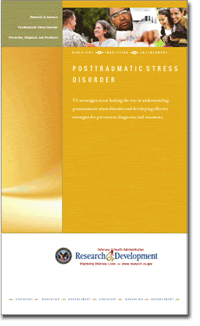
The Veterans Health Administration as part of its VA Research: Improving Veterans Lives brochure series, has produced a six-pager on Posttraumatic Stress Disorder [pdf]. Written by the communicators at VA's Research & Development Department, the slant is on treatment modalities currently being developed and tested:

This brochure presents examples of VA’s recent accomplishments in PTSD research. These studies, it is hoped, will benefit veterans and many other Americans now and in the future and spare them from PTSD’s life-disrupting symptoms and complications.

One of nearly 10 other offerings to choose from (Iraq & Afghanistan Veterans [pdf], Mental Health [pdf], Rural Health [pdf], TBI [pdf] Women's Health [pdf] and more) -- all worth at least a glance.


Monday, April 19, 2010

Combat Clicks: Military Science, Health and Technology News (April 2010)

Recent press reports on science, technology and health re: combat veterans and military. Edric Thompson, CERDEC Public Affairs via Army.mil:
Maj. Gen. Nick Justice, Research, Development and Engineering Command commanding general and key members of his staff traveled to Apple headquarters March 5. Apple officials gave the Army group tours of its laboratories and other facilities and talked about some examples of where the military is already using Apple technology. The Army's research and development command is evaluating commercial hand-held solutions such as iPad, iPhone, iPod, iMac, and MacBook platforms. ...

"We're continuing to leverage commercial technology for battlefield uses; we can't ignore that kind of existing knowledge," [Justice] said. "Our job, as stewards of the taxpayer's dollar, is to adopt and adapt appropriate commercial technology and offer the best possible solution to the warfighter."

The meeting was part of the Army's efforts to support "Connecting Soldiers to Digital Applications," an initiative to demonstrate the technical capabilities of hand-held devices and applications to the Army and gathering warfighter. The working group is tasked with looking at how commercial cellular technology - including devices, applications and networks - could be utilized in a tactical environment.


Tuesday, April 13, 2010

Latest Military Combat Veteran Suicide Statistics

Military suicide figures recently reported on in the press. First up, Mark Thompson asks in an article for Time magazine, Is the U.S. Army Losing Its War on Suicide?

From the invasion of Afghanistan until last summer, the U.S. military had lost 761 soldiers in combat there. But a higher number in the service — 817 — had taken their own lives over the same period. The surge in suicides, which have risen five years in a row, has become a vexing problem for which the Army's highest levels of command have yet to find a solution despite deploying hundreds of mental-health experts and investing millions of dollars. And the elephant in the room in much of the formal discussion of the problem is the burden of repeated tours of combat duty on a soldier's battered psyche. ...

[T]he service's suicide rate continues to rise (it doubled between 2001 and 2006) while remaining flat in the civilian population, even when adjusted to reflect the Army's age and gender. Last year, 160 active-duty soldiers killed themselves, up from 140 in 2008 and 77 in 2003.


Basic Training for the Mind: Ft. Jackson's New Mental Health School

One of the newest courses at Fort Jackson, the Army's biggest basic training and combat instruction outpost, is something called Master Resilience Training. The genesis for the course has been the rise of suicide in the military.

Yesterday, Army Chief of Staff Gen. George Casey, a vocal proponent of warrior resilience training, toured the South Carolina base and spoke about the novel 10-day program.

Joseph Kasko, New Channel 7-ABC:

Casey toured a new school where sergeants and young officers learn positive approaches toward mental health to reduce suicide and post-traumatic stress.

“It was clear to me after my time in Iraq that we’re going to be at this for a while,” said Casey.

“The human mind and body wasn’t made to deal with repeated combat deployments, one after the other. So we had to give every soldier the opportunity to and the skills to deal with those challenges,” he said. ...

Casey said the Army currently has 1,000 master resilience trainers and he hopes to [have] one in every battalion by the end of the year. He said, however, there is still resistance to mental health training in the military.

“We’ve been working very hard since 2007 to drive down the stigma for getting treatment for post-traumatic stress or mild-traumatic brain injury,” said Casey.

“My expectations for this, is that it is gradually embraced by the Army and becomes part of our culture.” ...

Casey said the Army has budgeted $125 million for the program over the next five years, which he called an “investment” in their soldiers. He said the Army has been working on the program for two years, after militarizing a similar program developed at the University of Pennsylvania.

Lots more background and details below the fold.


Sunday, April 11, 2010

Chicago Tribune Reports on VA Claims Process Quandary

Headline splashed across the front page of today's Chicago Tribune: The Cost of War.
Analyzing more than 3 million VA disability claims (this figure equals the number of vets receiving such compensation in 2009 -- a jump of 24 percent over the 2003 total), it is the latest in a long line of government and private studies on problems at the VA. The Trib found:

The bulk of the increases didn't come from veterans of the current wars in Iraq and Afghanistan but from those who served years or even decades before. Veterans from the Vietnam and Persian Gulf eras accounted for roughly 84 percent of the rise in spending, which hit $34.3 billion last year.

The surge from past eras comes even as more soldiers than expected are returning home from Iraq and Afghanistan in need of care. With hundreds of thousands of troops still deployed, the VA already provides disability payments to nearly 200,000 veterans from the current conflicts, a number that is expected to balloon during the next 30 years.

The unanticipated crush of claims is exacerbated by the VA's antiquated compensation system, which hasn't been overhauled since 1945. Cumbersome and heavily bureaucratic, the system requires a mountain of paperwork, is based on diagnoses that lag far behind medical advances and runs on a computer system that is so outdated it can't accurately verify whether veterans were deployed.


Are Veterans Who Kill in Combat More Likely to Get PTSD?

Yes. (Not a very surprising conclusion, is it?) Recent research shows this to be true for Iraq War veterans:

[A study led by Shira Maguen of the San Francisco VA Medical Center and University of California-San Francisco] examined the mental health impact of reported direct and indirect killing among 2,797 U.S. soldiers returning from Operation Iraqi Freedom. Data were collected as part of a postdeployment screening program at a large Army medical facility. Overall, 40% of soldiers reported killing or being responsible for killing during their deployment. Even after controlling for combat exposure, killing was a significant predictor of posttraumatic disorder (PTSD) symptoms, alcohol abuse, anger, and relationship problems. Military personnel returning from modern deployments are at risk of adverse mental health conditions and related psychosocial functioning related to killing in war. Mental health assessment and treatment should address reactions to killing to optimize readjustment following deployment. ...

Military personnel who have killed may experience significant shame and/or guilt and need to know that they will be allowed to explore the impact of killing in a safe and supportive environment (e.g., Veterans Affairs). They also may have received criticism or been subject to insensitive questioning by acquaintances, friends, or family members that cause them to be weary of speaking to others about this sensitive issue, especially when they fear others will not understand or judge them for their actions.

Source: "The impact of reported direct and indirect killing on mental health symptoms in Iraq war veterans," Journal of Traumatic Stress, Volume 23 Issue 1, Pages 86 - 90

An earlier study by the same research team shows a similar correlation between killing in combat and increased incidence of PTSD in the Vietnam War veteran population.


Sunday, April 04, 2010

Problems Accesing Content?

Sorry for the state of the website right now.

I'm putting the finishing touches on a long-needed template update. So, I'm working quite a bit in the background, which will cause some hiccups for anyone attempting to access the site.

In the next few days, you'll find some discontinuity between a number of pages (the sitemap and alternate home page at ptsdcombat.com, for example, won't integrate smoothly with the rest of the site until I finish cleaning them up and bringing them in line with the rest of the blog).

If you're having problems, please check back later.

Thanks for your patience.


A Basketful of Simple Stress Solutions

I recently came upon a beautifully-filmed and presented set of stress management videos created by Joy of Ritual author Barbara Biziou.

Geared toward a general audience (and not specifically for those with PTSD), yet just about as colorful as a basketful of Easter eggs, I thought I'd share them with you (be sure to check in extended for parts 2 + 3).


Here's to a relaxing yet 'hoppy' holiday!


Saturday, April 03, 2010

Is There Anything 'Good' About Traumatic and/or Intense Life Experiences?

Yes.

Studies suggest posttraumatic growth can be a significant, positive outcome of surviving and even thriving following a traumatic event. Controversial in some quarters, at this juncture the data shows such life experiences may be character-building:

That which does not kill us makes us stronger. — Friedrich Nietzsche

In contrast to Nietzsche’s well-known quote, life-threatening experiences may lead to psychiatric conditions such as posttraumatic stress disorder (PTSD; Kessler, Sonnega, Bromet, Hughes, & Nelson, 1995). Furthermore, greater exposure is usually linked to more severe symptoms (Brewin, Andrews, & Valentine, 2000). Psychopathology nevertheless occurs only among a minority of those exposed to such events, leaving open the possibility of other outcomes, including benefits (Bonanno, 2004). Tedeschi and Calhoun (1995) identified the positive psychological changes that can occur following a potentially traumatic event as posttraumatic growth: improved relationships with others, openness to new possibilities, greater appreciation of life, enhanced personal strength, and spiritual development. ...

How are strengths of character related to growth following trauma? A retrospective Web-based study of 1,739 adults found small, but positive associations among the number of potentially traumatic events experienced and a number of cognitive and interpersonal character strengths. It was concluded that growth following trauma may entail the strengthening of character.

Source: "Strengths of character and posttraumatic growth," Journal of Traumatic Stress, Volume 21 Issue 2, Pages 214 - 217


Thursday, April 01, 2010

Finding Balance and Resilience 101: Free Workbooks and Guides for Veterans, Military Families and Counselors

Last summer, I crossed paths with Pamela Woll, MA, CADP.

A Chicago-based author and consultant in writing, training, and instructional development, Woll works on getting individuals and organizations to "recognize and build on resilience; understand the nature, neurobiology, and effects of stress and trauma; and promote successful recovery from the effects of embodied stress and trauma."

While her entire Human Priorities website is well worth more than one visit (so much good information to be found there), I'd like to point you to two sets of resources she's created specifically with veterans, military families and counselors in mind.


Wednesday, March 31, 2010

Combat Clips: A Selection of OEF/OIF Veteran Statistics, Feb/Mar 2010

Recent statistical data found in news reports regarding today's veterans. First up from HealthDay News:

Between 2002 and 2008, nearly 50,000 veterans from the Iraq and Afghanistan wars received diagnoses of post-traumatic stress disorder. But fewer than 10 percent of those completed the recommended treatment of 10 to 12 weekly sessions within four months; the number only grew to fewer than 30 percent over a year, the study authors found.

Some types of veterans are less likely to receive recommended care: males, veterans who are under the age of 25, those who live in rural areas and those who got their diagnoses at primary-care clinics and needed referrals to mental health programs, according to the report published online Feb. 9 in the Journal of Traumatic Stress.

Dr. Karen Seal, the study's head researcher and a practitioner at the San Francisco Veteran Affairs Medical Center, said in a news release that most veterans did attend at least one mental-health appointment. But problems -- including those at the system and personal levels -- led to lack of follow-up.


Later/Newer Posts Previous/Older Posts Return Home

Archives
2011: Jan Feb
2010: Jan Feb Mar Apr May Jun Jul Aug Sept Oct Nov Dec
2009: Jan Feb Mar Apr May Jun Jul Aug Sept Oct Nov Dec
2008: Jan Feb Mar Apr May Jun Jul Aug Sept Oct Nov Dec
2007: Jan Feb Mar Apr May Jun Jul Aug Sept Oct Nov Dec
2006: Jan Feb Mar Apr May Jun Jul Aug Sept Oct Nov Dec
2005: Sept Oct Nov Dec

Legal Notice

The information presented on this web site is based on news reports, medical and government documents, and personal analysis. It does NOT represent therapeutic prescription or recommendation. For specific advice and information, consult your health care provider.

Comments at PTSD Combat do not necessarily represent the editor's views. Illegal or inappropriate material will be removed when brought to our attention. The existence of such does not reflect an endorsement.


This site contains at times large portions of copyrighted material not specifically authorized by the copyright owner. This material is used for educational purposes, to forward understanding of issues that concern veterans and military families. In accordance with U.S. Copyright Law Title 17 U.S.C. Section 107, the material on this site is distributed without profit. More information.