Showing posts with label media. Show all posts

Tuesday, January 12, 2010

"Collaboratory" Journalism That Matters in the Pacific Northwest and Beyond

Virginia Pellegrino, Seattle Post-Intelligencer:

Who speaks for the public if no journalist is listening?

This is but one of the questions posed by a group of journalists, educators, new media producers, artists and members of the community who have come together to explore the media landscape in the Pacific Northwest. This unconference organized by Journalism that Matters is entitled: Re-imagining News and Community in the Pacific Northwest and is taking place at the University of Washington January 7-10.

At the heart of the conference is the central question, What is possible when journalists and the public come together? At a time when the basic underpinnings of mainstream journalism seem to be coming undone, this conference offers an opportunity to break through the fear of change and begin to recognize what is emerging in our changing news environment. Words like trust, passion, collaboration and possibility all have been identified as important ingredients in the evolution of what's next. And the questions that are being posed by those attending the conference offer a window on this time of transformation and re-invention.

And so, each morning we were asked to submit a question to the mix, to share our passion and/or interests and take responsibility by spearheading a break-out session around it.


Wednesday, March 19, 2008

Reflecting on the 5th Anniversary of the Iraq War

From my Northern Star column, which runs today:

This week ushers in the 5th anniversary of the start of the war in Iraq. While war markers rarely bring a smile to the face as other anniversaries do, and while numbers are cold and sterile and harbor nothing of the humanity or gravity of such losses, they serve a useful purpose.

They ask that we observe, if only briefly, the sacrifices made for us half a world away.

Quick: Do you know how many troops have deployed, become injured, or even died so far? If you said 1.6 million (this first figure includes Afghanistan) have deployed you’d be on target. Toss in nearly 30,000 injured and nearly 4,000 killed in action in Iraq alone, and you’re totally engaged.

You’re lonely, too.

According to a Pew Research News IQ survey released last week, only 28 percent of us currently know how many U.S. troops have died in Iraq. This figure is down from 54 percent in August 2007. The indifference or even boredom reflects what’s going on in the media, too. War coverage made up only 3 percent of last month’s overall “newshole,” down from July 2007’s more generous 15 percent slice of the news pie.

IAVA is asking us to join together in signing an open letter to the media asking that they increase coverage of the Iraq war. They've made it easy for us to send via this handy online form.


Friday, August 31, 2007

Issue Forum w/Frank Avila: YearlyKos, ePluribus Media and Citizen Journalism

Coming together in Chicago for the YearlyKos Convention earlier this month, ePluribus Media's Tanya Harned, Kay Shepherd and Ilona Meagher were invited to appear on a local cable access program, Issue Forum with Frank Avila.


Twice in September, Chicago Access Network, or CAN-TV's Channel 19 ("seen by the 400,000+ Cable-TV households in the City of Chicago"), will air the interview recorded on August 3. Avila, an Army Reserve Captain, was a super host. Thanks to the whole CAN-TV crew for showing us a good time and having us on to talk about citizen journalism and new media.

Kay scooped me by two weeks, and sets the scene:

One of the extracurricular activities we undertook at YearlyKos 2007 was a trip to Green Street and the Chicago Access Network studios, a production facility for the area's five-channel public access television network. We learned a great deal about their citizen programming as well as their outreach to at-risk youth.

Watch it online now, or see it on channel 19 next month:

Friday, September 21 at 9:30 pm CDT [streaming online]
Sunday, September 23 at 4:30 pm CDT [streaming online]


Sunday, July 22, 2007

Coming this Week: Phoenix and Seattle TV Spots Explore Combat PTSD

Media opportunities on the Moving a Nation to Care book tour have led to two upcoming local television programs I'd like to share with you this week.

In the Phoenix area (or near a computer) this Monday night?

3TV's beautiful -- inside and out -- Carey Peña begins a two-part series on combat PTSD featuring clips from an hour-long interview I sat for during my visit to Tempe's Changing Hands bookstore last month. (I learned that Peña had previously interviewed Madeline Albright in that very spot). The first segment airs tomorrow, Monday July 23, between 5:00 and 6:00 pm on Good Evening Arizona. Catch it as well in Peña's online archives.

For those in the Seattle area, my University Bookstore stop last week was taped by TVW; in addition to being available online, area viewers can watch my turn on Author's Hour Thursday July 26 at 8pm and Sunday July 29 at 9pm.

More media spots if you can't get enough!


Tuesday, February 13, 2007

Frontline Tackles Media and the Run-up to War in Iraq Tonight

Last month I covered an enlightening panel I attended at the National Conference for Media Reform in Memphis. "The Press at War & the War on the Press," combined with my participation in the preceeding Journalism That Matters sessions, is right in step with a new four-part Frontline series beginning tonight on PBS: News War: Secrets, Sources & Spin. A worthy examination.

Click on 'Article Link' below tags for more...

A few details:

Feb 13 | News War: Secrets, Sources & Spin (Part I)

Correspondent Lowell Bergman examines the relationship between the Bush administration and the press; the controversies surrounding the use of anonymous sources from Watergate to the present; and the unintended consequences of the Valerie Plame investigation -- a confusing and at times ugly affair that ultimately damaged both reporters' reputations and the legal protections they thought they enjoyed under the First Amendment.

Feb 20 | News War: Secrets, Sources & Spin (Part II)

The series continues with a look at the legal jeopardy faced by a number of journalists. Correspondent Lowell Bergman interviews reporters facing jail for refusing to reveal their sources and asks how much the press can reveal about secret government programs in the war on terror without jeopardizing national security. FRONTLINE examines how much of this battle is politics and whether such reporting actually harms national security.

Feb 27 | News War: What's Happening to the News (Part III)


The third part of News War puts viewers on the front lines of an epic battle over the future of news. Correspondent Lowell Bergman talks to network executives, journalists, Wall Street analysts, bloggers, and key players at Google and Yahoo! who are all battling for survival and market dominance in a rapidly changing world of news. FRONTLINE also goes inside the embattled newsroom of The Los Angeles Times.

Info on Part IV not up yet.

Trailer and access to show offerings and info here.


Tuesday, April 04, 2006

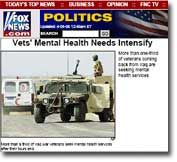
Fox News Delivers Strong Combat PTSD Piece

FOX News delivers a great piece of reporting on PTSD this week. I want to thank reporter Kelley Beaucar Vlahos for her efforts in presenting PTSD to the FOX News audience. She wrote a solid piece any veterans health advocate should be glad to be associated with. And she eased my worries (this was the first time I was approached for an interview on the subject).

Click on 'Article Link' below tags for more...

From the article:

Blaming what they say is a shortsighted, under-funded system that does not learn from past mistakes, some advocacy groups say they are concerned that the federal government is unprepared to help the wave of troops returning from Iraq seeking mental health care.

"We should have been ready for this," said Steve Robinson, director of the National Gulf War Resource Center, a veterans advocacy organization. "It's simple math: If there is an increase in demand, and there is not an equal increase in dollars to hire new people to buy more equipment or provide more services, the person who suffers is the returning veteran."

Vlahos goes on to share some veteran mental health stats that come from a study published in the Journal of the American Medical Association in March.

She refreshingly included my main criticism I have with the data: you simply can't use these statistics (which are from the first year of the war) to reliably conclude what the current mental state of our soldiers is. As ground-breaking as this study was (and it honestly deserved the credit and attention it received), today's Iraq battlefield is entirely different than the one that existed in 2003 -- and that difference has a direct bearing on the number and intensity of PTSD cases we're seeing today.

The numbers were based on screening and follow-ups of more than 300,000 troops returning from Iraq, Afghanistan and Bosnia from May 2003 to April 2004, leading many to surmise that the number with mental health problems has increased since then, since the rate of battlefield casualties among U.S. service members has also risen.

"[The study] is only marginally relevant to what condition our troops currently find themselves in," said [the] editor of PTSD Combat: Winning the War Within. "A lot has changed since that time, including increased number of troop deployments ... and an escalation in [improvised explosive device] attacks."

She'd asked me if I believed that the nation is prepared to deal with the needs of our returning veterans coping with PTSD. I was glad to see that she included my response:

[A]n alarming rate of violent incidents, suicide, homelessness and unemployment among recent veterans has been documented, but the issue has not garnered much national attention. "We simply have not been the beneficiaries of that type of substantial coverage by the media these past three years," she said. "So, how exactly would the public be expected to be prepared for what's to come -- in fact, what is already here?"

Vlahos moves on to include a response by the VA, listing some of their efforts in providing the best health care possible to our returning veterans: the record-setting $80 billion set aside in Bush's 2007 VA budget is mentioned as is the addition of PTSD specialists in every VA facility.

The article concluded:

Republican Sen. Larry Craig of Idaho, chairman of the Senate Veterans Affairs Committee, said the government is already meeting the new demands. "The president has always made it clear that military veterans are among his highest priorities, and this budget demonstrates his dedication to all who have worked in uniform," he said.

In any case, advocates ... say they hope the government will stick to its promises. "How loudly we cheered them onward as they laced up their boots has no relevance once they've done their job. It's how well we took care of them when they return that really defines our true moral character."

Can I say that I'm humbled to have been the one whose words closed out this fine piece of reporting (not the least bit impartial at the moment, am I?). Although this one article is but a grain of sand in a sandstorm of spin and analysis in the modern media landscape, I welcome it (and I'll keep fingers crossed for more of its kind).

Bit by bit, hopefully people of all political stripes can come together on this of all issues. Can we all agree that our soldiers should be taken care of -- for their own good, as well as that of the society at large? Again, I'd like to personally thank Ms. Vlahos for writing this piece.

It personally gives me much to be hopeful for: the plight of our soldiers and Marines weighed down by PTSD is reaching a wider national audience, one that probably doesn't hear enough about this issue. Or, what it hears of the issue falls more along the lines of what's found in a recent Oliver North column -- that the mere public discussion of PTSD seems to be causing the high unemployment rates of our returning troops:

According to the U.S. Department of Labor, the national unemployment rate is hovering around 4.8 percent. But for veterans of the Global War on Terror (GWOT), the unemployment rate is more than three times higher -- 15.6 percent. Why?

Part of the answer is found in the fact that so few corporate executives and personnel managers are veterans themselves. Couple that with a drumbeat of adverse publicity about the war, a mainstream media fixation on military "atrocities" and the constant harping about post-traumatic stress disorder -- PTSD -- and one has to wonder how any war veteran gets hired. On a recent flight to Texas, my seatmate, a corporate CEO, asked if "all the troops coming back from 'over there' were 'screwed up.'" He cited a study alleging that, "more than a third of those who served in Iraq and Afghanistan needed psychological treatment." The actual number -- according to the American Medical Association -- is 35 percent -- a figure compiled by psychiatrists who have made diagnosing PTSD a self-employment program.

I have to say, I don't like this type of PTSD bashing attitude. Besides, 35% actually equals "more than a third" the last time I checked. And I've heard there's an organization that goes by the name of the Veterans Administration which has an entire website devoted to combat-related PTSD. An entire website!

Is the VA also merely trying to stay in business with its PTSD conspiracy ploy? What is someone like Oliver North trying to say when he makes light of PTSD, or blames its mere discussion for the woes of our returning troops?

So, I applaud Ms. Vlahos' solid reporting. A larger cross-section of people are learning more about combat-related PTSD tonight -- and, hopefully, a few more will rally around the cause as we have here. As great as it is for us to talk amongst ourselves, sometimes it's even better to have the opportunity to reach a wider audience -- and Ms. Vlahos' excellent piece allows us that opportunity.

And so, please:

Better late than never, say I! And keep it coming...


Monday, March 20, 2006

3 Years On, Combat PTSD Comes Out of the Closet

Yesterday's 3rd anniversary of the Iraq invasion found an interesting situation brewing: returning veterans coping with post-traumatic stress disorder [PTSD] are no longer being hidden away from our view. The media is beginning ever-so-slightly to lift the veil on this nerve disorder affecting at least 16,000+ of our troops who've served in Afghanistan and/or Iraq.

Since we have so very little else to celebrate as another year moves forward with no end in sight to war and its victims, I'm going to focus on the good reporting on this issue that is finally, finally seeing the light of day. And I celebrate the fact that rather than using this anniversary to glamorize and glorify the war, the media seem to have finally decided to use it to introduce this ballooning problem at last to the public.

Click on 'Article Link' below tags for links to yesterday's coverage...

A Partial List of Yesterday's Combat PTSD Coverage

There were many more reports that didn't find their way onto this list. Some were in local papers without online editions; others I haven't turned up, yet. If you know of any that I've missed, please drop them into comments; I'll be happy to add them.


Related Posts


Tuesday, February 21, 2006

Local Media Outlets Cover PTSD Stories

When it comes to PTSD education, the locals get it right. They may not have the big budgets the major media outlets do, but they do have one important resource: returning troops who have a story to tell.


Click on 'Article Link' below tags for more...

Here's a quick run-down of a few local outlets doing their best to inform their communities on the effects of combat-related PTSD:

Keep it up, locals. You show the big boys how reporting is really done!


Monday, February 20, 2006

PTSD: The Hidden War, The Hidden Enemy

We are fighting a hidden war with a hidden enemy.

Our leaders and most media outlets refuse to show the full face of this war. We're barely able to make out the form of our veiled enemy. Or even that of our supposed friends. We see no coffins. We see none of the wounded. We're shown none of the grief taking place at military bases across the country as loved ones return from combat in various states of disrepair.

Yet, another enemy lurks just beyond our gaze.

Click on 'Article Link' below tags for more...

It's a brutally personal, deeply buried adversary. You and I may know very little about its existence, but many of our returning combat veterans are intimately acquainted with this interloper. Its name is post-traumatic stress disorder [PTSD], and currently at least 19,000 OEF and OIF soldiers have been diagnosed with this debilitating brain condition which overloads the nervous system.

GLORY AND REALITY

From the advent of war, the warrior has been a mythic figure in the public realm.

Honored and glorified, a nation's soldiers are larger than life (and often even larger in death). Think WWI's Daniel ("Dan") Daly. Or WWII's Audie Murphy. Even the Hollywood version of `soldier' (in the form of John Wayne or Gregory Peck) reinforces for us what a real war hero should look and act like. These stoic protectors and heroic battles are given a special place in the national consciousness - especially during a time of war. Unfortunately, as noble a cause these notions may (or may not) serve, a few important details are conveniently discarded from view.

War is hell.

Pulled into battle by geopolitical forces much larger than themselves, the cross-section of soldiers in our military is as varied as that found in the general population. Each individual, though highly trained, is no less mortal or human. The diverse personal experiences they bring to the military; their physical nature; their genetic make-up, and their psychological strengths and weaknesses - all of these characteristics influence a soldier's wartime experience creating unique responses and outcomes for each man or woman serving in uniform.

The Department of Veterans Affairs Iraq War Clinician Guide [Chap. III, p.31] states:

"[O]ver time, soldiers develop a belief system (schema) about themselves, their role in the military, the military culture, etc. War can be traumatizing not only because of specific terrorizing or grotesque war-zone experiences but also due to dashed or painfully shattered expectations and beliefs about perceived coping capabilities, military identity, and so forth. As a result, soldiers who present for care in VA Medical Centers may be disillusioned in one way or another."

The answer to this is in proper post-deployment attention and care.  And good medical care doesn't come for free. A properly funded military health care budget should be a top priority of our government; yet, with a federal budget in disarray and an administration that continues to talk the talk -- but not walk the walk -- ensuring our veterans receive the very best care upon their return home becomes much more elusive. And much more scandalous.

We must take this issue on ourselves, then. We must become more vocal. We must be the defenders of our nation's defenders. We, the People must do right by our troops.

Senator John Kerry recently had this to say regarding this issue on Daily Kos:
Of all the things I've thought most about over the last year since the election, what's most disgusting to me is how ignored and forgotten and discarded the people I fought for have been by Washington. I'd love to have a debate about whether patriotism is giving speeches about veterans and then having a 1.2 billion dollar hole in our veterans budget, or whether it's actually going out and providing for veterans who come home from a war with all kinds of scars from the battlefield, visible or invisible.

There's a lot more we need to do, but it will only happen if we raise hell about it and organize around it. I intoduced a Military Family's Bill of Rights as legislation in this Congress and I've been able -- piece meal -- to pass parts of it to do things like improve housing benefits and death benefits for military families. But talking about PTSD and funding treatment programs and counseling programs is something Washington remains pathetically incompetent at really getting done. It requires pressure -- real pressure -- to do it. Please follow what I'm doing on it, and what people like Rep Lane Evans and others are doing on it because we really need your voice on it. 2006 will be a moment of accountability on this issue if we make it so, and we can especially with so many Iraq War vets running as Democrats.

by John Kerry on Sat Jan 21, 2006 at 12:38:56 PM CST

Our brave fighting men and women give their all to the nation they serve. They come from Nebraska, and Pennsylvania, New Mexico, and New York. All 50 states -- as well as from foreign shores -- to fight as one in the greatest military force on earth. After the warrior completes his mission, however, it's easy for them to fade out of our view. There are no more parades. No more speeches on bravery and sacrifice given in their honor. The task of folding back into society and home life is solely their own. Yet, veterans suffering from post-traumatic stress disorder are still in battle, though the battlefield is no longer visible to us.

As veterans from previous wars have borne out, those suffering from shell shock or PTSD end up fighting a private, personal war on their return to us. The consequences are enormous, as the effect is felt in entire families and communities across the country. The PTSD battle may be private and personal, but it should never be solitary. A nation has a responsibility of supporting its troops - be they actively fighting overseas in our name, or returned to us to live out their days in the peace and freedom they so valiantly fought to preserve.

History has shown societies may be unkind to their returning veterans. Often, their sacrifices are too quickly forgotten. Their needs not fully met. Let's refuse to make that unpardonable mistake.


WHAT CAN YOU DO?

Representative Lane Evans and Senator John Kerry have introduced legislation favorable (yet slow-moving) to help with PTSD and veterans' health care in general. Please consider contacting their offices (click on their names) and thank them. And consider asking your own district/state leaders to support their work.


Previous/Older Posts Return Home

Archives
2011: Jan Feb
2010: Jan Feb Mar Apr May Jun Jul Aug Sept Oct Nov Dec
2009: Jan Feb Mar Apr May Jun Jul Aug Sept Oct Nov Dec
2008: Jan Feb Mar Apr May Jun Jul Aug Sept Oct Nov Dec
2007: Jan Feb Mar Apr May Jun Jul Aug Sept Oct Nov Dec
2006: Jan Feb Mar Apr May Jun Jul Aug Sept Oct Nov Dec
2005: Sept Oct Nov Dec

Legal Notice

The information presented on this web site is based on news reports, medical and government documents, and personal analysis. It does NOT represent therapeutic prescription or recommendation. For specific advice and information, consult your health care provider.

Comments at PTSD Combat do not necessarily represent the editor's views. Illegal or inappropriate material will be removed when brought to our attention. The existence of such does not reflect an endorsement.


This site contains at times large portions of copyrighted material not specifically authorized by the copyright owner. This material is used for educational purposes, to forward understanding of issues that concern veterans and military families. In accordance with U.S. Copyright Law Title 17 U.S.C. Section 107, the material on this site is distributed without profit. More information.