Wednesday, April 05, 2006

MSNBC's Hardball Reports on Combat PTSD

Posttraumatic stress disorder continues to get some much-needed national media attention. Monday's Hardball is the latest example. Host Chris Matthews opened the the segment with the story of Marine Lance Corporal Blake Miller, an Iraq veteran who received international notoriety when a photograph snapped of him in Fallujah was printed far and wide. He's now returned to the states, and is coping with PTSD.

Click on 'Article Link' below tags for more...

From the Hardball transcript (scroll down 2/3 of the page):

MATTHEWS: Welcome back to HARDBALL. For many American troops fighting in Iraq and Afghanistan, getting home is only half the battle. Once back with their family and friends, they face the new challenge of coping with their sometimes traumatizing memories of war, the condition known as post traumatic stress disorder or PTSD. MSNBC‘s Norah O‘Donnell has more. (BEGIN VIDEOTAPE)

NORAH O‘DONNELL, MSNBC CHIEF WASHINGTON CORRESPONDENT (voice-over):

Remember this picture? It is one of the most iconic images from the Iraq war. Marine Lance Corporal Blake Miller went from Fallujah to the front pages of newspapers and was called The Marlboro Man. Now, almost two years later, Miller is at home in Kentucky a changed man.

BLAKE MILLER, ‘MARLBORO MARINE‘: You can put something aside, but as far as trying to forget it, it doesn‘t work.

O‘DONNELL: Miller now suffers from post traumatic stress disorder or PTSD.

Miller is 21, honorably discharged, and can't find employment. He's having trouble sleeping, he's bogged down by nervous ticks and an aversion to crowds. The video piece closed with comments made by Charles Engle, a Walter Reed psychiatrist, and Jay Nicholson, Secretary of Veterans Affairs stating that the VA is taking care of the needs of our returning veterans.

Following O'Donnell's opening report, Chris Matthews introduces his guests: Gordon Mansfield, deputy secretary for Veterans Affairs, and General Barry McCaffrey. Before he begins the debate in the studio, he asks O'Donnell the following question:

MATTHEWS: Norah, is there any deniers out there who say there‘s no such thing as PTSD?

O‘DONNELL: I did not speak to any who believe there is, because in every war from the Civil War, it was called soldier‘s heart, after Vietnam, it was called shell shock, and now we have this more clinical term called post traumatic stress disorder. So we know many our soldiers throughout America‘s history have suffered from some sort of mental illness, but of course all mental illness has been difficult to talk about until recently.

Blake Miller spoke to us, this very heroic soldier, because he says that by speaking out he hopes that other troops will feel more comfortable talking about some of the problems they‘re experiencing and there is help available from Veterans Affairs.

He asks the same question of his guests:

MATTHEWS: Mr. Secretary, thank you for joining us. Just to repeat the question, there‘s no doubt this exists?

GORDON MANSFIELD, DEPUTY SECRETARY OF VETERANS AFFAIRS: There‘s no doubt in my mind or in the V.A.‘s mind that it does exist.

Perhaps someone needs to tell Oliver North, or Sally Satel, MD, or Christina Hoff Sommers, or Mackubin T. Owens, or George F. Will, or...oh, you get the picture. PTSD is a political and financial liability, so there are a lot of people who might rather gloss over it.

Back to Hardball:

MATTHEWS: General McCaffrey, I was struck by the difficulty that soldier had, The Marlboro Man they called him, who appeared with the cigarette in that famous picture, talking about the casualties he inflicted. You‘ve been in a lot of combat. Is that something you‘ve seen from your fellow troops?

GEN. BARRY MCCAFFREY, U.S. ARMY (RET): Well, you know, first of all, let me start off by saying, there‘s no question that this PTSD is real. We‘ve always known you can take soldiers, Marines, push them over the edge.

A lot of artillery mortar fire, extreme cold, malnutrition, extreme heat. Don‘t tell them when they‘re going to come home from combat. There‘s all sorts of reasons why any combat soldier can reach his limit.

This young Marine obviously saw a lot of heavy combat. Having said that, Chris, let me just offer a balancing viewpoint. Most young soldiers and Marines that fought in heavy combat like Fallujah, as much fighting as we‘ve done since for God‘s sakes Aurora Pocket. That was high intensity battle. Most of them come home strengthened by it, not weakened. They‘re grateful for the comradeship, the valor of their fellow soldiers and Marines. They are grateful for hot water at night, grateful for freedom and safety here in America. Most of them aren‘t damaged by this experience.

MATTHEWS: Mr. Secretary, can you be that positive?

MANSFIELD: I would...

MATTHEWS: That combat doesn‘t generally hurt a person‘s psyche.

GORDON: Well, combat is not the ordinary way of life. It‘s an uncommon situation. So the question is what happens in that uncommon situation? What happens with the camaraderie of the unit that person serves in? And how that person is returned to the United States and how they can adapt to being back in the United States.

MATTHEWS: But all the guys that came back from World War II—you know, you talk about Tom Brokaw and the greatest generation. All of these guys came back, and I grew up with them as friends of mine—or father‘s of friends of mine. You know, Knights of Columbus guys, regular guys. And only later did I realize that these guys had been to hell and back, so many of them.

And they seem to be totally normal. They had a beer and a cigarette. They raised a family. They seemed to enjoy life, turned on the tube at night, watch Phil Silvers. You know, they seem to enjoy life, so many of them.

MANSFIELD: Your correspondent referred though to the term of shell shock and combat fatigue, and those two terms come out of basically World War I and World War II. And really I think they mean almost the same thing as PTSD means.

MATTHEWS: But they‘re the odd case or the familiar case?

MANSFIELD: Well, right now if you look at the total number of troops that have been in Iraq, that total is around 500,000. Out of that 500,000, we in the V.A. have seen about 145,000.

MATTHEWS: A third.

MANSFIELD: And out of those, 20,638 are being treated right now for PTSD or mental health problems. So that‘s 14 percent or 15 percent of the lesser number.

The Deputy Secretary, who was entirely sympathetic in my view, went on to explain some of what the VA is doing to help these thousands who are in need of help. Mental health assessments of all troops when they return home, as well as 6 months later (this new review, the PDHRA, has only recently been implemented), etc.

Now, it's nitpicking time. The problem I had with the Hardball segment was the choice of guests:

  • We had an official advocating for the VA.
  • We had an official advocating the hardline military 'rah-rah' view.
  • We had the pro-Bush administration host.
  • Anyone missing from this picture?
Why was there not a chair at the table for a representative from Veterans for Common Sense or any other veterans organization -- even someone from the more traditional/conservative AMVETS or American Legion?

Could the producers of Hardball not find anyone who directly represents and advocates solely for the veterans to sit at the table?


Related Posts


Democrats Present Bill to Raise PTSD Counseling, Care Funding

Great news to report on the PTSD legislation front. Sens. Daniel K. Akaka, Hawaii; John Kerry, Mass.; Frank Lautenberg, N.J.; and Hillary Rodham Clinton, N.Y. yesterday presented legislation to increase funding and provide appropriate counseling and benefits to combat veterans coping with PTSD.

Click on 'Article Link' below tags for more...

From the Army Times:

The bill, S 2500, the Healing the Invisible Wounds Act of 2006, aims to prevent the Bush administration from cutting disability benefits for veterans with combat stress and to improve counseling and readjustment services for National Guard and reserve members, sponsors said. ...

“Many of the men and women who served in Iraq and Afghanistan are suffering from some of the most severe physical injuries. However, even more of these brave service members have invisible wounds — difficulties with adjusting to not being on the battlefield or dealing with long-lasting visions and experiences that they encountered,” said Akaka, ranking Democrat on the Senate Veterans’ Affairs Committee. ...

The bill includes $180 million extra for readjustment counseling and mental health services at Vet Centers, and a promise of one-on-one counseling for returning veterans in addition to group counseling.

Akaka said it’s important to ensure that that counseling and other help is available as soon as combat veterans return because “the transition period for these soldiers is extremely critical, so critical that it can, in some cases, mean the difference between short-term readjustment issues and severely chronic psychological conditions.”

Guard and reserve members can demobilize so rapidly after returning from deployments in Iraq or Afghanistan that “they sometimes do not receive or are overwhelmed by the benefits information they need,” Akaka said. That is why the bill requires counseling to be available within 14 days of returning from combat, and that service members be kept on active duty to receive counseling, he said.

I applaud these Senators and this legislation. If you'd like to join me in thanking them, please feel free to contact them and let them know they're doing a great job for our returning veterans.


Tuesday, April 04, 2006

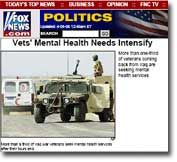
Fox News Delivers Strong Combat PTSD Piece

FOX News delivers a great piece of reporting on PTSD this week. I want to thank reporter Kelley Beaucar Vlahos for her efforts in presenting PTSD to the FOX News audience. She wrote a solid piece any veterans health advocate should be glad to be associated with. And she eased my worries (this was the first time I was approached for an interview on the subject).

Click on 'Article Link' below tags for more...

From the article:

Blaming what they say is a shortsighted, under-funded system that does not learn from past mistakes, some advocacy groups say they are concerned that the federal government is unprepared to help the wave of troops returning from Iraq seeking mental health care.

"We should have been ready for this," said Steve Robinson, director of the National Gulf War Resource Center, a veterans advocacy organization. "It's simple math: If there is an increase in demand, and there is not an equal increase in dollars to hire new people to buy more equipment or provide more services, the person who suffers is the returning veteran."

Vlahos goes on to share some veteran mental health stats that come from a study published in the Journal of the American Medical Association in March.

She refreshingly included my main criticism I have with the data: you simply can't use these statistics (which are from the first year of the war) to reliably conclude what the current mental state of our soldiers is. As ground-breaking as this study was (and it honestly deserved the credit and attention it received), today's Iraq battlefield is entirely different than the one that existed in 2003 -- and that difference has a direct bearing on the number and intensity of PTSD cases we're seeing today.

The numbers were based on screening and follow-ups of more than 300,000 troops returning from Iraq, Afghanistan and Bosnia from May 2003 to April 2004, leading many to surmise that the number with mental health problems has increased since then, since the rate of battlefield casualties among U.S. service members has also risen.

"[The study] is only marginally relevant to what condition our troops currently find themselves in," said [the] editor of PTSD Combat: Winning the War Within. "A lot has changed since that time, including increased number of troop deployments ... and an escalation in [improvised explosive device] attacks."

She'd asked me if I believed that the nation is prepared to deal with the needs of our returning veterans coping with PTSD. I was glad to see that she included my response:

[A]n alarming rate of violent incidents, suicide, homelessness and unemployment among recent veterans has been documented, but the issue has not garnered much national attention. "We simply have not been the beneficiaries of that type of substantial coverage by the media these past three years," she said. "So, how exactly would the public be expected to be prepared for what's to come -- in fact, what is already here?"

Vlahos moves on to include a response by the VA, listing some of their efforts in providing the best health care possible to our returning veterans: the record-setting $80 billion set aside in Bush's 2007 VA budget is mentioned as is the addition of PTSD specialists in every VA facility.

The article concluded:

Republican Sen. Larry Craig of Idaho, chairman of the Senate Veterans Affairs Committee, said the government is already meeting the new demands. "The president has always made it clear that military veterans are among his highest priorities, and this budget demonstrates his dedication to all who have worked in uniform," he said.

In any case, advocates ... say they hope the government will stick to its promises. "How loudly we cheered them onward as they laced up their boots has no relevance once they've done their job. It's how well we took care of them when they return that really defines our true moral character."

Can I say that I'm humbled to have been the one whose words closed out this fine piece of reporting (not the least bit impartial at the moment, am I?). Although this one article is but a grain of sand in a sandstorm of spin and analysis in the modern media landscape, I welcome it (and I'll keep fingers crossed for more of its kind).

Bit by bit, hopefully people of all political stripes can come together on this of all issues. Can we all agree that our soldiers should be taken care of -- for their own good, as well as that of the society at large? Again, I'd like to personally thank Ms. Vlahos for writing this piece.

It personally gives me much to be hopeful for: the plight of our soldiers and Marines weighed down by PTSD is reaching a wider national audience, one that probably doesn't hear enough about this issue. Or, what it hears of the issue falls more along the lines of what's found in a recent Oliver North column -- that the mere public discussion of PTSD seems to be causing the high unemployment rates of our returning troops:

According to the U.S. Department of Labor, the national unemployment rate is hovering around 4.8 percent. But for veterans of the Global War on Terror (GWOT), the unemployment rate is more than three times higher -- 15.6 percent. Why?

Part of the answer is found in the fact that so few corporate executives and personnel managers are veterans themselves. Couple that with a drumbeat of adverse publicity about the war, a mainstream media fixation on military "atrocities" and the constant harping about post-traumatic stress disorder -- PTSD -- and one has to wonder how any war veteran gets hired. On a recent flight to Texas, my seatmate, a corporate CEO, asked if "all the troops coming back from 'over there' were 'screwed up.'" He cited a study alleging that, "more than a third of those who served in Iraq and Afghanistan needed psychological treatment." The actual number -- according to the American Medical Association -- is 35 percent -- a figure compiled by psychiatrists who have made diagnosing PTSD a self-employment program.

I have to say, I don't like this type of PTSD bashing attitude. Besides, 35% actually equals "more than a third" the last time I checked. And I've heard there's an organization that goes by the name of the Veterans Administration which has an entire website devoted to combat-related PTSD. An entire website!

Is the VA also merely trying to stay in business with its PTSD conspiracy ploy? What is someone like Oliver North trying to say when he makes light of PTSD, or blames its mere discussion for the woes of our returning troops?

So, I applaud Ms. Vlahos' solid reporting. A larger cross-section of people are learning more about combat-related PTSD tonight -- and, hopefully, a few more will rally around the cause as we have here. As great as it is for us to talk amongst ourselves, sometimes it's even better to have the opportunity to reach a wider audience -- and Ms. Vlahos' excellent piece allows us that opportunity.

And so, please:

Better late than never, say I! And keep it coming...


Monday, April 03, 2006

Senators Announce New Bipartisan Mental Health Caucus

Springing from last week's regrouped New Freedom Commission on Mental Health panels on Capitol Hill, U.S. Senators Pete V. Domenici (R-NM), Edward M. Kennedy (D-MA), Gordon H. Smith (R-OR) and Tom Harkin (D-IA) announce today the creation of a Senate Caucus on Mental Health Reform. Its goal is to help Senators better understand mental health issues, including combat-related PTSD.

Click on 'Article Link' below tags for more...

From a Campaign for Mental Health Reform press release:

CMHR Executive Director Charles Konigsberg said, "We are very pleased that the establishment of the new Senate Caucus by Senators Domenici, Kennedy, Smith, and Harkin will give invaluable bipartisan political support to making mental health a national priority." ...

Comments on the Senate Caucus on Mental Health Reform:

Senator Kennedy said, "The Senate Mental Health Caucus will work in a bipartisan way to educate the Congress on the importance of addressing mental health as a national priority. No one is exempt from the human toll of mental illness, and it is time to end the discrimination and stigma that millions of Americans face each day."

In particular, Senator Smith noted that one example of the Caucus' efforts will be to "help those of us who care deeply about mental health to educate our colleagues about the devastating impact of mental illness and the vital importance of access to mental health coverage for all Americans."


Kudos to these Senators for creating this caucus. The mental health education of our elected officials will go far in increasing PTSD awareness across the board.


Later/Newer Posts Previous/Older Posts Return Home

Archives
2011: Jan Feb
2010: Jan Feb Mar Apr May Jun Jul Aug Sept Oct Nov Dec
2009: Jan Feb Mar Apr May Jun Jul Aug Sept Oct Nov Dec
2008: Jan Feb Mar Apr May Jun Jul Aug Sept Oct Nov Dec
2007: Jan Feb Mar Apr May Jun Jul Aug Sept Oct Nov Dec
2006: Jan Feb Mar Apr May Jun Jul Aug Sept Oct Nov Dec
2005: Sept Oct Nov Dec

Legal Notice

The information presented on this web site is based on news reports, medical and government documents, and personal analysis. It does NOT represent therapeutic prescription or recommendation. For specific advice and information, consult your health care provider.

Comments at PTSD Combat do not necessarily represent the editor's views. Illegal or inappropriate material will be removed when brought to our attention. The existence of such does not reflect an endorsement.


This site contains at times large portions of copyrighted material not specifically authorized by the copyright owner. This material is used for educational purposes, to forward understanding of issues that concern veterans and military families. In accordance with U.S. Copyright Law Title 17 U.S.C. Section 107, the material on this site is distributed without profit. More information.