Friday, November 30, 2007

VFA Releases Report on the Treatment of America's Wounded Warriors
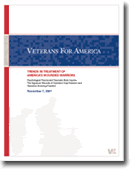
Released earlier this month, the Veterans For America 24-page Trends in the Treatment of America's Wounded Warriors report examines both psychological trauma and traumatic brain injuries. From VFA:

VFA investigators have visited every demobilization site in the United States and overseas, where they have monitored the quality of treatment, family support, rehabilitation, and other services that should enable a wounded servicemember to readjust to civilian life.

VFA has found that medical care for mental health and TBI is often inadequate or poorly delivered, and when a servicemember is discharged, decisions are often made by the military that negatively affect veterans for the rest of their lives.

VFA has also found that little consideration is given to TBI or PTSD in the military justice system despite the fact that these wounds are known to cause improper behavior. Lack of capabilities to treat these injuries, inadequate adherence to the Congressional inquiry process, and the inability or unwillingness to treat PTSD and TBI as wounds of equal legitimacy as physical injuries are some problems that require improved military leadership.

This report incorporates VFA investigative findings with open-source DoD and other reports and articles to provide a comprehensive picture of the state of care for America’s wounded warriors.


Thursday, November 29, 2007

Losing Inches: Heavy Gear Compressing Veterans' Spinal Disks

While not PTSD-related, quite interesting information on how combat is changing the physical body of troops. From the St. Paul-Minneapolis Pioneer Press:

After 16 months in Iraq, Minnesota National Guard members who came home this summer expected aches and pains. They did not expect to shrink.

Brian Hesse figures he lost an inch or so - a consequence of the heavy body armor and the gear he toted on convoy and security missions. The armor alone weighed more than 30 pounds. And then there was the 4-pound helmet, the 7.5-pound loaded M-4 rifle, the 10 pounds of extra ammunition and other necessities.

"I shrunk," the 25-year-old from Minnetonka said, "and got a bit wider. It's like my body said, 'OK, I need a wider base.' "

It's no myth. Some returnees and their doctors agree they did get shorter - if at least temporarily. The 60 to 90 pounds of gear around their torsos, shoulders and heads likely caused their spinal discs to compress, making the soldiers shorter and causing back pain.

Guard officials expected the 2,600 members of the state's returning 1st Brigade Combat Team to suffer from a host of physical ailments. While less dramatic than gunshot wounds or brain injuries caused by blast exposures, musculoskeletal injuries are easily the most common health problems for Iraq returnees.

"A good chunk of what we're seeing is actually overuse that we would really anticipate would get better in a short period of time," said Dr. Michael Koopmeiners, who directs community clinics for the Minneapolis VA Medical Center.

The key question , now that returnees have been home for three months, is how many are in fact developing chronic problems and how many are getting better.


20/20: ABC News Uncovers Soldiers and Drugs Story

Mental health experts say that a correlation -- a comorbidity -- exists between PTSD and drug abuse. In that vein, tomorrow night on ABC News, 20/20 covers the issue of some of today's soldiers turning to drugs, as some had in the Vietnam, to ease the experience of war. Throughout the week, the network's chief investigative correspondent, Brian Ross, and his counterparts have begun sharing some of the data and stories they collected over the past few months:

In the third year of a joint project with the nonprofit Carnegie Corporation, six leading graduate school journalism students were again selected to spend the summer working with the ABC News investigative unit.

This year's project involved an examination of whether, as happened in the wake of the Vietnam War, Iraqi war veterans were turning to drugs as a result of the trauma and pain of war. The U.S. military maintains the percentage of soldiers abusing drugs is extremely small and has not increased as a result of Iraq.

The students' assignment was to get the unofficial side of the story from soldiers, young men of their own generation.


Wounded and Waiting: Videos that Bring Sacrifice to Light

Kathie Costos has created another series of bracing and poignant videos along with a new PTSD group on YouTube for anyone wishing to share related multimedia clips. These videos are heartfelt tributes that reflect the real burdens and costs of war borne by the individuals who fight and the military families who support their warriors.

As such, please bear in mind that they may be difficult for some especially close to the situation to view.


Later/Newer Posts Previous/Older Posts Return Home

Archives
2011: Jan Feb
2010: Jan Feb Mar Apr May Jun Jul Aug Sept Oct Nov Dec
2009: Jan Feb Mar Apr May Jun Jul Aug Sept Oct Nov Dec
2008: Jan Feb Mar Apr May Jun Jul Aug Sept Oct Nov Dec
2007: Jan Feb Mar Apr May Jun Jul Aug Sept Oct Nov Dec
2006: Jan Feb Mar Apr May Jun Jul Aug Sept Oct Nov Dec
2005: Sept Oct Nov Dec

Legal Notice

The information presented on this web site is based on news reports, medical and government documents, and personal analysis. It does NOT represent therapeutic prescription or recommendation. For specific advice and information, consult your health care provider.

Comments at PTSD Combat do not necessarily represent the editor's views. Illegal or inappropriate material will be removed when brought to our attention. The existence of such does not reflect an endorsement.


This site contains at times large portions of copyrighted material not specifically authorized by the copyright owner. This material is used for educational purposes, to forward understanding of issues that concern veterans and military families. In accordance with U.S. Copyright Law Title 17 U.S.C. Section 107, the material on this site is distributed without profit. More information.