Monday, November 06, 2006

WaPo: Army Reserves Feel the Pinch of Increased Operation Tempo

From yesterday's Washington Post front page:

The Army's National Guard and Reserve are bracing for possible new and accelerated call-ups, spurred by high demand for U.S. troops in Iraq, that leaders caution could undermine the citizen-soldier force as it struggles to rebuild. ...

Next year, the number of Army Guard soldiers providing security in Iraq will surge to more than 6,000 in about 50 companies, compared with 20 companies two years ago, Guard officials said. "We thought we'd see a downturn in operational tempo, but that hasn't happened," said one official. ...


Continuing:

Stress on soldiers and their families is mounting as active-duty combat brigades now spend only a year to 14 months home between rotations, compared with a goal of two years -- a trend that Army leaders worry is not sustainable in the long term. Reserve and Guard units are staying home on average three years, compared with a goal of four or five, Army officials said. 'It goes without question that Guard brigade combat teams are going to have to deploy again to theater in less time than the . . . model originally called for,' said retired Air National Guard Brig. Gen. Stephen M. Koper, president of the National Guard Association.

Yet ordering more citizen-soldiers out of their communities and into war zones imposes a special burden, as reservists are older and more likely to have families and civilian jobs, and must also shoulder the task of responding to homeland disasters and other emergencies.

Ann Scott Tyson writes a solid report well worth a read.

Click on 'Article Link' below tags for related posts...


 Related Posts


Saturday, November 04, 2006

Raw's 'Mind Games' Series Wraps Up

Two of our good friends from Veterans for America (VFA), Steve Robinson and Paul Sullivan, appear throughout the fourth installment of Raw Story's excellent Mind Games series I've mentioned this past week. Read Parts 1 | 2 | 3.

Click on 'Article Link' below tags for a few grafs from Part 4...

From Raw Story (via Veterans for America):

Nearly 10 years after veterans' advocates successfully lobbied for Congress to mandate pre-and post-deployment face-to-face medical examinations for troops, (see public law 105-85, sections 762-767 in the attached National Defense Authorization Act for Fiscal Year 1998), they are still facing many of the same access-to-care and liability issues they once thought they had resolved.

Paul Sullivan and his Veterans for America (VFA) colleague, Steve Robinson, both fought for passage of the 1997 Congressional order. As Gulf War veterans they knew from bitter first-hand experience what a huge difference a mandatory, documented face-to-face medical examination with a health care professional could make for service members on their way to and from duty.

The men and women who fought in the Gulf War had neither. And thousands of them came home in the early 90s reporting symptoms that included joint pain, headaches, memory loss, rashes, balance problems, and loss of motor skills -- all part of what has commonly come to be known as "Gulf War syndrome."

But veterans' attempts to access diagnosis, treatment, and compensation through the DOD and/or the VA were mostly denied as unsubstantiated. It was easy to dismiss their claims, but nearly impossible for veterans to prove that their symptoms were not pre-existing conditions, because the DOD had never established a pre-deployment baseline for service members' health, nor measured their exposure to contaminants in the field. (Vietnam veterans two decades earlier had successfully sued the makers of Agent Orange for their ailments, but not the military itself.)

The DOD's failure to collect this data also meant that it avoided even the possibility of paying millions, if not billions, of dollars in compensation to disabled veterans.


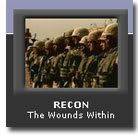
Pentagon Channel: 'The Wounds Within' Video on PTSD Now Online

Look for this month's edition of Recon on the Pentagon Channel for The Wounds Within, the latest installment in the military series. Check your local station's broadcast listings (the program is set to run a number of times throughout the month) or view the entire video online.

Click on 'Article Link' below tags for American Forces press release...

From the American Forces Press Service:

The half-hour show, called "The Wounds Within," explores how the understanding of PTSD has evolved from the Civil War to World Wars I and II to Vietnam and now to operations Enduring Freedom and Iraqi Freedom.
It also demonstrates how the Department of Defense is aggressively treating servicemembers returning from battle today, Pentagon Channel officials said. "It's not a small problem," said Air Force Master Sgt. Daniela Marchus, who hosts the show. "Seeking help is such an important thing." ...

"In the Civil War it was called 'nostalgia'; following World War I it was called 'shell shock'; following World War II it was called 'combat fatigue'," Dr. Robert Ursano of the Uniformed Services University of the Health Sciences told "Recon" producers. "There's always been a name, but never as much focus and trying to understand and intervene."

But even with today's understanding and treatment, "The Wounds Within" shows why many servicemembers refuse to seek help. "There's a stigmatization of mental health," said Army Lt. Gen. Kevin Kiley, the service's surgeon general. "It's a challenge to break through the stigma."

Many other wounded servicemembers share very personal stories of how they survived, how they were able to seek treatment and how they are coping today in this emotionally charged "Recon."

Marchus said she hopes "The Wounds Within" will spark discussion about PTSD and prompt servicemembers who are suffering in silence to ask for help. "They are suffering emotionally," she said. "They are not alone."


Sign Military.com's Veterans Bill of Rights

For Veterans Day, 11/11, Military.com has begun a Veterans Bill of Rights campaign in an effort to bring veterans, service members and their families together:

Now is the time to find your brothers and sisters, those who also once bore the nation's burden. Look not solely to government agencies but to each other, as well. As ten percent of the American population, you have the ability to inform, to employ, to mentor, to heal — to change the lives of other veterans.

Signing the bill is a symbolic act of support for this movement.


Later/Newer Posts Previous/Older Posts Return Home

Archives
2011: Jan Feb
2010: Jan Feb Mar Apr May Jun Jul Aug Sept Oct Nov Dec
2009: Jan Feb Mar Apr May Jun Jul Aug Sept Oct Nov Dec
2008: Jan Feb Mar Apr May Jun Jul Aug Sept Oct Nov Dec
2007: Jan Feb Mar Apr May Jun Jul Aug Sept Oct Nov Dec
2006: Jan Feb Mar Apr May Jun Jul Aug Sept Oct Nov Dec
2005: Sept Oct Nov Dec

Legal Notice

The information presented on this web site is based on news reports, medical and government documents, and personal analysis. It does NOT represent therapeutic prescription or recommendation. For specific advice and information, consult your health care provider.

Comments at PTSD Combat do not necessarily represent the editor's views. Illegal or inappropriate material will be removed when brought to our attention. The existence of such does not reflect an endorsement.


This site contains at times large portions of copyrighted material not specifically authorized by the copyright owner. This material is used for educational purposes, to forward understanding of issues that concern veterans and military families. In accordance with U.S. Copyright Law Title 17 U.S.C. Section 107, the material on this site is distributed without profit. More information.